In context: A long time ago, Radeon graphics cards were developed by ATI Technologies. The Canadian company was later acquired by AMD, but its name still lingers in the free and open-source community even today. Surprisingly, people are still using AGP cards in 2025, but they require improved support for memory operations in modern 3D libraries.
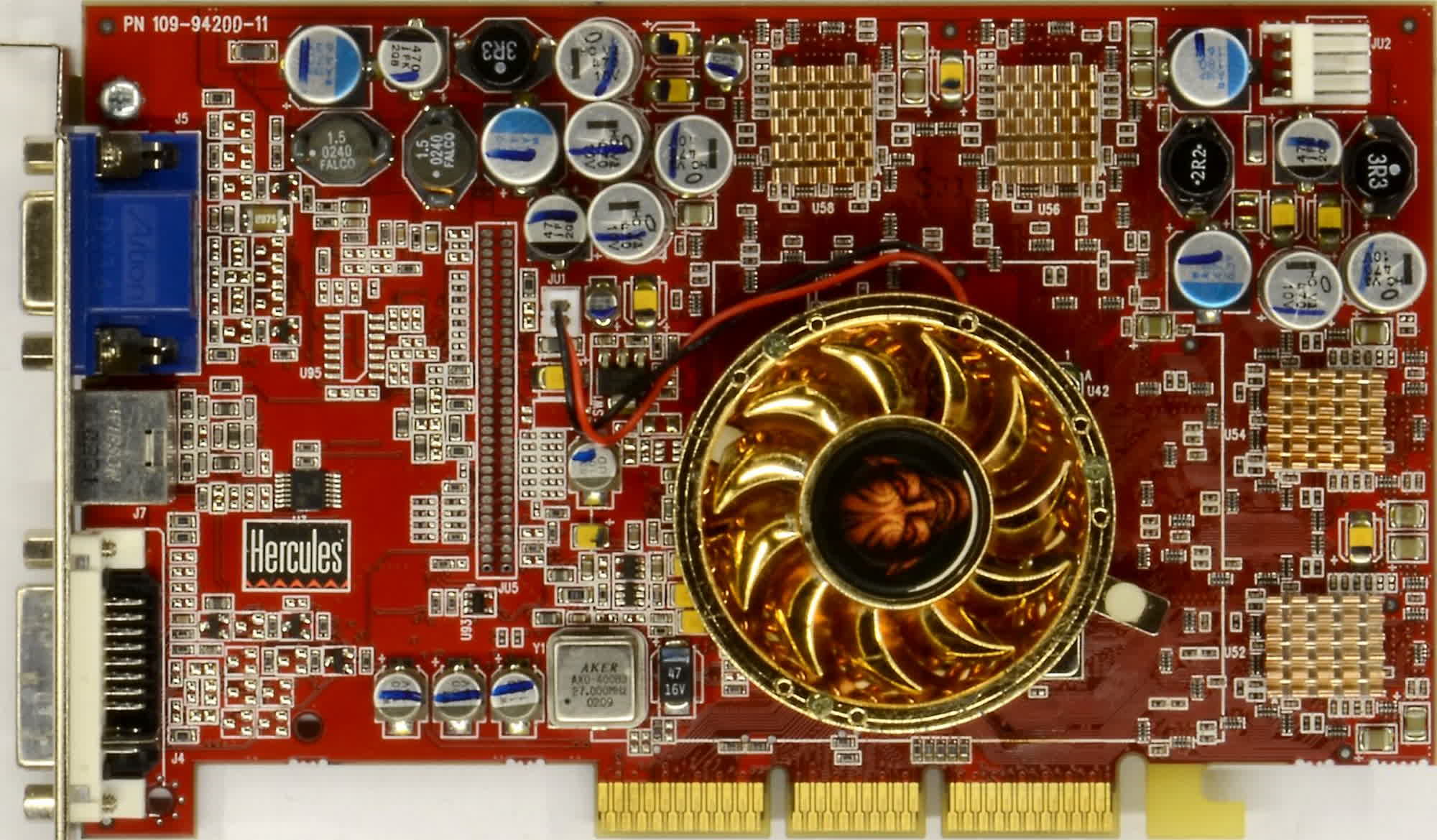
A developer named Brais Solla has recently added support for two "new" OpenGL features for graphics cards based on the R300 series, a GPU architecture first introduced by ATI in August 2002. ATI is long gone, but the Radeon GPU brand continues to fight an uphill battle against Nvidia's massive market share.
The Radeon R300 series represents the third generation of GPUs used in Radeon cards. When it first arrived in the Radeon 9700, the chip was the first consumer GPU to offer full compatibility with the Direct3D 9 API in addition to OpenGL 2.0. R300 cards were positioned against Nvidia's GeForce 4 series, launched earlier in 2002.
Although R300 cards are historically significant, it's surprising to see modern driver features being added to them. With his latest commit, Solla implemented the GL_ATI_meminfo and GL_NVX_gpu_memory_info extensions in the Mesa 3D Graphics Library project. These extensions allow OpenGL programs to determine the exact amount of available VRAM on both GPU memory and GTT, and they should work on Radeon cards ranging from the R300 to R500 series.
The OpenGL extensions were introduced in 2009, seven years after the R300 series first debuted. Official support for these cards on Windows ended that same year with the release of the Catalyst 9.3 unified driver. While Linux contributors generally avoid maintaining such old hardware, independent developers remain free to experiment and keep legacy GPUs alive.
The open-source community's efforts to improve support for aging Radeon GPUs stand in sharp contrast to the planned obsolescence embraced by most major technology corporations.
The new OpenGL extensions are expected to be included in the upcoming Mesa 25.3 release. Mesa is an open-source implementation of OpenGL, Vulkan, and other graphics APIs, translating them into vendor-specific drivers. The library provides cross-platform compatibility and supports BSD, Linux, and other open-source systems.
ATI's vintage R300 GPU continues to evolve with Linux driver updates

 when within a year or 2 of buying my first GPU they were releasing PCI-e cards.

