Blue Origin lands New Glenn booster for the first time, marking a major step toward reusable heavy-lift rockets

Skye Jacobs

Posts: 1,913   +58
Staff
What just happened? With its successful booster recovery, Blue Origin has taken a meaningful step toward demonstrating that it can deliver a launch cadence and reliability comparable to SpaceX. Whether New Glenn can repeat the feat consistently will determine its place in the heavy-lift launch competition – an era defined not only by engineering prowess, but by the speed at which companies can iterate and evolve.
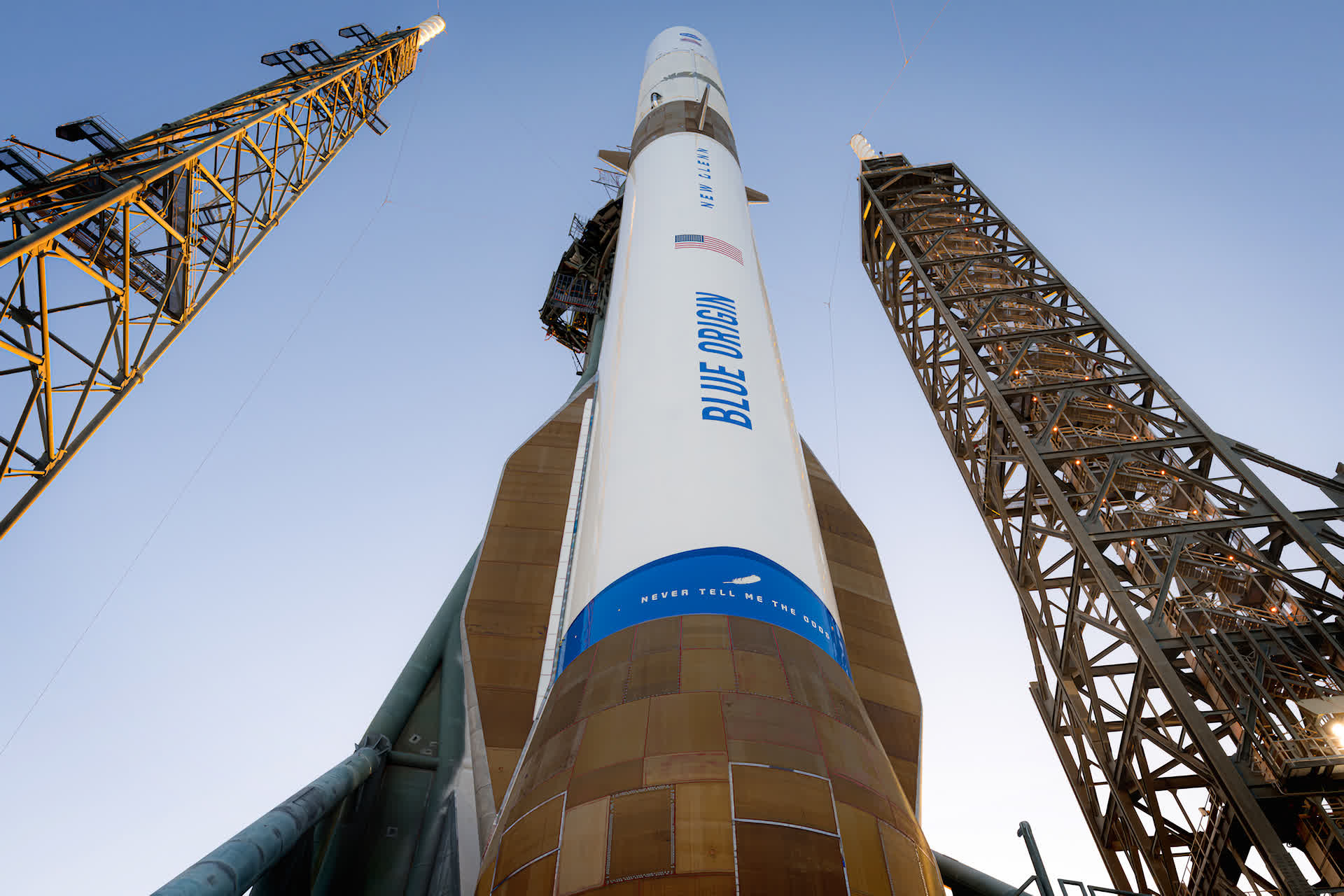
Blue Origin achieved a major milestone this week with the first successful landing of its New Glenn booster, bringing Jeff Bezos's space company closer to competing head-on with Elon Musk's SpaceX in commercial satellite launches.

The two-stage rocket lifted off from Cape Canaveral Space Force Station at 3:55 p.m. Eastern Time on Thursday, carrying NASA's Escapade mission en route to Mars along with a communications payload from Viasat.
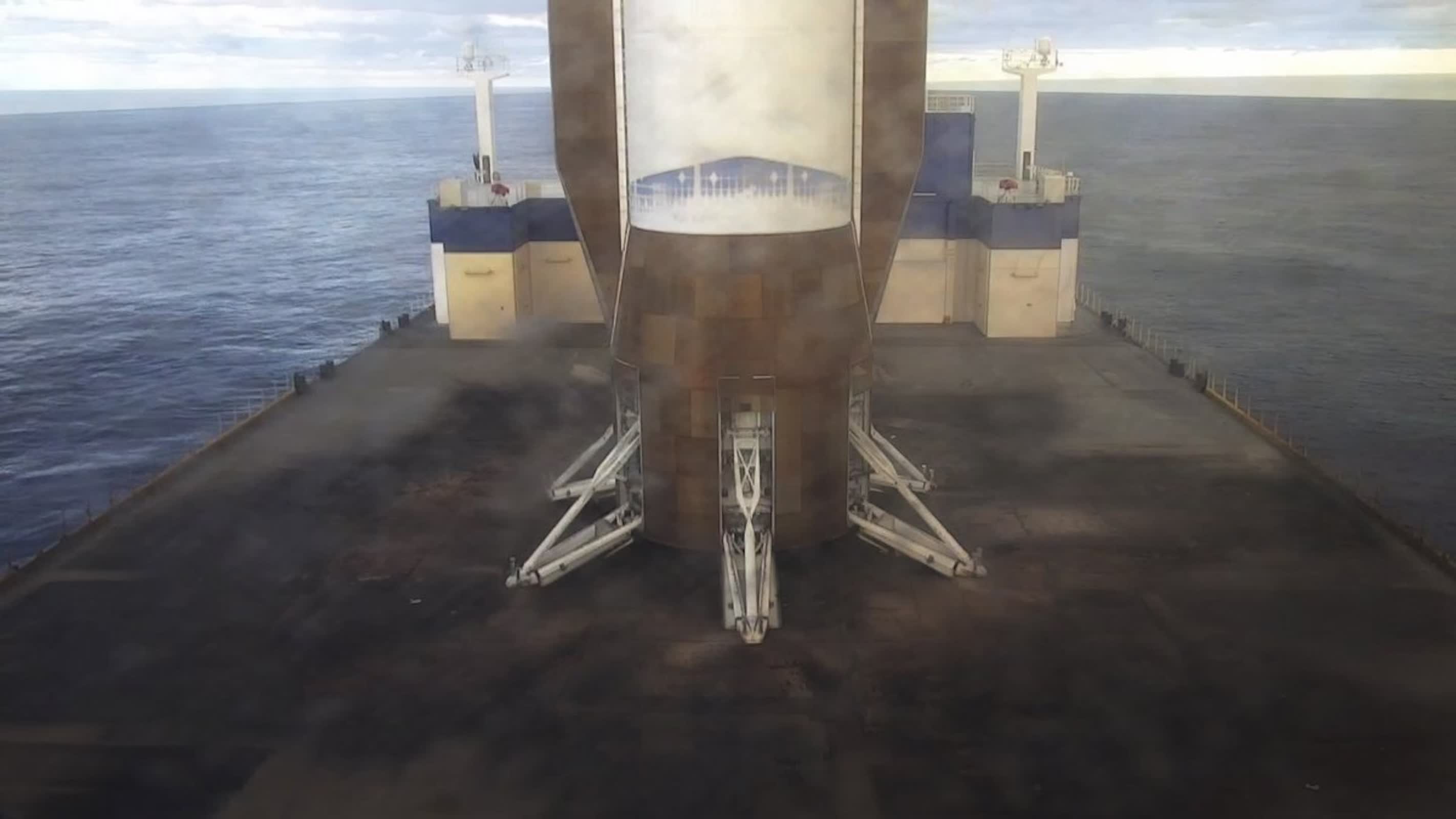
Minutes after separation, the rocket's massive first stage returned to Earth, touching down on a barge in the Atlantic Ocean – a precision maneuver never before accomplished by Blue Origin's largest launch vehicle.

The landing caps a pivotal second mission for New Glenn, which first reached orbit in January after a five-year delay. That inaugural flight ended with a failed booster recovery, underscoring the technical challenges of managing reusable launch systems at this scale. Thursday's successful flight represents a sharp reversal of that outcome and a critical proof of concept for the vehicle's reusability – the key to lowering Blue Origin's launch costs and sustaining the steady cadence required to meet its multibillion-dollar contracts.

Those contracts include major commitments to Amazon's Project Kuiper, a constellation designed to deliver broadband internet via low-Earth-orbit satellites. Delays in New Glenn's readiness have forced Amazon to rely on competing providers, including SpaceX and United Launch Alliance.

Blue Origin also holds a $3.4 billion contract with NASA for its Artemis lunar program, a high-profile effort that depends on a reliable and repeatable launch cadence.

New Glenn enters a field long dominated by SpaceX, which has perfected reusable rocket landings more than 500 times with its Falcon series. Blue Origin's comparable experience has, until now, been limited to its smaller suborbital vehicle, New Shepard – a single-stage launcher used primarily for space-tourism flights carrying high-profile passengers including Bezos, singer Katy Perry, and entrepreneur Justin Sun.

The technical gulf between New Glenn and New Shepard is enormous. Standing nearly 328 feet tall, New Glenn features one of the largest payload fairings in the industry and can carry up to 45 metric tons to low-Earth orbit.

That capacity, while substantial, still trails SpaceX's Starship, designed to lift as much as 150 tons. Starship's development path – marked by multiple explosive test failures before its 10th flight – finally reached orbit in August, illustrating the experimental nature of heavy-lift reusability across the sector.

Since taking over as Blue Origin's chief executive in 2023, Dave Limp has sought to accelerate the company's development pace after years of slow progress. A former senior executive at Amazon where he led the Project Kuiper satellite program, Limp has instituted layoffs and a cultural overhaul aimed at encouraging greater technical risk-taking.

Permalink to story:

 
Good for them; now they just need to figure out how to do those sorts of launches every two or three days. And have something in the works that will be able to compete with Starship.
 
If I correctly remember, SpaceX achieved that 10 years ago, 13 years after being established.

Blue Origin achieved it yesterday, 25 years years after being established.

Talking about Blue Origin as a competitor to SpaceX, and especially having "reliability comparable to SpaceX" is preposterous.
 
If I correctly remember, SpaceX achieved that 10 years ago, 13 years after being established.

Blue Origin achieved it yesterday, 25 years years after being established.

Talking about Blue Origin as a competitor to SpaceX, and especially having "reliability comparable to SpaceX" is preposterous.
Pure nonsense.

Space is hard. SpaceX is an outlier, not the baseline, so judging everyone else by their timeline is what’s actually preposterous.

Blue Origin is behind, sure, but they’re finally flying, building engines, and moving toward orbital capability. They’re not at SpaceX’s level yet—no one is—but it doesn’t mean they’re not a competitor.
 
Wild to think New Glenn went from a five-year delay and a failed recovery to nailing a barge landing on its second try. If they can repeat this even a handful of times, the whole launch market suddenly gets way more interesting.
 
Bezsos is a disgusting human being but that is going to be a beautifully polished looking phallus once completed.
 
Pure nonsense.

Space is hard. SpaceX is an outlier, not the baseline, so judging everyone else by their timeline is what’s actually preposterous.

Blue Origin is behind, sure, but they’re finally flying, building engines, and moving toward orbital capability. They’re not at SpaceX’s level yet—no one is—but it doesn’t mean they’re not a competitor.
SpaceX launches 90%+ of the payload to orbit worldwide, 95%+ in the US.
Blue Origin launches ZERO.
How could you possibly claim they are competitors ????????

Blue Origin may eventually become s SpaceX competitor somewhere in the distant future.
For the moment, SpaceX has above 90% of the market, while Blue Origin does not exist on the same market.
 
Good for them; now they just need to figure out how to do those sorts of launches every two or three days. And have something in the works that will be able to compete with Starship.
Compete with Starship? 🤣 Are you in an alternate universe?

If Starship could launch without exploding consistently, that might be a benchmark for Blue Origin to surpass.

As you might recall, NASA has said it is looking for competitors to SpaceX because of SpaceX's Starship woes, and much to fElon's disdain. Personally, I think this is a very good idea since NASA had put all its Eggs into the SpaceX basket.

 
Last edited:
Impressive. I hoped they'd succeed but didn't think they would.
Sometimes it's nice being wrong.
Sadly my current life sucked up all my attention so I wasn't even aware it was launch day, otherwise I'd have watched it live.
 
SpaceX launches 90%+ of the payload to orbit worldwide, 95%+ in the US.
Blue Origin launches ZERO.
How could you possibly claim they are competitors ????????

Blue Origin may eventually become s SpaceX competitor somewhere in the distant future.
For the moment, SpaceX has above 90% of the market, while Blue Origin does not exist on the same market.
This is Bezos' best chance to overtake Musk. If they can make 10 launches of superheavy rocket in a row without explosions, they will get contracts that Musk counted on.
 
SpaceX launches 90%+ of the payload to orbit worldwide, 95%+ in the US.
Blue Origin launches ZERO.
How could you possibly claim they are competitors ????????

Blue Origin may eventually become s SpaceX competitor somewhere in the distant future.
For the moment, SpaceX has above 90% of the market, while Blue Origin does not exist on the same market.
Pro tip: question marks and capitalized words don’t function as evidence, no matter how many you use ;-)

Market competition isn’t measured by today’s launch cadence. It includes who is developing vehicles, bidding on contracts, and has the ability to launch in the near future. SpaceX dominates, obviously, but that doesn’t remove Blue Origin from being a competitor.

My point stands on its own. I’m also super uninterested in debating semantics. Good luck and enjoy your weekend. Cheers.
 
SpaceX launches 90%+ of the payload to orbit worldwide, 95%+ in the US.
Blue Origin launches ZERO.
How could you possibly claim they are competitors ????????

Blue Origin may eventually become s SpaceX competitor somewhere in the distant future.
For the moment, SpaceX has above 90% of the market, while Blue Origin does not exist on the same market.
I don't think you read his post lol. He said no one is at SpaceX's level. He's comparing Blue Origin to SpaceX's competitors (not to SpaceX).

Anyways, New Glenn would be a phenomenal rocket if it's consistently manufactured and becomes a reliable launch vehicle. Its payload to LEO is listed pretty high, at 45 metric tons, but so far out of its two launches, it's only carried a payload of 1,070 kg to orbit (1T). Falcon 9 has a payload 18.5T to LEO, though the latest version (Block 5) typically delivers around 17T to LEO. Starship has a number of versions too, they just EOL'd their Block 2 and are working on Block 3 & 4. Block 2 has a listed payload capacity of 35T and has delivered 16T to orbit twice.

What makes Starship different though is its ability to land its upper stage. Both Falcon 9 and New Glenn do not have this capability (they can only land their first stage), and Blue Origin spent about 4 years on this before canceling it. In addition, Starship's Blocks 3 & 4 have a planned payload of 100T and 200T respectively. Starship's main objective to bring large amounts of payloads to Mars also depends on refueling in space (multiple launches to fuel a space tanker) and producing methane on Mars).
As you might recall, NASA has said it is looking for competitors to SpaceX because of SpaceX's Starship woes, and much to fElon's disdain. Personally, I think this is a very good idea since NASA had put all its Eggs into the SpaceX basket.

Remember, before SpaceX there were no other baskets for NASA to put its eggs into because nobody has done what NASA wanted to since Apollo. Furthermore, SpaceX won the contract because they are saving billions of dollars in government money. Orion cost the government $24 billion dollars and 5+ years of delays for Artemis I-II (Artemis II is still running on delays), whereas the Starship HLS is contracted at a fixed cost of under $3B and was originally slated to launch this year. Starship was selected for the mission because no other proposal even came close. So far Starship HLS (SpaceX's involvement in Artemis III) is delayed by 1-2 years, and part of the reason is because of Artemis II's delay. https://en.wikipedia.org/wiki/Artemis_III
 
Pro tip: question marks and capitalized words don’t function as evidence, no matter how many you use ;-)

Market competition isn’t measured by today’s launch cadence. It includes who is developing vehicles, bidding on contracts, and has the ability to launch in the near future. SpaceX dominates, obviously, but that doesn’t remove Blue Origin from being a competitor.

My point stands on its own. I’m also super uninterested in debating semantics. Good luck and enjoy your weekend. Cheers.
You're saying you're right according to your own definitions. Of course you are.
 
This is Bezos' best chance to overtake Musk. If they can make 10 launches of superheavy rocket in a row without explosions, they will get contracts that Musk counted on.
SpaceX has hundreds of commercial launches in a row without explosions, Blue Origin has zero. Even if Blue Origin manages to make 10 in a row, who would you trust if you have something to launch?
Besides, with its current speed Blue Origin will have 10 launches somewhere past 2030.

I would love SpaceX having real competition, but I'm not sure Blue Origin is a viable candidate.
 
SpaceX has hundreds of commercial launches in a row without explosions, Blue Origin has zero. Even if Blue Origin manages to make 10 in a row, who would you trust if you have something to launch?
Besides, with its current speed Blue Origin will have 10 launches somewhere past 2030.

I would love SpaceX having real competition, but I'm not sure Blue Origin is a viable candidate.
I meant specifically heavy version. SpaceX had a lot of explosions and still struggles to make a reliable heavy booster.
10 clean starts would allow BlueOrigin to prove their heavy rocket is superior.
 
I meant specifically heavy version. SpaceX had a lot of explosions and still struggles to make a reliable heavy booster.
10 clean starts would allow BlueOrigin to prove their heavy rocket is superior.
SpaceX has exactly zero failed commercial launches, if talking about the heavy versions (Facon Heavy & Starship) specifically.
Explosions are in test launches only, they are a part of the design process, it's one of the things that allows SpaceX to iterate so much faster than everyone else.

Besides, the New Glenn payload is claimed to be 45 metric tons to LEO, but that's the design target that's yet to be achieved. The current actual payload of New Glenn is ~25 tons, which puts it in the category of Falcon 9(hundreds of launches) , not Heavy or Starship.

I'm all for more competition, but BlueOrigin is very, very far from becoming a real SpaceX competitor.
 
Nice. But will they ever catch up to SpaceX?
:rolleyes:
I don't think you read his post lol. He said no one is at SpaceX's level. He's comparing Blue Origin to SpaceX's competitors (not to SpaceX).

Anyways, New Glenn would be a phenomenal rocket if it's consistently manufactured and becomes a reliable launch vehicle. Its payload to LEO is listed pretty high, at 45 metric tons, but so far out of its two launches, it's only carried a payload of 1,070 kg to orbit (1T). Falcon 9 has a payload 18.5T to LEO, though the latest version (Block 5) typically delivers around 17T to LEO. Starship has a number of versions too, they just EOL'd their Block 2 and are working on Block 3 & 4. Block 2 has a listed payload capacity of 35T and has delivered 16T to orbit twice.

What makes Starship different though is its ability to land its upper stage. Both Falcon 9 and New Glenn do not have this capability (they can only land their first stage), and Blue Origin spent about 4 years on this before canceling it. In addition, Starship's Blocks 3 & 4 have a planned payload of 100T and 200T respectively. Starship's main objective to bring large amounts of payloads to Mars also depends on refueling in space (multiple launches to fuel a space tanker) and producing methane on Mars).

Remember, before SpaceX there were no other baskets for NASA to put its eggs into because nobody has done what NASA wanted to since Apollo. Furthermore, SpaceX won the contract because they are saving billions of dollars in government money. Orion cost the government $24 billion dollars and 5+ years of delays for Artemis I-II (Artemis II is still running on delays), whereas the Starship HLS is contracted at a fixed cost of under $3B and was originally slated to launch this year. Starship was selected for the mission because no other proposal even came close. So far Starship HLS (SpaceX's involvement in Artemis III) is delayed by 1-2 years, and part of the reason is because of Artemis II's delay. https://en.wikipedia.org/wiki/Artemis_III
Your automatic fElon apologistics are ineffective. It does not matter who is first; it matters who produces the quality product.

Keep choosing to ignore reality when, in fact, NASA is seeking alternatives to SpaceX. NASA doesn't do things willy-nilly. In NASA's eyes, there must be sound reason to be searching for alternatives to SpaceX. And, it pissed-off fElon as if he's impartial in the matter.

IMO, NASA should NEVER have put all their Eggs in the SpaceX basket. As I see it, competition is common sense.

And remember, BOTH SpaceX and Blue Origin have ROYALTY FREE access to NASA's entire library of IP.
I would love SpaceX having real competition, but I'm not sure Blue Origin is a viable candidate.
I'm all for more competition, but BlueOrigin is very, very far from becoming a real SpaceX competitor.
You're saying you are right, according to your own definitions. Of course you are!
SpaceX has hundreds of commercial launches in a row without explosions, Blue Origin has zero. Even if Blue Origin manages to make 10 in a row, who would you trust if you have something to launch?
Besides, with its current speed Blue Origin will have 10 launches somewhere past 2030.
Right now, the reality is that Starship is the only vehicle that matters to the Orion program. It is a keystone vehicle in the program. I think it obvious that NASA is not happy with Starship and is looking for alternatives because without Starship, or a replacement heavy lift vehicle, NASA's current moon program does not happen.
 
Right now, the reality is that Starship is the only vehicle that matters to the Orion program. It is a keystone vehicle in the program. I think it obvious that NASA is not happy with Starship and is looking for alternatives because without Starship, or a replacement heavy lift vehicle, NASA's current moon program does not happen.
whether NASA is happy or unhappy, the Starship is the only viable option. Of course, NASA wants to have Plan B, but Blue Origin does not look like a reliable Plan B.
 
IMO, NASA should NEVER have put all their Eggs in the SpaceX basket. As I see it, competition is common sense.
...
Right now, the reality is that Starship is the only vehicle that matters to the Orion program. It is a keystone vehicle in the program. I think it obvious that NASA is not happy with Starship and is looking for alternatives because without Starship, or a replacement heavy lift vehicle, NASA's current moon program does not happen.
You don't seem to understand Artemis at all. Orion is not a NASA program. Artemis is the NASA program to bring man back to the moon. Orion is a spacecraft by Lockheed Martin that is supposed to bring them from Earth's orbit to the moon's orbit: https://en.wikipedia.org/wiki/Orion_(spacecraft)

Artemis I and Artemis II have no involvement by SpaceX. Artemis I was 6 years late, and Artemis II is 5 years late (and counting). What NASA is talking about is replacing SpaceX in the 1-2 years delayed Artemis III. In Artemis III, SpaceX's involvement is to create a rocket that will take astronauts from Orion in the moon's orbit to the moon's surface and back to earth. And somehow, SpaceX is being reconsidered while Lockheed Martin's received 10x more taxpayer money and has been delayed 3-5x longer.

Remember Artemis II still hasn't happened yet, and SpaceX has nothing to do with those delays. And for Artemis III, there isn't any other rocket that can do what is being asked. The only other option would be with Blue Origin in at least 6 years from now (too late for NASA): https://arstechnica.com/space/2025/...sts-starship-is-fastest-path-to-moon-landing/
 
You don't seem to understand Artemis at all. Orion is not a NASA program. Artemis is the NASA program to bring man back to the moon. Orion is a spacecraft by Lockheed Martin that is supposed to bring them from Earth's orbit to the moon's orbit: https://en.wikipedia.org/wiki/Orion_(spacecraft)

Artemis I and Artemis II have no involvement by SpaceX. Artemis I was 6 years late, and Artemis II is 5 years late (and counting). What NASA is talking about is replacing SpaceX in the 1-2 years delayed Artemis III. In Artemis III, SpaceX's involvement is to create a rocket that will take astronauts from Orion in the moon's orbit to the moon's surface and back to earth. And somehow, SpaceX is being reconsidered while Lockheed Martin's received 10x more taxpayer money and has been delayed 3-5x longer.

Remember Artemis II still hasn't happened yet, and SpaceX has nothing to do with those delays. And for Artemis III, there isn't any other rocket that can do what is being asked. The only other option would be with Blue Origin in at least 6 years from now (too late for NASA): https://arstechnica.com/space/2025/...sts-starship-is-fastest-path-to-moon-landing/
You may be right, but those "stages of heavy lifting vehicles" that you say fElon has on the drawing board - they don't exist yet (they are vapor hardware) and so far, fElons Starship results are less than stellar. Will SpaceX get it right? Probably, but if you want to put it that way, it is a similar waste of Tax Payer dollars and/or insurance dollars every time SpaceX launches one and it blows up. With fElon being so set on FAFO, WTF is the point of launching something you know is bound to fail? There's a saying "Experience is the best teacher, but she sends enormous bills." I think fElon and SpaceX are proving that.

And given this was only the second launch of "New Glenn" by Blue Origin, I'd say they are doing a much better job of getting things done in comparison to SpaceX. https://gizmodo.com/blue-origins-bi...now-about-new-glenns-second-launch-2000681616

How many times has Starship launched?

IMO, that "Waste of Taxpayer Dollars" is a dated and obsolete argument from people who have no clue about what the space program has contributed to everyday life.

A few years ago, other companies were already developing the new "Lunar Lander." So I don't know why fElon got so upset that NASA is soliciting other bids for that part of the program.
 
Back