BMW brings color changing tech closer to production with the iX3 Flow Edition

Skye Jacobs

Posts: 2,007   +58
Staff
First look: BMW's latest experiment with programmable vehicle surfaces no longer attempts to cover an entire car. Instead, it focuses on a single panel – and in doing so, may have addressed one of the biggest barriers to making color-shifting exteriors viable beyond the concept stage.
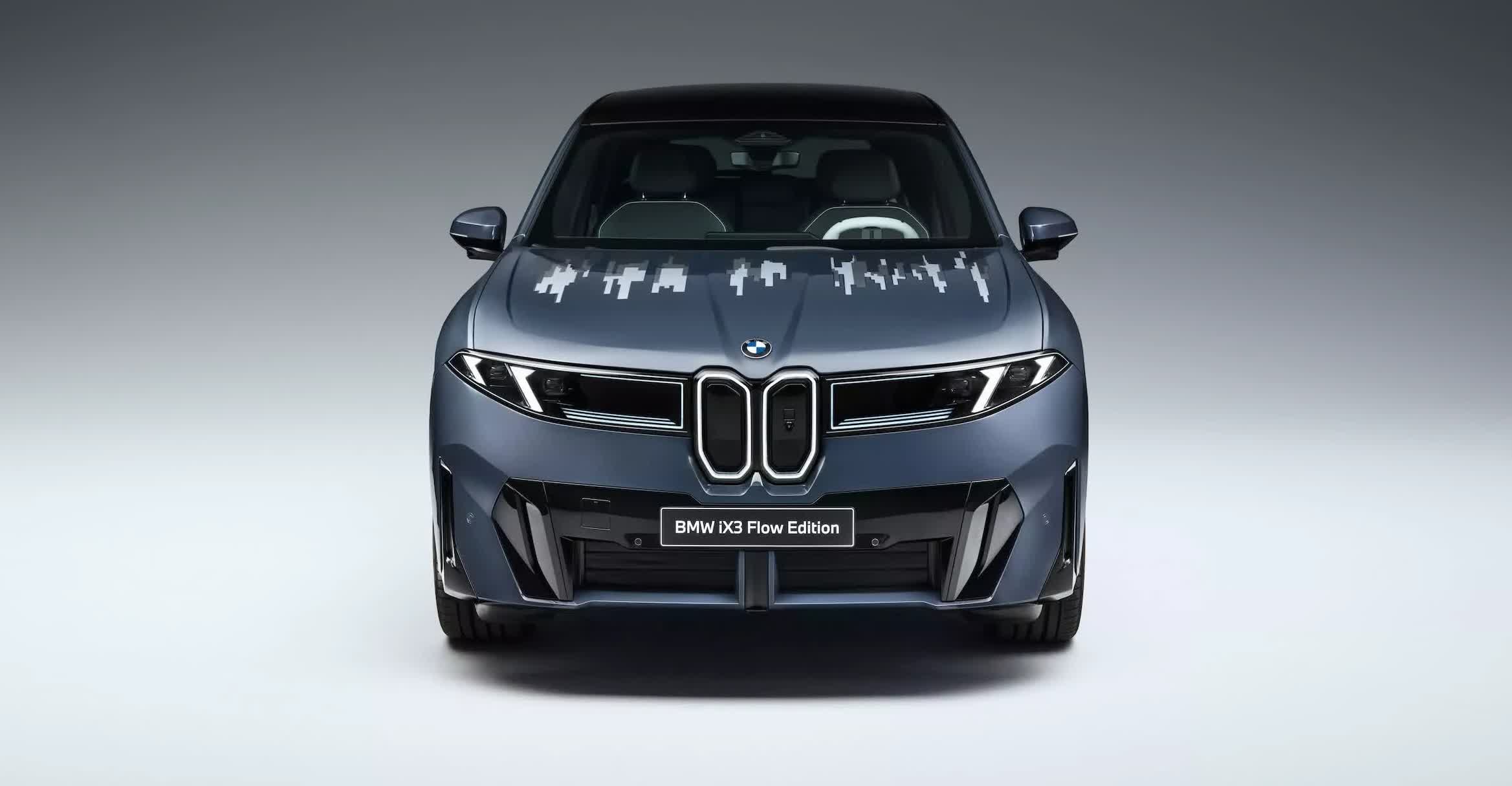
Unveiled at the 2026 Beijing Auto Show, the BMW iX3 Flow Edition integrates E Ink's Prism technology directly into the vehicle's hood, bringing the concept closer to real-world application. Unlike earlier efforts that relied on external layers of segmented panels, this version embeds the electrophoretic system into the structure of the body panel itself.

That distinction matters. Previous concepts, including the iX Flow shown at CES 2022 and the 2023 I Vision Dee, wrapped vehicles in dozens – or, in the case of Dee, 240 – separate E Ink segments. While visually striking, that approach was complex to manufacture, less durable, and difficult to scale. The iX3 Flow Edition instead integrates the technology directly into the panel, improving durability and making it more suitable for production-level automotive use.

The system still relies on electrophoretic technology, in which tiny pigment particles move within microcapsules when an electric charge is applied, changing the surface color. It only consumes power during state changes, making it especially efficient for electric vehicles.
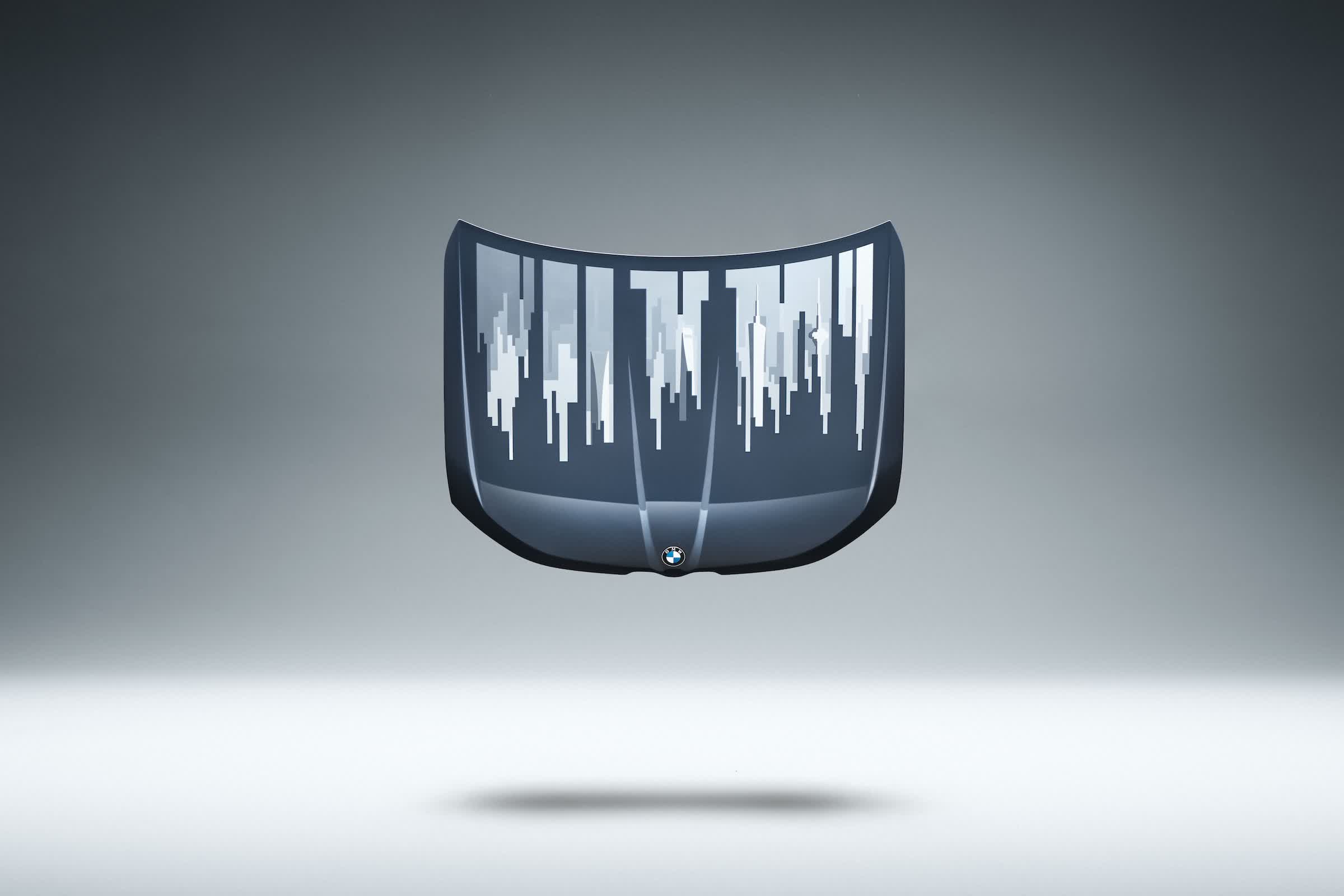
In its current form, the BMW iX3 Flow Edition limits this capability to the hood and a grayscale palette. Drivers can choose from eight pre-configured animations, including designs that outline notable buildings in China.

BMW describes the vehicle as demonstrating "the technology's readiness for series production," though it remains a concept for now. The phrasing suggests the company views it less as a showcase and more as an incremental step toward production.

Beyond aesthetics, the system may offer practical benefits. A lighter surface in hot conditions could reflect more sunlight, potentially reducing cabin heat buildup and lowering air-conditioning demand. Conversely, darker states could help absorb heat in colder or overcast environments, reducing reliance on climate control systems.

The iX3 Flow Edition also debuted alongside multiple variants of the iX3 platform at the Beijing Auto Show, including a long-wheelbase model intended for China and other Asian markets. The Flow concept itself is based on the standard-wheelbase version, which will not be sold in China.

The project reflects a broader shift in how automakers are approaching exterior surfaces – not as static finishes, but as programmable interfaces. BMW's earlier concepts framed this idea as a form of digital expression; the iX3 Flow Edition instead reframes it as a materials engineering challenge, with potential benefits in efficiency, durability, and manufacturability.

The result is less visually dramatic than a fully color-changing vehicle, but arguably more significant. By integrating E Ink technology into a structural panel and testing it in a more realistic automotive context, BMW has moved the idea of dynamic vehicle exteriors a step closer to leaving the concept stage.

Permalink to story:

 
Beyond aesthetics, the system may offer practical benefits. A lighter surface in hot conditions could reflect more sunlight, potentially reducing cabin heat buildup and lowering air-conditioning demand. Conversely, darker states could help absorb heat in colder or overcast environments, reducing reliance on climate control systems.
Sorry, but what a load of nonsense.

The cost of manufacturing and maintaining an E-Ink surface is going to be significantly higher than the electricity or fuel savings it ever provides. There is no way this translates to more than, at maximum, a 1-2% efficiency gain in the most extreme cases. So maybe you save $15-30 a year in energy costs; lol. Gonna take you 80 years to cost-justify it. Just a massive load of marketing BS.

Let’s also not forget BMW has been chasing any possible avenue to push feature subscriptions into their cars for years. Novelties like this is how they’re going to try and justify it until it becomes normalized.
 
How exactly would color change technology fit in with the law?
Imagine a person driving around in a blue car that's actually orange.
Commmitting crimes in a green car that is really white?

Somehow I don't see this ever being a thing.

It's like those license plates that can alter themselves.
 
Will cost a fortune to replace. I mean, for a car like this it would be expensive even without display, but with this thing, the cost to fix would be insanely high.
It would be cool if the entire car color could be adjusted, though.
 
Theoretically cool, but utterly *****ic from a real use case perspective, and also, since body damage is the most expensive thing on a car, and I imagine a new bonnet / hood like that ain't cheap, you'd probably be expecting to pay a good chunk more on insurance for your car just to have it be flashy...
 
Instead of this, I would love to see a window tech that can transform into fully black and back to half-transparent, like in the Knight Rider series.
 
Instead of this, I would love to see a window tech that can transform into fully black and back to half-transparent, like in the Knight Rider series.
That's probably already possible but illegal because windows tint is heavily regulated. Depending on what state you're in, your car can be towed if windows tint exceeds state limits. Funnily enough, many cars roll off the assembly line with tint that exceeds those limits
 
And if someone scratches it, will it be like a smartphone screen where you get green lines, or it flashes white all the time? 🤣
 
That's probably already possible but illegal because windows tint is heavily regulated. Depending on what state you're in, your car can be towed if windows tint exceeds state limits. Funnily enough, many cars roll off the assembly line with tint that exceeds those limits
That’s not really how it works.

Manufacturers aren’t rolling cars off the line with illegal tint...that would be a compliance and liability mess. Factory glass is built to meet federal standards and generally lands in a safe range that works across all states.

The darker stuff you see on SUVs and trucks is usually rear privacy glass, which is allowed to be darker in most states.

Where people get tripped up is stacking aftermarket tint on top of factory glass. That’s when you blow past legal limits, automakers aren’t sneaking illegal tint out the door. People just modify it afterward and then blame the car when it doesn’t pass.
 
That’s not really how it works.

Manufacturers aren’t rolling cars off the line with illegal tint...that would be a compliance and liability mess. Factory glass is built to meet federal standards and generally lands in a safe range that works across all states.

The darker stuff you see on SUVs and trucks is usually rear privacy glass, which is allowed to be darker in most states.

Where people get tripped up is stacking aftermarket tint on top of factory glass. That’s when you blow past legal limits, automakers aren’t sneaking illegal tint out the door. People just modify it afterward and then blame the car when it doesn’t pass.
Because states have varying regulations on top of the federal ones, they only have to meet federal stands and they usually don't know where each car rolling off the line is going. Since we have a dealership model in the US, the manufacturer can do what they want and it's upto the dealership to make sure the vehicle is in compliance with local regulations. Since the fine is small, most people just pay it and never make a fuss about it. What you need to know is that tint can be used as probable cause. The other thing is that the tint can be 100% legal and all the officer has to say is "well it was too dark for me to see in the vehicle" and it stands
 
Instead of this, I would love to see a window tech that can transform into fully black and back to half-transparent, like in the Knight Rider series.
They've had this for a while on higher-end vehicles .... I remember Ferrari's Superamerica introducing it back in 2005.
 
Because states have varying regulations on top of the federal ones, they only have to meet federal stands and they usually don't know where each car rolling off the line is going. Since we have a dealership model in the US, the manufacturer can do what they want and it's upto the dealership to make sure the vehicle is in compliance with local regulations. Since the fine is small, most people just pay it and never make a fuss about it. What you need to know is that tint can be used as probable cause. The other thing is that the tint can be 100% legal and all the officer has to say is "well it was too dark for me to see in the vehicle" and it stands

You are mixing a few truths with a lot of reach.

Yes, there are federal standards, but automakers don’t just ignore state laws and dump non-compliant cars into the dealer network. They build to a baseline that works across all markets specifically so they don’t have to track “this car goes to Florida, that one goes to New York.”

It’s not the Wild West where manufacturers do what they want and dealers magically fix legality after the fact.

Also, factory glass itself is never the problem. It’s designed to pass everywhere for front windows. The darker rear privacy glass is allowed in most states, so that’s not some loophole, it’s intentional and legal.

Where people actually get burned is aftermarket tint. Stack film on top of factory glass and now your total light transmission drops below state limits. That’s on the owner or the shop, not the manufacturer or dealership.

On the enforcement side, sure tint can be used as probable cause, and yes, it can be subjective. But that doesn’t mean cars are rolling off the line illegal. It just means enforcement isn’t always perfectly consistent, which is a completely different argument.
 
You are mixing a few truths with a lot of reach.

Yes, there are federal standards, but automakers don’t just ignore state laws and dump non-compliant cars into the dealer network. They build to a baseline that works across all markets specifically so they don’t have to track “this car goes to Florida, that one goes to New York.”

It’s not the Wild West where manufacturers do what they want and dealers magically fix legality after the fact.

Also, factory glass itself is never the problem. It’s designed to pass everywhere for front windows. The darker rear privacy glass is allowed in most states, so that’s not some loophole, it’s intentional and legal.

Where people actually get burned is aftermarket tint. Stack film on top of factory glass and now your total light transmission drops below state limits. That’s on the owner or the shop, not the manufacturer or dealership.

On the enforcement side, sure tint can be used as probable cause, and yes, it can be subjective. But that doesn’t mean cars are rolling off the line illegal. It just means enforcement isn’t always perfectly consistent, which is a completely different argument.
Say whatever you want, I have seen it first hand. I don't think anyone would disagree that our legal system is ****ed, I don't know why this would be a surprise to anyone.
 
Say whatever you want, I have seen it first hand. I don't think anyone would disagree that our legal system is ****ed, I don't know why this would be a surprise to anyone.
“Seen it first hand” doesn’t really prove the point though.

What you likely saw was either factory privacy glass (which is legal in most states for rear windows) or a car that already had aftermarket tint added before it ever hit the lot. Dealers absolutely do that, and thats where things can cross the line, but not the factory. I have seen it first hand as well, my 2020 F150 Supercrew came from the factory with 30% on the cab side windows and 20% on the rear windows. I have been from Florida to New Hampshire and west to Montana in that truck and never been stopped. Its factory stained glass tint, not dealer installed film.

Automakers aren’t shipping out cars with illegal front window tint and hoping nobody notices. That’s an easy lawsuit and a compliance failure they have zero incentive to risk.

I will agree, enforcement can be inconsistent, no argument there. But that’s a separate issue from claiming cars leave the factory illegal. They aren't. Those are two completely different things you are lumping together.

But, if you need to win, I will concede. You win as this has nothing to do with the article anyway.
 
Back