Bolt Graphics claims 13x leap over Nvidia RTX 5090 with less wattage – and huge caveats

Daniel Sims

Posts: 2,560   +77
Staff
Add a LARGE GRAIN OF SALT: The GPU market is hotter than ever, fueled by gaming, AI, and data center demand. But real competition to Nvidia remains scarce. That's where Bolt Graphics comes in, pitching its new Zeus architecture as a disruptor. The company claims it can beat Nvidia's flagship cards in raw performance, but a closer look suggests Zeus might be more smoke than silicon, possibly repackaging server-class hardware in gamer-friendly clothing.
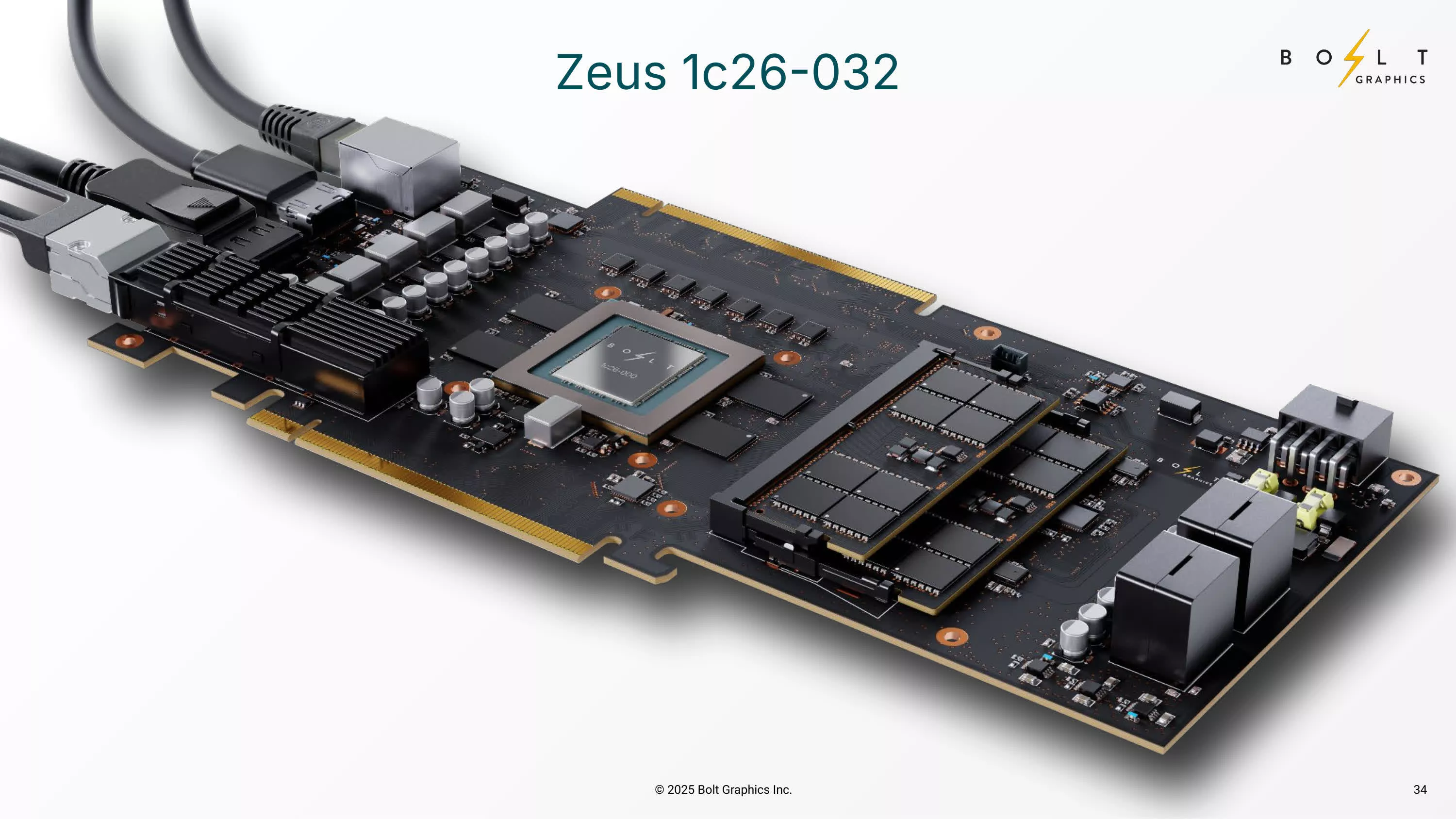
California-based startup Bolt Graphics recently revealed detailed specifications for its upcoming graphics cards, claiming they outperform the Nvidia RTX 5090 in path tracing workloads. While the Zeus lineup appears impressive on paper, several details raise red flags.

The company first unveiled its ambitious plans in March, boasting enormous memory pools and graphics processors that are, according to them, orders of magnitude faster than Nvidia's.

A newly released spec sheet takes these claims even further – but Bolt's vertical TFLOP numbers appear suspiciously low, and the company opting for older VRAM formats cast doubt on the gaming credentials of these GPUs.
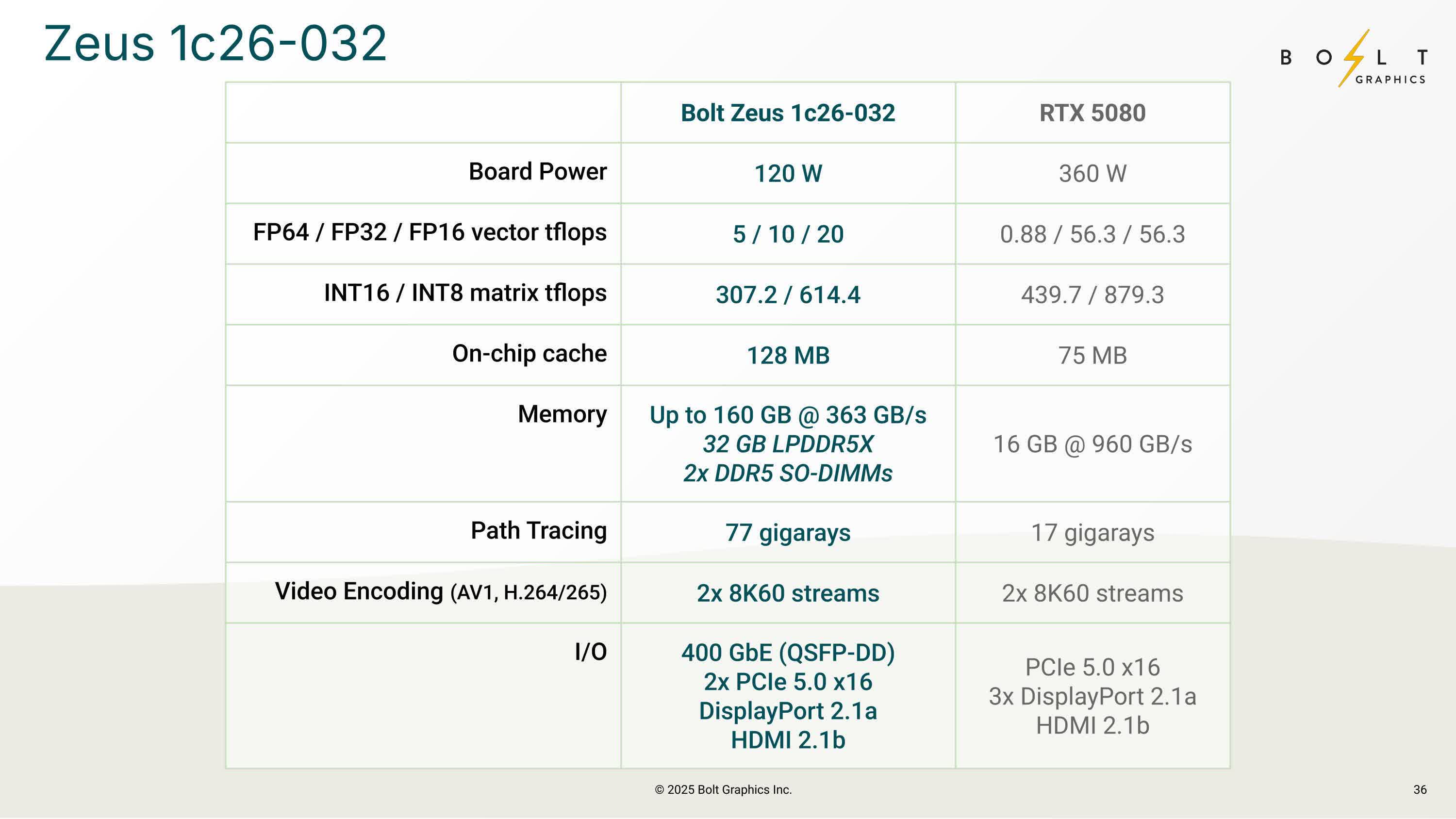
The specifications for the company's four planned GPUs: the Zeus 1c-032, 2c-064, 2c-128, and 4c-256, appear to outperform the RTX 5080, 4090, and even 5090 in several areas, all while consuming less than half the power.

For instance, the weakest entry-level "1c-032" is said to achieve 77 gigarays in path tracing compared to the RTX 5090's 32. It also includes 128 MB of cache, and Bolt is attempting to revive socketable VRAM, enabling configurations with up to 160 GB of memory.

All of this is achieved with a power draw of just 120W, lower than even the RTX 5050. In a subtle jab at Nvidia, Bolt emphasized that Zeus uses standard 8-pin power connectors, which it notes are "known to not melt."
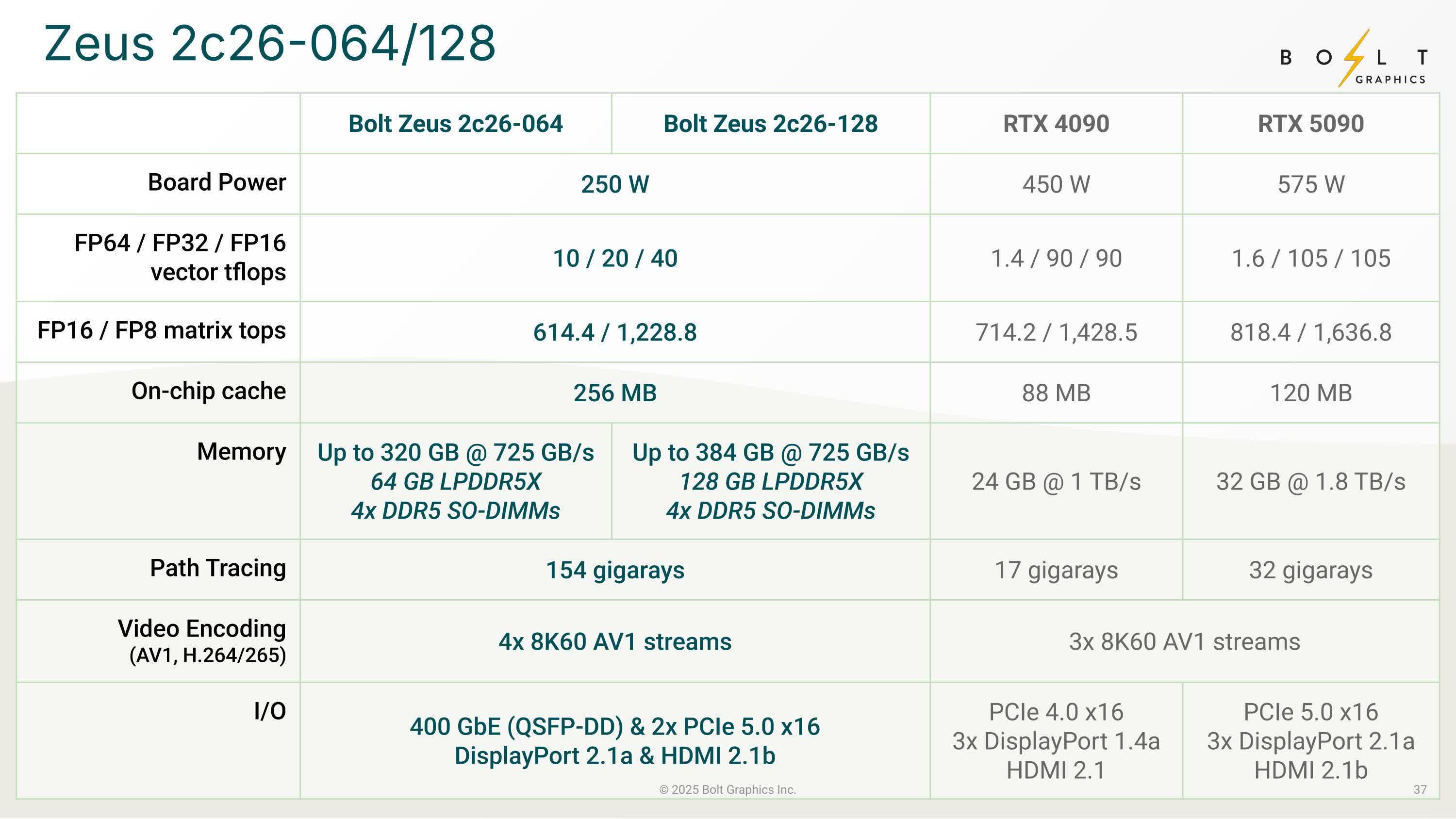
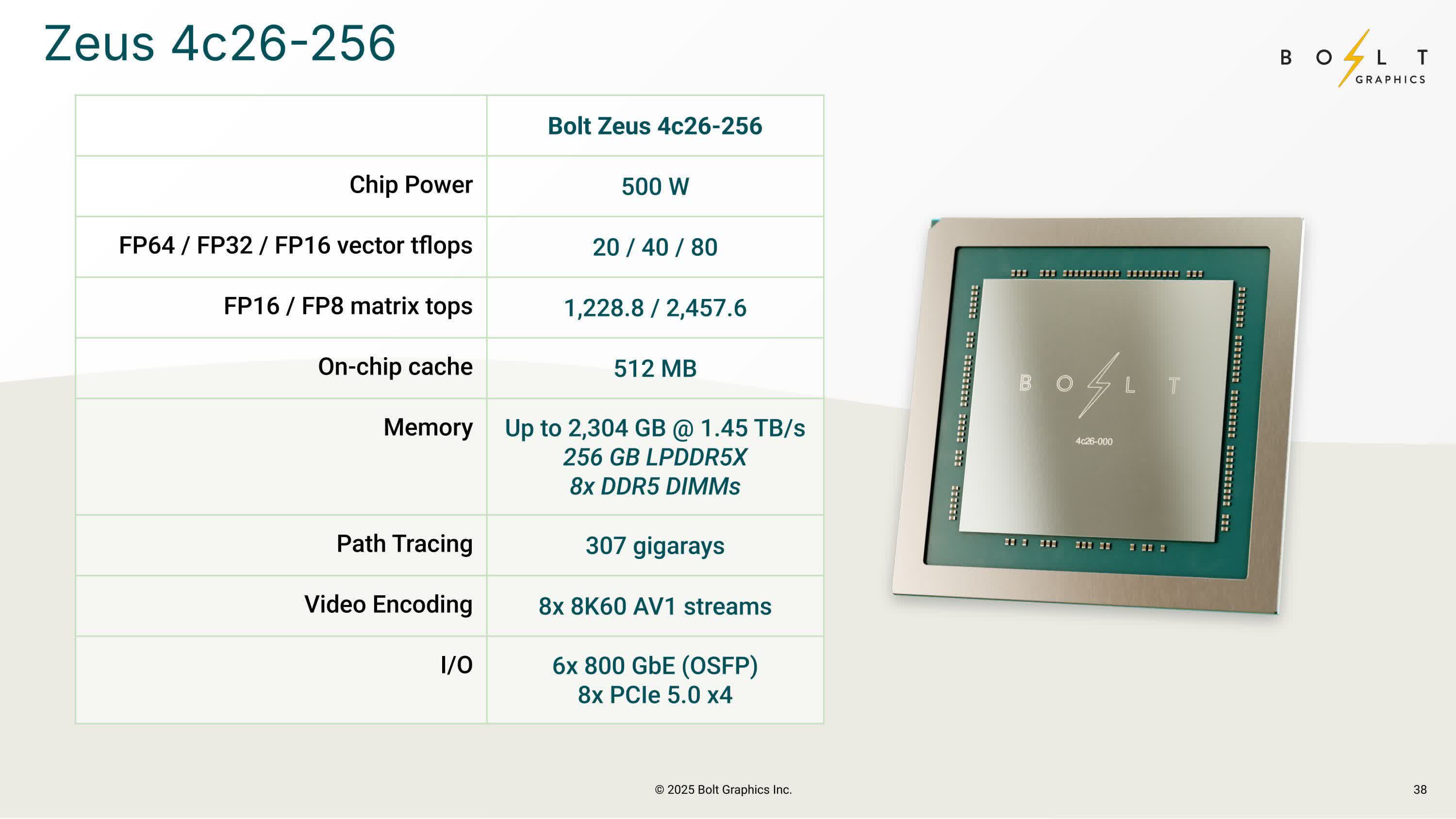
The higher-end Zeus models scale up the 1c's specs significantly, increasing cache, VRAM, gigarays, and 8K video stream support to levels that seem almost too good to be true.

The flagship 4c GPU, which uses slightly less power than the RTX 5090, delivers 307 gigarays, features 512 MB of cache, and supports an astounding 2.3 TB of VRAM.

However, all of these numbers remain theoretical. Bolt's "pre-silicon" performance estimates are based on synthetic benchmarks, not real-world gaming tests. Additionally, production isn't expected to begin until late 2026, meaning the GPUs won't be available before 2027. By then, both AMD and Nvidia will likely have launched next-generation hardware.

If you're wondering why any of this exists, the answer might be as simple as hype. Bolt could be trying to turn heads and turn that attention into funding, by riding the current wave of GPU gold rush fever, especially as AI accelerators continue to be Silicon Valley's hottest hardware obsession.

The spec sheet also reveals areas where the Zeus cards significantly trail Nvidia's high-end RTX 5000 series. Those massive VRAM capacities rely on LPDDR5X and DDR5, which are likely much slower than AMD and Nvidia's GDDR6 and GDDR7 memory.

Furthermore, FP32 and FP16 TFLOP counts – crucial for gaming performance – fall well below the RTX 5090, and in many cases, even below the RTX 5080.

If Bolt's numbers prove accurate, the Zeus series could be compelling for certain HPC, rendering, or server workloads. But when it comes to gaming (which also needs optimized drivers, and that takes a lot of time – just ask Intel), their real-world performance will likely remain uncertain for at least the next couple of years.

Permalink to story:

 
If those gigaray number are actually real, Rubin will not save Nvidia. There's not a chance in hell Rubin will increase 5090's 32 gigarays by more than 400%.
 
Is this company even suggesting it will make products for gamers? My quick read is that they are making specialized equipment to serve a specific creator/business need that is currently not targeted by general purpose GPUs.
Wondering if they are fluttering their feathers for a purchase or licensing agreement. If I was AMD I would make an offer to integrate this into udna/rdna5.

Or
Dedicated physx card when? I mean rt card😅.
 
That bandwidth they claim must be the internal cache only as even even octa channel doesn't reach such high speeds.
 
What's a gigaray? Surely there must be some function of time to compare specs e.g. gigarays / second?
 
The link to dedicated X article shows responses like this one about performance. FYI
 

Attachments

  • Screenshot_20250805_072448_Chrome.jpg
    Screenshot_20250805_072448_Chrome.jpg
    803.5 KB · Views: 1
I notice that this GPU is supposed to be aimed at the commercial server use and not for us gamers so why compare it to gaming GPU's instead of say AMD's MI series and nVidia's H series GPU's oh maybe because it's not as good as it first looks if compared to apples instead of oranges
 
Is this company even suggesting it will make products for gamers? My quick read is that they are making specialized equipment to serve a specific creator/business need that is currently not targeted by general purpose GPUs.
I notice that this GPU is supposed to be aimed at the commercial server use and not for us gamers so why compare it to gaming GPU's instead of say AMD's MI series and nVidia's H series GPU's oh maybe because it's not as good as it first looks if compared to apples instead of oranges
Especially since the renders seem to show an ethernet port and what is either a DAC or FO port. Also it looks like there is a second PCIe connector on the opposite edge from where you normally find a PCIe connector.

Either this card is aimed entirely at the enterprise sector, meant to enable rendering & AI workloads, or the renders are AI slop that through on a bunch of different cables and connectors.
 
Especially since the renders seem to show an ethernet port and what is either a DAC or FO port. Also it looks like there is a second PCIe connector on the opposite edge from where you normally find a PCIe connector.

Either this card is aimed entirely at the enterprise sector, meant to enable rendering & AI workloads, or the renders are AI slop that through on a bunch of different cables and connectors.
Gaming
Experience the power of Zeus, the fastest and most efficient graphics processor in the industry. Whether you’re playing games or making them, Zeus delivers the gaming experience you’ve always wanted.
https://bolt.graphics/workload/gaming/

This the only place I've seen where they say "playing games." Everything else is about developing them.
 
This product is for 3D animation rendering for movies, shows, and web animations. It has nothing to do with gaming, though if you could game on them, it may game poorly. They have a booth at Siggraph this year for 3D artists/studios to look at as a MUCH NEEDED alternative to Nvidia's overpriced trash
 
I recall a Tech Startup called Gigapixel back in the 90s, they were supposed to take the big 3 down (ATI/3dfx/nvidia), they promised amazing specs at the time. Ended up releasing nothing. I think 3dfx bought them
 
I recall a Tech Startup called Gigapixel back in the 90s, they were supposed to take the big 3 down (ATI/3dfx/nvidia), they promised amazing specs at the time. Ended up releasing nothing. I think 3dfx bought them
Ah, Gigapixel.....yeah, they were hyped as the next big GPU disruptor back in the late ’90s. They had this tile based rendering approach that was supposed to leapfrog the big three in efficiency and performance. But like a lot of “next big thing” startups, they never got a product out the door. 3dfx ended up buying them in 2000 mainly for their tech and engineers, but by then 3dfx itself was already circling the drain and got swallowed by Nvidia not long after.

Basically, Gigapixel became a cool “what could have been” footnote in GPU history.
 
This product is for 3D animation rendering for movies, shows, and web animations. It has nothing to do with gaming, though if you could game on them, it may game poorly. They have a booth at Siggraph this year for 3D artists/studios to look at as a MUCH NEEDED alternative to Nvidia's overpriced trash

Overpriced trash that dominates like 90% of the 3d rendering, animation, post production and special effects markets. Hate nvidia all you want but nvidia is the dominant player in pretty much every market it's in. Among the one's I mentioned already add, AI, Gaming, HPC, robotics, VR, and its not like it dominates with just 50% of the market, it has close to or above 90% in most of the markets its in.

Yeah, trash.
 
"Bolt Graphics claims 13x leap over Nvidia RTX 5090 with less wattage" the proper term is power, "less power". "Wattage" isn't the correct term when discussing power. It's like saying celsiuses when talking about temperature I.e. what's the celsuises outside today, what celsiuses do I set the oven to, and the celsiuses rating on this device is too low...etc.

I don't understand this style of writing:
"California-based startup Bolt Graphics...claiming they outperform the Nvidia RTX 5090 in path tracing workloads... but Bolt's vertical TFLOP numbers appear suspiciously low..."

Are TFLOP numbers important to path tracing? It's like you didn't look at the table they showed and realize all the things, I assume, have to do with path tracing are much higher on their card than the one they are comparing their card to. Their card is designed to be better at path tracing workloads which is their claim, nowhere in the article did they claim they are better at anything else than the 5090 other than path tracing.

Another article trying to generate drama when it isn't necessary. "New graphics card from a new company claiming to have better path tracing than a 5090" would have gotten people to click on the article.
 
Last edited:
Overpriced trash that dominates like 90% of the 3d rendering, animation, post production and special effects markets. Hate nvidia all you want but nvidia is the dominant player in pretty much every market it's in. Among the one's I mentioned already add, AI, Gaming, HPC, robotics, VR, and its not like it dominates with just 50% of the market, it has close to or above 90% in most of the markets its in.

Yeah, trash.
Why are you being so defensive? Why do you feel the need to stand up for a trillion dollar company? If a card costs the same amount, but does 13x as much work, then yeah, the 5090 would be overpriced trash, calling it trash might be too far, unless you work on path tracing all day and the 5090 is much much slower, but I don't care enough about the ridiculous hyperbole to defend a trillion-dollar company that doesn't care about us anyway.
 
Why are you being so defensive? Why do you feel the need to stand up for a trillion dollar company? If a card costs the same amount, but does 13x as much work, then yeah, the 5090 would be overpriced trash, calling it trash might be too far, unless you work on path tracing all day and the 5090 is much much slower, but I don't care enough about the ridiculous hyperbole to defend a trillion-dollar company that doesn't care about us anyway.

I don't even need to defend nvidia, I'm just stating facts which just happen to speak for themselves. If calling a trillion dollar company trash makes you happy, great, more power to you. You don't like them because they don't care about consumers? I have bad news for you, none of them do, not AMD, not Intel, not Apple and of course not nvidia
 
Back