

At this point, it seems many people are starting to give up on the impact Generative AI was supposed to have. After all, haven't we already fallen into the dreaded "trough of disillusionment"? The tenor of media coverage, social media posts, and more has clearly shifted from giddy excitement to weary skepticism, driven by a fear of overhyping the technology.
But out in the real world, it's clear that GenAI initiatives across businesses of all sizes and industries are actually just starting to shift into higher gear.
A new study by TECHnalysis Research emphasizes this point. "The Intelligent Path Forward: GenAI in the Enterprise" is based on a web survey of over 1,000 US-based IT decision makers across ten industries and both medium businesses (100-999 employees) and large enterprises (1,000+ employees).
The study results show that not only are investments in GenAI initiatives continuing, but companies are also finding new sources of funding to support these efforts. Over half of the survey respondents said they're using funds outside traditional IT to help pay for these efforts – 31% from special budgets dedicated to GenAI, and another 22% from other corporate budgets or initiatives, such as business units.
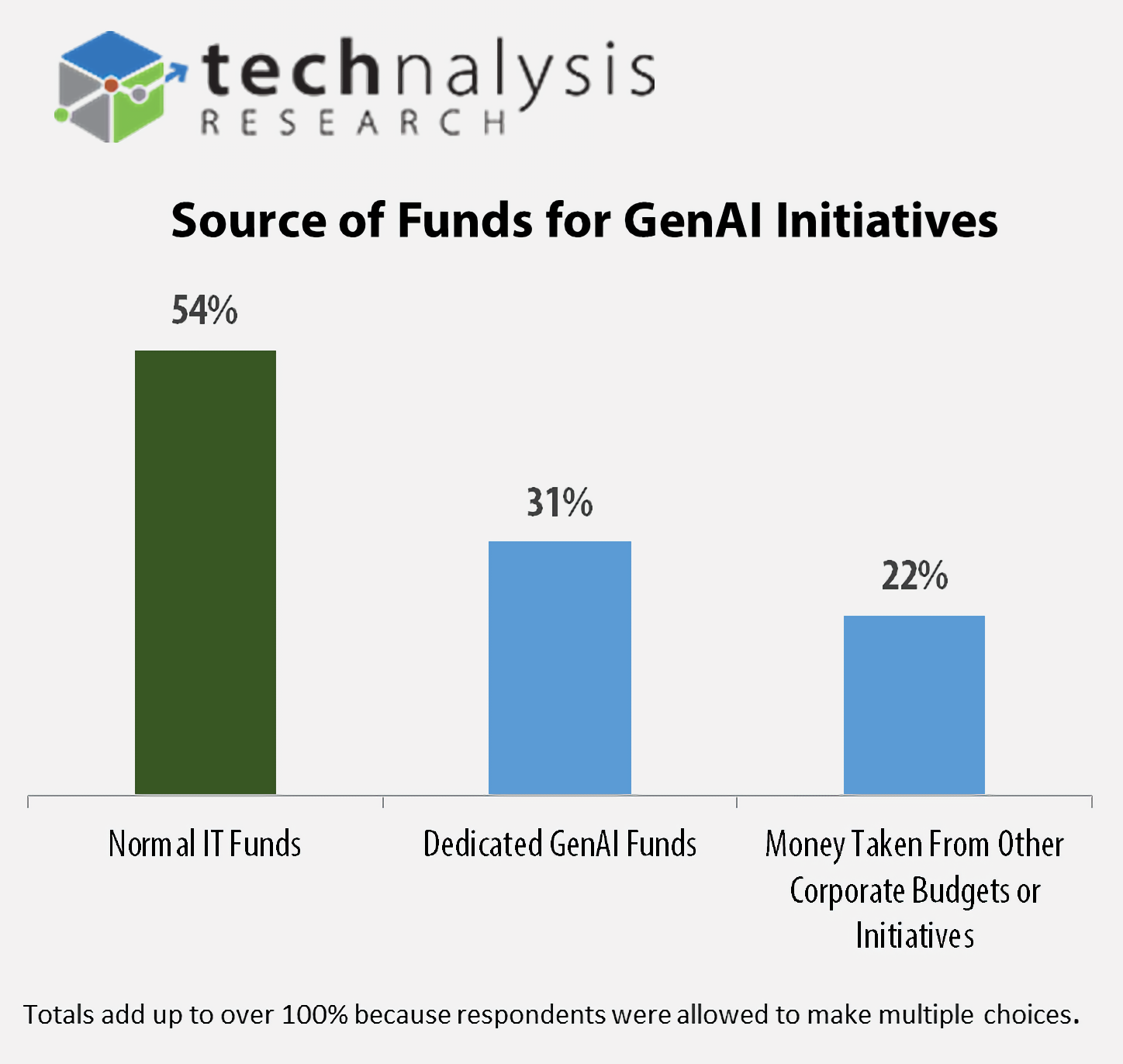
Fig. 1
The results shown in Figure 1 above. It's an amazing statistic that highlights how companies continue to be enthusiastic about their GenAI-related efforts (as well as how disconnected many short-term thinking pundits are from what's really happening!).
In addition to their continued enthusiasm, companies are evolving their thinking about how and where GenAI deployments are taking place. Due to the need to use vast amounts of critical, often sensitive, data to train and fine-tune the models driving their GenAI applications, many organizations are interested in conducting more of this work within their own data centers or colocation facilities.
While cloud-based GenAI efforts continue to dominate and will likely remain the majority for some time, a remarkable 80% of respondents expressed some degree of interest in local deployments. This shift from established industry practices represents a significant opportunity for GenAI industry participants to develop new products, services, and solutions to meet these needs.
As Figure 2 highlights below, there are still several challenges that need to be addressed before these local efforts become a reality – not the least of which is a dramatic need for more education and training – but the potential pivot opens up some very interesting new paths for industry evolution.
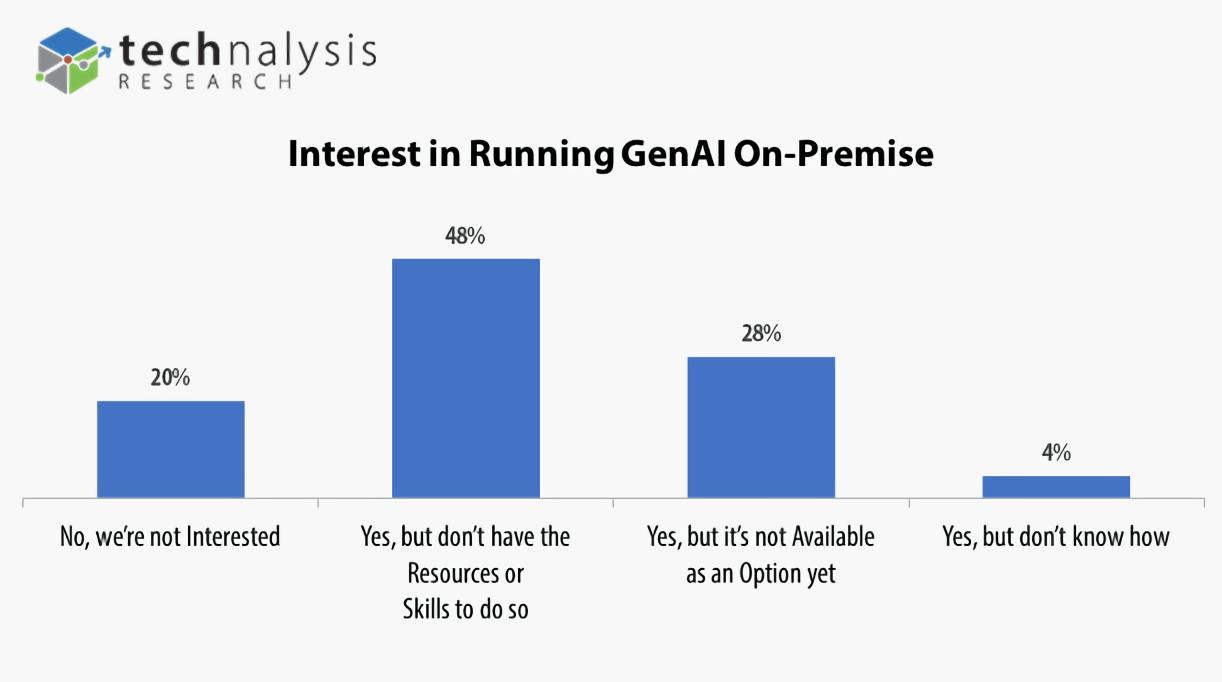
Fig. 2
In addition to new funding sources and deployment strategies, the study uncovered overlooked challenges that aren't being widely addressed. Many early GenAI efforts failed due to issues with data quality and the processes used for model training and tuning – topics directly related to provenance (determining the source and characteristics of the model and data) and governance (procedures to ensure output quality and mitigate potential risks).
Among medium-sized businesses, a staggering 84% reported having no provenance policies, and 64% lacked governance policies. Large enterprises fared better, but even there, about a quarter had no provenance policies, and a fifth had no governance procedures. (See "Two Words That Are Critical to GenAI's Future" for more on provenance and governance.)
The number one benefit that organizations hope to get from their GenAI initiatives is increased efficiency and productivity followed by improved quality and accuracy of output.
While some of the study's findings were surprising, others confirmed what many in the industry have been thinking. The number one benefit that organizations hope to get from their GenAI initiatives, for example, is increased efficiency and productivity followed by improved quality and accuracy of output.
When asked to the rank the importance of the potential outcomes of their GenAI efforts, however, the results showed more pragmatic, measurable results. Most importantly, companies said they wanted to create new products or services with the help of GenAI, and reducing costs was their second most important outcome. Not only does this reflect the fact that benefits and importance don't always align when it comes to these initiatives, but it also indicates that organizations recognize what GenAI can offer now, yet still have more aspirational goals for the future.
In terms of the GenAI-powered applications that organizations are using, as Figure 3 illustrates, the first and third top choices are text-related with Text-Based Document Creation number one and Text-based Summarization number three.
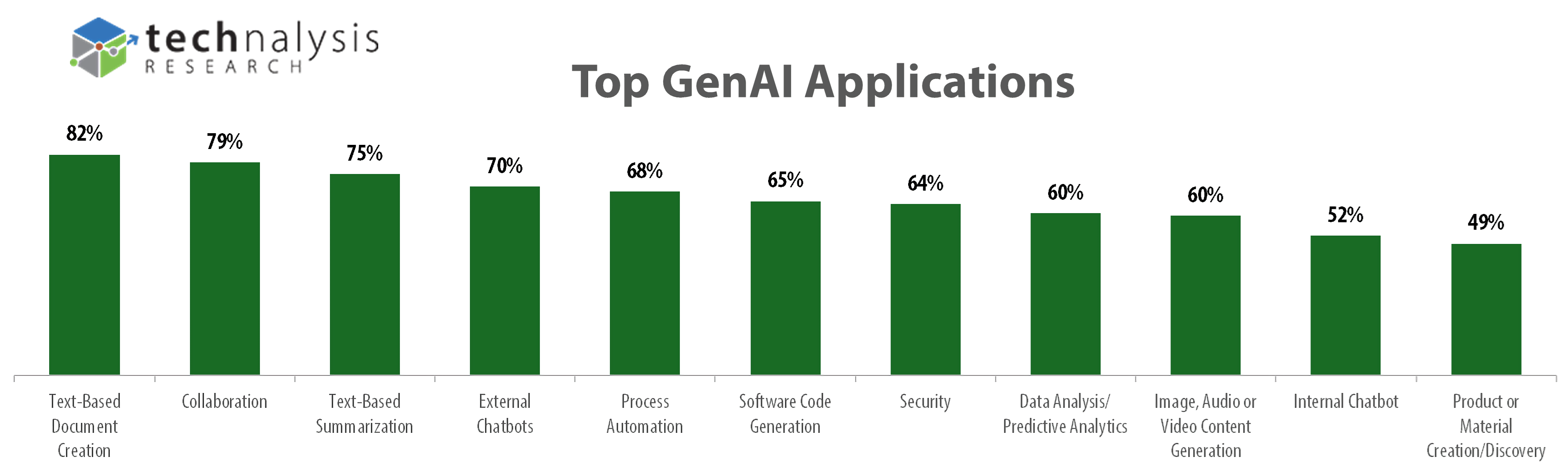
Fig. 3
Collaboration-based applications came in second, reflecting the popularity of GenAI features such as meeting summarizations, automatic note-taking, language translation, and other capabilities integrated into messaging platforms. Despite their heavy usage, satisfaction with collaboration tools was found to be lower than with other product categories.
The study also dives into more detailed aspects of the companies' GenAI efforts, including which foundation models and platforms they're using, why they chose them, techniques for data preparation and model fine-tuning, the deployment of GenAI applications at the edge, on PCs, and on smartphones, as well as the types of partners companies are working with and the specific services they need.
Finally, returning to the original theme, GenAI-powered summarization and sentiment analysis of the survey respondents' comments highlight that we're still in the early stages of the GenAI revolution. While companies expressed legitimate concerns about GenAI and its impact, they also made it clear that they understand the long-term potential of the technology and are eager to integrate it into their organizations.
---
If you'd like to download a free copy of the summary results from "The Intelligent Path Forward: GenAI in the Enterprise", you can find it here. The full study with detailed breakdowns for all topics by company size and industry is also available for purchase.
Bob O'Donnell is the president and chief analyst of TECHnalysis Research, LLC, a market research firm that provides strategic consulting and market research services to the technology industry and professional financial community. You can follow Bob on Twitter @bobodtech
Masthead image: Gerard Siderius
Businesses are still betting on generative AI despite media skepticism


