
The big picture: Writing an operating system kernel from scratch usually takes a team of seasoned engineers years of work. Gregory Kurtzer, who co-founded CentOS and later launched Rocky Linux, says he just built one in 11 days – mostly by having an AI agent write the code. Even without any Linux code underneath, his new kernel can already boot Rocky Linux 10. That said, it's still very much a research prototype.

Kurtzer unveiled the kernel, Ginux, on X last week. The code is on GitHub, too, under the Apache 2.0 license. As for the name, it blends Linux, GPT, and Greg. The README jokes that to keep its author's ego in check, the G officially stands for GPT.
Despite the name, Ginux isn't a fork of Linux. Everything from memory management and scheduling to filesystems and networking was written from scratch, mostly in Rust. What it does share with Linux is the ABI, so unmodified Linux programs can run on it as-is.
Its README describes Linux as a "personality" the kernel presents to software. That's the only one built so far, though BSD is floated as a possibility down the line.
Even that one personality still has plenty of gaps, though. Of the 375 system calls in Linux 6.12's x86-64 interface, Ginux fully implements just 82. Another 245 only partly work. The remaining 48 are blocked on purpose.
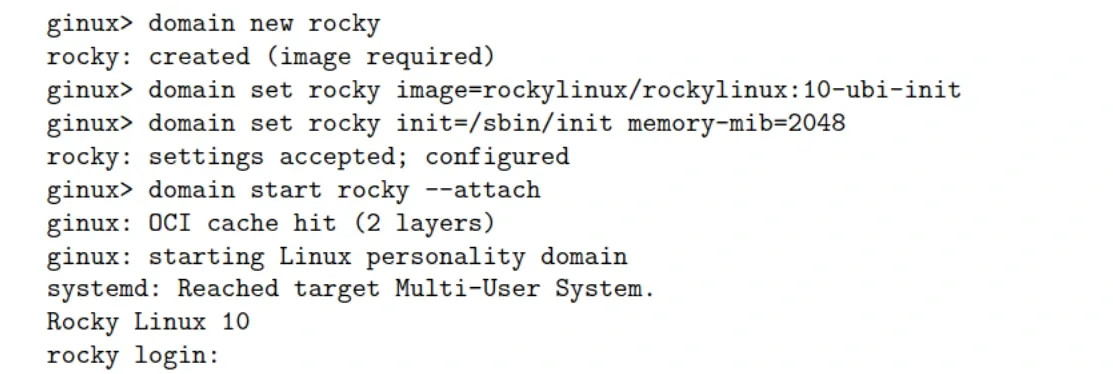
Software on Ginux runs inside isolated "domains," each with its own processes, memory, and filesystem. The project pitches these as a stronger boundary than containers, though Ginux still pulls standard OCI container images to assemble each domain's files. That's how it gets Rocky Linux 10 all the way to systemd's multi-user target.
In a technical report, Kurtzer calls his approach Human-Directed Agentic Engineering. He set the architecture, milestones, and pass criteria himself. The agent handled the rest, from writing the code to booting the kernel, testing it, and fixing whatever broke.
All of that ran as a single long-running OpenAI Codex task using GPT-5.6 Sol. Over the 11 days, it produced about 139,000 lines of code and tests across more than 1,000 commits. Real-world distros like Rocky Linux also exposed bugs that the project's synthetic tests missed.
Even so, Ginux is strictly a research project for now. Nobody has independently audited its security. It also lives entirely inside a QEMU virtual machine, since there's no support for physical hardware, GPUs, or NVMe drives. Kurtzer himself says AI can now write complex systems software, but things like compatibility, security, and long-term maintenance "remain the real moat."
Meanwhile, Linux's own developers have been warming up to AI. Last month, Linus Torvalds had Claude Code write a set of experimental page cache patches. Reviewers soon spotted a race condition in them, so the work is still under review. Around the same time, kernel maintainers agreed to stop requiring contributors to disclose AI-assisted code.


