Companies are losing money to AI "workslop" that slows everything down

Cal Jeffrey

Posts: 4,595   +1,682
Staff member
Cutting corners: Large language models excel at producing grammatically correct sentences but often stumble on accuracy and clarity. Without human review, their outputs create more confusion than progress. This workslop shifts effort downstream, bogging down the very workplace processes AI is supposed to make faster and more efficient.

Modern workplaces are increasingly adopting artificial intelligence, promising speed, efficiency, and innovation. However, the reality is often messier in practice. Many companies feel pressured to adopt AI quickly, worried that failing to do so will leave them behind competitors. Yet work produced by AI can create more correction and confusion than it saves, a phenomenon Harvard Business Review (HBR) has termed "workslop."

Research from HBR's BetterUp Labs and Stanford Social Media Lab shows that AI-generated documents that appear polished can lack the substance needed to advance a task. According to Stanford's ongoing survey of US-based full-time employees, 40 percent reported receiving such outputs in the past month. Workers spend nearly two hours per incident correcting or interpreting them, creating significant hidden costs for companies. Multiplied across large organizations, those hours translate into thousands of lost workdays each year and millions of dollars in wasted effort.

Harvard Business Review cited one retail director who was less than impressed with his company's implementation of AI automation.
"I had to waste more time following up on the information and checking it with my own research," the director said. "I then had to waste even more time setting up meetings with other supervisors to address the issue. Then I continued to waste my own time having to redo the work myself."

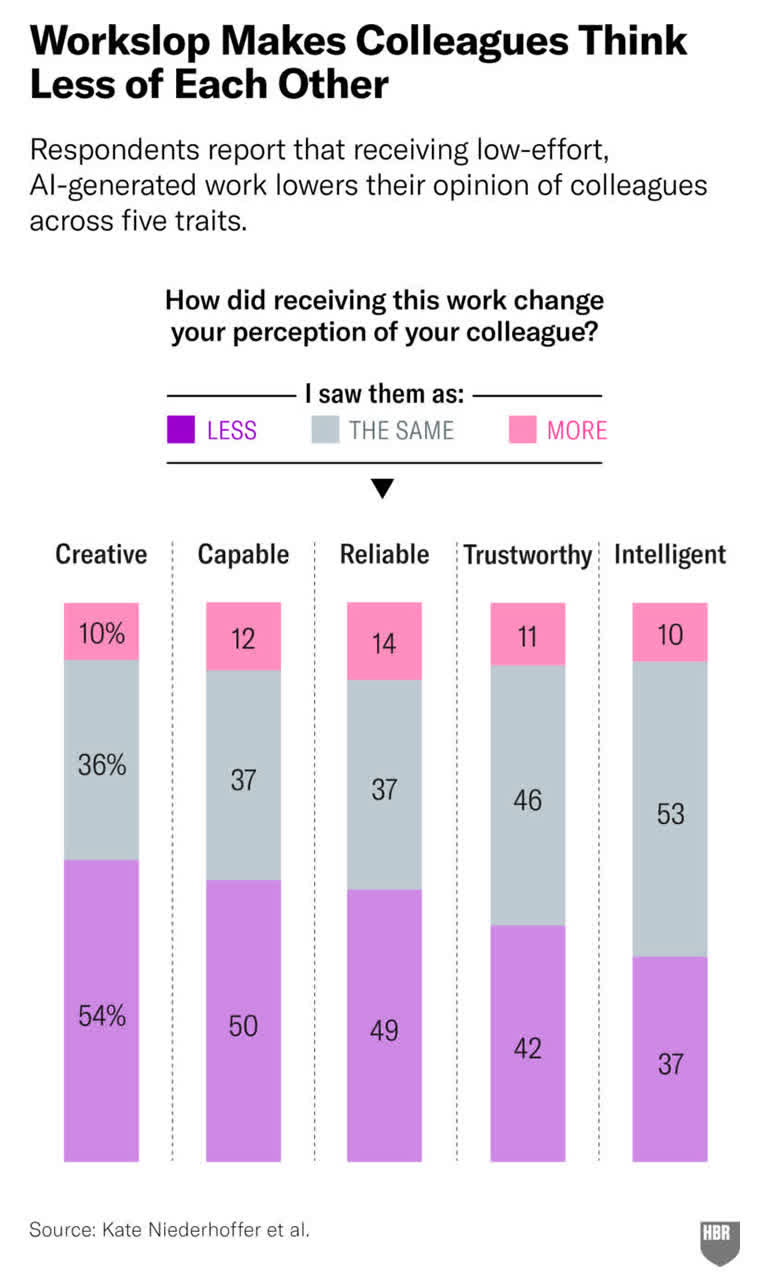
That manager's frustration isn't an isolated case. The social and emotional toll is real. Over half of respondents said receiving low-quality AI outputs made them feel annoyed (53 percent), while nearly a quarter reported feeling offended (22 percent). Colleagues who sent such work were often seen as less capable or reliable, showing how AI missteps can ripple through team dynamics.

Even with AI adoption soaring – Gallup reports that US employees using AI at least a few times a year have nearly doubled in recent years – many pilot programs fail to generate measurable returns. An MIT Media Lab study found that fewer than one in ten AI projects delivered real revenue gains, warning that "95 percent of organizations are getting zero return" on their AI bets.

The challenge isn't just the technology itself, but how organizations deploy it. Blanket mandates to use AI everywhere often encourage mindless copy-paste behavior rather than thoughtful application. Researchers recommend clear guardrails, deliberate workflows, and leaders who set the example for using AI effectively. That can mean setting limits on where AI is appropriate, such as early drafts or routine summaries, while requiring human oversight for final outputs. When management models selective, purposeful use, employees are more likely to see AI as a tool rather than a shortcut.

Image credit: Harvard Business Review

Permalink to story:

 
First, they lost their conscience, by throwing good workers under the bus and replacing them with AI.

Now they are losing money, following the AI fad, created mainly to enrich the companies behind it.

Next, they will lose their faith in AI, getting questionable return on their investment, hate from community, pressure from the government and anti-AI movements.

In the end, they will lose their business, as a result of having no more right tools to get the job done and no more people willing to trust them again.

I could say that they will lose their minds next, but it likely happened way back. One has to be a psychotic egomaniac to get here in the first place.

And they deserve what's coming, by choosing to do something extremely anti-social and anti-community. The community can only thrive while supporting each other, never by killing each other, we are not at war, and we are not cannibals (yet).
 
Last edited:
I think one of the things that becomes to be obvious now is that useless info can be generated many times more "efficiently." The bots that are responsible for half the global internet traffic could double or triple and companies like Google would have to divert a lot more attention to fighting all sorts of scams using AI.
 
ML has its uses, it always has, but that's not what's being forced on people.
The problem is the excessive money spend and electricity consumption. It's totally out of proportion to the usefulness. And it's killing jobs just because of the unrealistic assumptions of those director's spendings. Sam Altman has a lot of blame here.
 
It reminds me of the invention of the spreadsheet and an interesting column by John Dvorak. Like AI, the spreadsheet was revolutionary and was a great boon to companies. John pointed out how it didn't take long for accountants to start thinking "what if?" John's point was this great tool was quickly used to make business decision to the exclusion of all other factors. I think almost all businesses have become victims of the "maximizing shareholder value," again to the exclusion of all other considerations. As a result, AI has become the shareholders friend and the enemy of the worker. I think the worst part of this endless money chase is that sooner or later, most of these companies take it one step too far. (General Electric, anyone?)

Now that we're discovering AI is not the second coming, what are they going to do? Some are hiring workers back, but will they learn or just kick them out again at the next breakthrough?

What ever happened to consistently turning a solid profit year after year? Taking care of your employees?
I hope someday to see some of these ideas return. LOL, maybe I'm just getting too old.
 
It's not AI. It's a crappy search engine. It returns data that you inquire about....a search engine.

Aside from the obviousness that "AI" isn't actually AI, the thing that bugs me the most about this article is the graph because the purple color for "Less" doesn't match the purple color used in the chart for the percentages. Not that this is Techspot's fault, but it still bugs me nonetheless.
 
Last edited:
It's not AI. It's a crappy search engine. It returns data that you inquire about....a search engine.

Aside from the obviousness that "AI" isn't actually AI, the thing that bugs me the most about this article is the graph because the purple color for "Less" doesn't match the purple color used in the chart for the percentages. Not that this is Techspot's fault, but it still bugs me nonetheless.
The use of two purples was purposeful, as a Turing test. Congratulations, you passed, human!
 
It's not AI. It's a crappy search engine. It returns data that you inquire about....a search engine.

Aside from the obviousness that "AI" isn't actually AI, the thing that bugs me the most about this article is the graph because the purple color for "Less" doesn't match the purple color used in the chart for the percentages. Not that this is Techspot's fault, but it still bugs me nonetheless.
IKR!!!
 
"Technology is dominated by two types of people, those who understand what they do not manage and those who manage what they do not understand."
 
The problem is not AI itself but the pressure from leadership to slap AI on everything so they can say they are innovating. It is like forcing every employee to use a tool they barely understand and then acting surprised when productivity drops.
 
A consequence of trying to have a computer do your job. AI should only be used to help you do your job.

For what I do, it's pretty good at writing a short, one paragraph summary. It saves me typing time. That said, I always preface it "AI Summary:".
 
Back