What just happened? At a time when fabricated videos are increasingly difficult to identify, researchers at Cornell University have unveiled a new forensic technique that could give fact-checkers a critical advantage. The method embeds invisible digital watermarks into the light sources of a scene, enabling investigators to verify the authenticity of video footage after it has been recorded.
The concept, called noise-coded illumination, was presented August 10 at SIGGRAPH 2025 in Vancouver, British Columbia, by Peter Michael, a Cornell computer science graduate student who led the project. The approach was first envisioned by Abe Davis, an assistant professor.
"This is an important ongoing problem," Davis said. "It's not going to go away, and in fact, it's only going to get harder."
Earlier watermarking strategies have typically been embedded directly in video files, altering minuscule elements of pixels to create a hidden identifier. While effective under controlled conditions, those systems require cooperation from the device or platform creating the footage. If a bad actor chooses not to use a compatible camera or capture software, the digital watermark will never appear – making enforcement impractical.
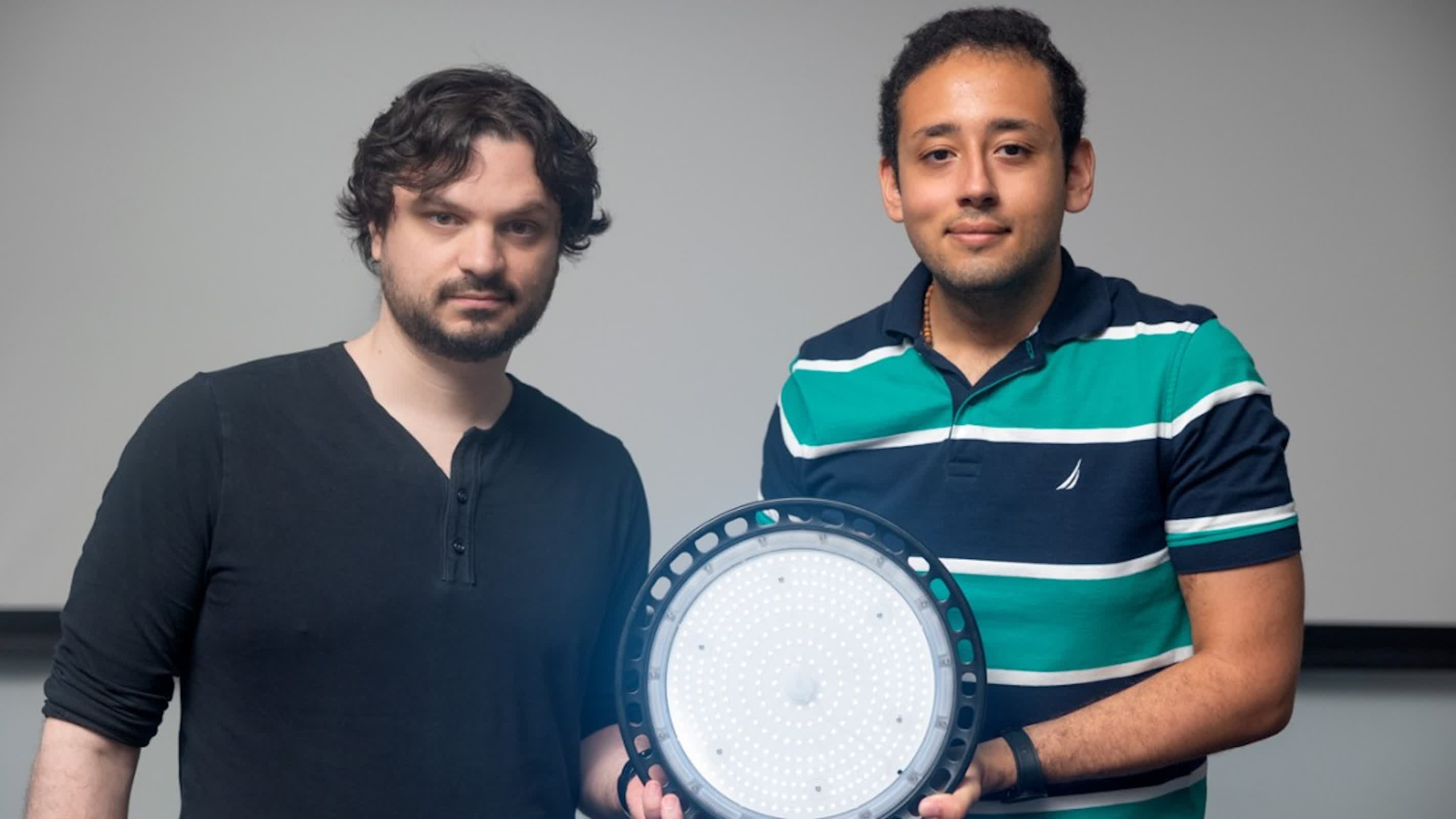
Abe Davis, left, and graduate student Peter Michael with a watermark light.
The Cornell team's method operates differently by embedding the watermark into the physical light that illuminates the subject during recording. This means that any camera in the environment, from professional broadcast equipment to a smartphone, will inadvertently capture the watermark as it records the scene.
Programmable light sources such as computer monitors, studio lighting, or certain LED fixtures can be embedded with coded brightness patterns using software alone. Standard non-programmable lamps can be adapted by fitting them with a compact chip – roughly the size of a postage stamp – that subtly fluctuates light intensity according to a secret code.
The embedded code consists of tiny variations in lighting frequency and brightness that are imperceptible to the naked eye. Michael explained that these fluctuations are designed based on human visual perception research.
Each light's unique code effectively produces a low-resolution, time-stamped record of the scene under slightly different lighting conditions. Davis refers to these as code videos.
"When someone manipulates a video, the manipulated parts start to contradict what we see in these code videos," Davis said. "And if someone tries to generate fake video with AI, the resulting code videos just look like random variations."
By comparing the coded patterns against the suspect footage, analysts can detect missing sequences, inserted objects, or altered scenes. For example, content removed from an interview would appear as visual gaps in the recovered code video, while fabricated elements would often show up as solid black areas.
The researchers have demonstrated the use of up to three independent lighting codes within the same scene. This layering increases the complexity of the watermark and raises the difficulty for potential forgers, who would have to replicate multiple synchronized code videos that all match the visible footage.
"Even if an adversary knows the technique is being used and somehow figures out the codes, their job is still a lot harder," Davis added. "Instead of faking the light for just one video, they have to fake each code video separately, and all those fakes have to agree with each other."
Field tests have shown the method is effective in certain outdoor environments and performs consistently across varying skin tones.
The team says that while noise-coded illumination represents a promising advance, it is not a definitive solution against synthetic media. As generative AI tools grow more sophisticated, researchers expect that tactics for producing realistic forgeries will continue to evolve.
"Video used to be treated as a source of truth, but that's no longer an assumption we can make," Davis said. "Now you can pretty much create video of whatever you want. That can be fun, but also problematic, because it's only getting harder to tell what's real."
Cornell researchers develop invisible light-based watermark to detect deepfakes


