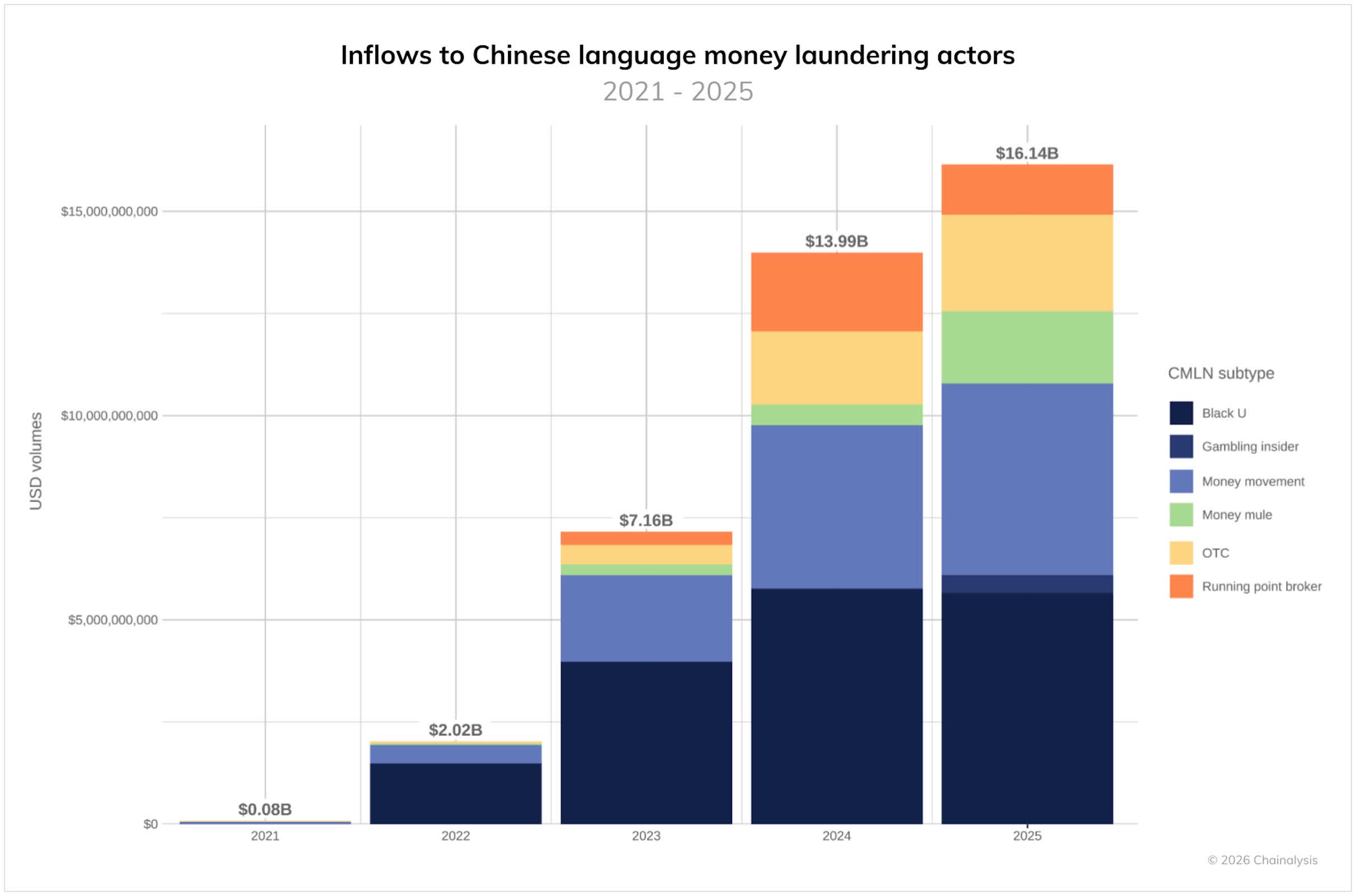
Bottom line: When researchers at Chainalysis mapped crypto transaction flows for 2025, they found that a regionally concentrated ecosystem had quietly engineered a global takeover of digital money laundering. Chinese-language money-laundering networks, which first emerged during the pandemic, now process nearly one-fifth of all identified illicit crypto flows worldwide – roughly $16.1 billion in 2025 alone, or about $44 million every day.

The data represents a staggering leap from 2020, when illicit crypto laundering totaled just $10 billion globally. By contrast, last year's total reached $82 billion, driven largely by the rise of specialized Chinese-language "guarantee platforms" and related laundering services operating across Telegram, payment processors, and over-the-counter markets.
Chainalysis identified 1,799 active crypto wallets linked to these Chinese-language laundering networks in 2025. While the company declined to disclose its full methodology, it told Reuters that its analysis combines blockchain forensics, machine learning models, and human intelligence to link wallet behaviors to real-world networks.
This approach allows investigators to trace the movement of tainted funds across Ethereum, Tron, and Bitcoin, following the digital fingerprints left by each transaction – even when wallets are cycled or renamed.

Unlike traditional crypto exchanges – many of which now comply with international sanctions and perform know-your-customer (KYC) checks – these laundering networks operate through decentralized and semi-private escrow systems.
Guarantee platforms such as Huione and Xinbi host marketplaces where brokers, mules, and money-movement services advertise their offerings, handling billions in volume without directly controlling the underlying criminal funds. Despite regulatory crackdowns and takedown efforts in 2025, vendors quickly migrated to new communication channels, rebuilding their networks within weeks.
Chainalysis identified six distinct service types, each optimized for different stages of laundering. "Black U" and gambling services fragment large sums into micro-transactions to obscure their origins, while over-the-counter services reassemble those fragments into larger sums for integration into the legitimate financial system.
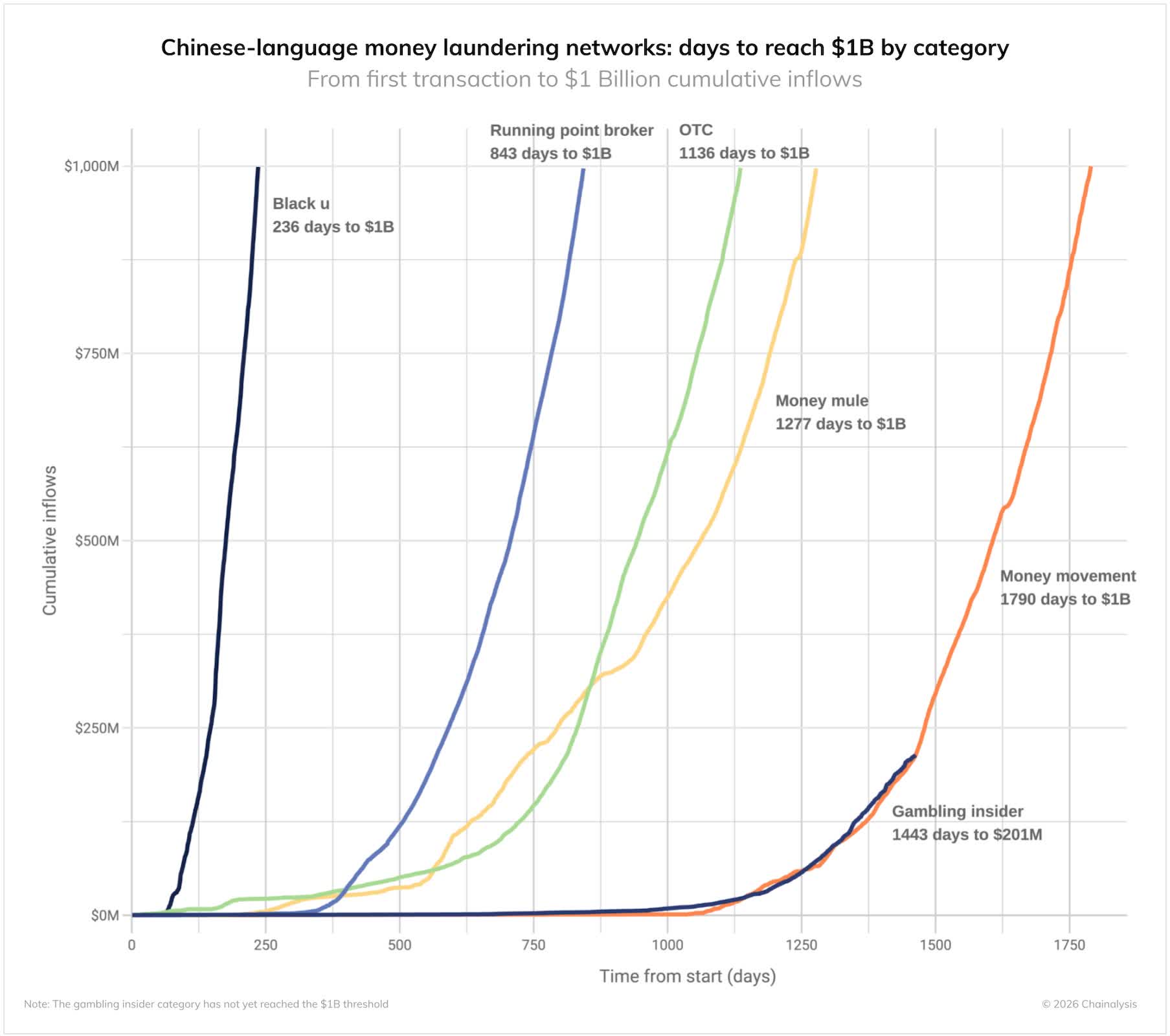
According to Chainalysis, a single Black U service processed $1 billion in just 236 days – a milestone that took some traditional laundering mechanisms several years to reach.
That velocity highlights both the size and liquidity of the capital behind these networks. Investigators believe they are intertwined with off-chain capital flight channels, including those used by wealthy Chinese nationals seeking to bypass domestic capital controls. Experts say this linkage provides the liquidity that sustains their rapid expansion.
Tom Keatinge, director of the Centre for Finance and Security at RUSI, described these networks as multi-billion-dollar, cross-border operations that have evolved to serve both organized crime overseas and individuals transferring wealth abroad. He added that their speed of development owes much to China's capital controls, which inadvertently created a vast liquidity pool that these actors now exploit.
Traditional underground banking systems, such as the Black Market Peso Exchange or Fei Qian, once dominated Chinese transnational laundering. Over the past five years, however, the shift to cryptocurrency has completely redrawn that landscape.
The digital model allows criminal groups to move value instantly across borders without relying on paper records or the human brokers typical of informal value-transfer systems. It also leverages privacy coins, stablecoins, and rapid-settlement blockchains to compress processes that once took weeks into mere minutes.
Regulators have scrambled to respond. In 2024, China prosecuted more than 3,000 individuals for crypto-linked laundering crimes. Meanwhile, the US Treasury's OFAC and the UK's OFSI sanctioned key facilitators, such as the Prince Group. The Financial Crimes Enforcement Network designated Huion Group a "primary money-laundering concern" and later issued an advisory specifically targeting Chinese-language networks.
Yet enforcement remains a game of whack-a-mole. Chainalysis found that takedowns of individual guarantee services only temporarily reduced activity. Once disrupted, operators quickly re-emerged under new brand names on Telegram and other platforms.
The persistence of these networks highlights a broader dilemma for global financial oversight. While blockchains record every transaction, they rarely reveal who controls each address. Without tighter coordination between on- and off-ramp regulators and forensic analysts, investigators may continue tracing pseudonymous trails without ever cutting off the operators behind them.
Crypto laundering surged to $82 billion last year and the numbers keep rising


