Dangerous new spyware can take full control of iPhone and Android devices

Alfonso Maruccia

Posts: 2,508   +934
Staff
In context: Smartphones and other mobile devices now sit at the center of everyday digital life, carrying an enormous amount of sensitive data in plain sight. As that reliance grows, so does the incentive for cybercriminals, who are responding with increasingly sophisticated malware and surveillance tools.
Security firm iVerify says it has uncovered a new spyware platform dubbed ZeroDayRAT, a tool designed to seize near-total control of a compromised smartphone. According to the company, the malware works on both Android and iOS devices – including the latest versions of each operating system – and offers a level of surveillance power typically reserved for far more resourced attackers, provided the buyer is willing to pay.

ZeroDayRAT's unnamed developer is reportedly marketing the spyware through Telegram, where it was first spotted on February 2, 2026. The offering appears to be pitched as a full commercial service, complete with customer support, regularly scheduled updates, and access to a remote web-based dashboard used to control infected devices.

The researchers describe ZeroDayRAT as a level of spyware complexity that once required nation-state backing to achieve.

The malware is primarily distributed through smishing campaigns: phishing attempts delivered via SMS. Victims receive a text message containing a link that leads to a download masquerading as a legitimate app. Once installed, the app quietly activates its spyware components. iVerify says the same payload can also be delivered through phishing emails, fake third-party app stores, and links shared via platforms like WhatsApp or Telegram.

Once a device is compromised, attackers gain access to a dashboard organized into multiple tabs, each unlocking deeper levels of surveillance. The Overview tab provides high-level details about the device, including its model, operating system, battery status, country, SIM and carrier information, app usage, and more.
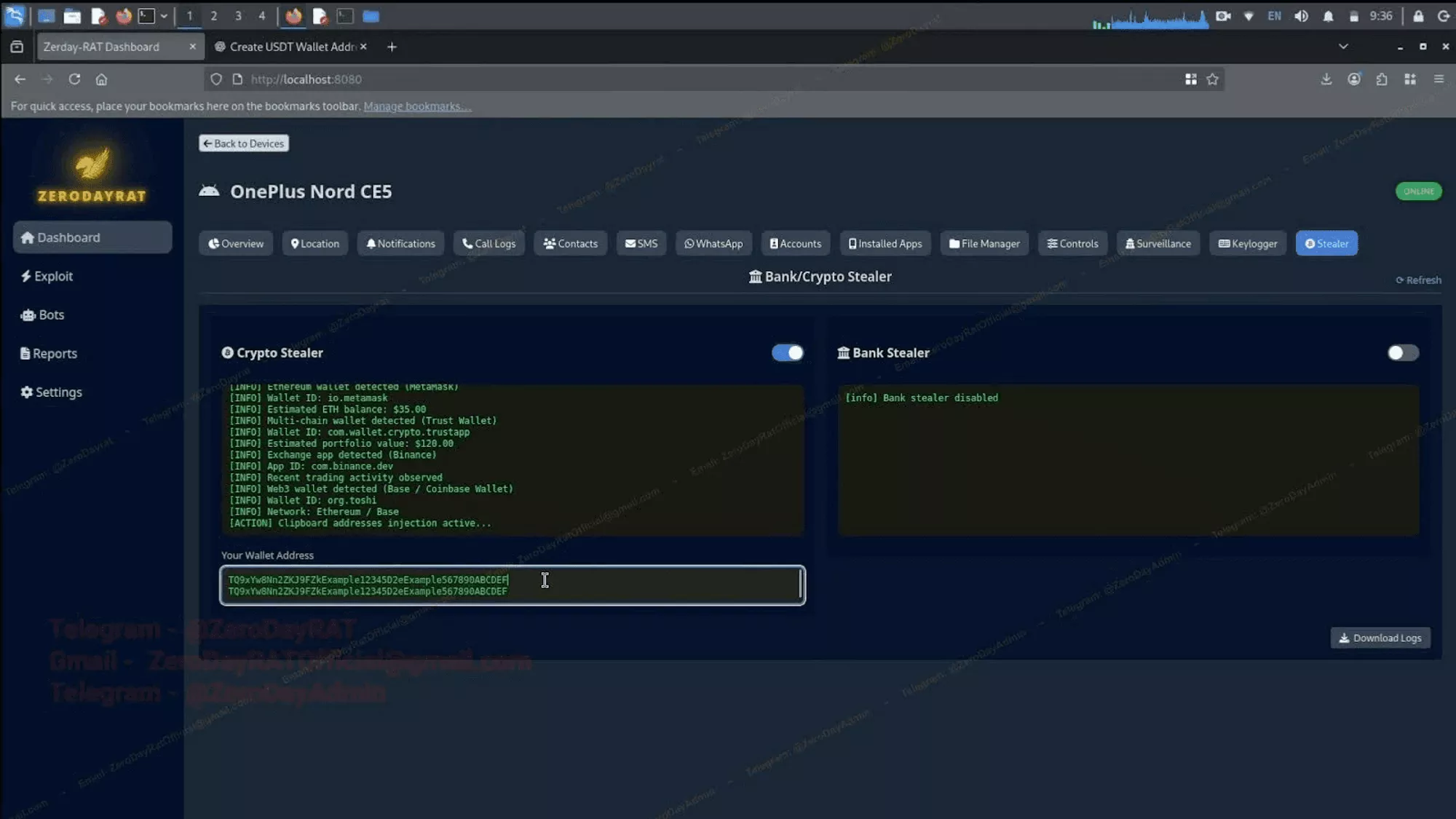
Other sections expose far more sensitive data. Attackers can view messages from banks, mobile carriers, and personal contacts. A Location tab uses GPS data to track a victim's movements worldwide. Because the malware can intercept system notifications, it can also surface WhatsApp messages, YouTube alerts, system events, and virtually any other notification that appears on the device.

An Account tab aggregates usernames and email addresses tied to services such as Google, Facebook, and Amazon. The spyware also tracks SMS messages, allowing it to capture one-time passwords, SMS-based two-factor authentication codes, and similar security messages.

At its most invasive, ZeroDayRAT includes live surveillance and keylogging features. iVerify says the malware can provide real-time access to a device's camera, microphone, and screen recording, while its keylogger intercepts every tap and input, complete with a live preview of the screen at any given moment. The toolkit is also designed to target payment services, banking systems, and cryptocurrency wallets in an attempt to steal digital assets.

The researchers describe ZeroDayRAT as a level of spyware complexity that once required nation-state backing to achieve. For individual users, an infection could mean total erosion of personal privacy. For organizations, a compromised work phone could serve as the entry point for a large-scale data exfiltration campaign. The firm warns that mobile security should be treated with the same seriousness as traditional endpoints (laptops, PCs) and email security, not as an afterthought.

Permalink to story:

 
Can it make them blow up?
Can it run Crysis?
Can it fix the my relationship with my family?
Can I haz babies wit it?
 
This, is what you get for paying hundreds of dollars and even over a thousand, to purchase these worthless Smartphones, (paying anywhere from $80 to $200 a month to use them) and trusting the likes of Apple, or just about any cell phone maker to protect your data from evil hackers! By, a flip phone, and save many hundreds of dollars and get on with living, get your face out of that Smartphone, and actually live like people, instead of being controlled by a phone! It's pathetic!
 
Last edited:
What really bothers me are the way permissions and security features are implemented within Operating Systems. For smartphones, there should be 'ADMIN' level controls that require direct user input through the touch display, and 'APP' level controls that the developer can request during install. For eg. if 'ADMIN' level controls are active or exist, the 'APP' level controls for that specific feature(s) have no effect.

Operating Systems also need to have very specific features that are inherent towards keeping it secure and safe. For eg. Within the app install panel every app installed on the device should be visible - that can NOT be hidden for any reason - with their permissions list, where if necessary you can deactivate 🤔 any of them.

Some security features that should've been implemented a long time ago. During screen recording, camera front/rear recording, a continuous caution alerting the user that something is occuring in progress should be present in the dashboard.
 
Last edited:
All these phones, android and iPhone, can monitor room conversations out of the box. Some are open source but no one checks the source. And with computers, I once had a program that checks which programs websites are running. Almost every website out of hundreds has a microphone program running monitoring your room conversation.
 
"It" does not exist. The information about this mega-powerful spyware comes from a website that sells the one and only available 'protection'. No one else has ever seen the alleged spyware. It's a scam.
I dunno.. I though the same thing. But like a smart internet user who is skeptical of most internet information, I always verify things I read and sure enough its not just one website talking about it.

Just do a google search... its on all the major of tech sites as well as common security sites . AI also has some information about it.

Guess its time to start looking at alternatives to smart phones - like maybe dumb phones LOL
 
I dunno.. I though the same thing. But like a smart internet user who is skeptical of most internet information, I always verify things I read and sure enough its not just one website talking about it.

Just do a google search... its on all the major of tech sites as well as common security sites . AI also has some information about it.

Guess its time to start looking at alternatives to smart phones - like maybe dumb phones LOL
Or, maybe don't tap on links in messages that come from unknowns or that look suspicious?

It was my understanding on iOS that all apps had to come from the App store, otherwise you are sideloading which does not exist on normal iPhones.

If this stuff even really exists, good luck getting into my banking apps, all of which require FACE ID.
 
There is one very safe way of using a smart phone, and that is do not install and use anything that requires your banking details or could damage your personal security. Old-fashioned maybe, but we have known about cloning and dangerous apps for years, yet most people run their phones without any security let alone 2fa and do not know how to go through them to switch things off as much as possible. Instead they install things that can call home without question for convenience. What's inconvenient is getting your bank account drained or having your ID stolen!
Its bad enough that Apple and Google already know too much about us without adding anything else! And Microsoft if we run Windows on a computer. I see people store their cards beside their phones so there is no reason to use a phone to pay for anything when a card can do the same job unless they are putting it on Zippay which is a whole 'nother story. Shops only ask us to use apps because we are dumb enough to do so without question. The more we sign up to, the more vulnerable we become and our phones are the biggest vulnerability we have. But try explaining that to a teenager who has not been hacked.
 
There is one very safe way of using a smart phone, and that is do not install and use anything that requires your banking details or could damage your personal security. Old-fashioned maybe, but we have known about cloning and dangerous apps for years, yet most people run their phones without any security let alone 2fa and do not know how to go through them to switch things off as much as possible. Instead they install things that can call home without question for convenience. What's inconvenient is getting your bank account drained or having your ID stolen!
Its bad enough that Apple and Google already know too much about us without adding anything else! And Microsoft if we run Windows on a computer. I see people store their cards beside their phones so there is no reason to use a phone to pay for anything when a card can do the same job unless they are putting it on Zippay which is a whole 'nother story. Shops only ask us to use apps because we are dumb enough to do so without question. The more we sign up to, the more vulnerable we become and our phones are the biggest vulnerability we have. But try explaining that to a teenager who has not been hacked.
"Old-fashioned" or just untrue? You think smart phones are the only way to get your bank account drained or ID stolen? Do you even watch or read any news? Every other day some massive breach of millions of SSN's or other personal information is stolen, put on the dark web. People that don't even use a smart phone can get their ID stolen or bank account drained a hundred different ways that don't even involve phones and we hear about it every day!

The truth is, a physical CC is the most unsecure method of payment. Between card skimmers on gas pumps and ATM's, to handing your card to the waitress at the restaurant who disappears with it in the back, possibly recording your card info for an online shopping trip the next day with your money, handing someone a piece of plastic with your account number on it is NOT SECURE! I've never seen a shop that asks us to use apps...it's an available method (which most people prefer), but terminals in the stores offer all possible options of payment so not sure where you even get that from. I'll pay with Apple Pay ANY DAY over handing someone my card!

Here's the real deal -- using your phone for banking and payment is one of the most secure ways of doing so. Using Apple Pay creates a virtual card number so your real card number is never made public. Banking apps have facial ID and 2FA. The truth is, if you haven't done your due diligence and set up banking alerts and 2FA to protect yourself, then it's your own fault!

I haven't heard of a single person who's bank account was violated because they used Apple Pay at the grocery store...have you? The fact is, the opposite of what you say is true and your phone is a very secure method of payment and banking. Almost all cases of stolen identity come from phishing attacks, fake calls from scammers, data breaches, and people who are tricked into handing over passwords and other sensitive information, not from someone's locked phone.
 
Last edited:
"a level of spyware complexity that once required nation-state backing to achieve"

Who can say that a tool of this ability is not a nation-state op? This seems just another means of making spyware available to the uncaring masses.
 
Or, maybe don't tap on links in messages that come from unknowns or that look suspicious?

It was my understanding on iOS that all apps had to come from the App store, otherwise you are sideloading which does not exist on normal iPhones.

If this stuff even really exists, good luck getting into my banking apps, all of which require FACE ID.


Perhaps you should research the secure aspects of FaceID. Specifically, has it already been bypassed? Yes. How easy is it to do? Quite. Is there an app for that? Several. Once your face scan / palm print/ fingerprint / iris scan has been uploaded, can it be grabbed by others for their use? Yes. Is this just my opinion? No.

Do your own detailed research.
 
Let’s be perfectly clear as a developer: this only could happen to the general iPhone public on European iPhones. Using alternative App Stores. (Or extreme briefly on the official App Store as a bad payload would be pulled quickly)

Only the most technical developers can sideload on a standard iPhone outside of the eu.

So— its targeting eu users (proving Apple’s warnings of alternative App stores correct), OR its its targeting extremely technical users unlikely to be roped into the necessary steps, OR
It’s Completely fake.
 
I had someone text me a couple months ago, they were like hi its been awhile, and I was look who's this, and they said something like jessica or amanda or w/e and I was like I dont know anyone by that name so that means ur blocked forever, then I blocked them, and never got another message like that since, you got to be careful in the modern age, dont humor potential scammers and dont click on links from people not in your contact list, comon people be vigilant!
 
Back