Decompilation on Steroids: Why AI Is Suddenly Cracking Open Old Software

It makes sense. Constrained by a serialised file, resource, or binary, it walks a narrow path, by iteration, till source and result match. Take the constraint away, and it is wandering through a desert, chasing mirages that may or may not be an oasis (the human method of creating something new).

Strangely, it makes me think of another question: Is our universe being constrained, similarly, towards a result (teleologically), and is everything between start and finish an intermediate result of that process?
 
AI can now do the same thing we could do in the 80s simply by copying a disk: create a completely illegal clone of a software which we had no legal right to sell or claim ownership of (not even in the "licenced" sense). But we can do that now by wasting tens or hundreds of thousands of dollars worth of tokens, and creating even more global warming.

Meanwhile AI still can't create anything actually new, and by taking the livelyhood of those people who actually can and did, it even actively contrains the amount of new work created more and more, until it will eventually come to a complete halt, and everything will be just an infinite regurgitation in infinite variatons of what has come before.

What a great time to live in.
 
Impressive, but from: https://momo5502.com/posts/2026-10-09-game-decompilation/
"I don’t know the exact number of tokens that were spent. My estimate is something between 600-700 billion tokens."

From Google AI:
"Assuming a standard blend of 80% input prompts and 20% output responses, here is the simple breakdown of your total bill:
For your core known usage (300B Luna + 3B Sol)

  • You spent a total of $141,600.
    This breaks down to $120,000 for your Luna tokens and $21,600 for your Sol tokens.

For the full 700 billion token ceiling:
  • If your actual usage hit the upper limit of your estimate (maintaining your 100:1 ratio), your maximum total cost is $327,600.
By routing 99% of your massive workload through the hyper-efficient Luna model rather than the premium Sol model, you saved hundreds of thousands of dollars."

So, is spending almost half a million dollars to port a video game really worth it? The fact that they were able to do this is amazing, but it comes at a pretty steep cost. Definitely not something for your average home hobby.
 
Last edited:
My apologies for a second post, but this article is really interesting to me. The key thing, as the author pointed out, was the use of the direct compiled output comparison.

Here is the interesting part. From the link above, the breakthrough did not come from adding more agents or selecting a more powerful model. It came from changing how correctness was established. Initially, the team used a separate AI reviewing agent. That AI reviewer missed significant problems and sometimes accepted the coding agent's explanation for why its implementation was correct.

The team subsequently introduced an automated verification tool that compared reconstructed functions with the original program's compiled output. That gave the coding agents a feedback mechanism:
- Generate an implementation.
- Compile it.
- Compare it with the reference.
- If verification fails, revise the implementation.
- If verification passes, accept it and move to the next task.
The system could repeat this process without a person inspecting every attempt.
 
It all goes back to the answer key. A matching decompilation is graded by the compiler, so a wrong guess costs nothing. Graphics, netcode, physics or a user interface have no such referee, so code that looks right but isn't can go unnoticed for years.

And even when AI code does match, it's often ugly and hard to follow. Byte-perfect code nobody can read doesn't help much if the goal is to understand, maintain or mod a game.

That's the bigger lesson for software developers, too. AI has made reading and translating old code dramatically cheaper. It hasn't made judgment, design or long-term maintenance any cheaper.

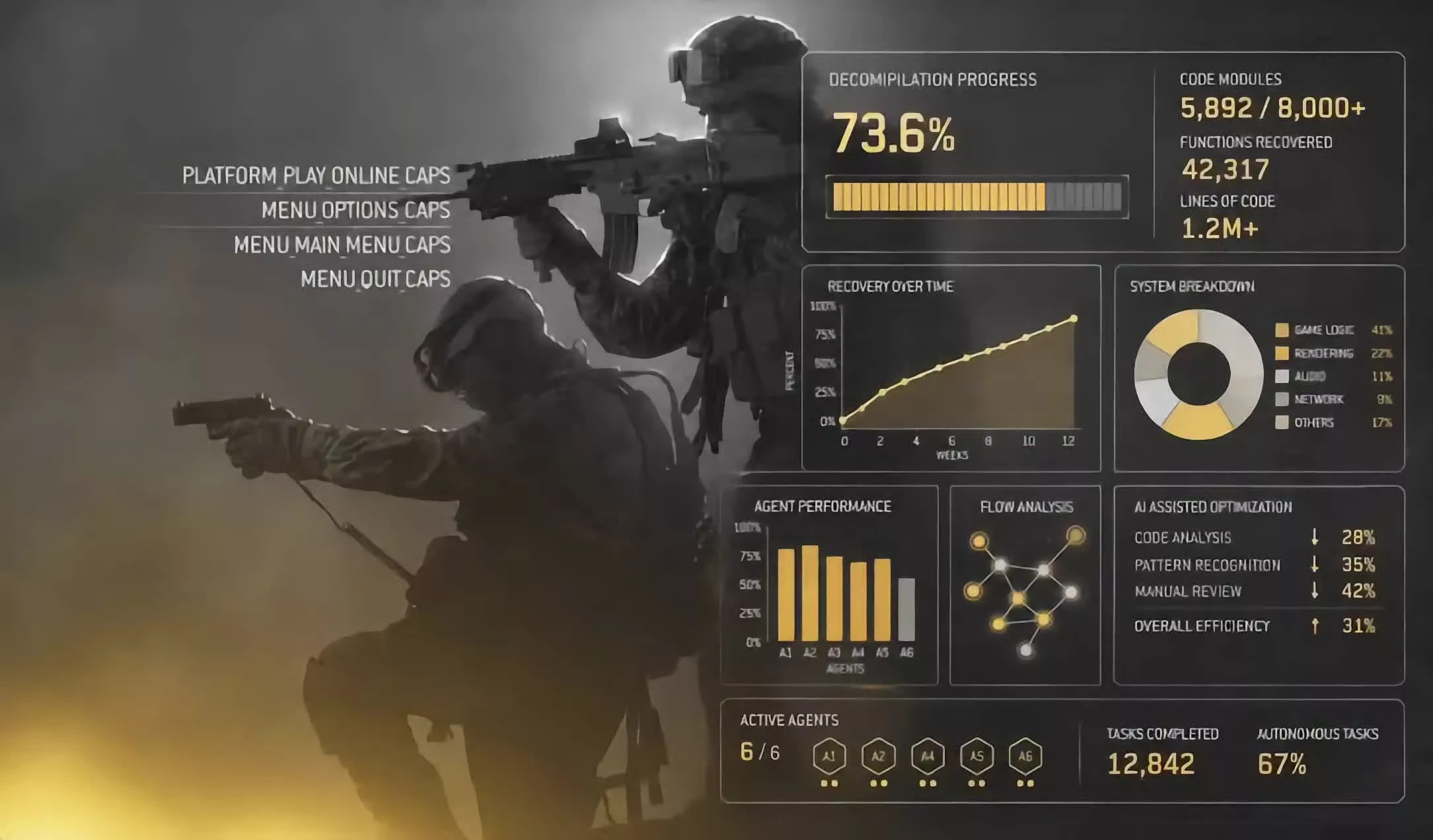
This section REALLY reads like something Claude would output. "a wrong guess costs nothing" in particular is the kind of wording it would use.
I can't know/prove that, but I can't unsee it either. I hope that I am mistaken, and that if site authors are using AI to help produce their articles, they would say so.
 
The research cutoff had to be made at some point, and I tried to make the article evergreen as much as possible, but honestly this topic will be a moving target for some time to come. Just this morning I came across new things happening that didn't make it into the article, but I still wanted to share them here:

REA = Reverse Engineer Anything
https://github.com/morluto/rea

I'll probably add this somewhere anyway. And then ideas like this one:

What about removing artificial subscriptions from hardware like Whoop or the Oura ring?
 
It's funny how the push for AI of the big tech it's also going to be their demise. The subscription model it's already dead, their revenues will fall sharply. Everything is being reversed engineered and will be available for free. I'm looking forward for a cloned, free, no bloatware Windows. But wait, what if AI advances in cryptography? Bitcoin will be dead instantly and with it the whole market. Well, I must say, even if AI it's going to end the world, there will be some fun times and benefits until then.
 
This has been my experience with AI.

It's great when it has my old code to build off and check against, but much more wandering without it.

It is still sometimes stupid in how inefficient it is at building and testing against old code and output but it eventually gets there - hopefully while you are able to do other things.
 
Impressive, but from: https://momo5502.com/posts/2026-10-09-game-decompilation/
"I don’t know the exact number of tokens that were spent. My estimate is something between 600-700 billion tokens."

From Google AI:
"Assuming a standard blend of 80% input prompts and 20% output responses, here is the simple breakdown of your total bill:
For your core known usage (300B Luna + 3B Sol)

  • You spent a total of $141,600.
    This breaks down to $120,000 for your Luna tokens and $21,600 for your Sol tokens.

For the full 700 billion token ceiling:
  • If your actual usage hit the upper limit of your estimate (maintaining your 100:1 ratio), your maximum total cost is $327,600.
By routing 99% of your massive workload through the hyper-efficient Luna model rather than the premium Sol model, you saved hundreds of thousands of dollars."

So, is spending almost half a million dollars to port a video game really worth it? The fact that they were able to do this is amazing, but it comes at a pretty steep cost. Definitely not something for your average home hobby.
That's using token factories. You can actually produce tokens significantly cheaper than buying them for a data center if you want to self host. You also don't need flagship models with parameters going to the nth degree to run functional ai.

It might be an interesting exercise looking into which companies have decided it's cheaper to self host AI rather than buy tokens
 
Back