In context: Researchers have long explored DNA's unique properties as a medium for digital storage. So far, the experiments have fallen short of practical applications. However, new DNA-based innovations continue to emerge from labs and universities worldwide, hinting at the potential to transform how we store and process data.
While practical DNA storage remains elusive, a team of Chinese researchers has developed a DNA cassette tape that could theoretically store every music track ever recorded. Xingyu Jiang, a professor of biomedical engineering at the Southern University of Science and Technology in Guangdong, China, collaborated with a colleague to combine the convenience of a classic cassette tape design with DNA strands in a long-term storage medium.
While classic cassette tapes are enjoying a revival, the DNA cassette points to the future of digital storage. The cassette-inspired design stores synthetic DNA molecules on a long plastic tape. Jiang explains that the team programmed the DNA bases – A, T, C, and G – to generate the sequences needed to encode digital files on the tape.
The DNA cassette features a massive number of addressable data partitions, with up to 1,570 processed per second. It can hold 28.6 mg of DNA per kilometer of tape, with multiple copies of the same data preserved to maintain information integrity for hundreds of years.
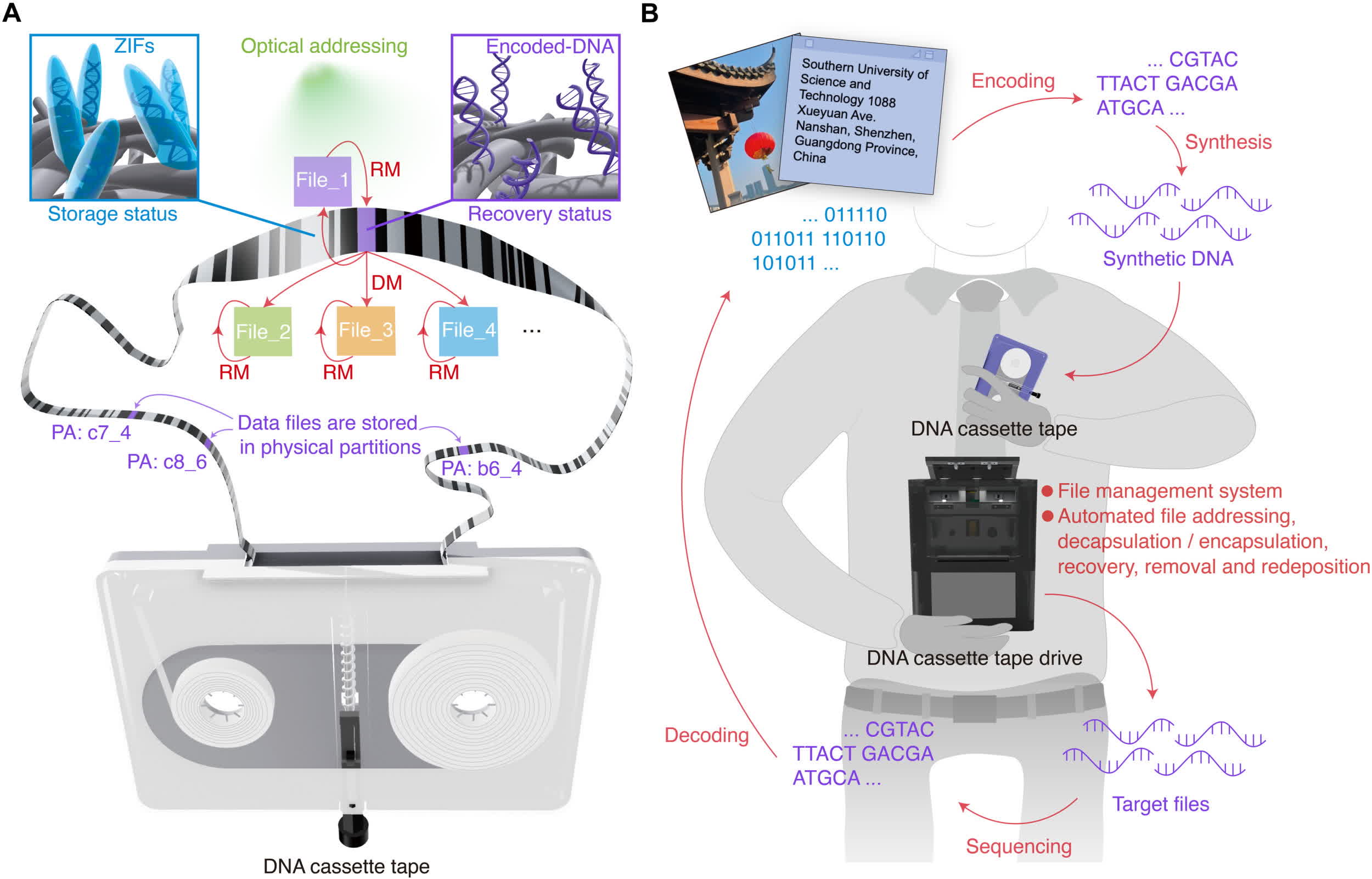
The researchers also created a DNA cassette "drive," which randomly stores incomplete images across the available data partitions. The drive could recover, remove, and perform other storage operations on the synthetic DNA strands within 50 minutes. Complete image restoration would require "next-generation" DNA sequencing and decoding techniques.
Old cassette tapes stored about 12 tracks per side on a polyester film coated with magnetic particles. The new DNA cassette uses a long plastic tape embedded with synthetic DNA molecules, with a zeolitic imidazolate "armor" to protect the fragile DNA bonds from degradation. Its total capacity of 36 petabytes is enough to hold over 3 billion tracks if each song takes up 10 megabytes.
The study notes that DNA offers extremely high storage density – around 455 exabytes per gram – and could serve as an alternative storage solution in an increasingly data-hungry world. Using a compact high-speed cassette tape design could help the industry adapt this promising technology to current computing systems.
"DNA cassette tape" can store every song ever recorded with petabytes to spare