Dolby Vision 2 is rolling out now, starting with select Hisense TVs

zohaibahd

Posts: 986   +19
Staff
In a nutshell: Dolby Laboratories and Hisense have announced that Dolby Vision 2 has begun rolling out to customers as a firmware update. The first sets to get the feature all come from Hisense's 2026 lineup, and include the UX, UR9, UR8, and U7 models. Each model must be running either Google TV or VIDAA, Hisense's own television operating system, for the update to be installed.
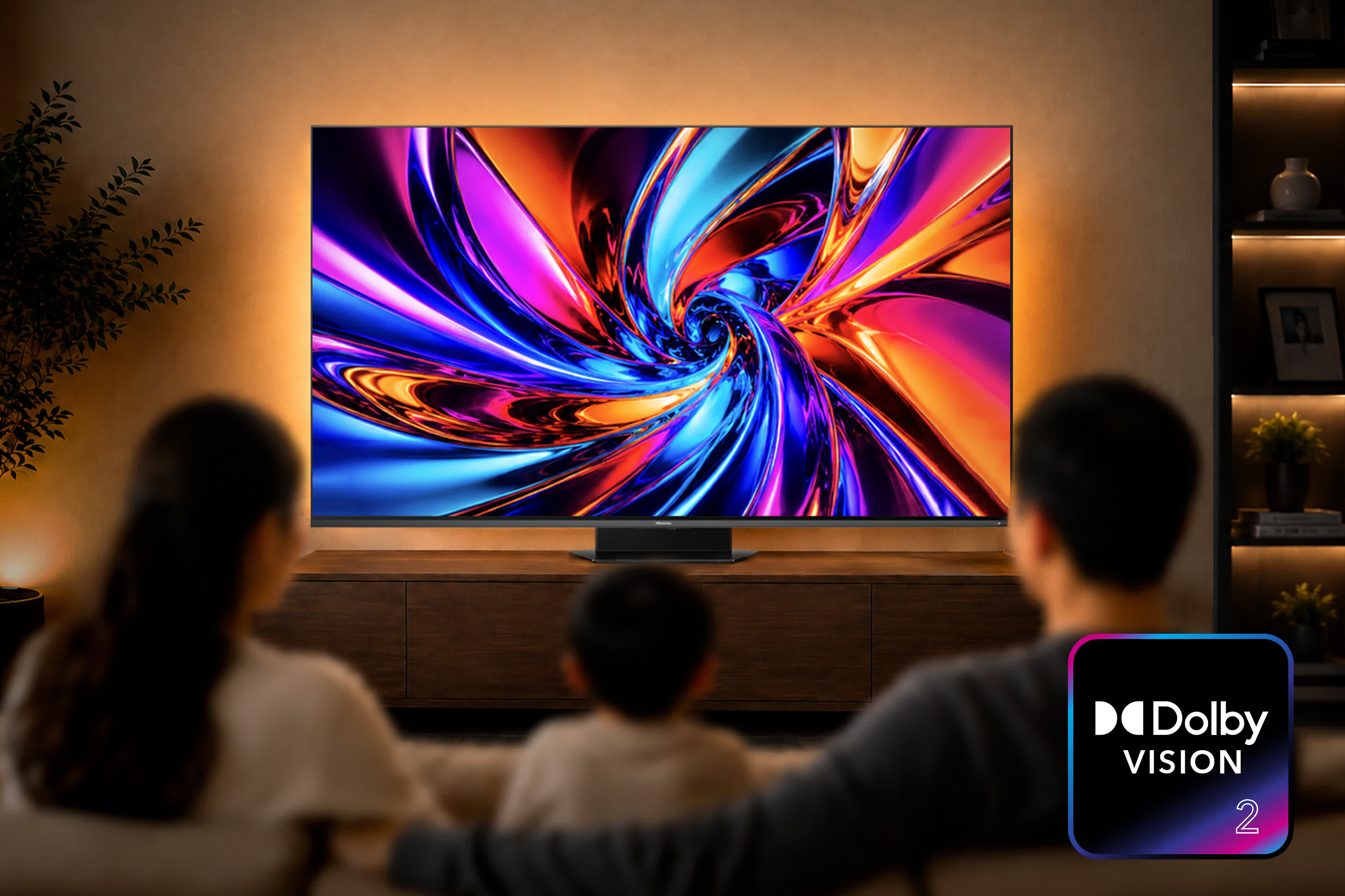
Dolby Vision 2 is the successor to Dolby Vision, the dynamic HDR format that has adjusted brightness and color on a scene-by-scene basis for more than a decade. Dolby unveiled the sequel last September, just ahead of the IFA show in Berlin, then spent the following 11 months gradually answering questions about what it actually does.

It turns out the technology does quite a bit, with features spread across two tiers: a standard version and a higher-end variant that Dolby calls Dolby Vision 2 Max. The standard version relies on a rebuilt image engine, which is why Dolby believes existing Dolby Vision movies and games will look better as soon as the firmware update is installed.
The engine performs that work blindly, improving whatever content you put on the screen without knowing anything about it in advance. Sitting alongside it is a second feature that does the opposite, reading the metadata attached to a title – both newly authored metadata and information already embedded in older releases.

Dolby calls it Content Intelligence, and it allows the TV to follow instructions left behind by whoever mastered the content for a given scene. This helps because a murky stretch of a thriller and a floodlit soccer match require very different handling. The feature works this out automatically instead of forcing viewers to switch between picture modes.

That slider and the image engine behind it are what everyone on the standard tier gets. The Max tier is where all four of those Hisense models really stand out, starting with Authentic Motion. This feature smooths out judder while attempting to avoid the soap opera effect that plagues most motion-processing systems. Light Sense 2 is included as well, using your TV's ambient light sensor to keep dark scenes visible in a sunlit room.

It's worth noting that none of this will reach older Dolby Vision TVs, as the format requires a specific piece of silicon – the MediaTek Pentonic 800 – to handle the processing. Those sets can still play Dolby Vision 2 content, of course, but they will ignore the additional metadata included with it.

For now, content authored specifically to take advantage of that metadata remains limited, with Canal+, Peacock, and iQIYI the only streaming services Dolby has named so far. Netflix and Disney+ are absent from that list for now.

Beyond those three, Dolby has some TCL sets and European Philips TVs lined up for later this year.

Permalink to story:

 
No one needed this except for Dolby and HiSense, that's why they're huddled together to present this garbage to the public with their hands out for cash. Netflix can't even fill .709 or .2020 with pixels worth watching. Good luck.
 
In Europe Phillips has a Dolby Vision 2 via Oled911 amd Oled951 with up to 4500 nits of brightness.Fyi1000072189.jpg
 
Last edited:
Cool tech, shame it's gated behind a specific MediaTek chip, so most of the "Dolby Vision 2 support" TVs on shelves this year will just quietly not do the interesting part.

Netflix and Disney+ sitting this one out feels less like a technical limitation and more like a "we'll wait and see who wins" move.

 
I feel like a lot of TV content still doesn't have great standard HDR color grading. I can't imagine the studios are going to spend a lot of extra money and attention on a specialized format supported by few TVs and streaming partners.

I often end up watching in SDR, which while clearly technically inferior, also is well understood at every stage of the production process and rarely gotten far wrong.

 
No one needed this except for Dolby and HiSense, that's why they're huddled together to present this garbage to the public with their hands out for cash. Netflix can't even fill .709 or .2020 with pixels worth watching. Good luck.

I mean I buy films that are available in HDR because streaming quality sucks
 
How many people here prefer HDR10 over Dolby Vision?
Most people don't have their TVs setup to care. So most don't even know the differnce. Now people who buy blurays, have oled/mini led TVs that can really utilize dolby Vision can tell the difference. It's a massive one. Dolbyvision 2 sounds like a massive cash grab though. Sounds like TVs already supporting the original will get the piece that matters. Better HDR. The other features are gimmicky. Most are already out of the box on TVs and everyone turns them off.
 
Must suck for those who purchased top of the line TVs with dolby to learn they are old tech now.
To me it was simple. I watched R-Tings video explaining it and the difference from Samsung's HDR.
I found it too insignificant to care. Besides, if I did go with a DV TV, it would now be the old tech.

 
I don’t think most people care to be honest. Though Samsung not supporting Dolby, their market share shrinking and evening else supporting it might make them reconsider
Blu ray vs HD all over again. If I were Samsung, I would not give up, but I would compromise.
I would offer both on their TVs hdr and dolby vision.

Samsung is big though, they can persist for a long time. But I think one thing that would make them give up would be if all content makers stop caring about hdr. Then they would definitely lose this battle.
 
Blu ray vs HD all over again. If I were Samsung, I would not give up, but I would compromise.
I would offer both on their TVs hdr and dolby vision.

Samsung is big though, they can persist for a long time. But I think one thing that would make them give up would be if all content makers stop caring about hdr. Then they would definitely lose this battle.

I'm not sure that's the right comparison. Blu-ray vs. HD DVD was a war of two competing proprietary standards. Each disc and player supported only one.

Whereas with HDR, you have a free open standard baseline (HDR10) that is supported by 100% of HDR production & playback devices, and then Dolby Vision as the proprietary extension on top requiring extra production, equipment, and licensing at every step of the chain.

My opinion is we're all better off without an outside party trying to make everything harder and more expensive for everyone. To the extent HDR isn't "good enough", my preferred solution is extend its capabilities in a way that everyone will use. But like I said above, it also still feels like we're yet pretty immature even in that baseline. I'm more worried about the industry fully using the capabilities we have today, vs. adding more on top that will be well used in a small fraction of viewing hours.
 
Blu ray vs HD all over again. If I were Samsung, I would not give up, but I would compromise.
I would offer both on their TVs hdr and dolby vision.

Samsung is big though, they can persist for a long time. But I think one thing that would make them give up would be if all content makers stop caring about hdr. Then they would definitely lose this battle.
Issue is the TV business operates on razor thin margins and as they keep losing market share it’s not something they can afford to persist with.

I actively avoided Samsung and went with Hisense because they don’t support Dolby vision
 
I'm not sure that's the right comparison. Blu-ray vs. HD DVD was a war of two competing proprietary standards. Each disc and player supported only one.

Whereas with HDR, you have a free open standard baseline (HDR10) that is supported by 100% of HDR production & playback devices, and then Dolby Vision as the proprietary extension on top requiring extra production, equipment, and licensing at every step of the chain.

My opinion is we're all better off without an outside party trying to make everything harder and more expensive for everyone. To the extent HDR isn't "good enough", my preferred solution is extend its capabilities in a way that everyone will use. But like I said above, it also still feels like we're yet pretty immature even in that baseline. I'm more worried about the industry fully using the capabilities we have today, vs. adding more on top that will be well used in a small fraction of viewing hours.

HDR10 is open. HDR10+ is not, IIRC. HDR10 is the "fallback" that both DV and HDR10+ use, while HDR10+ is Samsung's answer to DV because they didn't want to pay the DV tax.

I do wish Samsung had succeeded in getting more vendors on board with running HDR10+on any panel that also supported DV. That alone would have made things more simple. But that's not what happened.
 
Back