Forward-looking: Researchers have developed a prototype device that converts infrared light into full-color images, offering a different approach to night vision that goes beyond the usual monochrome displays. The system, built by a team at the Beijing Institute of Technology, uses mercury telluride quantum dots paired with a dual-layer OLED. Instead of translating infrared into a single color based on brightness, the device maps different wavelengths and intensities into distinct visible colors.
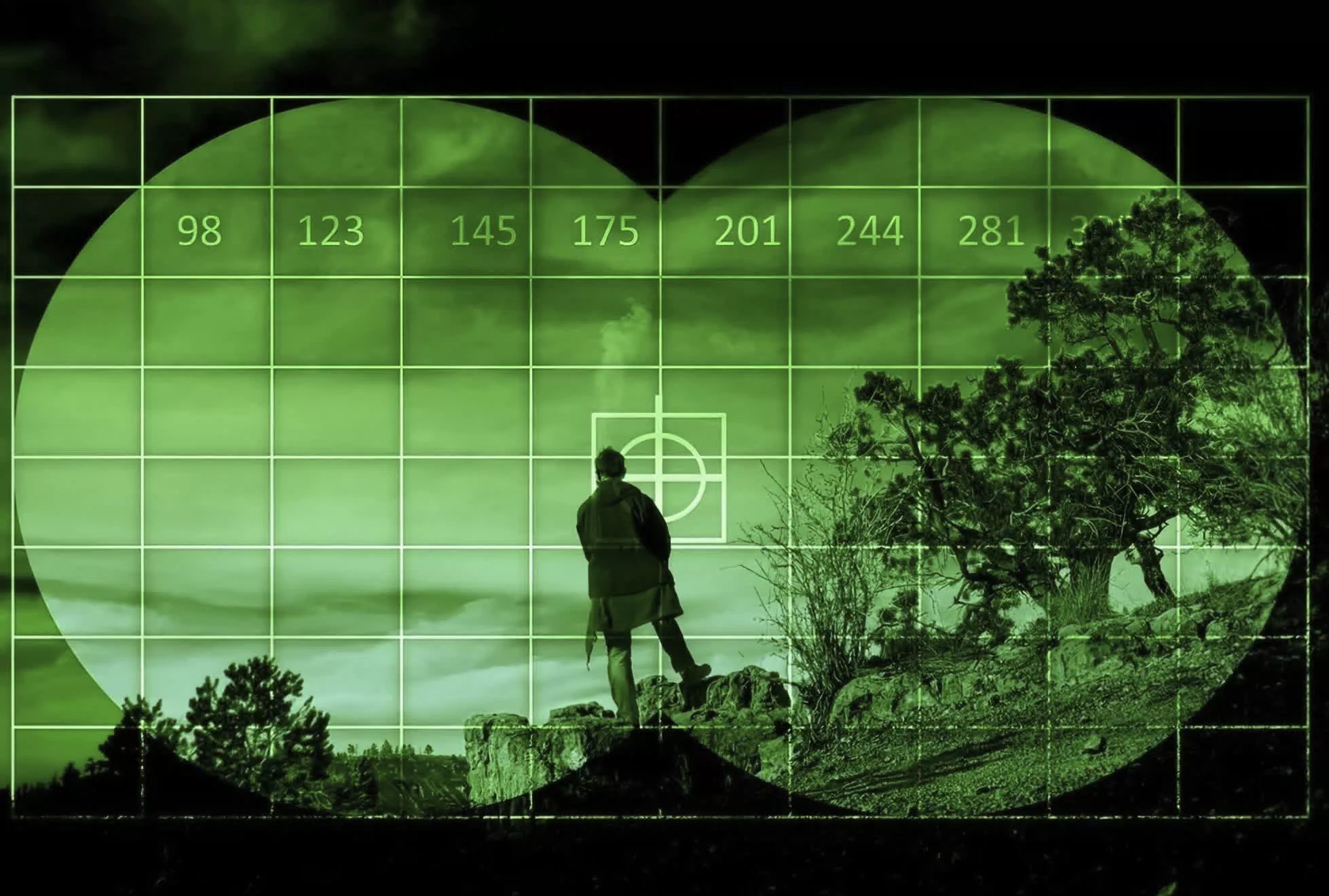
That distinction is key. Traditional infrared imaging systems rely on detectors that capture a broad range of wavelengths but don't preserve much detail about them, so the output is typically rendered as brightness differences in a single color, often green. Effective as that is, it doesn't take advantage of how well the human eye can distinguish subtle color changes.
The new design tackles that limitation at the material level. The quantum dots used in the device are only a few nanometers in size, which gives them discrete energy states.
As a result, they respond differently depending on the wavelength and intensity of incoming infrared light. Lower-energy, longer wavelengths generate fewer charge carriers, while shorter wavelengths and stronger signals can trigger more complex electronic transitions and produce more carriers.
Those signals are then passed into a two-layer OLED structure. One layer emits red light, while the other emits cyan. An energy barrier between them controls how charge flows through the device.
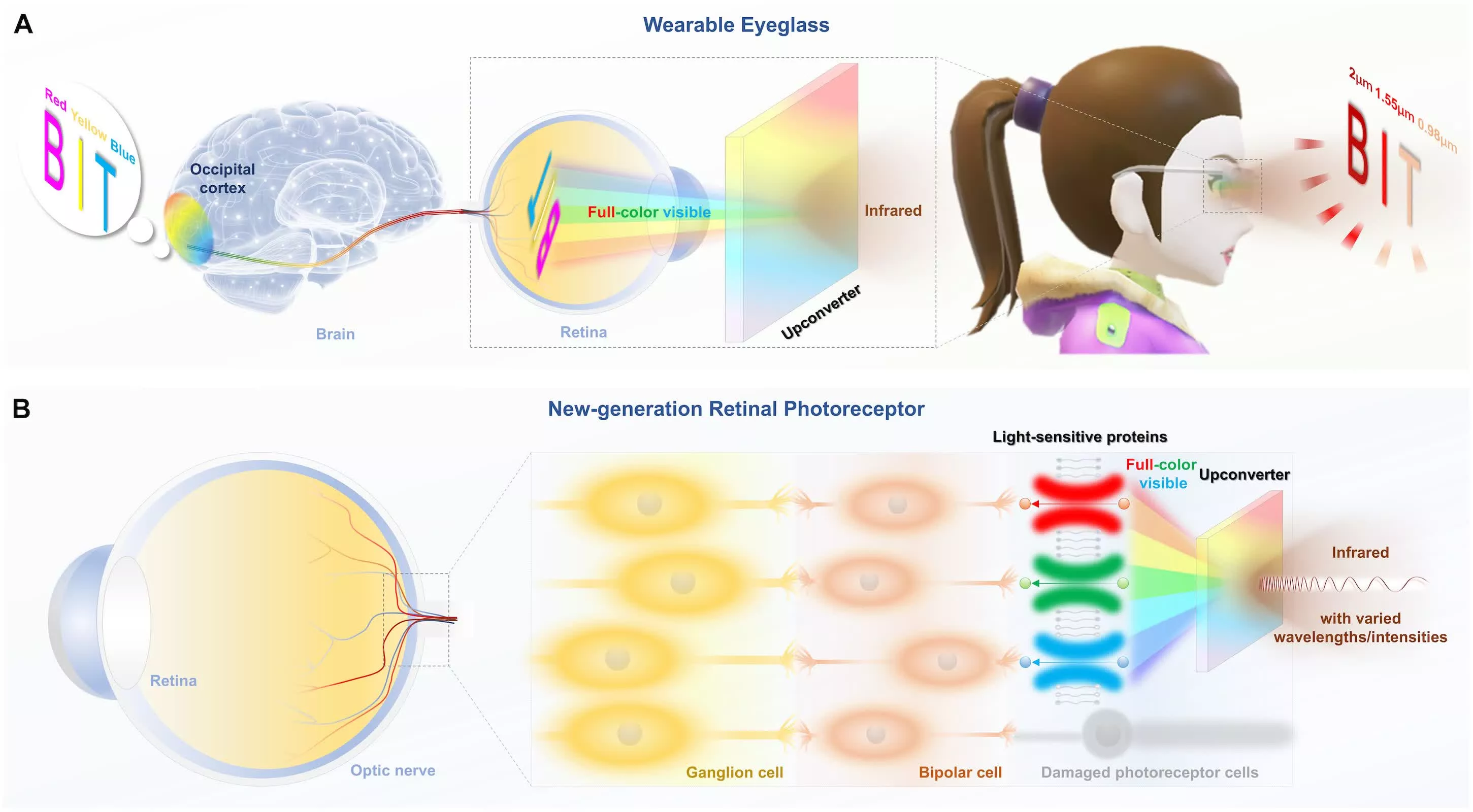
The infrared-to-full-color upconverter is demonstrated in two applications: (A) a wearable eyeglass and (B) a next-generation retinal photoreceptor.
With weaker infrared input, the system produces dim red light. As the signal strengthens or shifts to shorter wavelengths, more charge crosses the barrier and activates the cyan layer, resulting in a mix of colors and increased brightness.
Because the color output is tied directly to the physics of the incoming signal, rather than a preset mapping, the system carries more information. The researchers estimate it could detect much smaller differences in infrared power than conventional brightness-based systems.
To test the concept, the team built a lightweight eyeglass prototype. The device weighs 23 grams and is semi-transparent, allowing users to see both visible and infrared-enhanced images at the same time. In controlled experiments, it produced clear, color-coded images of simple patterns and moving objects under shortwave infrared illumination.
The setup can also be configured in different modes, either overlaying infrared information onto normal vision or filtering out visible light entirely for a more immersive view.
The researchers also explored whether the converted signal could be picked up by biological systems. In lab tests, infrared light processed through the device triggered responses in engineered cells that react to visible light.
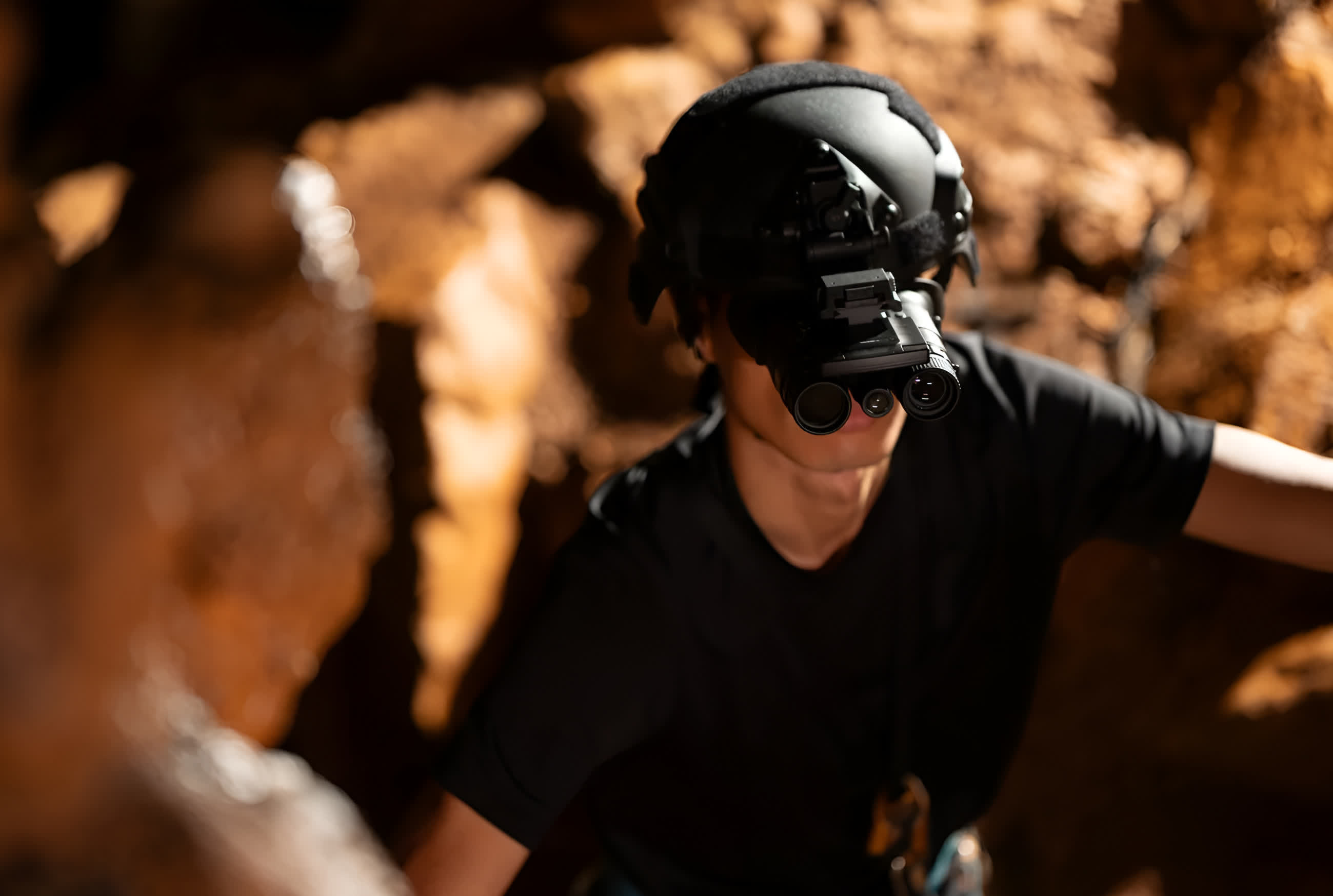
The prototype turns infrared light into different colors, while traditional night vision goggles usually show everything in one green shade.
Additional experiments showed measurable brain activity in mice and retinal responses in human volunteers when viewing infrared signals through the system. Infrared light on its own produced no such effects.
In the paper, the team says the work "redefined infrared vision" by "transcending the monochrome paradigm," adding that it paves the way to "next generation visual prosthetics."
There are still limitations. The tests were done in controlled environments using simple, high-contrast targets, so it's not clear how well the system would perform in more complex real-world settings. The OLED component also requires external power, which makes the current version more like a wearable display than a passive optical device.
There are also open questions around materials. Mercury telluride is a heavy-metal compound, and the study does not address long-term safety or whether it could be used in devices that come into direct contact with the body.
For now, the work shows a different way to handle infrared imaging – one that builds color into the sensing process itself rather than adding it afterward.
Scientists built night vision that shows full color instead of just green


