Don't expect a Steam Deck 2 until silicon breakthroughs arrive, says Valve

midian182

Posts: 11,624   +176
Staff member
Forward-looking: Following the excitement over Valve's announcement of three new pieces of hardware this week, some asked the question, "but where's the Steam Deck 2?" According to the company, we won't see a successor to the four-year-old device until technology is available that enables an enormous performance boost over the current Steam Deck – and without sacrificing battery life.

Valve Software Engineer Pierre-Loup Griffais talked to IGN about the prospect of a Steam Deck 2. He admitted that Valve does plan to release the next-gen portable at some point, as expected, but only when silicon has advanced to the point where it feels like a massive upgrade over the current Steam Deck.

"The thing we're making sure of is that it's a worthwhile enough performance upgrade [for a Steam Deck 2] to make sense as a standalone product," Griffais told the gaming publication. "We're not interested in getting to a point where it's 20 or 30 or even 50 percent more performance at the same battery life. We want something a little bit more demarcated than that."

"So we've been working back from silicon advancements and architectural improvements, and I think we have a pretty good idea of what the next version of Steam Deck is going to be, but right now there's no offerings in that landscape, in the SoC [System on a Chip] landscape, that we think would truly be a next-gen performance Steam Deck," Griffais continued.

Portable gaming technology has made several advancements since the Steam Deck launched in February 2022. The AMD Ryzen Z2 Extreme in the new ROG Xbox Ally X, for example, is a Zen 5-based chip that has 8 cores and an RDNA 3.5-based Radeon 890M GPU with 16 compute units. The Steam Deck, in contrast, uses a 4-core Zen 2 APU and an RDNA 2-based GPU with 8 CUs.
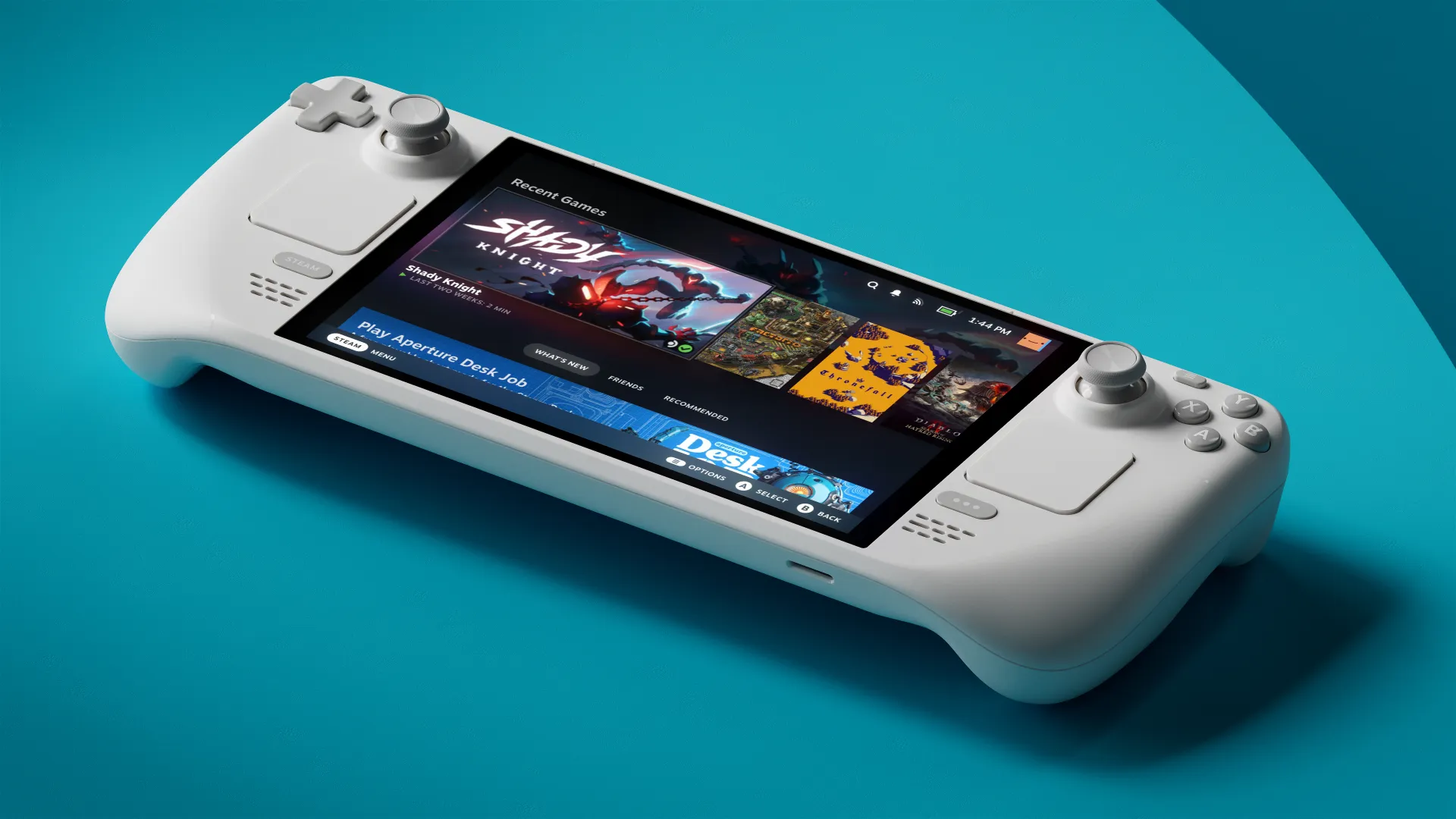
Maintaining or increasing battery life in the Steam Deck 2 is just as important to Valve as the performance improvements. It's never been the Steam Deck's strongest suit, so it appears that Valve is determined to address this issue.

Griffais never gave any hint of how much Valve's next handheld might cost. The Steam OLED is $549, which is relatively cheap compared to the $1,000 ROG Xbox Ally X. It's likely that Valve will aim for a price point somewhere between the two, probably toward the lower end.

None of this gives us a hint of when the Steam Deck 2 will arrive, of course – it will be up to Valve to decide when it feels technology has advanced enough to create a portable gaming device worthy of succeeding the Steam Deck. In August, prominent leaker KeplerL2 predicted that it wouldn't be here until 2028, at which point AMD will likely have released APUs based on Zen 6 and RDNA 5.

For the foreseeable future, Valve will be busy promoting and supporting the newly announced Steam Machine, Steam Frame VR, and Steam Controller 2, all of which will launch in 2026.

Image credit: Georgiy Lyamin

Permalink to story:

 
More than that, I want to be able to swap the new board into the old chassis. I love my steam deck and it's form factor. The touch pads are non negotiable and I'm happy to see them on the new steam controller. I'm going to try to get my hands on one ASAP
 
Gotta respect Valve for refusing to do the “half-step upgrade” dance. Every handheld maker is out here stapling more watts onto the battery problem, and Valve’s like, nope, wake us up when Zen 6 can run Jedi Survivor without turning the chassis into a panini press.
 
The problem is not with the Steam Deck's seeming lack of power, the problem is with the gaming economy. Games are demanding more and more power, for admittedly very few visual improvements. Whether due to managerial incompetence, compressed project schedules or mandates from corporate to "ship something", more products are releasing unfinished, using unoptimized implementations of the Unreal 5 engine. Therefore, gaming handhelds need to pack more power, in order to compensate for the bloat-filled visual diarrhea spewing out of publishers' rear ends, that people still dignify as "video games".

Irrespective of the "why", though, the result is the same: the Steam Deck is increasingly looking underpowered and weak. It's main strength is that it is affordable and sets a minimum threshold for performance benchmarks; only *nix nerds care that it "runs Arch, btw". Otherwise, it's being left further and further behind, as the hardware remains the same while the competition gets better.

It's a sign of long-term planning and thinking, that Valve is waiting until the hardware landscape produces a system commensurate with expected target goals and directives, but actions have consequences.
 
I can see the pros and cons to this approach, but I feel that it will only work if Valve works actively with developers to produce Steam Deck versions of games. It also indicates that the Steam Deck, even with its relative success, isn't enough of a mass market product to get a special design from AMD. I believe that AMD could produce something that would fit Valve's needs.

Then again, with the current RAM market, it's probably not a good idea to aim for an inexpensive product right now.
 
Breakthrough. They can already build a kickass Deck2 with what AMD APUs can offer.
Do it, Steam. The time is right.
Oh and make it with one of those new silicone batteries that can last 50% longer.
 
...Games are demanding more and more power, for admittedly very few visual improvements. Whether due to managerial incompetence, compressed project schedules or mandates from corporate to "ship something", more products are releasing unfinished, using unoptimized implementations of the Unreal 5 engine. Therefore, gaming handhelds need to pack more power, in order to compensate for the bloat-filled visual diarrhea spewing out of publishers' rear ends, that people still dignify as "video games"...
I don't think it's fair for you to say any of this until you've been involved with developing any game. There are good games out there and it's unfair to paint every developer, every manager, and every corporation with such a wide brush. Satisfactory is one great example of a great game developed by people who are passionate about gaming.
 
I don't think it's fair for you to say any of this until you've been involved with developing any game. There are good games out there and it's unfair to paint every developer, every manager, and every corporation with such a wide brush. Satisfactory is one great example of a great game developed by people who are passionate about gaming.
Perhaps it is an unreasonable ask, but all games should perform moderately well, on medium/low settings without raytracing enabled (which is even more applicable if raytracing is mandatory and cannot be disabled), and even this low bar is starting to become too much. Whether the technology companies are using is to blame or the fact that project managers are bad at their jobs and don't know how to head off problems before they balloon into disasters is the issue, it doesn't really matter. The bottom line is, more and more games are coming down the pipeline in a less-than-optimized state and, the hardware needs to compensate for those issues.

There is also the fact that GPUs are using upscaling to achieve performance targets, which suggests a trend in the marketing industry towards egregious levels of puffery―where the desire to sell games on the basis of "next-generation technology" ran away from the capabilities of the machines on offer. So now, every device is playing catch-up with this mythological, impossibly-performant device that exists only in fiction, that can do "'4K60 with raytracing' on high settings, without upscaling". I mean, that is what the PS5 and XSX consoles were sold on. Upscaling was supposed to be "nice-to-have", not "need-to-have". Hell, the RTX 5090―a graphics card so large, it's basically a "small computer, inside of a larger computer"―is the most powerful graphics currently available and it is struggling to manage 4K60 with raytracing on some games, without FSR or DLSS. Make it make sense.
 
Perhaps it is an unreasonable ask, but all games should perform moderately well, on medium/low settings without raytracing enabled (which is even more applicable if raytracing is mandatory and cannot be disabled), and even this low bar is starting to become too much. Whether the technology companies are using is to blame or the fact that project managers are bad at their jobs and don't know how to head off problems before they balloon into disasters is the issue, it doesn't really matter. The bottom line is, more and more games are coming down the pipeline in a less-than-optimized state and, the hardware needs to compensate for those issues.

There is also the fact that GPUs are using upscaling to achieve performance targets, which suggests a trend in the marketing industry towards egregious levels of puffery―where the desire to sell games on the basis of "next-generation technology" ran away from the capabilities of the machines on offer. So now, every device is playing catch-up with this mythological, impossibly-performant device that exists only in fiction, that can do "'4K60 with raytracing' on high settings, without upscaling". I mean, that is what the PS5 and XSX consoles were sold on. Upscaling was supposed to be "nice-to-have", not "need-to-have". Hell, the RTX 5090―a graphics card so large, it's basically a "small computer, inside of a larger computer"―is the most powerful graphics currently available and it is struggling to manage 4K60 with raytracing on some games, without FSR or DLSS. Make it make sense.
" the fact that project managers are bad at their jobs" Where is the fact? Do you develop software? Are you a project manager? Do you know the limiting factors for every game developed? How much does optimizing games for every combination of hardware cost? How much does "good enough" costs?
 
Back