Forward-looking: DoorDash is introducing Dot to its delivery network, aiming to create a robot that communities will welcome alongside human drivers. Executives say that an approachable design is just as important as the technology itself for winning public acceptance and promoting broader adoption.

DoorDash is making its biggest push yet into robotics and automation, unveiling a delivery robot and a new tool for restaurants as part of a strategy years in the making. The announcement marks the first public showcase of hardware developed by its DoorDash Labs unit, which has been advancing autonomous delivery technology since 2018.
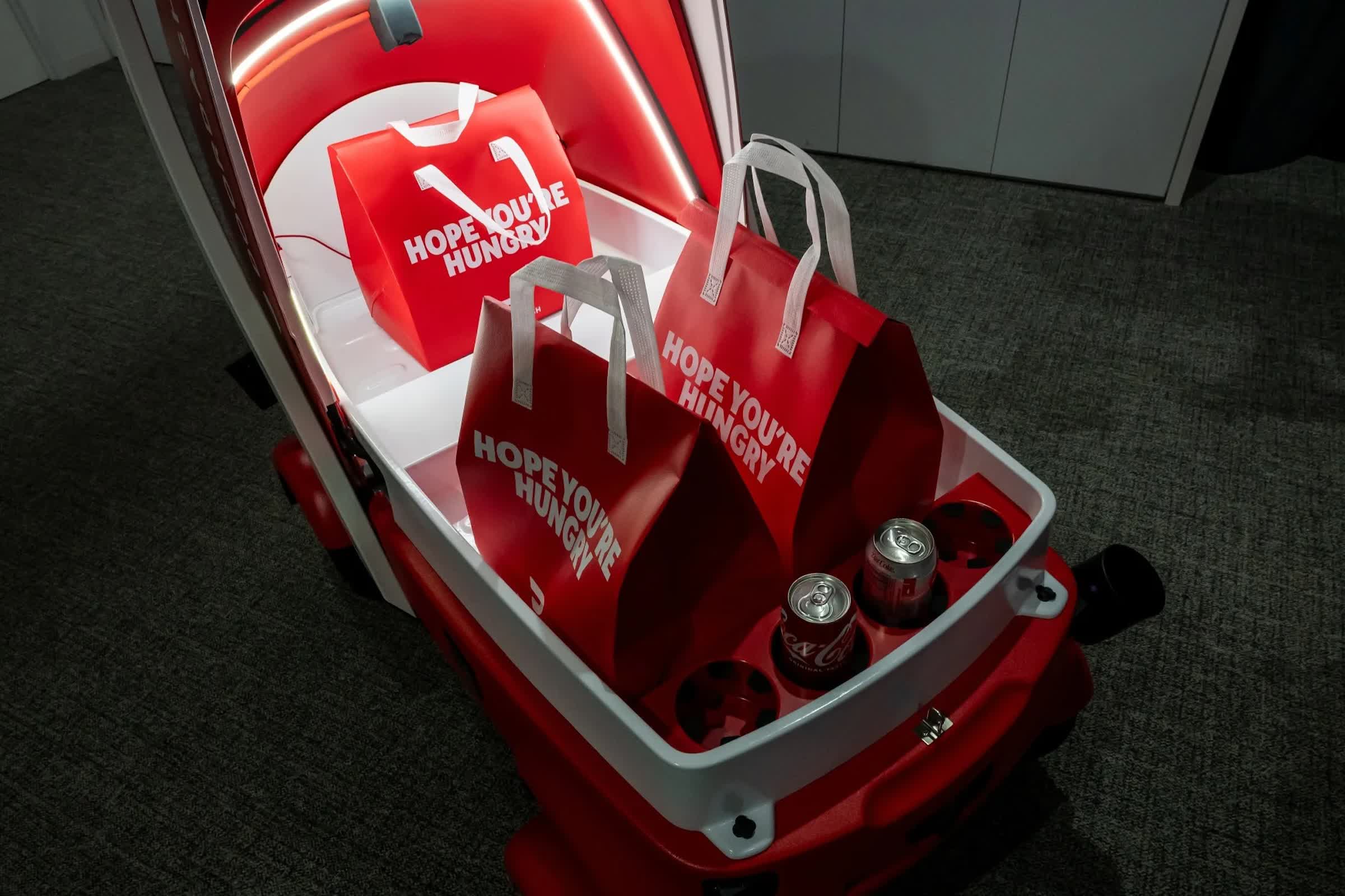
At a demonstration this week in San Francisco, DoorDash co-founder Stanley Tang introduced "Dot," a four-wheeled electric robot designed to carry food and retail orders. Standing 4 feet 6 inches tall and roughly one-tenth the size of a car, Dot is built to handle larger deliveries – up to six pizza boxes or 30 pounds – while traveling at speeds of up to 20 miles per hour.
The robot relies on a combination of cameras, lidar, and radar sensors to navigate streets, sidewalks, and bike lanes. DoorDash said Dot is equipped with eight external cameras for 360-degree vision, three lidar units for high-resolution mapping, and four "inexpensive" radar sensors. An interior-facing camera monitors the cargo during transit. A swappable battery provides six hours of runtime before the robot needs to recharge.
Unlike boxier designs developed by competitors such as Coco Robotics and Serve Robotics, DoorDash opted for a circular compartment inspired by its D-shaped logo. The container opens from the front, resembling the motion of a stroller canopy. Circular light displays on the front serve both functional and aesthetic purposes, illuminating in a way that mimics eye movement to make the robot appear more approachable in public spaces.
DoorDash has already been testing Dot through a limited-access program in Arizona, with deliveries in Tempe and Mesa. The company has not disclosed how many robots are currently in use but said it plans to expand operations to additional markets.
Ashu Rege, DoorDash's vice president of autonomy, said the company is still evaluating where the robots will be manufactured and how components will be sourced. He told Bloomberg that as DoorDash moves beyond prototypes, one of its goals is to replace the current lidar technology with more affordable, automotive-grade alternatives to reduce production costs.
The rollout is part of a broader push into automation. Since 2018, Tang has overseen DoorDash Labs, which has filed patents for robotic delivery systems and outlined its autonomous technology goals. The company has hired dozens of engineers and operations staff to support the effort, including former employees of General Motors' shuttered Cruise subsidiary, who now work in product design, policy, partnerships, and remote robot support.
DoorDash continues to rely primarily on human couriers for meal, grocery, and retail deliveries, but said Dot would allow it to better serve larger orders and longer suburban routes. Tang explained that the company is also developing machine-learning systems to determine the most cost-effective delivery method depending on location and order size.
The announcement comes as major delivery platforms race to establish a foothold in autonomous services. Uber has laid out its own driverless ambitions, while startups backed by Silicon Valley investors are expanding delivery robots into more markets.
Image credit: Bloomberg
DoorDash expands autonomous delivery with four-wheeled "Dot" robot


