Planetary Potato: Earth has a complex internal structure consisting of a solid iron-nickel core at the center and a liquid outer core. The interaction between these two elements can significantly impact the planet's solid, outer crust, and unusual events have been occurring within it for years.
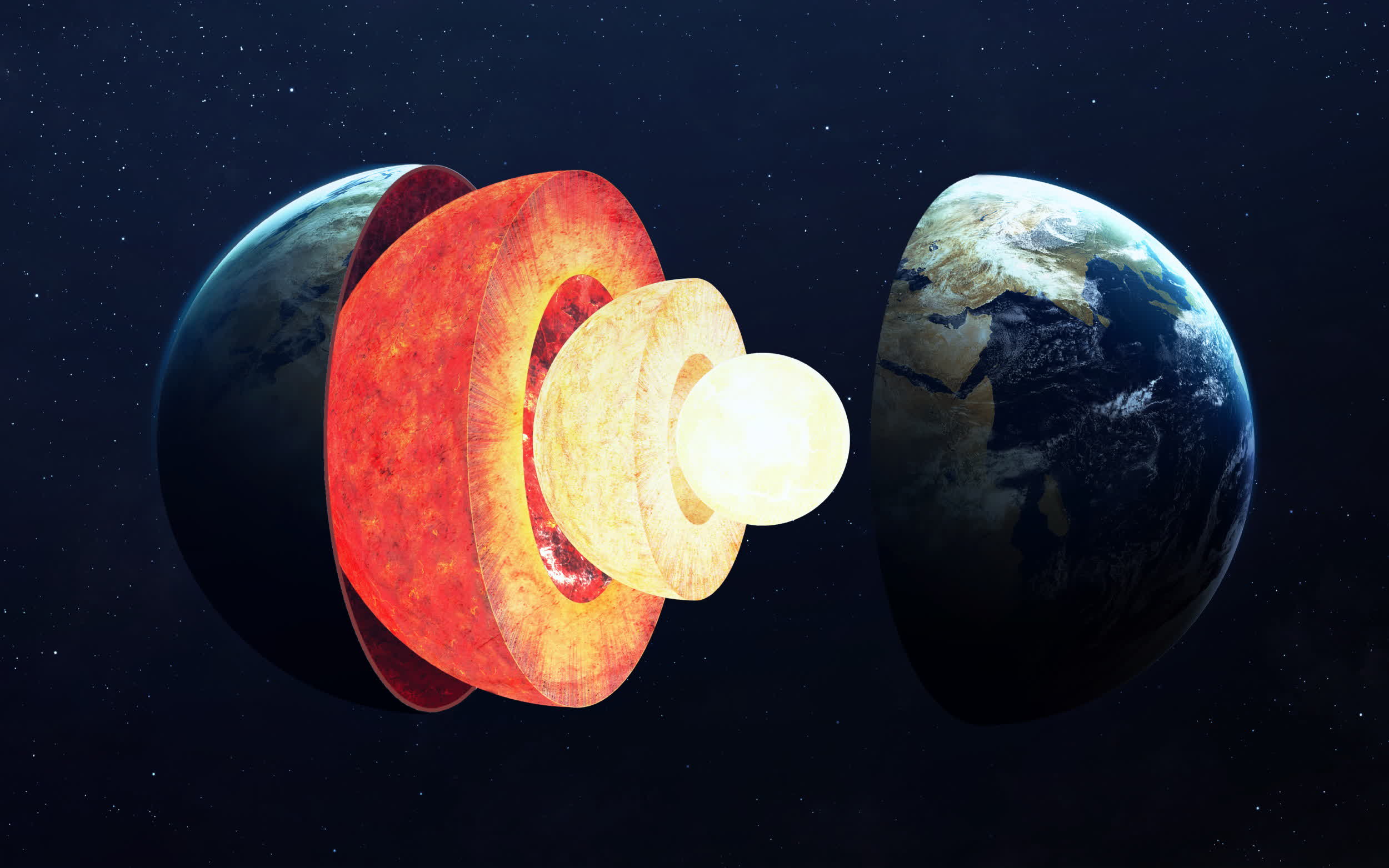
Earth's inner core has changed shape over the past 20 years. A team of scientists studied the core's behavior to understand why its rotation slowed down relative to Earth's in 2010, and discovered new evidence of the mysterious, shapeshifting nature of the planet's center.
Earth's core is thought to be a solid sphere spinning independently from the liquid outer core and the rest of the planet. This rotation generates the magnetic field that protects Earth from solar winds and harmful solar radiation, acting as a shield for life on the crust. Without this spinning core, we wouldn't be here today.
The researchers analyzed a series of seismic waves produced by 121 repeating earthquakes recorded in the same region of North America, between 1991 and 2023. Earthquake shockwaves are essentially the only way we can study what's happening deep beneath the planet's surface, as no one has yet been able to dig 4,000 miles to directly probe the hellish conditions of the core.

By studying the repeated earthquakes, Professor John Vidale and his colleagues confirmed that the core actually slowed down around 2010. They also made a second, serendipitous discovery: Earth's core was changing shape in different locations. This phenomenon occurred at the boundary between the inner core and the liquid outer core, where the solid core approaches its melting point.
The material flowing between the inner and outer cores could disrupt Earth's gravity field, causing the apparent deformation of the solid core. Hrvoje Tkalcic, a professor from the Australian National University, noted that this is an intriguing concept deserving further research in the future.
Understanding what is happening in our planet's hidden, chaotic interior will undoubtedly affect the future of our world in unknown and unpredictable ways. When Earth's core eventually stops, its magnetic field will cease to exist, and life will likely go extinct. While this apocalyptic event could happen billions of years from now, Earth will likely be consumed by our Sun's supernova before that occurs.
Earth's inner core has shifted shape over two decades, scientists discover