Gen Z is turning subscriptions into short-term rentals for shows, movies, and games

Skye Jacobs

Posts: 2,012   +59
Staff
The takeaway: Streaming services and game publishers are facing an audience that no longer behaves like a traditional subscriber base. Instead of sticking with a single platform or paying upfront for content, younger users are moving in and out of services based on what they want at a given moment. The findings come from a report by Dentsu and IGN Entertainment.
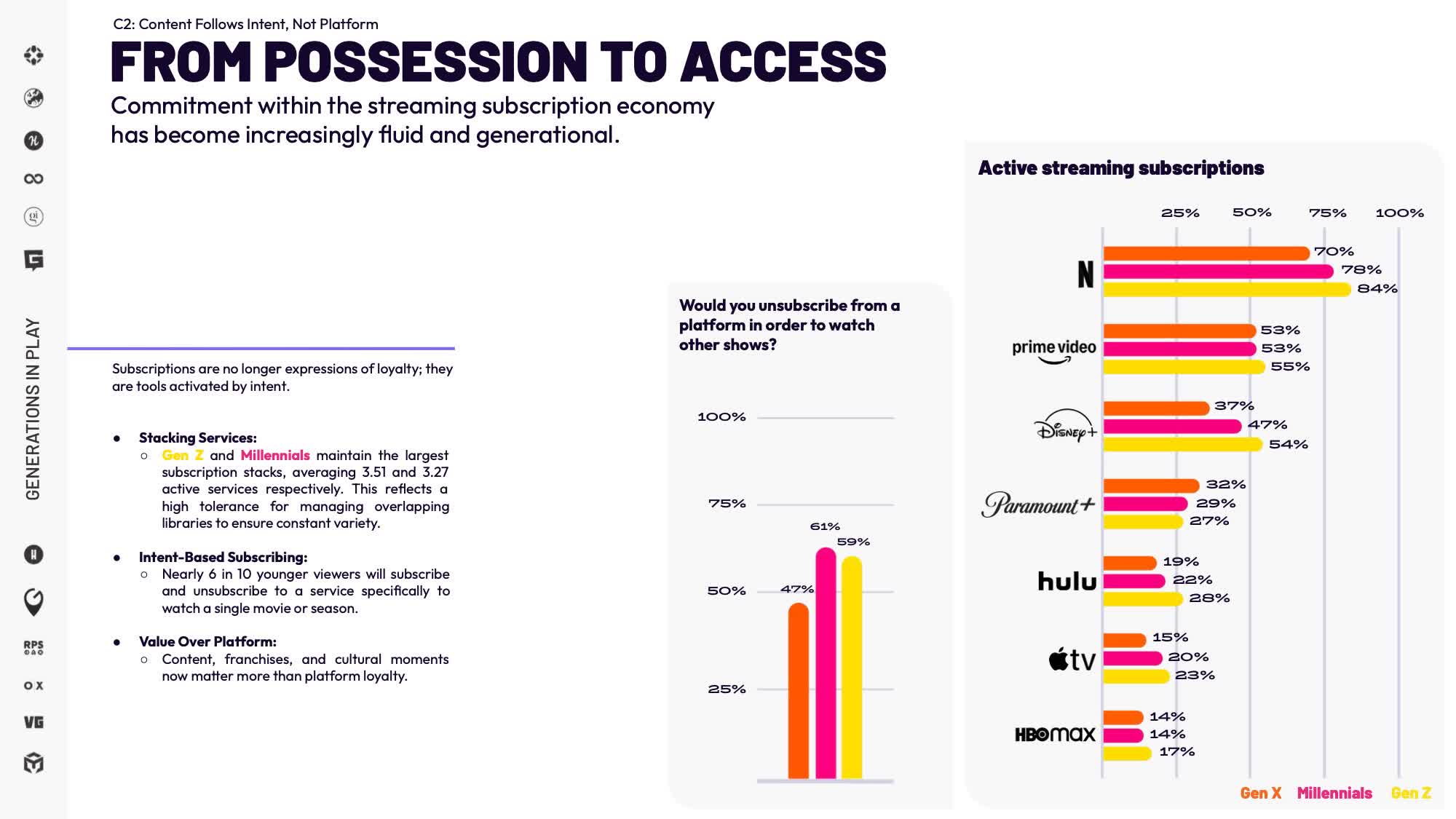
One of the clearest signals in the data is how Gen Z approaches streaming. The report finds that 59% of users in that group subscribe to and unsubscribe from platforms specifically to watch a single show or film. In effect, streaming subscriptions have become temporary access points rather than ongoing commitments. The report concludes that "platform loyalty is effectively dead," reflecting how easy it has become to cycle through services as content libraries fragment.

That behavior is less about dissatisfaction and more about how the technology itself is structured. Subscription systems, built to generate recurring revenue, now allow users to join and leave with minimal friction. As a result, the balance of control has shifted toward the viewer.
The same dynamic is playing out in gaming. According to the report, 62% of Gen Z users are unwilling to pay full price for video games. Instead, they are gravitating toward subscription models and free-to-play ecosystems that lower the barrier to entry.

For publishers, that changes how revenue is generated. Brent Koning, Dentsu's global head of gaming, framed it as a question of what happens after a player gains access. "The question publishers should be asking is, how do we convert access into commitment?" he told Variety. "Subscriptions and free-to-play have become the regular front door nowadays, but what happens after players come through that door is where the new business models lie. Season passes, in-world status, virtual goods… these are the new rules of monetization."

In that model, games operate less like standalone products and more like ongoing services. Revenue depends on sustained engagement rather than a single purchase. The report notes that 71% of Gen Z users have stopped buying physical music, and 70% no longer purchase physical copies of TV shows or movies.
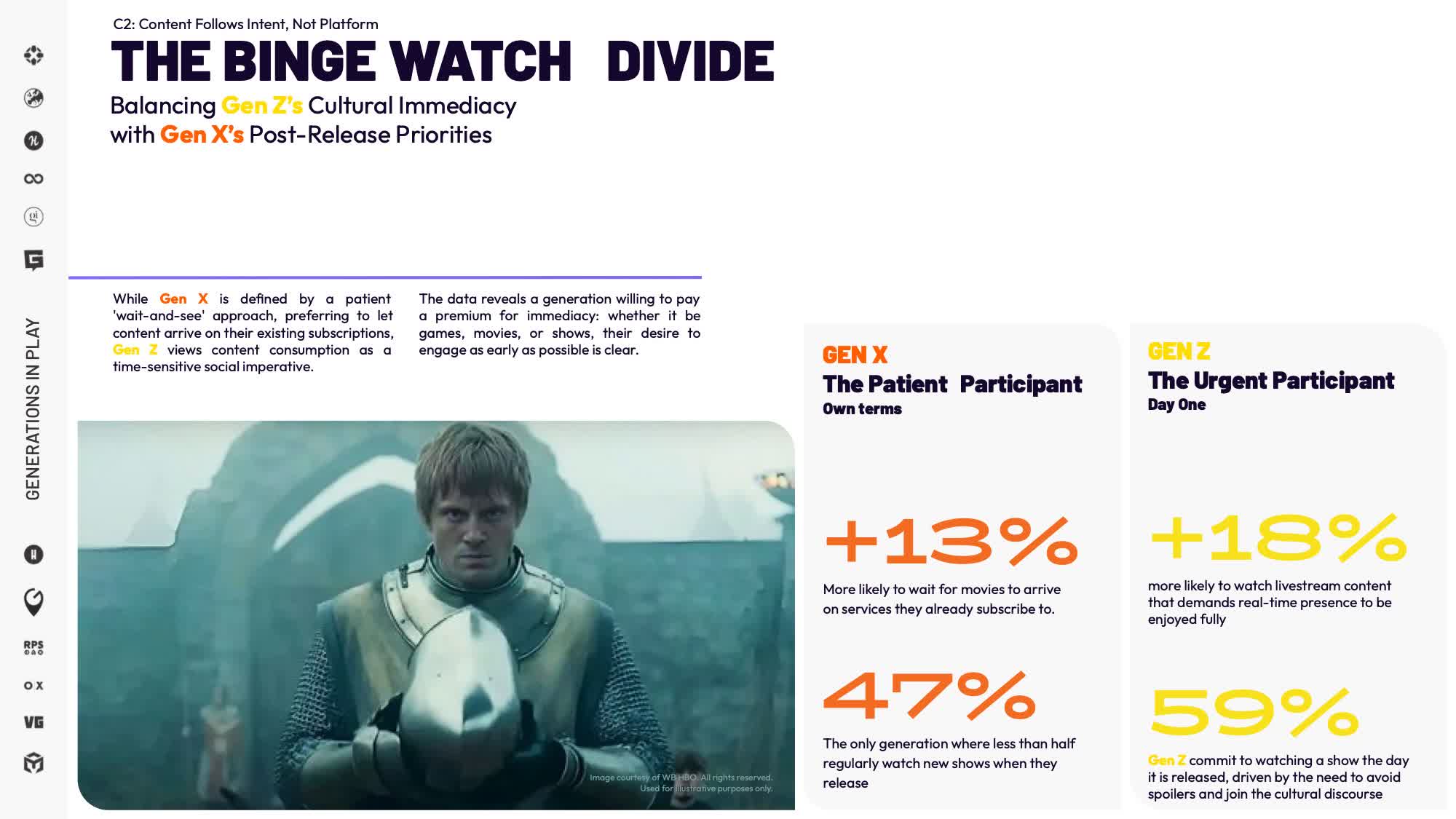
Despite the shift to digital, the data highlights one area where younger audiences still show up in person. Gen Z is 13% more likely than older groups to attend opening weekend screenings in theaters, suggesting that shared, event-driven experiences still carry weight.

The findings suggest that simply increasing content volume may not solve retention challenges. Instead, long-term engagement appears to depend on recognizable intellectual property that can extend across formats.

Koning pointed to franchises with sustained appeal as a key factor. "The shift here isn't necessarily about just creating more, new or original content, because we know that loyalty actually centers on IP that has longevity," he said. "Stranger Things, Game of Thrones, The Walking Dead… these are sagas that keep audiences engaged and coming back for more. But we're also seeing that when IP transitions between formats, it brings audiences with it – so those sagas can be borrowed too."
That ability to move franchises across platforms – film, television, and games – has become more important as companies try to hold attention in an environment where users are quick to move on.

The systems designed to lock users in – subscriptions, digital storefronts, and platform ecosystems – are now enabling more flexible behavior. For Gen Z, access matters more than ownership, and engagement is increasingly shaped by convenience rather than loyalty.

Permalink to story:

 
"The report notes that 71% of Gen Z users have stopped buying physical music, and 70% no longer purchase physical copies of TV shows or movies."

Amazing facts... I'm way beyond Gen Z and I haven't bought anything physical in 10+ years. Neither does anybody else I know.

In fact it's probably Gen Z buying records, tapes, DVD's, and CD's for novelty purposes, because they never grew up owning anything physical... that pushes it down a little.

"Despite the shift to digital, the data highlights one area where younger audiences still show up in person. Gen Z is 13% more likely than older groups to attend opening weekend screenings in theaters, suggesting that shared, event-driven experiences still carry weight."

Err, younger people do not have children or other commitments, and hence have more time to go out and go to the movies with friends.
 
"The report notes that 71% of Gen Z users have stopped buying physical music, and 70% no longer purchase physical copies of TV shows or movies."

Amazing facts... I'm way beyond Gen Z and I haven't bought anything physical in 10+ years. Neither does anybody else I know.

In fact it's probably Gen Z buying records, tapes, DVD's, and CD's for novelty purposes, because they never grew up owning anything physical... that pushes it down a little.
The only thing I buy physical copies of now are books. I do read a lot in my tablet, but I like having lots of history and science books laying around with high gloss paper. Some people refer to them as "coffee table books".

But I think streaming services killed themselves. They cost too much, they have shrunk in what they offer and now they throw ads at you even if you pay. The best part of streaming previously was no ads.
 
If those streaming companies want "loyalty" they need to offer something in return. They can't just expect it. An obvious thing they could do is offer discounts for longer subscription periods, either lower prices, or a "free" month after maintaining service for a year, that sort of thing.
 
With so many services and the limited spare time it is more efficient to rotate subscriptions. anyway there are probably only a few notable releases per year that are worth the time.
 
Loyalty ended the day every industry started ignoring Gen X.

Gen X always supported buying vs rentals.
Gen X always supported quality vs quantity.
Gen X always supported ownership vs subscriptions.

But once the industry turned in favor of Gen Z, the world became more expensive with cheaper made materials with a disposable mindset.
 
Last edited:
Long term subscriptions to most services often aren't worth it anymore, paying for a month to watch what you want then drop it if the content isn't worth the subscription is a better way to save money.
However these streaming services need to do something to be more worthwhile paying the increasing costs, such as stop making users pay to only still show ads. People of course won't be loyal when the cost of subscribing is the same as cable TV and still shows ads.
 
Scam the scammer IMO. Some of these streaming services are so fluid with their content. For example, I originally got Paramount+ for Star Trek, shows for the kids, and classic Nick cartoons.

Star Trek movies would leave and come back (not that I care for all of them), 'Blues Clues and You' just disappears all of the sudden ( a lot of angry moms when that happened), and some of my favorite classic Nick cartoons have vanished as well.
 
Loyalty ended the day the every industry started ignoring Gen X.

Gen X always supported buying vs rentals.
Gen X always supported quality vs quantity.
Gen X always supported ownership vs subscriptions.

But once the industry turned in favor of Gen Z, the world became more expensive with cheaper made materials with a disposable mindset.
Most of gen z was barely old enough to vote when these changes started. These changes were a coordinated effort of more than a decade to increase profit margins. Companies stopped competing and started copying each other instead.
 
With such heavy fragmentation and a constant rotation of what content is actually available, remaining subscribed is just meaningless.

Back when netflix had everything I remained subscribed for years. Now you couldn't pay me to sub to them.
 
Today's content is ephemeral. Gen Z did the math and realized they didn't want to spend $70 for a single game that they're probably going to be tired of in 3-6 months, or $15 for the digital rights (not even ownership) to a single movie they're maybe going to watch once or twice a year.
 
"The question publishers should be asking is, how do we convert access into commitment?"

What a hard question...
Quality shows and movies will keep subscribers. But the opposite is obviously happening. Mountains of sh*te are filling streaming services storage, while there are fewer and fewer good movies and shows.

"The findings suggest that simply increasing content volume may not solve retention challenges. Instead, long-term engagement appears to depend on recognizable intellectual property that can extend across formats"

They surely know how to dig up recognizable IPs. But they do not understand how not to turn those into modern garbage. Take the latest Star Trek show for example. It was created to degrade a viewer's brain. Its characters are so unbearable that you feel nothing but disgust seeing them on screen. At some point, I began to suspect some of its characters were created to represent people with mental disabilities because they behave like ret**rds.

I fear that eventually streaming services will "solve" the "problem" with service jumping as they did with password sharing. I think it is very obvious that they are not ok with people subscribing to binge the best content and then cancel. I hope this does not happen, but it seems like something someone very smart is already working on.
 
"The question publishers should be asking is, how do we convert access into commitment?"

What a hard question...
Quality shows and movies will keep subscribers. But the opposite is obviously happening. Mountains of sh*te are filling streaming services storage, while there are fewer and fewer good movies and shows.

"The findings suggest that simply increasing content volume may not solve retention challenges. Instead, long-term engagement appears to depend on recognizable intellectual property that can extend across formats"

They surely know how to dig up recognizable IPs. But they do not understand how not to turn those into modern garbage. Take the latest Star Trek show for example. It was created to degrade a viewer's brain. Its characters are so unbearable that you feel nothing but disgust seeing them on screen. At some point, I began to suspect some of its characters were created to represent people with mental disabilities because they behave like ret**rds.

I fear that eventually streaming services will "solve" the "problem" with service jumping as they did with password sharing. I think it is very obvious that they are not ok with people subscribing to binge the best content and then cancel. I hope this does not happen, but it seems like something someone very smart is already working on.
Well they already have that way of stopping it, that is to require a year long commitment when you subscribe, ala amazon prime.

The reason they dont do it is that, unlike amazon, they dont have an omnipresent service available to justify that cost. All they have is media, which is mostly slop now. They saw a huge increase in users when they got rid of the year commitments and went month to month instead. If they go back they will only lose subs from people who are not economically stable and dont want to sign up for a commitment they cant guarantee they will fulfill.
 
Most of gen z was barely old enough to vote when these changes started. These changes were a coordinated effort of more than a decade to increase profit margins. Companies stopped competing and started copying each other instead.
Perhaps Gen Z was "barely older to vote" when changes in the industry started to happen but once adults they solidified the problem with their subscription habits, their unnecessary overspending habits, quantity vs quality preferences, among other undesired shifts in every industry....heck you can't even buy most apps on the Google Store, but just subscribe to use them....all this happened under their watch. Remember companies wouldn't cater to those that are not actively investing on what they produce. And right now everything we see around us is catered to Gen Z.

It's not me saying it, but every consumer report and investigation is stating it loud and clear.
 
When they stop trying to turn streaming back into a $200 cable TV subscription, maybe we'll have some loyalty. Sensible households aren't going to subscribe to "all of them" -- regardless of age/generation. We're going to sign up for a service, watch the interesting parts of the library, then cancel and move on to a different service.

The message is clear: offer your service on favorable terms and we will stay. Screw us and we will screw you back.
 
Interesting how society works. There was a time when people thought there was nothing wrong with hunting animals in Africa or smoking in restaurants. Now much of society would never tolerate such views and behavior. The same social conditioning and psychological mechanisms are at play here. I personally think subscription services are the work of the devil, but others really love them and wonder why you wouldn't too. Wait long enough and an entire population will disappear and be replaced by a new unrecognizable one.

Me personally I would never get caught dead paying subscriptions for movies and games. Quit literally, If I cant get the physical media and back it up on my drives I look the other way. Now I'm being very naughty here, I'm withholding the fact that I have absolutely zero interest in modern content. The best music ever made for me came long before the age of subscriptions. So I don't know how I would react if the content online was actually good.

The fact that these masses cannot see how subscriptions have robbed them blind and how we had it so much better and cheaper in the past is in some ways disturbing. The only thing ill pay subscriptions for is a VPN or something similar.

Its similar with games, they look amazing, but taking into account all the DRM and fees and platforms, I just say, nah. It all counteracts the game itself. Its like asking for a drink of water and it comes laced with chemicals. No thanks.
 
Scam the scammer IMO. Some of these streaming services are so fluid with their content. For example, I originally got Paramount+ for Star Trek, shows for the kids, and classic Nick cartoons.

Star Trek movies would leave and come back (not that I care for all of them), 'Blues Clues and You' just disappears all of the sudden ( a lot of angry moms when that happened), and some of my favorite classic Nick cartoons have vanished as well.
This is why people pirate
 
I don't think this is specific to any generation. I'm a boomer, and I quit DishNetwork - a "trad" premium TV service because I only watched maybe 5 channels of the 500+ channels of :poop: they had on the service AND I was paying $85/mo for those 5 channels and I can get most of those OTA for FREE.

As I see it, there are two factors. 1.) High-speed internet capable of delivering reasonable quality Video/Audio 2.) "Trad" services were far too expensive for what they were offering; this, perhaps, being the main reason people went to streaming in the first place.

And when streaming started to catch on, CEOs of every asinine content company were only able to see dollar bills in their eyes, withdrew their content from Netflix, and figured they could make even more money by starting their own overpriced streaming services - Thus, if anyone wanted all the services, doing so pushed the price up to and beyond the costs of "Trad" services like DishNetwork. Those CEOs were blind to the fact that those of us who started streaming did so because the cost was far too high for the value we were getting out of it. I've more than paid for the 2 HTPCs I built with the savings by going to streaming.

And I have subscribed to a service for what I wanted to watch - BritBox, then cancelled. And did the same with Apple TV, although, I had 6-months of Apple TV for free through my T-Mobile subscription. When that ran out, I cancelled Apple TV. I will resubscribe to Apple TV when the shows my wife and I watched come out with new seasons, but we will cancel again when we are finished watching those new seasons.

I also subscribed to Disney for a year at a promo rate, but cancelled because we had watched everything we wanted to watch. And like Apple TV, when new seasons of the shows we watched finally all hit Disney, we will subscribe for a month or two and then cancel again.

The only thing we continually subscribe to is Netflix and part of the reason we continue our subscription is because T-mobile includes "basic" Netflix, although, we go to the no commercial subscription for basically half the price because of the T-mobile deal.

The long story short, though, is that the plethora of streaming services have become priced like "Trad" subscription TV, and no one, IMO, wants to pay such a high price especially when there's not enough time to watch all the content and some of that content is pure garbage.

I do still buy DVD, Blu-ray and UHD Blu-ray and will continue to do so. Can't beat the BR formats for video/audio quality.

And I also use the vast library of DVD/BR/UHD-BR that our local library system lets me borrow for free.

IMO, the streaming services need to wake up and realize that their subscribers are not Money Trees from which they are completely free to pick their pockets on a monthly basis.
 
Loyalty ended the day that every industry started ignoring Gen X.

Gen X always supported buying vs rentals.
Gen X always supported quality vs quantity.
Gen X always supported ownership vs subscriptions.

But once the industry turned in favor of Gen Z, the world became more expensive with cheaper made materials with a disposable mindset.
Gen X supported Wal Mart and Amazon
Gen X supported leasing cars
Gen X championed remaining in debt and constantly upgrading cars, homes, ece.
Gen X is now in charge of these companies that are enshitifying all the products we use today.

This is not a "gen Z" issue. This is a "people are not dumb enough to keep paying for garbage" issue.
I don't think this is specific to any generation. I'm a boomer, and I quit DishNetwork - a "trad" premium TV service because I only watched maybe 5 channels of the 500+ channels of :poop: they had on the service AND I was paying $85/mo for those 5 channels and I can get most of those OTA for FREE.

As I see it, there are two factors. 1.) High-speed internet capable of delivering reasonable quality Video/Audio 2.) "Trad" services were far too expensive for what they were offering; this, perhaps, being the main reason people went to streaming in the first place.

And when streaming started to catch on, CEOs of every asinine content company were only able to see dollar bills in their eyes, withdrew their content from Netflix, and figured they could make even more money by starting their own overpriced streaming services - Thus, if anyone wanted all the services, doing so pushed the price up to and beyond the costs of "Trad" services like DishNetwork. Those CEOs were blind to the fact that those of us who started streaming did so because the cost was far too high for the value we were getting out of it. I've more than paid for the 2 HTPCs I built with the savings by going to streaming.

And I have subscribed to a service for what I wanted to watch - BritBox, then cancelled. And did the same with Apple TV, although, I had 6-months of Apple TV for free through my T-Mobile subscription. When that ran out, I cancelled Apple TV. I will resubscribe to Apple TV when the shows my wife and I watched come out with new seasons, but we will cancel again when we are finished watching those new seasons.

I also subscribed to Disney for a year at a promo rate, but cancelled because we had watched everything we wanted to watch. And like Apple TV, when new seasons of the shows we watched finally all hit Disney, we will subscribe for a month or two and then cancel again.

The only thing we continually subscribe to is Netflix and part of the reason we continue our subscription is because T-mobile includes "basic" Netflix, although, we go to the no commercial subscription for basically half the price because of the T-mobile deal.

The long story short, though, is that the plethora of streaming services have become priced like "Trad" subscription TV, and no one, IMO, wants to pay such a high price especially when there's not enough time to watch all the content and some of that content is pure garbage.

I do still buy DVD, Blu-ray and UHD Blu-ray and will continue to do so. Can't beat the BR formats for video/audio quality.

And I also use the vast library of DVD/BR/UHD-BR that our local library system lets me borrow for free.

IMO, the streaming services need to wake up and realize that their subscribers are not Money Trees from which they are completely free to pick their pockets on a monthly basis.
Yes this has nothing to do with generations, that's just a misdirection so people have convenient scapegoats instead of looking at the rotten industry for what it is.

People are un-subbing because A) the content is garbage and B) what little good content there is keeps rotating to different services. When people are saving every buck, paying $50+ to maintain multiple streaming services for just a few shows cant be justified.
If you’re subscribing on and off to watch a couple of things why not is it buy them?
Why would I pay $40 for a blu ray when I can spend $5, stream two $40 blu rays worth of shows, then unsub?
 
If you’re subscribing on and off to watch a couple of things why not is it buy them?
For a lot of people they will subscribe to a service to watch a new season of a show they watch, then drop after they have finished that season, and go subscribe to something else to catch up on a different show they like. If you only really plan on watching a series once then subscribing for a month is usually cheaper than buying.
 
Back