German utility launches dedicated electricity tariff for gamers with power-hungry PCs

midian182

Posts: 11,963   +183
Staff member
In context: PC gaming, especially the kind involving high-end hardware and multiple machines, is a very expensive hobby these days – even more so than before. Not only do parts cost a fortune, the electricity they consume adds to the final bill. It's why a German power company is offering a specialized tariff to customers designed specifically for gamers.

German publication ComputerBase writes that meinGAMING is the tariff name being offered to gaming households in Germany. There are three tiers available, each with its own annual energy consumption.

The first category, Casual Gamer, is aimed at those who game for 10 or more hours per week and see gaming as a way to unwind after work or at weekends. Selecting this profile sets the calculator's estimated annual household electricity consumption to 2,500 kWh.

Pro Gamer, meanwhile, targets more dedicated players with high-end setups, multiple systems, or an interest in streaming or modding. The description refers to 30 or more hours of gaming per week, alongside working from home, and the calculator defaults to 3,500 kWh per year.

The final category, Gaming Households, is aimed at families or shared homes with two or more active gamers. Its description refers to 50 or more hours of gaming per week across devices such as PCs and consoles, with a default annual household electricity consumption estimate of 5,000 kWh.
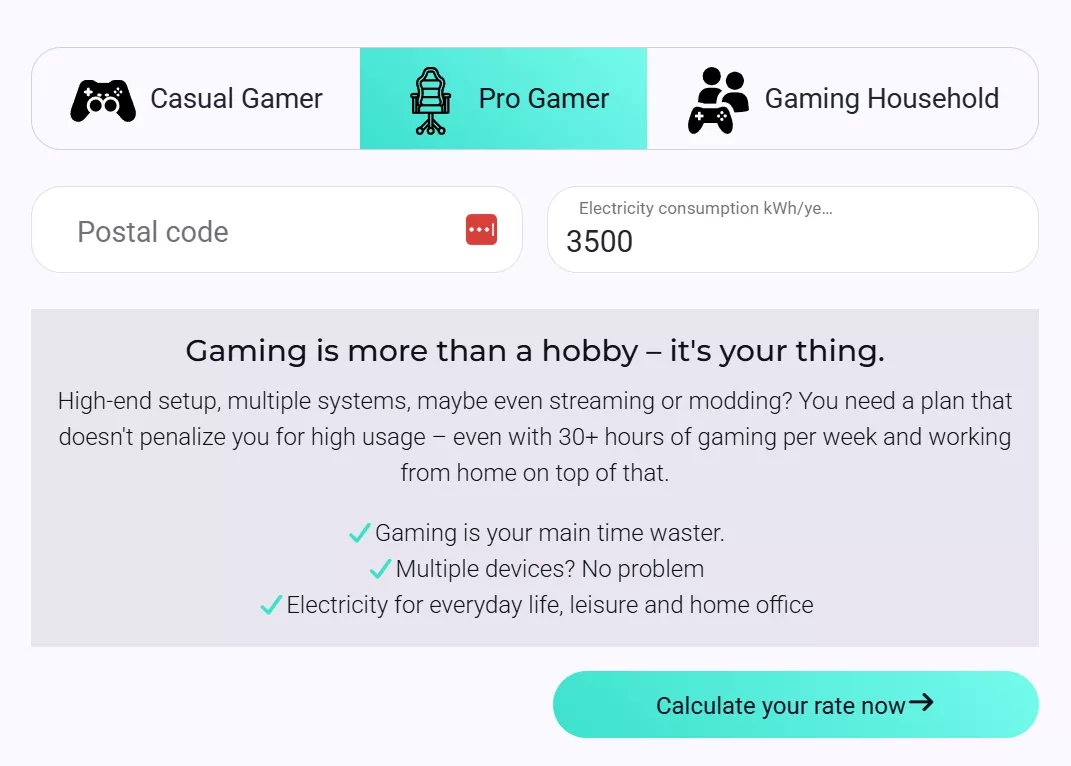
The idea here is that gamers who use a lot of electricity might benefit from this tariff. The fixed charge is relatively high, but the price per kWh is lower, so whether it makes sense depends on your household's annual electricity usage (beyond just gaming). Those who use enough could save money compared to their current tariff. The website claims there's an energy price guarantee of up to 24 months, too.

SWK ENERGIE, Krefeld's municipal utility company, provides meinGAMING's electricity. It writes that 100% of this comes from renewable energy, which is a nice extra.

It is interesting to see an electricity tariff targeting gamers. A gaming PC with an RTX 5090 and a Core Ultra 9 285K being used for gaming 30 hours per week could use roughly 1,100 kWh per year. Include the monitor, and that could rise to more than 1,200 kWh/year, illustrating why the electricity company sees this demographic as a prime potential customer.

Permalink to story:

 
Is this just another flavor of a general "commit to bulk purchase" plan they offer? If so I'd get adding one more skin for gamers along with whatever other marketing segments they're targeting.

If it's unique, I don't get it. A high end gaming PC is not nothing, but then again it's probably also not super material compared to say air conditioning, pool pumps, refrigerators and ice makers, electric heat, etc etc.

Or maybe this is simply about building awareness in a way they think will land better than a "have you considered the electric costs of your PC?" nag latter.
 
Some cards are absolutely ridiculous with power draw. It's not hard to get over a kilowatt once you include the CPU, motherboard and an m.2 drive. Modern gaming seems like it should be a winter hobby because they're basically a space heater.

While I don't think the people gaming on 5090s are worried about the cost of electricity, sitting in a room with a high end PC under load is noticably warmer.

I think part of the reason for developing the 12vhpwr connector is to hide how much power these cards are actually using. If you saw a 7900xtx with 3, 8pins sticking out the side was a pretty good representation of how much power the cards are using.

I wish there was more demand for power efficient equipment. I guess you can always under clock your card but if I'm getting charged extra for the electricity ANYWAY then I'm not really incentivised to do that.

This seems like one of those "unintended consequences" story where people who might want to knock a hundred watts off a 5090 just so it's more comfortable to be in a room with is being charged for an extra 2000-5000kwhr of electricity for.

A side note, the coolers are getting ridiculous. I remember when 2 slot coolers started popping up and you got extra power from the 4 pin molex connector
 
Some cards are absolutely ridiculous with power draw. It's not hard to get over a kilowatt once you include the CPU, motherboard and an m.2 drive. Modern gaming seems like it should be a winter hobby because they're basically a space heater.

While I don't think the people gaming on 5090s are worried about the cost of electricity, sitting in a room with a high end PC under load is noticably warmer.

I think part of the reason for developing the 12vhpwr connector is to hide how much power these cards are actually using. If you saw a 7900xtx with 3, 8pins sticking out the side was a pretty good representation of how much power the cards are using.

I wish there was more demand for power efficient equipment. I guess you can always under clock your card but if I'm getting charged extra for the electricity ANYWAY then I'm not really incentivised to do that.

This seems like one of those "unintended consequences" story where people who might want to knock a hundred watts off a 5090 just so it's more comfortable to be in a room with is being charged for an extra 2000-5000kwhr of electricity for.

A side note, the coolers are getting ridiculous. I remember when 2 slot coolers started popping up and you got extra power from the 4 pin molex connector
Hitting a sustained kilowatt is extremely hard, you need a 5090 and oced 9800xed with multiple drives to achieve that. Any other GPU won't do it.

But then as always, if a few cents in electricity is the problem, you shouldn't be buying multi thousand GPUs in the first place.

And if you want lower power cards then buy them. The dual slot cards didn't go anywhere. We just call them the 5060 now. We can now support more powerful cards so those designs are no longer high end. But people get hung up on names for some reason.
 
Hitting a sustained kilowatt is extremely hard, you need a 5090 and oced 9800xed with multiple drives to achieve that. Any other GPU won't do it.

But then as always, if a few cents in electricity is the problem, you shouldn't be buying multi thousand GPUs in the first place.

And if you want lower power cards then buy them. The dual slot cards didn't go anywhere. We just call them the 5060 now. We can now support more powerful cards so those designs are no longer high end. But people get hung up on names for some reason.
Its actually not that hard once you factor in the 20% loses in the power supply. People also seem to forget there monitors can use a decent chunk.

The problem with just buying a 5060 or something all the UE5 garbage that gets thrown out is horribly unoptimized. And the lower end cards are ridiculously gimped through a combination of tiny memory busses and having extremely cut down dies. Essentially nvidia is designing their products to prevent doing exactly what you're suggesting I do. Performance doesn't scale well at higher resolutions with those tiny memory busses.
 
I dont see the gaming rig being the big player in a household electricity bill. How many percent? Feels like a marketing stunt.
 
I dont see the gaming rig being the big player in a household electricity bill. How many percent? Feels like a marketing stunt.
Well, personally, I have a few old compact fluoresecnet bulbs and otherwise LED so lighting is like 10% of what it was in the old days of incadescent bulbs. Washer and dryer chug power but don't run long. Air conditioning uses a lot (it gets very hot here, 100F/38C in summer) but that AC only runs a few months out of the year. I have a GTX1650 (75W peak) card so my desktop tops out under 150W, but if I had a '90 series card my PC would probably be over 50% of my bill. That said Mid American Energy invested heavily in wind power so my rate is only about $0.09 a kwh anyway, but that's among the lowest rates here in the US.
 
I hesitate to call anyone with a '90 series card a 'casual gamer' LOL. My GTX1650 is a 75W card, frankly due to connector melting I'd probably avoid anyhing above a 5070 or so (probably I'd go with AMD actually, but still avoid the 600W+? odels for the same reason.). Sounds like a nice deal for people with power-hungry gaming rigs though!
 
I dont see the gaming rig being the big player in a household electricity bill. How many percent? Feels like a marketing stunt.
It depends a lot what else is being used and how those things are powered.

I live solo in a two bedroom flat, heating and hot water is from district heating and cooking is gas a gas burning stove and electric oven. Most of the year I don't need heating as my electronics does the job, as in the PC, the console, the stereo (big stereo). Electricity also does lights, fridge/freezer, dish washer and washing machine.

I use around 3.000 KWh or 250 KWh per month if you'd like. My monthly consumption is definitely impacted by what I game and how much, in periods where I may be into some strategy game with plain graphics and so I dip below 200 KWh and if it is some FPS I may hit 350 KWh. If my GPU wasn't a modest 1900XT and a 5090 instead I suspect the difference would be even bigger.

I haven't data on what my base consumption for a month without gaming would be, but maybe I should try a few days just to get an idea (electricity is tracked hour by hour here, so it should be doable).
 
Some cards are absolutely ridiculous with power draw. It's not hard to get over a kilowatt once you include
Hitting a sustained kilowatt is extremely hard, you need a 5090 and oced 9800xed with multiple drives to

To that point, as more of unintended but real consequences, our "computer room" housed 4 PC's, which my 2 boys and my "gamer girl" daughter play in. 7900 XTX/7800x3d (460w average output), 7800 XT/5800x3d and a 6900 XT/5800x3d. Combined, the room did not warm up. After hours, doors closed, AC set at 75, it stayed 75 in that room.

Then comes my grotesque beast with a Gigabyte ICE 5090/9800x3d (everything bought just at the dip, hitting the timing lottery)...the GPU consistently consumes 610w (no OC), CPU around 130's (PBO) and suddenly the room is 88 to 90 degrees unless we open the room, dumping in excess of around 700w to 800w out (not quite the 1Kw number). It is...honestly ridiculous. We hooked up a shroud exhaust system with rigged fans to direct airflow outside through the window with scrounged up AC window parts and the room is back to maintaining 75. Not even a small room (20x11).

Just my anecdotal story :)
 
Some cards are absolutely ridiculous with power draw. It's not hard to get over a kilowatt once you include the CPU, motherboard and an m.2 drive. Modern gaming seems like it should be a winter hobby because they're basically a space heater.

While I don't think the people gaming on 5090s are worried about the cost of electricity, sitting in a room with a high end PC under load is noticably warmer.

I think part of the reason for developing the 12vhpwr connector is to hide how much power these cards are actually using. If you saw a 7900xtx with 3, 8pins sticking out the side was a pretty good representation of how much power the cards are using.

I wish there was more demand for power efficient equipment. I guess you can always under clock your card but if I'm getting charged extra for the electricity ANYWAY then I'm not really incentivised to do that.

This seems like one of those "unintended consequences" story where people who might want to knock a hundred watts off a 5090 just so it's more comfortable to be in a room with is being charged for an extra 2000-5000kwhr of electricity for.

A side note, the coolers are getting ridiculous. I remember when 2 slot coolers started popping up and you got extra power from the 4 pin molex connector

You water heater uses and average 6-12 KwH per day just *MAINTAINING* temp, not even flowing. So we should tax them too.
 
Its actually not that hard once you factor in the 20% loses in the power supply. People also seem to forget there monitors can use a decent chunk.

The problem with just buying a 5060 or something all the UE5 garbage that gets thrown out is horribly unoptimized. And the lower end cards are ridiculously gimped through a combination of tiny memory busses and having extremely cut down dies. Essentially nvidia is designing their products to prevent doing exactly what you're suggesting I do. Performance doesn't scale well at higher resolutions with those tiny memory busses.
20% losses? What kind of third world crap are you using? Have you never heard of 80plus ratings? Most modern supplies will be 90+ percent efficient at heavy load.

As to the rest, notice how your argument started with how you missed the days of basic cards and then pivoted to "oh well they don't perform well enough"? Do you get it? You're so close to getting it, why we don't limit cards to those low levels today!

Cards back int the day were limited by process nodes and financial restrictions. Making something the size of a 5090 was infeasible 20 years ago. And 10 years ago we figured out that making the cooler bigger made the card quieter, which consumers wanted.
 
To that point, as more of unintended but real consequences, our "computer room" housed 4 PC's, which my 2 boys and my "gamer girl" daughter play in. 7900 XTX/7800x3d (460w average output), 7800 XT/5800x3d and a 6900 XT/5800x3d. Combined, the room did not warm up. After hours, doors closed, AC set at 75, it stayed 75 in that room.

Then comes my grotesque beast with a Gigabyte ICE 5090/9800x3d (everything bought just at the dip, hitting the timing lottery)...the GPU consistently consumes 610w (no OC), CPU around 130's (PBO) and suddenly the room is 88 to 90 degrees unless we open the room, dumping in excess of around 700w to 800w out (not quite the 1Kw number). It is...honestly ridiculous. We hooked up a shroud exhaust system with rigged fans to direct airflow outside through the window with scrounged up AC window parts and the room is back to maintaining 75. Not even a small room (20x11).

Just my anecdotal story :)
That reminds me of the window unit I had when I was younger and it could barely keep up as it is. If I ran my computer, which probably peaked at 500watts, it would get miserable after about an.hour. it was also an 8x10 room.
You water heater uses and average 6-12 KwH per day just *MAINTAINING* temp, not even flowing. So we should tax them too.
Water heaters are stupidly efficient, they can peak at that, sure, but most are limited to 5.2kw. it also has a big deal with what the ground water temperature is coming out of the line. My water heater in PA works a lot harder to hear the ~60 degree water coming out of the line than it would in Florida where the ground water can be in the 80s
20% losses? What kind of third world crap are you using? Have you never heard of 80plus ratings? Most modern supplies will be 90+ percent efficient at heavy load.

As to the rest, notice how your argument started with how you missed the days of basic cards and then pivoted to "oh well they don't perform well enough"? Do you get it? You're so close to getting it, why we don't limit cards to those low levels today!

Cards back int the day were limited by process nodes and financial restrictions. Making something the size of a 5090 was infeasible 20 years ago. And 10 years ago we figured out that making the cooler bigger made the card quieter, which consumers wanted.
Not everyone is getting the super high rated power supplies and efficiency isn't linear. The closest you are to either end of what's basically a bell curve the less efficient they are. Even the best power supplies drop into the 80s if they aren't sizes right for your build. Considering most PCs these days are prebulilts, not custom machines, the company building them is going with what they can get the best deal on and they don't care what your electric bill is after the sale.
 
Its actually not that hard once you factor in the 20% loses in the power supply. People also seem to forget there monitors can use a decent chunk.

The problem with just buying a 5060 or something all the UE5 garbage that gets thrown out is horribly unoptimized. And the lower end cards are ridiculously gimped through a combination of tiny memory busses and having extremely cut down dies. Essentially nvidia is designing their products to prevent doing exactly what you're suggesting I do. Performance doesn't scale well at higher resolutions with those tiny memory busses.

Power supply /= system usage at all. it is a irrelevant measure.

unless you are gaming or rendering a gpu uses 35-70 watts per hour on average if you dont have power savings on
google : "5090 nvidia idle power draw"


unless you re gaming a cpu shuts off unused cores, and idles around the same amount of watts per hour.
Google : 9950x3d power draw idle

ssds are a pointless measurement. they consume less then a 75watt equivalent LED bulb under sustained load for 6 year old ssds per hour
Google : samsung 990 power draw

Motherboards to not consume energy, that is a error. motherboards deliver energy, and waste some in heat loss. they do not use it. at most the PHY and Sound chip will consume some energy

intel 2.5 gigabyte onboard transceiver power draw = 3 watts under load per hour
google : intel 2.5 gigabyte onboard transceiver power draw

Realtek sound card on mobo = 2 watts per hour
google : realtek sound chip power draw


adding it all up using worst case idle power number(in us currency apologies)
55 watts / hour GPU
45 watts / hour CPU
3 watts / hour SSD
2 watts / hour lan card
----------
105 watts.

add on 20% for heat loss (inefficiency of gpu/ram/cpu/motherboard) == 126 watts per hour
add on 90 watts for a 32 inch led 4k monitor at 124khz (averages)

you have 216 watts *if you don't have sleep enabled* at idle.

aka ((216/1000) to get kilowatt ratting of .216 * TIMES the cost in pennies for German electricity per KWH of .40 CENTS) == 8.64 PENNIES PER HOUR COST to keep the system on. ((216/1000)*40)=cost in pennies.

Since there are thousands of more people watching TVs with sound bars than there are gamers, they consume more power then a idle gaming rig.

If the gaming rig has a 15 minute sleep setting then it consumes somewhere close to 73% less electricity than the average German tv+soundbar in an evening.

in conclusion .. this is a stupid tax made by stupid people who failed at math in grade school. <

there are a bejillion more TVs than gaming rigs.. but nobody is taxing tv power usage
water heaters use 6-12 kilowatts per day DOING NOTHING.. if you shower or run a dishwasher that usage goes up fast.. but nobody is taxing water heaters.
Heat pumps use 5+ kilowatts per day depending on size, commercial units use 30-75 kilowatts a day.. but nobody is taxing air-cons
Even 'amazing' mini-splits can use 8 kilowats - 10 kilowatts per day for a small room if the condenser kicks on or the hearer kicks on..
electric stoves and ovens can use up to 20 kilowatts a day if you bake,roast or use your oven .. but nobody is taxing stoves.


Man those numbers are crazy. My current PC idles at 41W from the wall (R7 5700, 9060 XT 16GB, B450) and previous ones have idled at 33W (i7-9700F, 3070, B360) and my low was 25W (i5-8400, 6600 XT, B360).

Low idle power keeps your room a lot cooler.
 
Back