Solar panel costs have plummeted from $6 per watt in 2000 to just 12 cents today

Skye Jacobs

Posts: 2,186   +62
Staff
The big picture: Cheap solar panels are reshaping the way electricity systems operate from Pakistan to Australia. Businesses and households are generating more of their own power, reducing daytime grid purchases while still relying on utilities to maintain networks and supply electricity when solar output falls. The shift is making demand harder to forecast and prompting grid operators to invest in better system visibility, storage, and new pricing models.
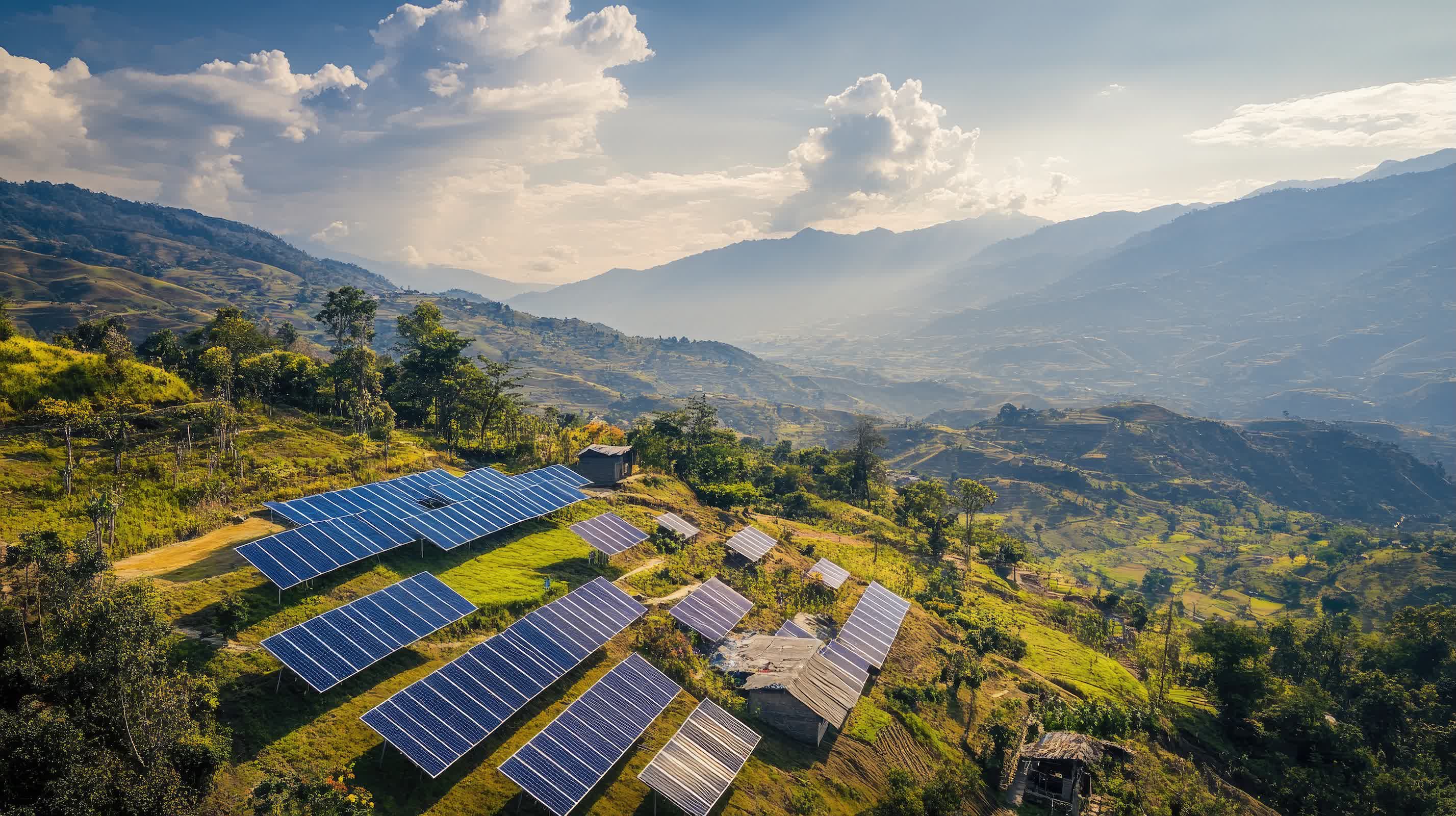
At Bestway Cement's plant in Chakwal, Pakistan, solar already supplies more than a quarter of the electricity used to make cement. The company has 26MW installed and expects to add another 6.34MW by the end of the year.

"It's the only way we can compete," Abdul Waheed, the plant's general manager, told the Financial Times. "Our rivals have already gone in this direction."

The economics are driving the shift. Solar panels that sold for $5 to $6 per watt around 2000 now cost about 12 cents per watt, according to Dave Jones, co-founder of Ember. China's manufacturing expansion is behind much of that decline. Wood Mackenzie estimates Chinese solar manufacturing capacity at roughly 1.36 terawatts.

The lower prices have made rooftop and on-site solar practical in countries where power is costly or unreliable. By the end of 2025, installed small-scale solar capacity worldwide had reached nearly 1.2 terawatts, according to the Energy Institute's Statistical Review of World Energy. While solar does not generate at full capacity around the clock, the installed total is about three times the size of the global nuclear fleet.
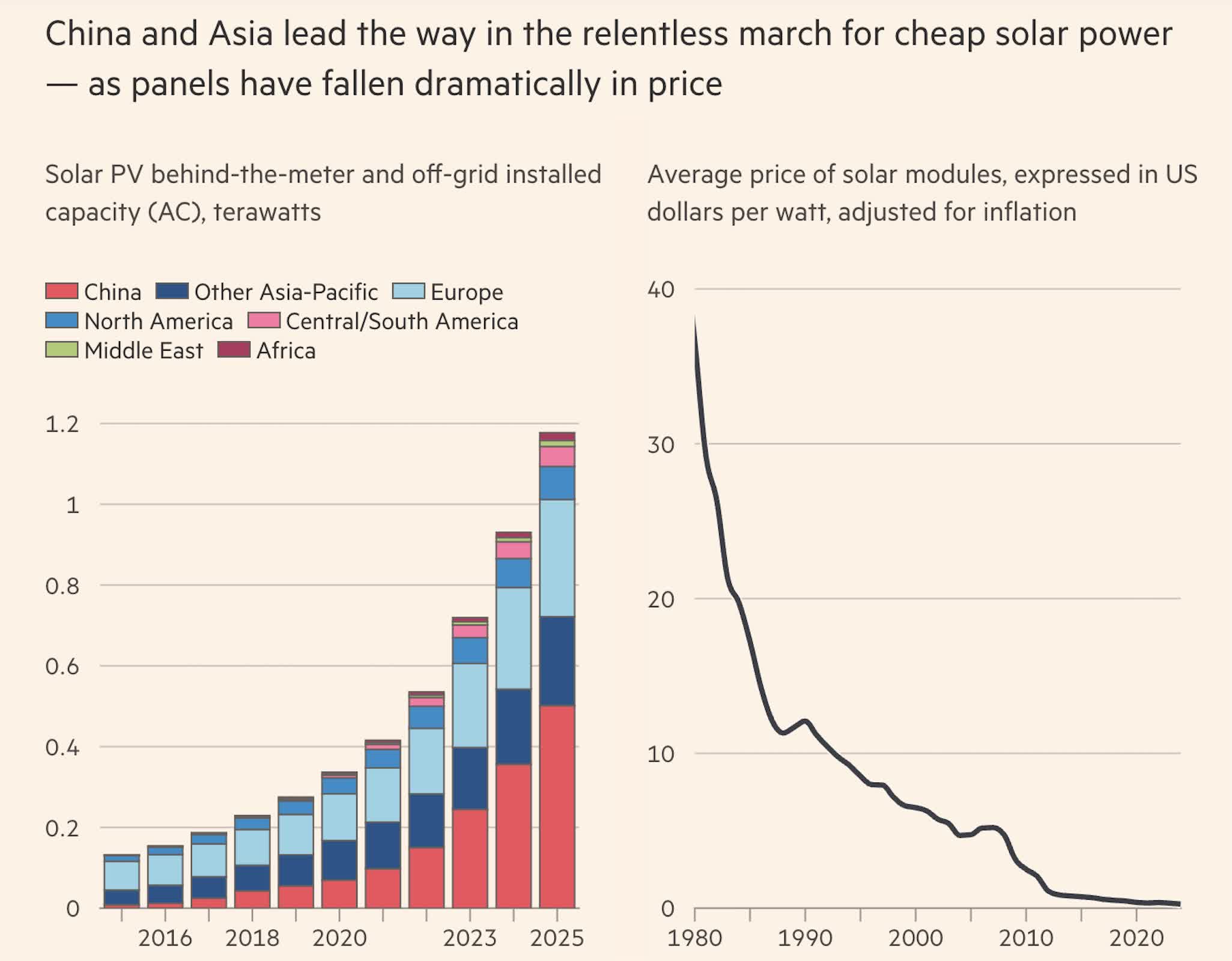
Credit: The Financial Times

Businesses have been among the fastest adopters because their peak electricity use often occurs during sunny hours. Ember expects Africa to add about 17GW of solar this year, largely through smaller systems at factories and commercial sites.

In the Philippines, rooftop solar capacity may have nearly doubled in the 12 months through April, Ember says. Meralco, the country's electricity distributor, said rooftop systems generated 372 gigawatt hours in the first six months of the year. Ember estimates that residential systems can now pay for themselves there in a little more than three years.

India is scaling rooftop systems through a national subsidy program launched in February 2024. The program has installed panels on more than 5 million homes and is adding about 500,000 homes a month, according to Tata Power chief executive Praveer Sinha. "It's a democratization of the use of electricity," he said.

But the same trend is putting pressure on utilities. Customers who can afford solar systems and batteries often use less grid power. That reduces utility revenue even though those customers still rely on the grid at night, during cloudy weather, and when their batteries run low.
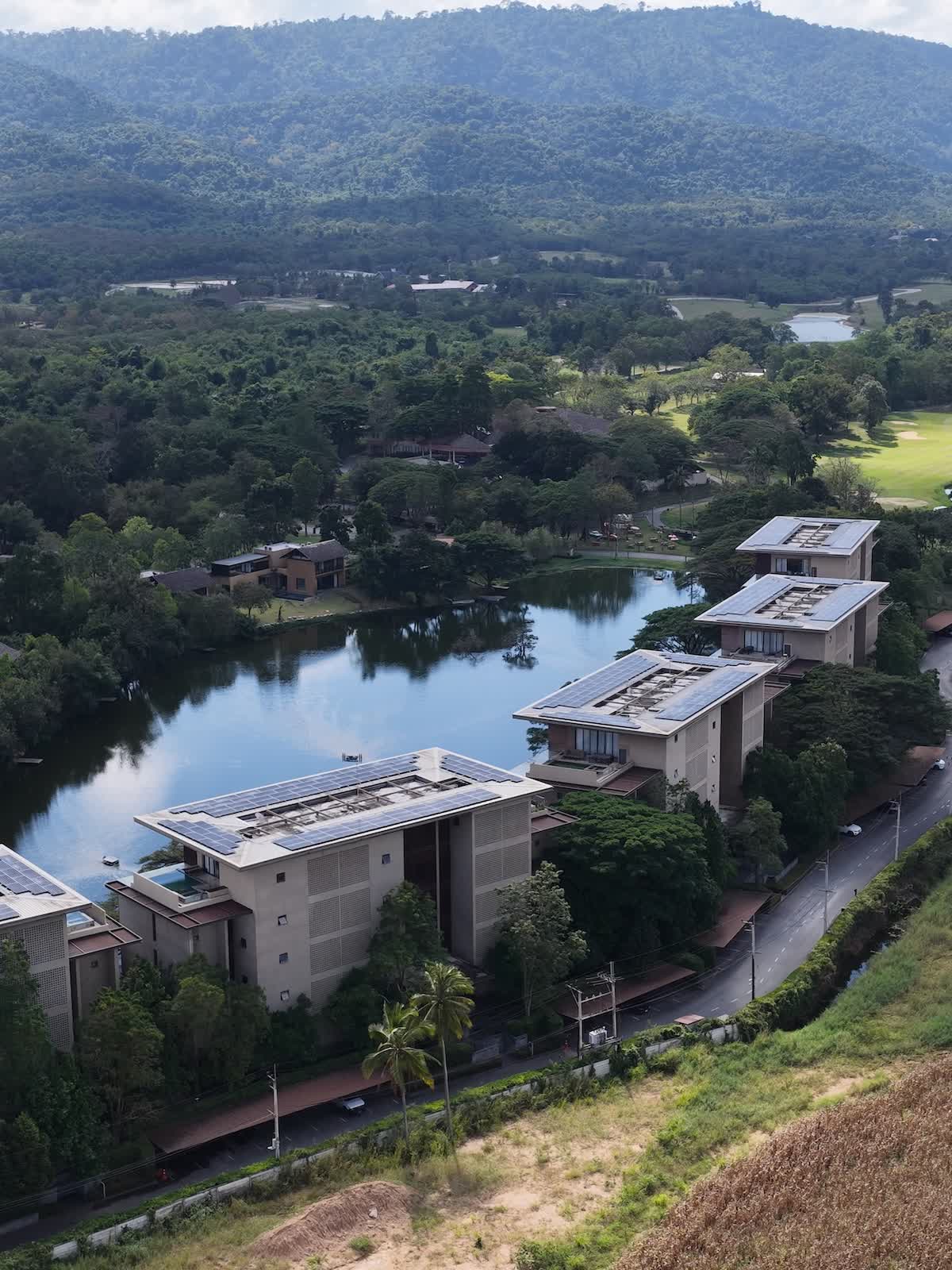
K-Electric, which supplies Karachi, has seen solar spread through the city's affluent Defence Housing Authority neighborhood. Chief executive Syed Muhammad Taha called solar panels a "curse and a blessing." The customers installing them are among the utility's best-paying users, but they are buying less electricity.

The risk is that costs shift to people who cannot install solar. In Karachi's Lyari district, K-Electric says it loses Rs30 to Rs40 ($0.31 to $0.42) for every Rs100 ($1.04) spent providing electricity. Azem Baloch, a mechanic who rents a flat in the neighborhood, said, "I am spending more than half of my income on power."

South Africa is dealing with a similar problem. Shoprite has installed solar panels on buildings and trucks in South Africa and Namibia since 2015. The retailer now has about 43MW of peak capacity and is considering batteries.

For Eskom, the country's state utility, less demand from businesses and wealthier customers means less revenue for power plants and grid maintenance. Eskom estimates rooftop solar and batteries accounted for around 7% of its 11.7 terawatt-hour decline in electricity sales in the year ended March.

Grid operators also have a technical problem. Solar production can change sharply as weather changes, especially in places with high rooftop adoption. In Australia, midday solar output can push grid demand so low that it becomes harder to operate conventional plants needed to keep the system stable.
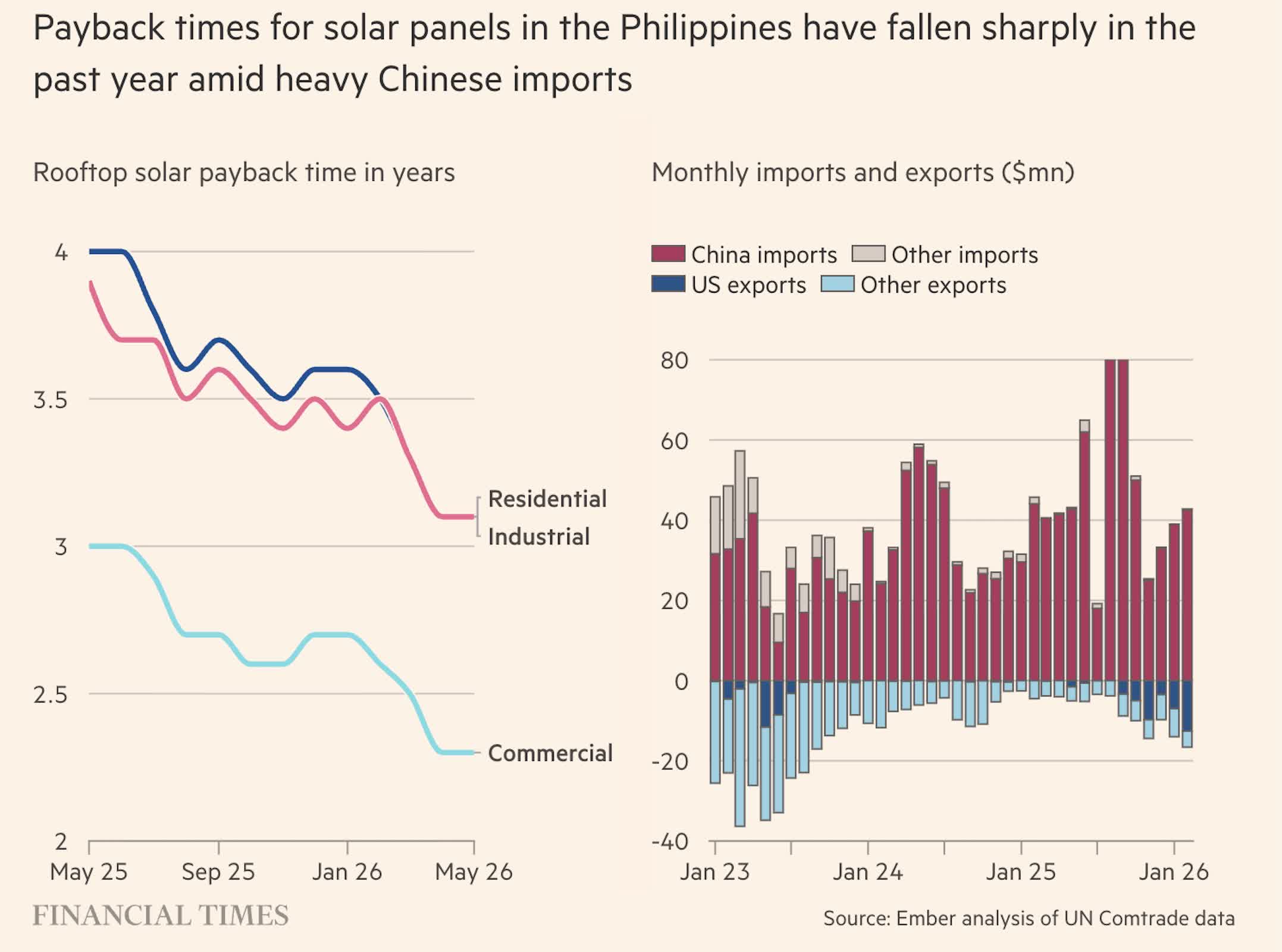
Credit: The Financial Times

Rooftop systems can also send excess power from local distribution networks into high-voltage transmission lines, increasing voltage and limiting how much electricity households can export. Forecasting output from millions of small systems has become a major task for grid operators.

Pierluigi Mancarella, chair professor of electrical power systems at the University of Melbourne, said the risk becomes clear when clouds move over areas with heavy rooftop solar use. "If you have a massive cloud formation, the rooftop PV production can drop by so much that it looks like you have lost basically almost a nuclear power station."

Utilities are responding with batteries, new tariff models and better forecasting tools. UK Power Networks recently completed a £389,000 ($523,992) study on machine-learning models to estimate how much solar capacity is connected to its network. Solar forecasting company Amperon retrains its models every hour to account for changing conditions.

The shift is unlikely to slow. Solar is becoming a standard way for businesses and households to lower energy costs, but it is also turning the traditional power grid into a more complex system – one that must handle electricity flowing in both directions.

Permalink to story:

 
That's how Solar power investments were supposed work from the very beginning, but instead it became another hassle, another misleading production, another bill on top of everything else.

When these companies really want a product to succeed and take off they find ways to do it otherwise it would be stuck for decades just like the electric car did from its creation in the 1930s till they finally found a need to rush its technology and creating demand in 2020.
 
Somehow I don't feel It on my monthly energy bill, so I call It BS. Grid operators will always find excuse to keep Their margins high.
 
Somehow I don't feel It on my monthly energy bill, so I call It BS. Grid operators will always find excuse to keep Their margins high.
Could be that the energy price is tied to the generation from a coal or gas fired plant still due to concerns if the price drops, those facilities will just stop producing energy, which is a measure we had for a while in the UK for example until more recently where cheaper renewable production was at a high enough level to offset the risk
 
South Africa has actually changed the law. They could not provide stable power for 10+ years, so people used alternative methods and installed solar panels. Now they changed the law so that you have to register your solar thus they can still bill you. They gave my mother 8k bills for 3 months, from 1.5k, and this month, straight 24k. She's a 70-year-old pensioner, but this is because of her skin color. We have an opposing party looking into this now.

This is how dumb they actually are. They first tried to say they did not take her readings for 8 years; now, as I know the law, I told them you cannot hold my mother accountable, and then they changed they took incorrect estimates. The reason why they changed the 8 year argument, they knew it would never hold up in court, as they are responsible for that. Because of this, my mother can lose her house because of this corrupt government. This is just the tip of the iceberg of how corrupt the South African government is. They value money over fighting poverty.
 
South Africa has actually changed the law. They could not provide stable power for 10+ years, so people used alternative methods and installed solar panels. Now they changed the law so that you have to register your solar thus they can still bill you. They gave my mother 8k bills for 3 months, from 1.5k, and this month, straight 24k. She's a 70-year-old pensioner, but this is because of her skin color. We have an opposing party looking into this now.

This is how dumb they actually are. They first tried to say they did not take her readings for 8 years; now, as I know the law, I told them you cannot hold my mother accountable, and then they changed they took incorrect estimates. The reason why they changed the 8 year argument, they knew it would never hold up in court, as they are responsible for that. Because of this, my mother can lose her house because of this corrupt government. This is just the tip of the iceberg of how corrupt the South African government is. They value money over fighting poverty.
I'm sorry to hear that your mother is having so much difficulty.

So what you are telling us is that things haven't changed much since before Apartheid?
 
Last edited:
Such as it is, Solar has become a disruptive technology now that its price is so low. Sometime, I expect things will work out and Solar will become a dominant technology. It is less expensive and faster to implement than nuclear. Depending on where you live and whether you are able to put an array up that serves your electric needs, especially if backed up by Wind or sufficient battery storage, doing so could be very advantageous.
 
Last edited:
Such as it is, Solar has become a disruptive technology now that its price is so low. Sometime, I expect things will work out and Solar will become a dominant technology. It is less expensive and faster to implement than nuclear. Depending on where you live and whether you are able to put an array up that serves your electric needs, especially if backed up by Wind or sufficient battery storage, doing so could be very advantageous.

Solar/Wind + Battery is probably sufficient for the majority of demand; throw in a few nuclear plants for baseline production needs and your set.

Coal is currently the most expensive non-nuclear power option; there's no economic justification for their continued operation.
 
THIS is why republicans are banning inverters. They are tied to their coal/natgas power plants and all the bribes, and Solar+wind+hydro kill their meal tickets faster than meal-team-six ICE executing brown and black legal US residents and deporting brown US soldiers.

full recyclable Sodium ION batteries + wind and solar will eventually win though because every day there are more democrats than republicans. they will go extinct and we will undo everything they have done in the last 20 years.
 
Solar/Wind + Battery is probably sufficient for the majority of demand; throw in a few nuclear plants for baseline production needs and your set.
The problem is that if properly sized, solar/wind + battery could significantly reduce the need for grid power as was covered in the article. Does nuclear (I have nothing against it) then retain cost effectiveness to justify the cost of building the plants - even SMRs?
Coal is currently the most expensive non-nuclear power option; there's no economic justification for their continued operation.
I'm not sure I agree with that, although, I do agree coal needs to die. Coal is certainly the most polluting, and when the EPA is doing its job, no rational energy company would build a new coal plant, however, traditional nuclear is likely far more expensive to build. Maybe not SMRs, but traditional nuclear plants.
 
full recyclable Sodium ION batteries + wind and solar will eventually win though because every day there are more democrats than republicans.
In the not-too-distant future, Solid State batteries will be in full commercial production as three automobile companies are actively road testing them. No currently available battery technology will be able to compete against them. Believe it or not, this is coming to fruition in an apolitical way even with 47's war on EVs.
they will go extinct and we will undo everything they have done in the last 20 years.
I agree that the current GOP is committing suicide, and democrats will undo everything Tantrump has done. Let's hope that they find a way to really "build back better."
 
Since putting solar on my roof, I havent had to pay one cent in electricity. it works great and I reduce the load on the grid by doing so.

Yes, I have to still draw during off hours but I produce way more than I am using.

A battery would get me off the grid entirely and that will be next.

Its very viable and as a long term investement, very valuable. I essentially have paid for electricity for 20 years and it will amortize itself in about 6-8 depending.

If houses had solar by default or apt buildings, we could reduce our reliance on coal but thats not what the oligarchs want and not where their pockets get lined so its been an uphill battle politically. Clean energy being considered a "woke" thing is so odd.

I am even starting to see parking lots with solar panel covers which is amazing, shade for your car and generating electricity at the same time!
 
Back