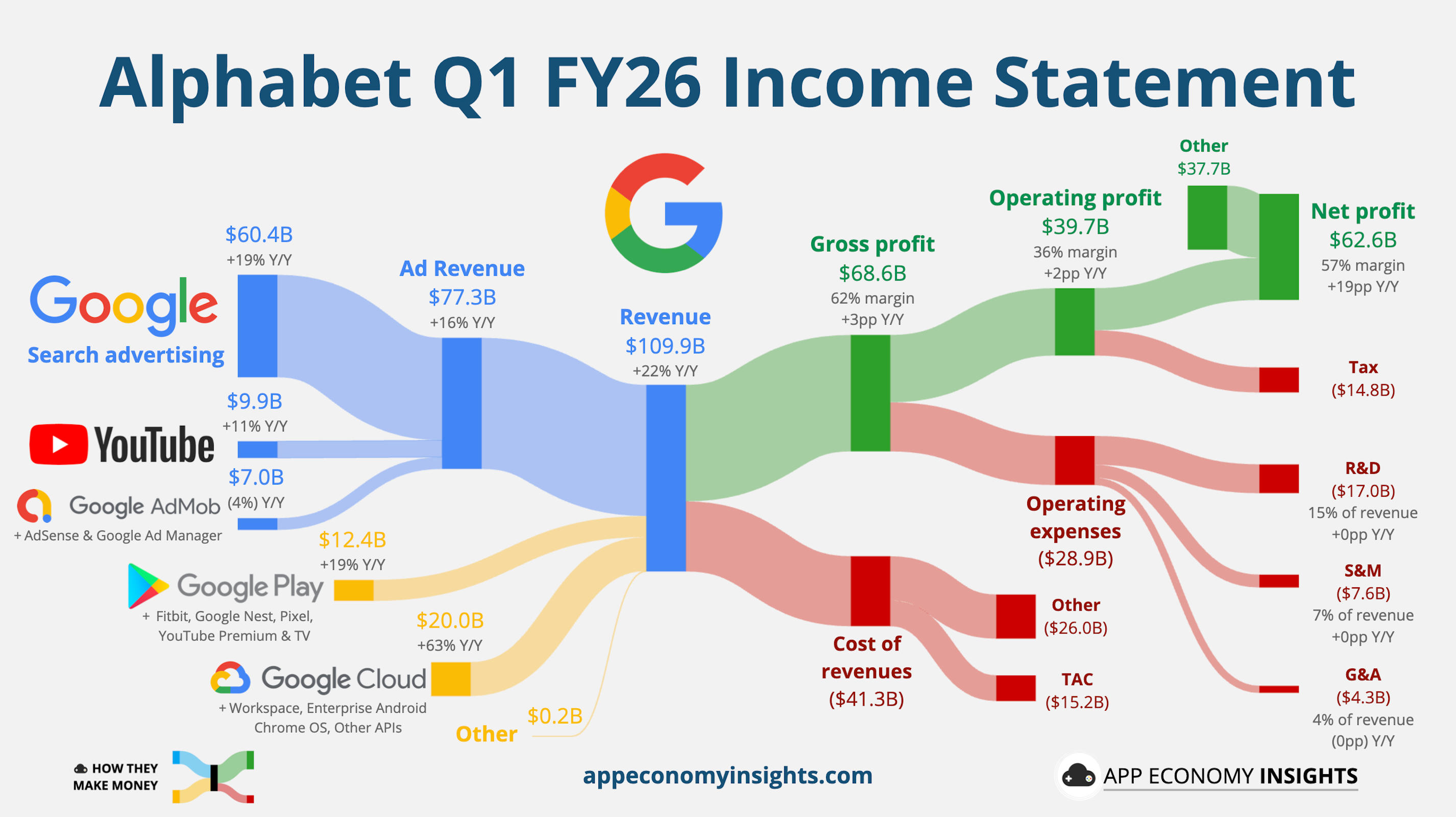
Bottom line: Alphabet's latest results show how central artificial intelligence has become to its growth – and how aggressively the company is increasing spending to support the technology. The Google parent reported $94.7 billion in first-quarter revenue, excluding partner payouts, beating analysts' expectations of $91.6 billion. Earnings came in at $5.11 per share, well above the $2.62 estimate. Investors responded quickly, pushing the stock up more than 6% in after-hours trading.
Much of Alphabet's momentum is tied to AI, particularly inside Google Cloud. The division brought in $20 billion in revenue, ahead of the $18.4 billion analysts had projected, and showed what the company called a "meaningful acceleration in growth." Just as notable, its backlog – future revenue under contract – nearly doubled from the previous quarter to more than $460 billion, reflecting growing demand for AI infrastructure and services.
That demand is strong enough that Google can't fully keep up. "We are compute constrained in the near term, and as an example, our cloud revenue would have been higher if we were able to meet the demand," CEO Sundar Pichai said. "We are working through that moment and investing."
The scale of that investment is significant. Alphabet now expects to spend up to $190 billion on capital expenditures this year, slightly above its prior estimate and roughly double its 2025 spending. Chief Financial Officer Anat Ashkenazi said spending will climb further in 2027. "These strong results reinforce our conviction to invest the capital required to continue to capture the AI opportunity," she said.
Credit: App Economy Insights
A significant portion of that spending is going toward hardware. Google's tensor processing units, or TPUs, have long powered its internal AI workloads, but the company is now preparing to offer them directly to select customers for use in their own data centers. The move puts TPUs in more direct competition with Nvidia's chips as companies seek scarce high-performance compute.
On the software side, adoption is rising alongside infrastructure. Google said use of its Gemini models continues to expand across both consumer and enterprise products. The Gemini chatbot reached 750 million users by the end of 2025, while paid monthly active users for Gemini Enterprise grew 40% from the previous quarter.
At the same time, Google is continuing to rework its core search business around AI. The company now integrates AI-generated answers directly into many search results, and Pichai said query volume has reached an all-time high since those features were introduced. He also noted that Google has reduced the cost of serving AI-powered responses, addressing earlier concerns that generative AI could make search significantly more expensive to operate.
The results help address investor concerns that chatbots from companies like OpenAI and Anthropic could erode Google's search dominance. "AI has enhanced search, not killed it," Andrew Rocco, a strategist at Zacks Investment Research, wrote. "Google has masterfully integrated AI into its search offering."
Even so, the competitive landscape is becoming more complicated. Alphabet is both a backer of and a rival to some of the companies competing in the same AI markets. It has invested heavily in Anthropic, with plans to put up to $40 billion into the startup, while also competing against it in areas like AI coding tools. Anthropic's Claude Code, in particular, has emerged as a fast-growing product that has drawn attention inside Google.
For now, Alphabet's results indicate that its strategy – spanning chips, cloud, and AI applications – is gaining traction. But the company's own comments about limited compute capacity point to a constraint that extends beyond Google. Across the industry, scaling AI is becoming as much an infrastructure challenge as a software one.
Google's AI bet is paying off: Alphabet posts $94.7 billion Q1 revenue, AI demand outpaces supply


