The big picture: Virginia high school student Mia Heller has built a working water filter that strips out nearly all microplastics from drinking water without using a traditional membrane – and then recycles its own magnetic filtration medium. Her latest prototype, about the size of a bag of flour, is designed as a stand-alone, at-home filter that can process roughly a liter of water at a time. "The result is an affordable, low-waste filtration system without the use of a solid membrane," Heller said.
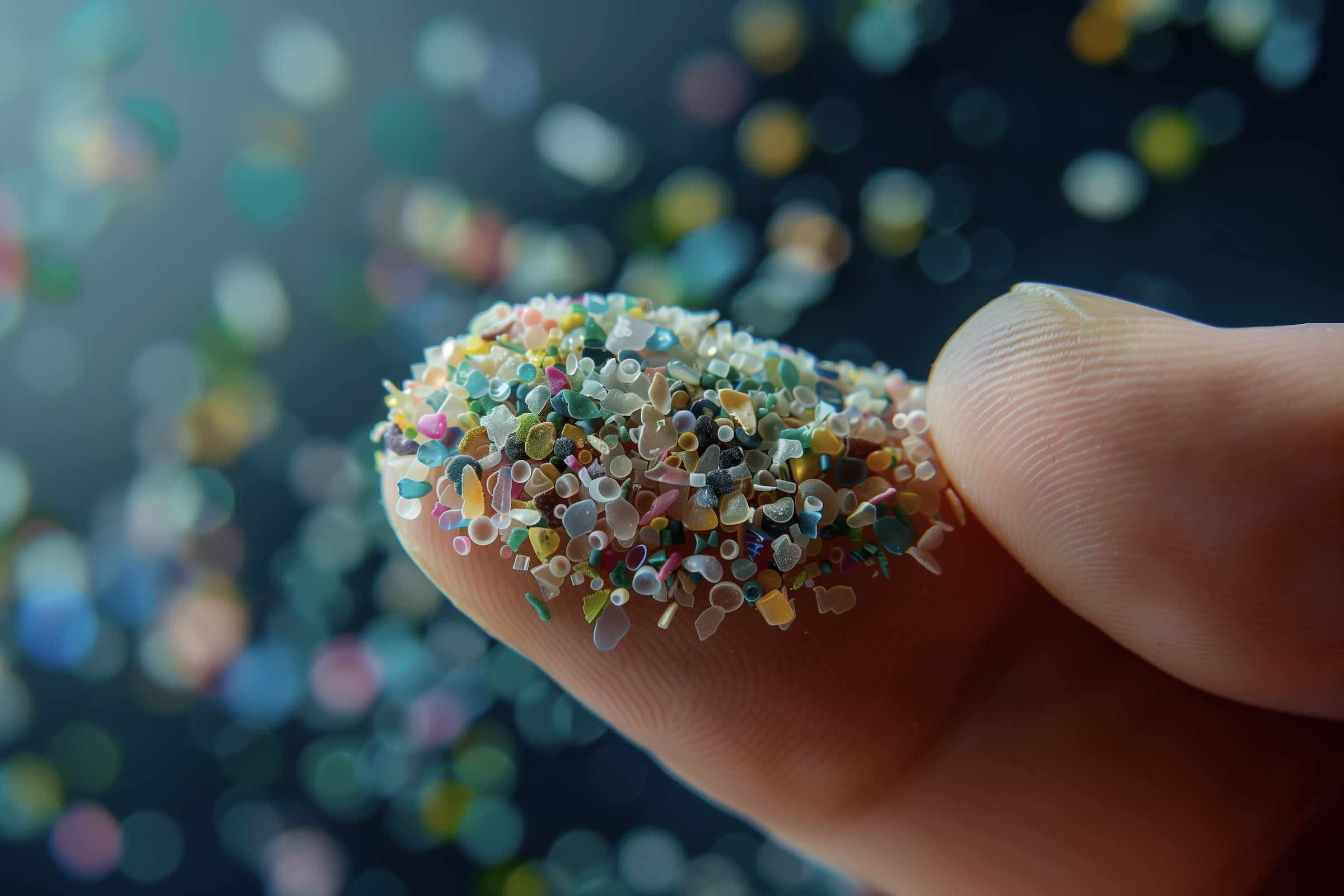
As reported by Smithsonian Magazine, Heller's interest in water treatment began close to home in Warrington, Virginia, after she read a local newspaper story about contamination in her neighborhood's drinking water. Tests had found high levels of PFAS and microplastics, and officials made clear that no government money would be available for filtration. "It was up to people to provide their own filtration," said Heller.
Her parents responded by installing an advanced filtration system, but the equipment required frequent attention. Watching her mother repeatedly replace filter membranes, Heller started looking for an approach that could cut both cost and maintenance. "It inspired me to design a filter without the use of membranes, to decrease the costs and maintenance needs associated with water filtration," said the now 18-year-old student at Kettle Run High School, who also attends a half-day math, science, and technology program at Mountain Vista Governor's School.
She first conceived the core idea in the spring of 2024 and began intensive work the following summer. By early January 2025, after experimenting in her garage and kitchen, Heller had a basic proof of concept. "It was essentially just a container," she said.
Inside, she built what she called a "spinning magnified vial," using ferrofluid – a reusable magnetic oil – to selectively bind to microplastic particles as water passed through. The early version removed microplastics in two steps, but because the ferrofluid was not automatically recovered, the system still demanded ongoing maintenance.
"But if I could create a system that was able to basically clean itself and reuse material," she explained, "the maintenance needs could go down by a lot." Making that closed loop work became the main engineering challenge. She needed to position the components so the ferrofluid, which is thicker than water, could move into the water chamber above it without clogging the flow. At the same time, magnetic separation and ferrofluid recovery had to operate as a single, coordinated process rather than in opposition.
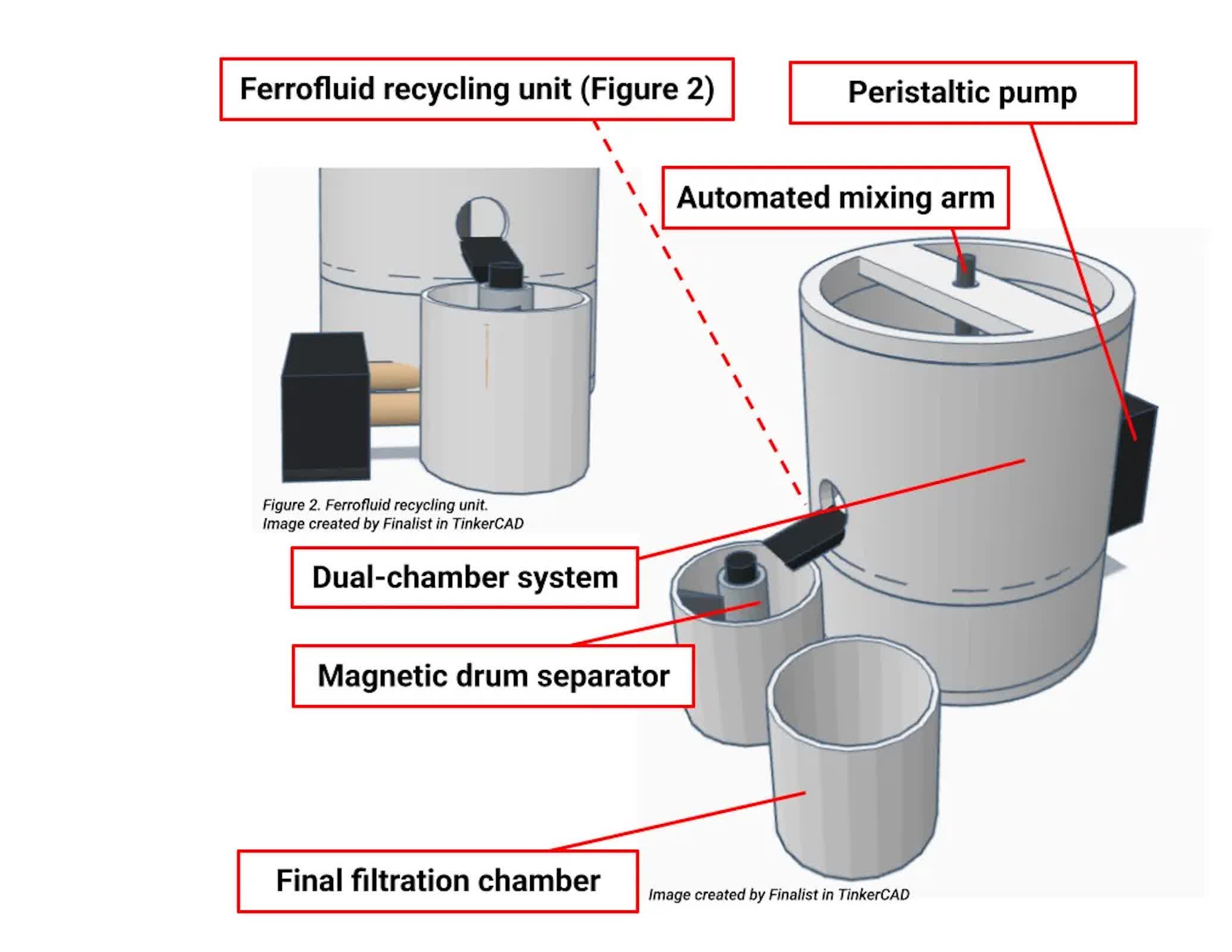
Image credit: The Smithsonian Magazine
After about five design cycles, Heller arrived at the three-module configuration she is now testing. The first unit, with a volume of about one liter, holds the contaminated water. A second unit stores the magnetic oil-based ferrofluid. The much smaller third module is where the physics comes into play: "A magnetic field pulls the microplastics out of the water, and the ferrofluid is recovered and reused in a closed loop," explained Heller. In its current form, the device operates like a consumer pitcher filter, but with a ferrofluid-based separation stage in place of a solid membrane.
To validate performance, Heller built a turbidity sensor capable of measuring suspended solids in the water stream. She used the sensor to quantify both ferrofluid and microplastic levels and to calculate the weight-based percentage of microplastics removed. Her tests showed that the prototype removed 95.52% of microplastics and recycled 87.15% of the ferrofluid.
For comparison, traditional drinking-water treatment plants typically remove about 70 to 90% of microplastics. "The result is an affordable, low-waste filtration system without the use of a solid membrane," she said.
The project has already earned recognition on the competition circuit. Heller was a finalist at the 2025 Regeneron International Science and Engineering Fair, regarded as the world's largest science competition for high school students. There, she received a $500 special award from the Patent and Trademark Office Society for her low-cost, efficient filtration design.
Researchers see her work emerging amid intensifying concern about microplastics in the environment and the human body. The Environmental Protection Agency defines microplastics as particles ranging from 1 nanometer to 5 millimeters in size, and these fragments are now widely found in ecosystems and living organisms. "Micro- and nanoplastics are getting into our bodies," said Matthew J. Campen, a toxicologist at the University of New Mexico in Albuquerque who studies complex inhaled pollutant mixtures and their effects on respiratory, cardiac, and vascular outcomes.
Microplastic intake by organisms has increased sixfold since 1990, and a 2025 University of New Mexico study co-authored by Campen reported a roughly 50% rise in microplastic concentrations in human brain tissue over less than a decade.
The health implications of that exposure are still under active study. Even so, multiple recent studies have associated microplastic consumption with cancers, respiratory and cardiac diseases, hormonal disruptions, Alzheimer's disease, and other noncommunicable illnesses.
From an engineering and public health standpoint, Campen views Heller's system as an encouraging direction. He called it a "really great idea," adding that "She is doing something that has to be done." Still, he underscored open technical questions. "We have to know that the way she extracts these microplastics captures them in a way that we can then discard them or destroy them in a way that gets rid of them completely," he said.
Any viable solution, he added, must not "leave some other pollutant residue that we have to deal with." If those concerns can be resolved, the next question is scale: should a technology like Heller's live at the household level, inside individual plumbing systems, or be deployed upstream at municipal treatment plants?
For now, Heller sees a clear use case in the home. Before exploring commercialization, she wants independent labs to confirm the performance numbers she obtained in her own testing. "I would love to eventually bring it out to market," she said. "I think that would be something that would be really interesting."
High school student develops membrane-free filter that removes most microplastics from water


