Hubble observes Cloud-9, a failed galaxy dominated by dark matter

Alfonso Maruccia

Posts: 2,602   +978
Staff
The Cosmic Picture: An international team of researchers has observed the first-ever instance of a new type of celestial object. Dubbed Cloud-9, the structure is a gas cloud composed primarily of dark matter. Unlike typical clouds that collapse to form stars, Cloud-9 never developed into a single star and may offer a unique window into the so-called "dark universe," which is dominated by dark matter.
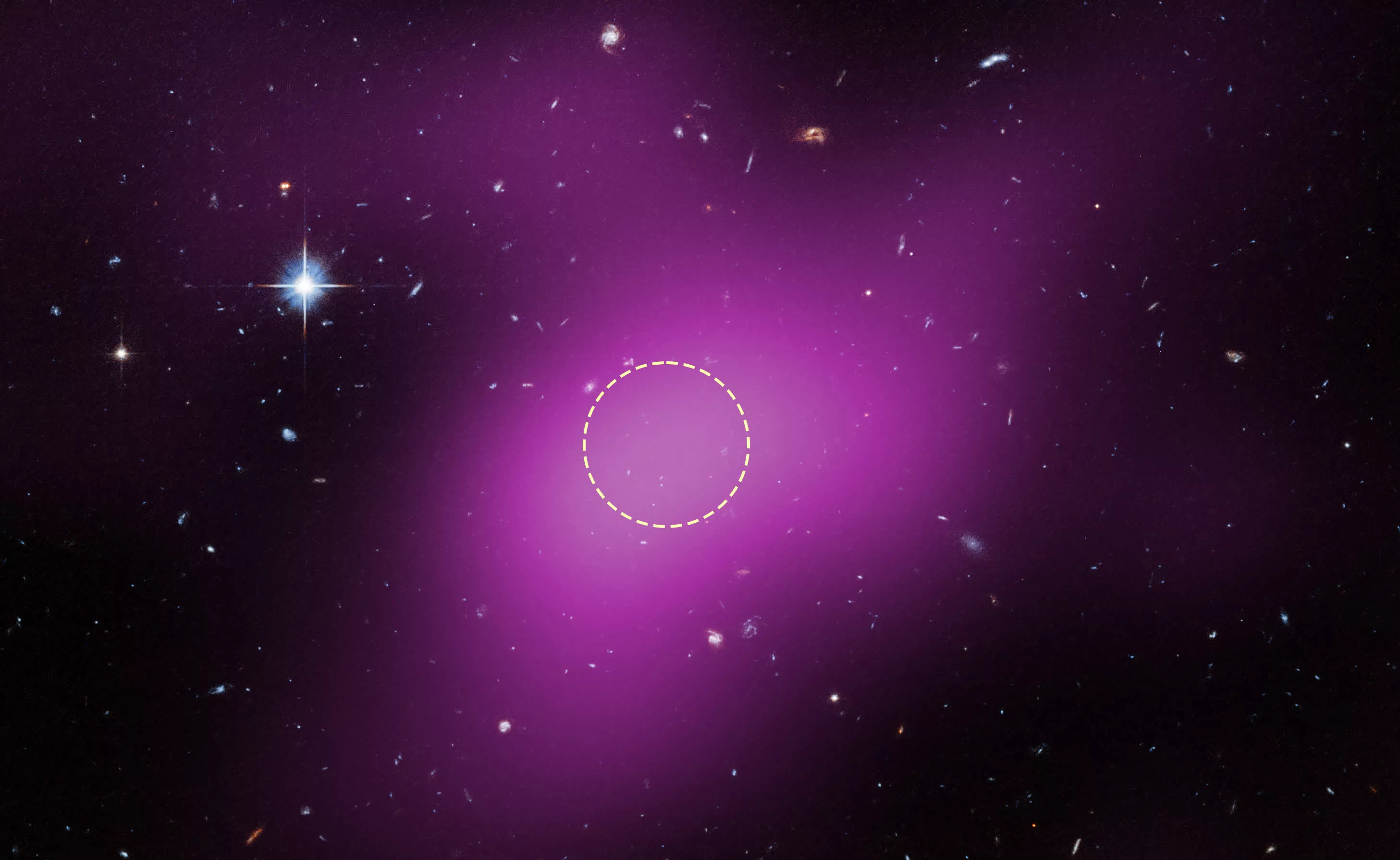
The researchers describe Cloud-9 as a failed galaxy, a "relic" or remnant of the processes that gave rise to early galaxies. Alejandro Benitez-Llambay suggested that the cloud can be considered a fundamental building block of a galaxy that never fully formed.

Cloud-9 was first detected three years ago during a radio survey conducted with two ground-based radio telescopes. Follow-up observations using the Hubble Space Telescope confirmed that the gas cloud contains no stars and exhibits a compact, highly spherical shape.
Dark matter is a hypothetical, invisible form of matter believed to shape the major cosmic structures in our universe. It does not interact with electromagnetic radiation and can only be detected through its gravitational influence on celestial objects composed of ordinary matter.

The object is technically known as a Reionization-Limited H I Cloud, or "RELHIC." It is composed mostly of neutral hydrogen and spans approximately 4,900 light-years in diameter. By analyzing its radio emissions, the researchers determined that the cloud contains gas with a mass roughly one million times that of the Sun. The gas pressure balances the gravitational pull of the dark matter, implying that Cloud-9 contains around five billion solar masses of the exotic substance.

Cloud-9 is located on the outskirts of Messier 94 (M94), a spiral galaxy about 16 million light-years away from the Milky Way. A 2008 study suggested that M94 contains almost no dark matter, but the new research on Cloud-9 indicates that the two objects are interacting in some way.

Astronomers speculate that RELHICs like Cloud-9 are clouds with high concentrations of dark matter that failed to attract enough gas to ignite stars. Other RELHICs likely exist in the universe, as dark matter continues to influence the formation and evolution of galaxies and other large cosmic structures.

Cloud-9 may eventually develop into a star-bearing galaxy far in the future, but for now, it appears to reside in a "sweet spot" where RELHICs remain stable without forming stars. Thanks to the unprecedented insights gained from studying Cloud-9, researchers are planning new radio surveys to search for additional failed galaxies.

Permalink to story:

 
At present, the Standard Model doesn't account for dark matter. I think the long-awaited successor to quantum mechanics and general relativity will cause a fundamental change in the Standard Model, and the current version will be seen as an approximation to the deeper description, which would, among other things, predict and explain what dark matter really is.

There are many gaps in physics and cosmology—the measurement problem, singularities, the problem of time, dark matter and energy, matter-antimatter assymetry, etc.—and without a theory of "quantum gravity" (it may end up not being quantum in the conventional sense, and GR's bidding defiance to quantisation certainly suggests that), these problems will remain.
 
"After the Big Bang, dark matter clumped into blobs along narrow filaments with superclusters of galaxies forming a cosmic web at scales on which entire galaxies appear like tiny particles."


This reminds me of a scene in Prey when the Alien cloud envelopes the space station, developing the narrative, that these Alien's metamorphosis element has it's fabric in the very structure of space itself, like some kind of genetic structure. Aliens were always present, it came to player's realisation just later.

Dark matter and dark energy. We can conclude that this pier must have a law that governs weaker structures, genetic forms and star formations.
 
Calling this a “dark-matter cloud” feels like putting the conclusion in the premise.

What’s actually observed is a starless hydrogen cloud with unusual dynamics; the rest is a model-dependent inference that assigns billions of solar masses of invisible matter to make the equations work. That’s not a detection of dark matter, it’s an interpretation within a framework that already assumes it exists.

Interesting object, sure—but branding it as a new class of dark-matter-dominated structure seems premature until there’s a testable prediction that clearly distinguishes dark matter from modified gravity or environmental effects. Otherwise this is just a hypothesis layered on assumptions, retrofitting an invisible component until the math balances.
 
Calling this a “dark-matter cloud” feels like putting the conclusion in the premise.

What’s actually observed is a starless hydrogen cloud with unusual dynamics; the rest is a model-dependent inference that assigns billions of solar masses of invisible matter to make the equations work. That’s not a detection of dark matter, it’s an interpretation within a framework that already assumes it exists.

Interesting object, sure—but branding it as a new class of dark-matter-dominated structure seems premature until there’s a testable prediction that clearly distinguishes dark matter from modified gravity or environmental effects. Otherwise this is just a hypothesis layered on assumptions, retrofitting an invisible component until the math balances.
To be fair to the dark matter claim, scientists don't know what dark matter is, or even if it is explainable by only 1 thing. It's fairly common to describe a phenomenon which has "more gravity than it should based on the observable matter" as dark matter. Dark matter is really a name for a behavioral observation, not so much the solution as to what causes the observation. So, is it wrong to call this dark matter? No, but that doesn't mean that the "dark matter" which explains this is the same as the "dark matter" that explains other phenomenon. It might be, it might not. This does seem to fit within the ΛCDM model of the universe (lambda, for the cosmological constant we currently use to describe dark energy, cold dark matter), as an object like this isn't composed of hot (high velocity) dark matter.

Put another way, "the rest is a model-dependent inference that assigns billions of solar masses of invisible matter to make the equations work" is more or less the definition of dark matter (distribution of how mass is assigned aside, as there are competing ideas there).
 
To be fair to the dark matter claim, scientists don't know what dark matter is, or even if it is explainable by only 1 thing. It's fairly common to describe a phenomenon which has "more gravity than it should based on the observable matter" as dark matter. Dark matter is really a name for a behavioral observation, not so much the solution as to what causes the observation. So, is it wrong to call this dark matter? No, but that doesn't mean that the "dark matter" which explains this is the same as the "dark matter" that explains other phenomenon. It might be, it might not. This does seem to fit within the ΛCDM model of the universe (lambda, for the cosmological constant we currently use to describe dark energy, cold dark matter), as an object like this isn't composed of hot (high velocity) dark matter.

Put another way, "the rest is a model-dependent inference that assigns billions of solar masses of invisible matter to make the equations work" is more or less the definition of dark matter (distribution of how mass is assigned aside, as there are competing ideas there).
Dark matter’s existence is not settled science. It is a hypothesis inferred from gravitational anomalies—not an observed or directly identified entity.

While it is the dominant explanatory model, it has not been directly detected or physically identified, and alternative explanations (such as modified gravity theories) remain scientifically viable.

Observations demonstrate missing or unexpected gravitational effects; concluding that these effects must be caused by a specific, unseen form of matter is a model-dependent interpretation, not an established fact.

History shows that many widely accepted scientific models have later proven incomplete or wrong. For that reason, there is no justification for treating dark matter as definitively real rather than provisional—at least not yet.
 
Calling it a failed galaxy sounds harsh, but it’s kind of amazing that something can sit there for billions of years as a pristine fossil of early structure formation. It’s like finding a half-built city preserved exactly as construction stopped.
 
Back