In a bizarre twist, robots protest in Poland to warn that AI and automation could take human jobs

midian182

Posts: 11,898   +182
Staff member
WTF?! In an ironic turn of events, humanoid and quadrupedal robots in Poland protested outside of the country's digital affairs ministry. The machines demanded increased regulation of AI and automation to protect human jobs from being replaced. But this wasn't some kind of Futurama-like scenario where the robots had decided to stick up for us meat sacks.
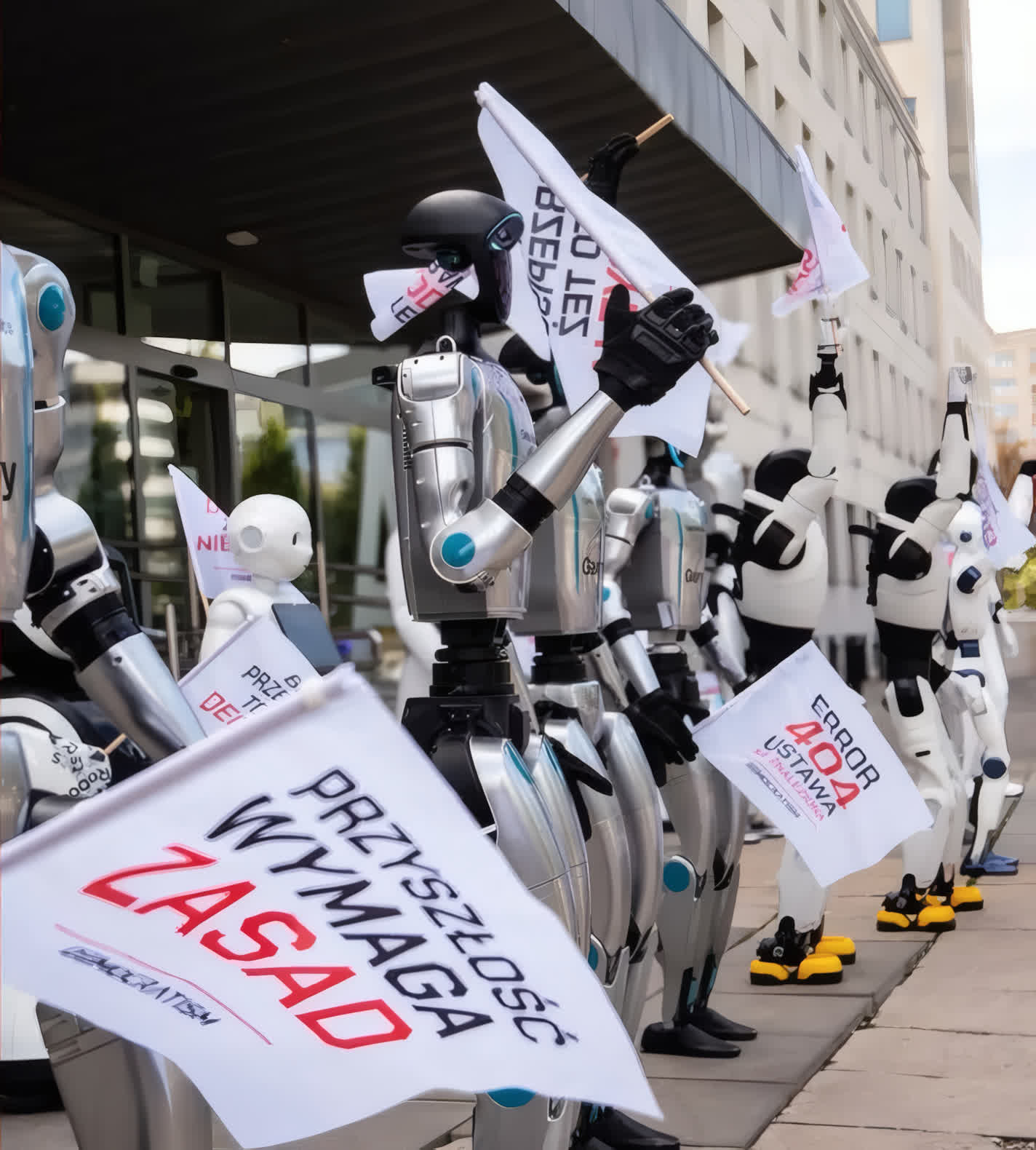
The protest, which saw around 30 robots "chanting" slogans, holding signs, and marching in circles, was organized by Democratism. The group aims to launch a public debate on how rapid AI and advancements in robotization impact the human labor market, according to its website.

"We want regulations, we want rules, we want law" were some of the chants played through loudspeakers. "Don't wait, regulate, protect jobs."

Organizer Grzegorz Kuliś said, "We particularly want to address the issue of the potential replacement of people both by humanoid robots and by artificial intelligence in cognitive work."

The use of the robots was meant to illustrate that the threat of machines and AI taking jobs is no longer theoretical. With the robots' existing capabilities on show, it was hoped that the display would make people pay attention and spark a debate.

"If we don't react now, we may soon have a problem," Kuliś said.

The word "protesting" is doing a lot of heavy lifting here. The video shows the machines being manually placed, the chanting was reportedly pre-loaded, and there isn't a whole lot of movement going on – it doesn't look like the riot police were on standby.

That's not to say the threat isn't real. There have been numerous stories about humanoid robots moving into jobs traditionally occupied by people who inconveniently require wages, breaks, and the occasional day off.

Amazon has long been using robots in its warehouses, while BMW announced plans to put Figure's humanoids to work in its factories. Hyundai's proposed deployment prompted its union to warn of a "huge employment shock."

The companies tend to insist the machines will help workers, not replace them – a line that's becoming very familiar. Arm's CEO was rather less reassuring, predicting that AI-powered robots would replace most factory workers within five to ten years.

That's not to mention the AI-specific job losses that are happening across the globe, either. US tech firms in particular have laid off tens of thousands of people in recent times as they focus on automation and paying for AI infrastructure.

"We are constantly debating the impact of migrants on our society, whilst the vast majority of 'migrants' will arrive either via undersea cables across the Atlantic in the form of AI agents, or as humanoid robots in shipping containers from China," Kuliś warned.

Permalink to story:

 
How about if we send robots to protest for us so that when the human ICE agents and law enforcement attempt to harm them, arrest them, etc, they end up fighting wave after wave of Terminators...
 
How about if we send robots to protest for us so that when the human ICE agents and law enforcement attempt to harm them, arrest them, etc, they end up fighting wave after wave of Terminators...

The regime can send their own bots to strike down the protest. We can place bets on the outcome on Kalshi.
 
People really don't understand the existential threat of mass automation to society. What are people supposed to do when the only jobs left are low-paying, dirty ones that robots can't do? That's how its going to play out.
 
People really don't understand the existential threat of mass automation to society. What are people supposed to do when the only jobs left are low-paying, dirty ones that robots can't do? That's how its going to play out.
Disagree. Comments like this, IMHO, misunderstand how human economics function. Automation is not a one-way street to economic collapse.

Economy is governed by supply and demand. Full stop. If robots take every job and people have no income, corporations would destroy their own markets, rendering their automated factories worthless. No business survives without consumers. Businesses are owned by people and they require people to survive.

Future automation transitions will map the same as all historic shifts because economics requires balance.

The only purpose of automation is to drive down manufacturing costs. This leads to increased competition as market barriers relax, forcing businesses to pass savings onto consumers and drastically lowering the cost of those goods.

This shift redefines monetary value (inflation/deflation) and what employment pays people. Survival becomes radically cheaper, and the entire economic ecosystem is forced to realign. Automation leads to growth and higher yields—bigger for cheaper, not collapse.

Yes, there will be some painful transitions as people learn to navigate a new economic reality. There may be recessions and downturns. But those realities will only serve to lead market corrections the same way they have for centuries of historic human advancement. There is not going to be a collapse into some existential customerless void—that’s a fear with no basis in function.

Automation will open new markets, like mega projects that could never be taken on in the current economic environment. For example: if anyone ever wants to build the Starship Enterprise, it will take a future with an army of automated robots, in combination with humans, to achieve. We simply could never reach the conclusion of such a project on any reasonable timeline without it.

Fear of the unknown is totally fair. And, on an individual level, nobody likes having to relearn how to survive—there are going to be winners and losers (like with all things in life). But the overall logic supports the notion, for humanity as a whole, that the only thing we have to fear here, is fear itself (yet again).
 
The robots aren't doing anything except executing instructions on behalf of their owners, who are apparenty either too few in number, or too lazy to fill the sidewalks on their own. They seem well funded though.
 
Back