Intel Arc B580 matches RTX 4060 and RX 7600 XT in Geekbench, but in-depth reviews will tell the full story

Daniel Sims

Posts: 2,470   +74
Staff
Something to look forward to: With Intel's second generation of discrete graphics cards just days from launch, Geekbench leaks are starting to put the company's performance claims to the test. Early reports suggest the Arc B580's performance is comparable to existing mid-range competitors, but detailed analysis from TechSpot and other outlets will paint a more complete picture.
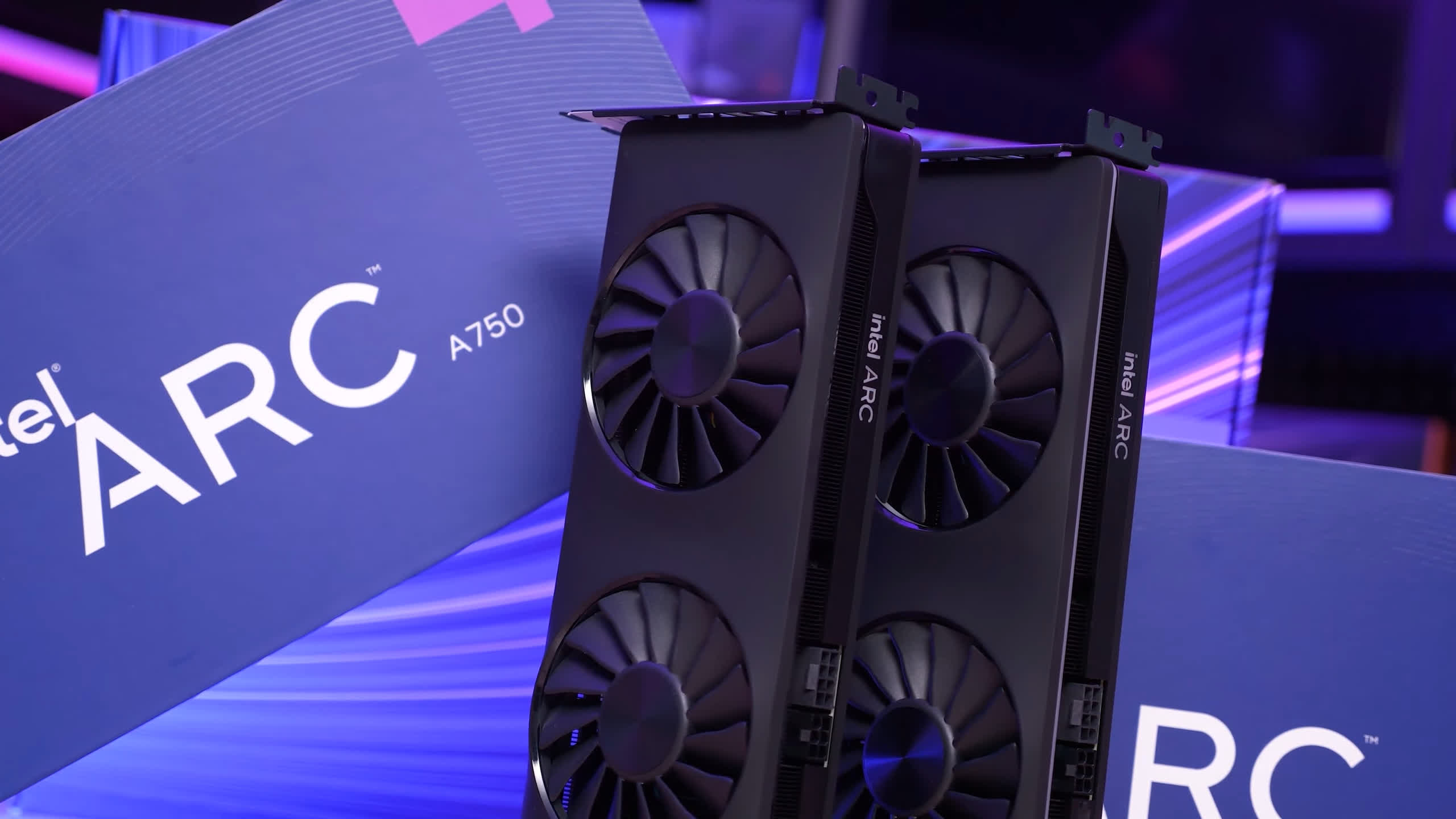
Early Geekbench results suggest that Intel's upcoming Arc B580 graphics card performs roughly on par with the Nvidia GeForce RTX 4060 and AMD Radeon RX 7600 XT. While the initial benchmarks fall slightly short of Intel's projections, the full picture may not become clear until the card is widely tested in real-world scenarios.

Tested on a system equipped with an Intel Core Ultra 9 258K processor and 48GB of DDR5 RAM, the Arc B580 achieved an OpenCL score of 98,343 and a Vulkan score of 103,445. These results place it in the same performance range as the RTX 4060 and RX 7600 XT. However, relying on only two benchmark tests leaves out other critical aspects of performance that could emerge once the card is in broader use.
Testing the Arc B580 alongside a high-end CPU and 48GB of RAM likely allowed the card to perform at its peak potential, whereas the Nvidia and AMD benchmarks account for a wider range of system configurations. As a $250 mid-range product, the B580 will likely be paired with mainstream CPUs and more modest memory setups in typical use cases.

However, synthetic benchmarks like Geekbench only tell part of the story. Real-world game-specific benchmarks, which are absent from both Geekbench and Intel's promotional materials, will provide a clearer picture of the card's true capabilities.

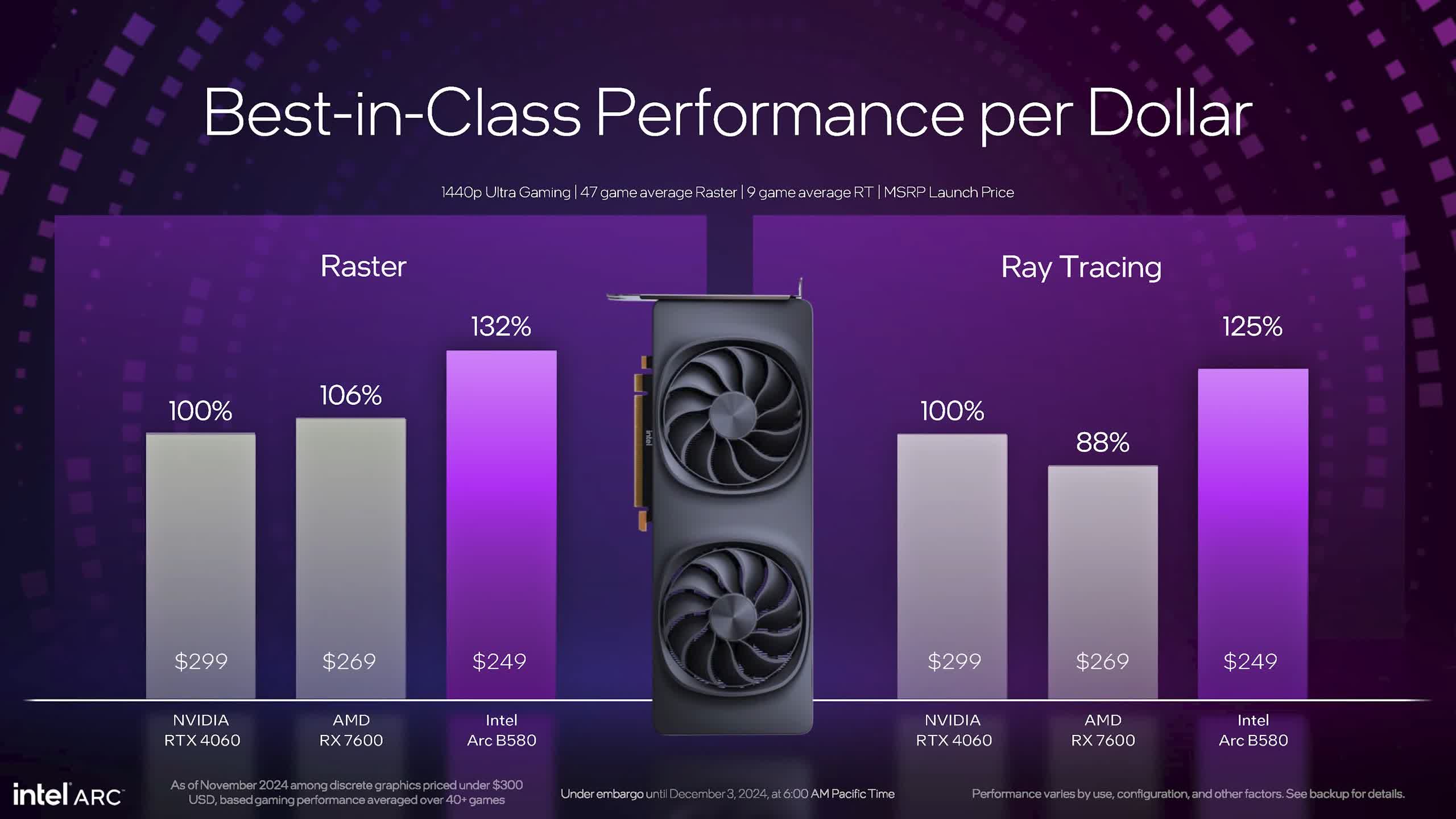
Intel claims the B580 delivers the best value in the mainstream GPU market, estimating its raster performance to exceed the RTX 4060 by 32 percent and the RX 7600 by 26 percent. These projections are significantly more optimistic than the recent Geekbench results suggest.
That said, the third-party tests do not specify which drivers were used, a critical detail given Arc's history of driver-related performance challenges and subsequent significant improvements. Additionally, Geekbench benchmarks omit ray tracing performance, where Intel claims the B580 outperforms the RTX 4060 by 25 percent and the RX 7600 by 37 percent.

While the B580 debuts as an aggressive value proposition – undercutting the RTX 4060 and RX 7600 by approximately $50 and offering significantly more VRAM – its competitive edge may be short-lived.

Nvidia and AMD are expected to reveal their next-generation GPUs at CES in January. AMD's RX 8000 series will primarily target the mainstream sector, competing directly with the B580, while Nvidia's RTX 5000 lineup will begin with enthusiast-level cards, followed by mid-range options. However, early rumors suggest the RTX 5060 may include only 8GB of VRAM compared to the B580's 12GB, potentially limiting its performance in high-resolution scenarios.

Permalink to story:

 
Please bring back Vulkan support in Linux. Arc lost support for it back in March and noone seems to know why. And older drivers aren't an option because, well, I don't really have to tell anyone about how bad their drivers were/are.
 
"Intel claims the B580 delivers the best value in the mainstream GPU market, estimating its raster performance to exceed the RTX 4060 by 32 percent and the RX 7600 by 26 percent. These projections are significantly more optimistic than the recent Geekbench results suggest."

That isn't what the chart says. The chart is "performance per dollar", meaning that if they were performance normalized, the Intel part would be at 100% if it were 16% slower in raster, because it's 16% cheaper.

The chart actually says that it's in the neighborhood of 10% faster in raster and about 5% faster in RT than a 4060, once normalized for price.
 
Yet my Tmobile 5g allowance is still 50 gigs per month before throttling.
 
Last edited:
Its nice and all, but 4060 is literally the worst card I have see in many many years. It sucks being as powerful as that... I honestly rather not have a GPU than have 4060. Its that bad. Saving money for 4070 is the only thing you can do this generation. So yeah, I hope Intel does well but idk... plus everyone that wants 4060, already has 4060. It is the most sold card and all...
 
Looking forward to it. XeSS 2 looks decent.
A 3rd player would be nice in the low to mid-end market.

Nvidia don't care about low-end at all.

The problem for Intel is that they will be fighting RTX 5000 and Radeon 8000 very soon. If price is sharp and XeSS 2 is good (and support will go up) it might be good.
 
Last edited:
If you are buying this card, you aren't interested in Ray-Tracing. So, if it's rasterization performance is up to snuff, then it's in the ballpark.
 
If you are buying this card, you aren't interested in Ray-Tracing. So, if it's rasterization performance is up to snuff, then it's in the ballpark.

I bought a 4090, and I am not interrested in Ray Tracing, especially not Path Tracing. Tested and tried so many games with it now, and I prefer the higher fps, every single time.

Sure, can look decent in some scenes, but worse in others. Simply not worth the performance hit to me.

To me, RT is a huge gimmick. Stuff like DLSS, DLAA and Frame Gen can be good tools tho and I hope AMD will get on the same level with FSR eventually. Features like this can be lifesavers for longevity, or if you are using "underpowered" GPUs for high res gaming, while still deliver a solid improvement with built in AA and sharpening.

RT might matter in 5-10 years, for now, not really. "Sadly" many new game engines like UE5 has software RT which slams AMD and Intel hard compared to Nvidia.

Well, some people probably like RT and think its great. We are all different. It's subjective.
 
I bought a 4090, and I am not interrested in Ray Tracing, especially not Path Tracing. Tested and tried so many games with it now, and I prefer the higher fps, every single time.

Sure, can look decent in some scenes, but worse in others. Simply not worth the performance hit to me.

To me, RT is a huge gimmick. Stuff like DLSS, DLAA and Frame Gen can be good tools tho and I hope AMD will get on the same level with FSR eventually. Features like this can be lifesavers for longevity, or if you are using "underpowered" GPUs for high res gaming, while still deliver a solid improvement with built in AA and sharpening.

RT might matter in 5-10 years, for now, not really. "Sadly" many new game engines like UE5 has software RT which slams AMD and Intel hard compared to Nvidia.

Well, some people probably like RT and think its great. We are all different. It's subjective.

I'm in the same boat as you. I don't like the "glossy" finish it gives to a lot of things. I prefer straight frame-rates and rasterization on highest resolution.
 
Back