Intel denies Arc desktop GPUs are going away

midian182

Posts: 11,747   +178
Staff member
Why it matters: Not for the first time, Intel has emphasized that despite rumors to the contrary, its Arc desktop graphics cards will not be killed off as the company shifts its graphics priorities. The reassurance comes as the long-rumored Arc B770 remains absent, raising more questions about what Intel's next consumer desktop GPU will look like – or whether we'll ever see another one.
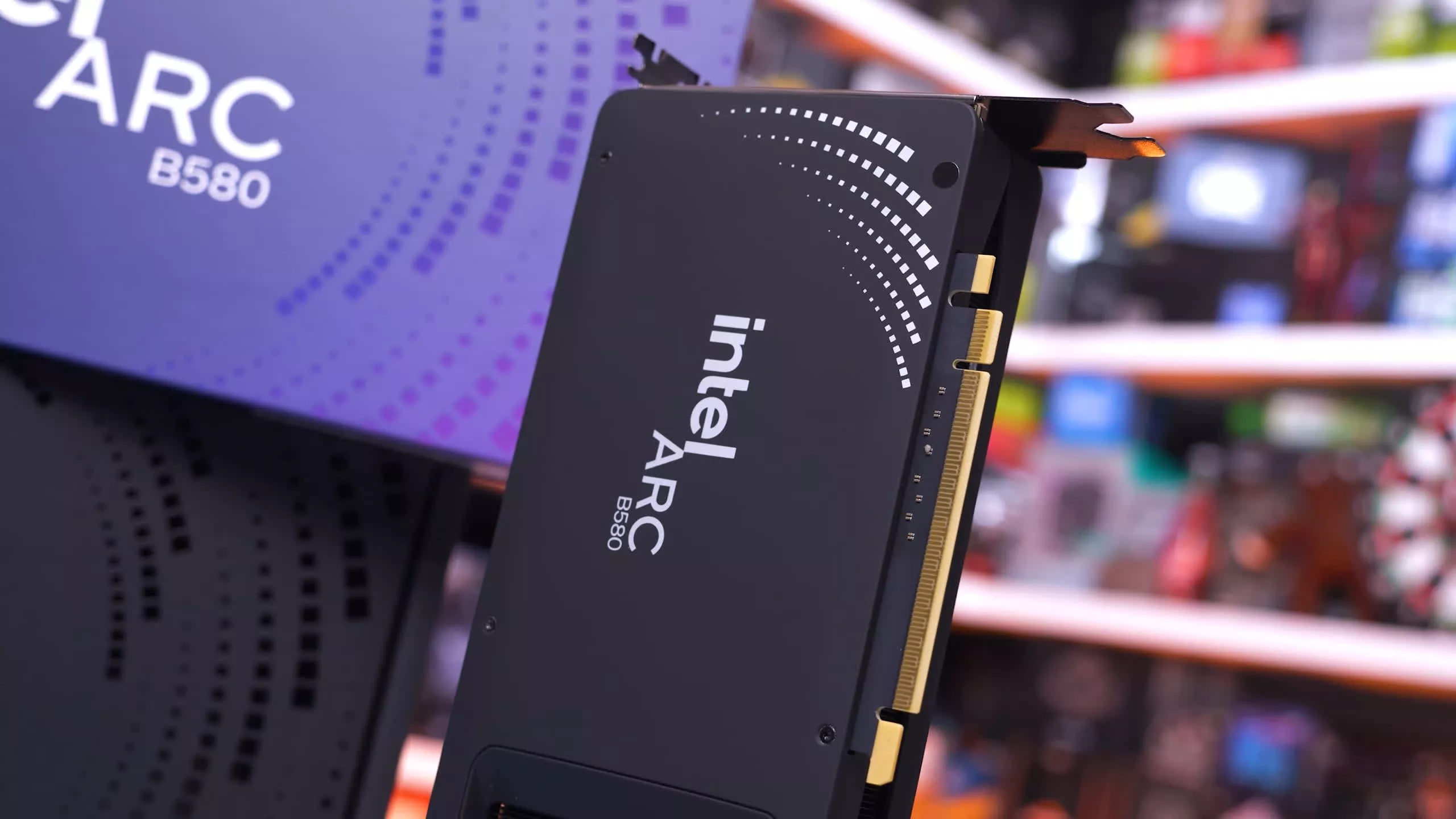
During a Q&A at Computex, Intel Client Computing Group general manager Alex Katouzian was asked by Tweakers about the future of Arc desktop graphics cards. He said that GPUs remain a "super important" part of Team Blue's PC lineup.

"If you look at gaming, both mobile and on PC, enormous revenue is being generated there," Katouzian said. "We want to make sure we play an important role in that."

Katouzian added that Intel is seeing strong traction with its GPU cores and that game engine developers are working with the company.

Intel entered the desktop GPU market in 2022 with Arc Alchemist, but the launch was rough. Battlemage has been a stronger effort, especially the Arc B580, which helped restore confidence in Intel's budget ambitions.
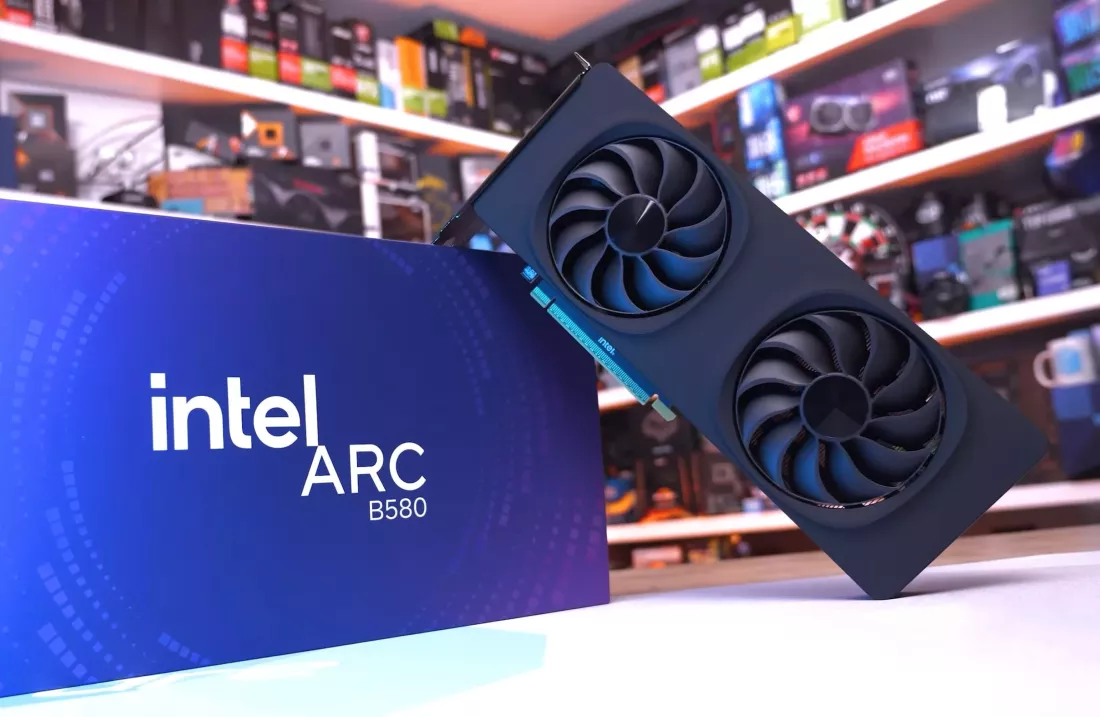
As we found in our Arc B580 review, Intel's $250 card delivered excellent value, helped by its 12GB of VRAM when Nvidia and AMD were still happy to sell budget cards with 8GB. Driver updates have also helped address some Arc CPU overhead issues.

What remains missing is a higher-end Battlemage gaming card. The Arc B770, sometimes called "Big Battlemage," has been rumored for a long time. Earlier reports claimed the card could arrive around CES 2026, but Computex has passed without any sign of it.

Intel has released something close to what many expected from a larger Battlemage GPU: the Arc Pro B70. The workstation card is not a B770, but it features 32 Xe-cores, 32GB of GDDR6, a 256-bit bus, and ECC support, making it look like the professional version of the silicon gamers were hoping to see.

Tweakers reports that it spoke with sources at Computex last year who said the B770 was planned for release at the end of 2025. The site now believes the card was likely canceled, though Intel has not confirmed that. Soaring component prices caused by the memory crisis haven't helped matters.

Intel's recent Arc activity has focused more on mobile and integrated graphics than discrete desktop cards, including Arc G3 chips for gaming handhelds and Panther Lake laptop CPUs.

March saw Intel Arc finally break into the main GPU section of the Steam survey, though it still holds a tiny 0.28% user share.

Intel might claim that Arc is still part of the roadmap, but with no B770 or other new desktop GPU to point to, it's difficult to know whether the company is committed to being a true third player in the desktop graphics card market.

Permalink to story:

 
Of course they aren't going to confirm that news if they have hundreds of thousands of those already manufactured.

Once the stock is a lot lower they might peddle back that statement.
 
Last edited:
As the B70's performance shows, the G31 silicon is not much faster than G21, despite considerably more compute and memory bandwidth. Its lacklustre performance and high price would have weakened Battlemage's name. Dressing it up as a workstation GPU let them charge some money.

I think it's all right the way things stand: better to work on the next Xe architectures, scaling the design to tackle the competition's midrange with less compute, then work up the ladder.
 
Last edited:
The rumors are awfully persistent.
Perhaps they internally decided against to see if NVIDIA let's the market slip.
It's not like the gaming market can't be extremely profitable and it's not like NVIDIA's focus is on it anymore.

AMDs GPU division can't stop shooting themselves in the foot for some reason so there's oppertunity for Intel as long as they can keep improving upon their designs (think the drivers are decent at this point? Any long-term Intel GPU users?)

Interesting to see Tweakers(.net) mentioned as the source - They're huge, in a small country (The Netherlands)
 
(think the drivers are decent at this point? Any long-term Intel GPU users?)
After using Arc for a year, the drivers are solid and updated frequently. Most issues are addressed quickly, though they do drag their feet on some. On the Linux side, not speaking from experience, there seems to be a lot of effort: recently, a new shader compiler, Jay, written from scratch.
 
Nvidia building its own CPU and having unchallengable GPU means that pretty soon, they'll be the go to (for everyone) when building their PC years from now.

AMD and Intel will get left in the dust as 2nd and 3rd place, but...they'll still be able to offer a complete desktop, workstation and gaming computer solution.

Too bad Nvidia is gonna be way off on the moon celebrating alone.

What you are witnessing is the death of DIY computer building and the rise of the pre-builts.
 
What you are witnessing is the death of DIY computer building and the rise of the pre-builts.
Yes, absolutely. The math simply doesn’t work, and it hasn’t for quite some time unless you had an existing system and were making incremental upgrades.
 
Nvidia building its own CPU and having unchallengable GPU means that pretty soon, they'll be the go to (for everyone) when building their PC years from now.

AMD and Intel will get left in the dust as 2nd and 3rd place, but...they'll still be able to offer a complete desktop, workstation and gaming computer solution.

Too bad Nvidia is gonna be way off on the moon celebrating alone.

What you are witnessing is the death of DIY computer building and the rise of the pre-builts.
Aside from the fact that their drivers have been getting progressively worse over the last year as they vibe code everything. The writing is on the wall, they've peaked. There are multiple most valuable companies in history and the deterioration in the quality of their product is a sign that their end is near. They can't rest on their laurels when customers need a real product to solve real problems. Their ability to be the best is what made them the most valuable company in the world in the first place. If they vibe-design a cpu architecture that's anything like their recent drivers then AMD and Intel have their work cut out for them.
 
Nvidia building its own CPU and having unchallengable GPU means that pretty soon, they'll be the go to (for everyone) when building their PC years from now.

AMD and Intel will get left in the dust as 2nd and 3rd place, but...they'll still be able to offer a complete desktop, workstation and gaming computer solution.

Too bad Nvidia is gonna be way off on the moon celebrating alone.

What you are witnessing is the death of DIY computer building and the rise of the pre-builts.
Nothing you listed means diy would die in favor of pre built.
Yes, absolutely. The math simply doesn’t work, and it hasn’t for quite some time unless you had an existing system and were making incremental upgrades.
In what world does "pay less to build it yourself" not work?

If you can just buy a board with the apu on it....you can still build the PC yourself.

But then again we saw this same pearl clutching a decade ago too, how mobile cpus soldered to motherboard were totally gonna destroy diy PCs.......something something chicken little.
 
With the amount of public money spent to keep Intel afloat, the least they could do is continue producing consumer grade hardware. Not that I would buy it, but I have involuntarily invested in it with no possibilty for a financial return.
 
In what world does "pay less to build it yourself" not work?
For incremental upgrades, yes... the math works. However, unless you happen to live near a Microcenter where they do processor, motherboard, and RAM bundles with deep discount prices, the math didn't really work out. Even in the past.

I happen to live near a Microcenter so I was able to take advantage of those kinds of deals but not everyone has that benefit so they have to pay full price. God help those people. I was lucky enough not to have to pay those stupid prices since, as I said before, I have a Microcenter across town.

With pre-builts, the company who built it can and often does benefit from being able to buy a whole damn pallet of video cards and other components thus are able to pass the savings onto you. The same goes with places like Microcenter where they can buy pallets of video cards, RAM, motherboards, and processors and thus able to pass the savings onto you.
 
If and a BIG IF, Intel really wants to disrupt the AI market, they should develop a on-prem, on-device local LLM solution for SMBs and individuals/families. Basically be the next generation of what the 'home PC' was in the 80s and 90s. 64-128-256GB VRAM configurations, compact solutions that can act as local AI models. Provide the software support and integration along with the hardware. Distributed computing/Local AI models are gaining traction every day. It would be foolish to not give this a good hard look and come up with a better DGX equivalent solution with easier on-ramp.
 
If and a BIG IF, Intel really wants to disrupt the AI market, they should develop a on-prem, on-device local LLM solution for SMBs and individuals/families. Basically be the next generation of what the 'home PC' was in the 80s and 90s.
If we look at what Apple has done, it's kind of already been done.
 
What I find interesting is that the current attitude toward Nvida is exactly what everyone though about Intel 10 years ago.They're huge, nobody can touch their hardware, they'll take over the entire pc market, etc.

That's not to say Nvidia will ever go away, but I think everyone misses the fact that while their GPUs are solid, it's CUDA that has made them what they are. recently. Until someone decides to buck Nvidia and create a truly competitive AI development framework, Nvidia will own the market and try to cement it with any proprietary software/hardware that with increase the vendor lock in.

As for their N1X system, it has none of the support that Apple gives their CPU's with OS and software. Microsoft WART is a running joke, and from what I've read, the ARM cores of the spark are nothing to write home about.

Will that matter, NO. Developers with buy it for CUDA support, and sheep will buy it for Nvidia.
 
Nothing you listed means diy would die in favor of pre built.
Except it does, it's possible that Nvidia monopolizes the PC gaming market, they've already essentially monopolized the GPU market with software lock-in and paying off game devs.
Nvidia is in bed with Microslop and all of the PC OEM's, all Nvidia has to do is pay off game devs to only support Windows on ARM and Nvidia GPU's. AMD and Intel would be left fighting for scraps and the indie game market. Intel's dGPU division already looks uncertain as the B770 was cancelled.
In what world does "pay less to build it yourself" not work?

If you can just buy a board with the apu on it....you can still build the PC yourself.

But then again we saw this same pearl clutching a decade ago too, how mobile cpus soldered to motherboard were totally gonna destroy diy PCs.......something something chicken little.
How is DIY any cheaper?
$600+ 32GB RAM kits and $300 per 1TB SSD's are signficantly more expensive than buying a prebuilt laptop or desktop.
Buying an APU board is already a thing, and not nearly as popular as what DIY'ers want, a fully modular build with room to upgrade.
It isn't "pearl clutching" when it's already happening, however it is very disheartening, so not surprising some people would rather deny that DIY is dying a painful death due to the great AI grift and greed thanks to Scam Altman and Nvidia.
 
Last edited:
Yes, absolutely. The math simply doesn’t work, and it hasn’t for quite some time unless you had an existing system and were making incremental upgrades.
I think we're moving towards more of a console model - no upgrading. Worse graphics and 'all-in-one' chips rather than a GPU and CPU and (V)RAM for both.
Saves on costs but kills upgradability - the 'Steam Machine' might actually come at the right time.
Games have reached a point where graphical fidelity really hasn't gotten that much better when you compare 2016 to 2026 titles. And 2016-2020 level of games would run fine on that kind of hardware. The 'good enough' plateau has been reached for a while now.

Ever since AMD purchased ATI and announced APU plans I thought it would be the case, never would have I thought it would take this long to get there though. I also thought we'd get there with it being the entry point ($500-800) to PC gaming and $800+ being reserved for a 'classic' setup with upgradability and dedicated graphics cards but at this point it seems more likely the market will be split between a 'cheap' $800 entry point system and then $2000+ 'real' gaming PCs.

Just hope Microsoft keeps effing up xBox and Sony keeps flopping their games so that the Steam Machine or similar can succeed whilst still doubling as a PC instead of having a limited locked down system like an actual console filling that market segment.
 
For incremental upgrades, yes... the math works. However, unless you happen to live near a Microcenter where they do processor, motherboard, and RAM bundles with deep discount prices, the math didn't really work out. Even in the past.

I happen to live near a Microcenter so I was able to take advantage of those kinds of deals but not everyone has that benefit so they have to pay full price. God help those people. I was lucky enough not to have to pay those stupid prices since, as I said before, I have a Microcenter across town.

With pre-builts, the company who built it can and often does benefit from being able to buy a whole damn pallet of video cards and other components thus are able to pass the savings onto you. The same goes with places like Microcenter where they can buy pallets of video cards, RAM, motherboards, and processors and thus able to pass the savings onto you.
I beleive both points are valid. DYI has not been cheaper for a long time now. However I also do not beleive it will be a thing of the past either, or that prebuilt are the only solution.

I can only speak for my self in this arena. I build my own PCs because I desired to build it with the components I prefered and configured it to my needs. Sometimes, in the past, it did indeed turn out to be cheaper, others not so much. But the results are always the same, a PC I built and to my standards.

To be transparent here: I have indeed purchased pre built PC, mostly for my business, or they simply were the best option for family and friends, and have never really had issues with them or regrets. Now I also rarely stick to the OS they came preinstalled with, and instead use alternative OSs, and that may have something to do with it.

Regardless, both DYI and prebuilts cater and fill consumers needs.
 
I think we're moving towards more of a console model - no upgrading. Worse graphics and 'all-in-one' chips rather than a GPU and CPU and (V)RAM for both.
How has graphics gotten better lately? Oh sure, shadows look more real, puddles reflect light more realistically but at what cost? Higher hardware requirements, higher power usage, and larger installations and downloads.

As far as I’m concerned, it’s not been worth it especially how in terms of re-playability modern games just suck.

And when it comes to combined a GPU and CPU’s, it solves one of the biggest performance bottleneck of the modern PC architecture. By having a unified memory architecture, the processor doesn’t have to copy the data from system memory over the PCI Express bus to VRAM. They both have access to same fast shared memory pool without having to copy data.
 
Well they are not lying. GPU focus is here to stay but it is hard to sell "cheap" GPUs when RAM prices are high, eating the margins.

Intel just needs to stay in this market. DX11 and older gets less and less important. Arc generally does well in DX12 and Vulkan, future is here.

They need the GPU progress for iGPUs and APUs anyway.


Direct3D Translation Layers, D3D9On12, D3D11On12 and DXVK (DX9-11 using Vulkan) eventually will fix Intels problems in DX11 and older.
 
Last edited:
Back