Intel claims retailers are facing high return rates for Snapdragon PCs, Qualcomm denies it

Skye Jacobs

Posts: 2,006   +58
Staff
Bottom line: While Arm-based PCs face some hurdles, their potential for growth remains significant, driven in particular by claims of superior battery life compared to previous generations. Intel, meanwhile, is making improvements to adapt to new market demands.

The PC market is undergoing a significant shift as Arm-based processors gain traction, challenging the long-standing dominance of x86 architecture. However, this transition is not without challenges, as highlighted by Michelle Johnston Holthaus, interim co-CEO of Intel, during the Barclays 22nd Annual Global Technology Conference.

Johnston Holthaus recently claimed that retailers are grappling with a high return rate of Qualcomm-powered machines. "If you look at the return rate for Arm PCs, you go talk to any retailer, their number one concern is 'I get a large percentage of these back,'" she said, attributing the issue to compatibility problems with common applications.

Qualcomm was quick to respond though, "Our device return rates are within industry norms," a representative told CRN. The spokesperson further added that Qualcomm "expects 30% to 50% of laptops to transition to non-x86 platforms within the next five years."
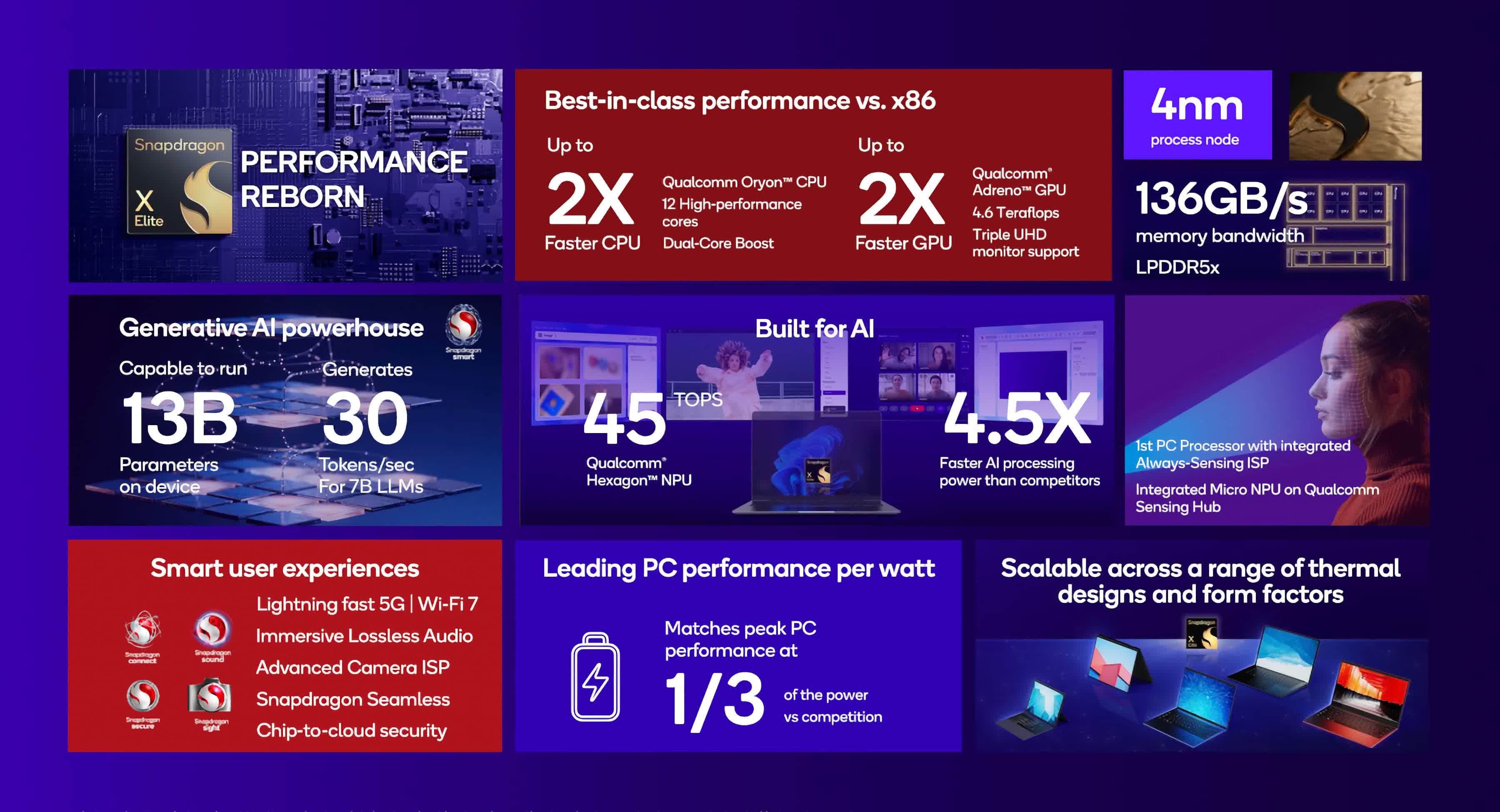
Regardless of one claim or the other, Arm-based systems are making inroads into the PC market. While Qualcomm Snapdragon X Elite machines currently hold a mere 0.8% market share, the overall Arm-based client PC segment commands approximately 10% of the market. This growth is primarily driven by Apple's M-series processors, which have paved the way for wider Arm adoption.

Intel, for its part, is acutely aware of the evolving landscape. "We [will] have more competitors than we have ever had. You will see more competitors enter the marketplace in 2025," Johnston Holthaus said, possibly hinting at rumors of MediaTek and Nvidia entering the Arm-based Windows PC market.

Team Blue has been improving performance and power efficiency to match Arm-based rivals. "We took too long at Intel to become performance and power-oriented, and we made a massive leap with our Lunar Lake product last year," Johnston Holthaus said.

For instance, Intel introduced a hybrid architecture in its latest processor series, combining Efficient-cores (E-cores) with Performance-cores (P-cores) to balance power efficiency with high performance. This design went beyond laptops and desktops and had a notable impact in Xeon 6 datacenter CPUs, which offer 3:1 rack consolidation and up to 2.6x performance-per-watt improvements over their predecessors.

Intel is also collaborating with Arm to produce low-power SoCs using its 18A process and is already integrating AI hardware into its processors. The Lunar Lake architecture, for example, features a fourth-gen NPU capable of delivering up to 48 TOPS – a fourfold improvement over its predecessor.

Laptops featuring Qualcomm's Snapdragon X Pro and Elite chips were the first PCs to support Microsoft's Copilot AI features, positioning them at the forefront of the company's AI PC push. However, most AI PCs are gaining market traction through Intel and AMD's x86 processors instead.

In Q3 2024, AI PCs accounted for 20% of all PC shipments, a 49% increase from Q2, driven by greater availability. Despite this growth, consumer interest in AI PCs and GenAI features remains modest. Intel and AMD devices, which represent about half of these shipments, are only beginning to receive support for Copilot.

Meanwhile, Snapdragon X laptops are receiving high praises primarily for their extended battery life, often lasting a full day. Additionally, the upcoming end-of-life for Windows 10 is expected to drive a significant sales boost, as users upgrading to Windows 11 may inadvertently adopt AI PCs.

Permalink to story:

 
It makes sense. A person not interested in gadjets and tech buys a "Windows" device to find out it cannot run something because it is not that windows.
It does not make Qualcomm a terrible company, but
it reminds them they should work on compatibility,
and work quickly.
 
Local Best Buy has two ARM models available they have sold 12 of them in store, 7 of the 12 have been returned. They resold the returns 3 times all 3 got returned. I don't mind my cheap Windows ARM laptop but I would never replace my full laptop or desktop with it, far to limited on capability.
 
After holiday sales are over, Qualcomm needs to do whatever they can to keep device costs as low as they currently are. Gaining market share has got to be their #1 priority right now if they want to be taken seriously.
 
Look, I'll say this knowing full well that is functionally impossible for any average consumer to adopt even the most widely easy-to-use version, but I've got a feeling you'd be able to sell more people on ARM as a personal computer capable CPU if you just ran Linux on it instead of Windows: I know it sounds crazy, but it's better to have the option of running the No-Brand version of your favorite piece of Software that *kinda* does something similar to what you expect I.e. 'I...I guess I can use this Kdenlive thing to kinda sorta edit instead of Premiere...For a little while anyway' than to go 'This Windows + Arm stuff just doesn't work or slows to a crawl with basically anything I need to do that's not just inside a browser'

Now if Qualcomm was even a bit more serious about this, they'd take some advise and pointers if not a full on partnership with Valve: they've shown what it takes to actually make Linux a viable consumer platform so why not ask them? In fact I think they might have but a) Valve did not offer them any money upfront to do it, like Microsoft probably did and b) Valve probably hit em with some Valve time like 'We think you can have a real chance of penetrating the market by 15%.....If you wait 5 more years while we all help you mature the software enough just like we did'
 
Who would post this biased nonsense. Did you even check what the return rates are without parroting Intel a competitor with vested interests in ARM's failure.
The story was basically cut/pasted from Toms...

The writer didn't do his research either - blame him, not Techspot...
 
Last edited:
Local Best Buy has two ARM models available they have sold 12 of them in store, 7 of the 12 have been returned. They resold the returns 3 times all 3 got returned. I don't mind my cheap Windows ARM laptop but I would never replace my full laptop or desktop with it, far to limited on capability.
Limited in what way? Some games?
 
Look, I'll say this knowing full well that is functionally impossible for any average consumer to adopt even the most widely easy-to-use version, but I've got a feeling you'd be able to sell more people on ARM as a personal computer capable CPU if you just ran Linux on it instead of Windows: I know it sounds crazy, but it's better to have the option of running the No-Brand version of your favorite piece of Software that *kinda* does something similar to what you expect I.e. 'I...I guess I can use this Kdenlive thing to kinda sorta edit instead of Premiere...For a little while anyway' than to go 'This Windows + Arm stuff just doesn't work or slows to a crawl with basically anything I need to do that's not just inside a browser'

Now if Qualcomm was even a bit more serious about this, they'd take some advise and pointers if not a full on partnership with Valve: they've shown what it takes to actually make Linux a viable consumer platform so why not ask them? In fact I think they might have but a) Valve did not offer them any money upfront to do it, like Microsoft probably did and b) Valve probably hit em with some Valve time like 'We think you can have a real chance of penetrating the market by 15%.....If you wait 5 more years while we all help you mature the software enough just like we did'
You seem unaware of the compatibility layer that lets it run most software seemlessly. Linux is a FAR bigger ask for normies than that.
 
The problem with this is the same reason that inexpensive x86 laptops sell. Most people won't use half of the capability of higher priced/more expensive machines, so the purchase what fits their needs. The problem ARM laptop with Windows is they are priced as premium devices with their only outstanding feature being battery life. I like having a laptop that allows me to do everything my desktop can. Not as fast, but capable (including games). It gets 8 hours of life with the dGPU turned off, and was just cost a little more than the ARM devices.

For people that don't have my use case, an extra 4-8 hours of battery life is not worth the cost and CHANCE that some software is slow and/or unusable for $400 or more. Not to mention the lack of ram upgrades, older devices without supported drivers, etc.

If they work for you, fine. but they are not ideal for most users, esp for the price.
 
Last edited:
The only thing these devices are designed to create is revenue. I wouldn't even trust it to hold papers down on my desk.
 
"We took too long at Intel to become performance and power-oriented.."

If they weren't focused on either of those, what WERE they focused on??
 
The story was basically cut/pasted from Toms...

The writer didn't do his reasearch either - blame him, not Techspot...
I knew I should have more seriously applied for this role if it's as easy as cutting and pasting news from rival news sites...
 
Look, I'll say this knowing full well that is functionally impossible for any average consumer to adopt even the most widely easy-to-use version, but I've got a feeling you'd be able to sell more people on ARM as a personal computer capable CPU if you just ran Linux on it instead of Windows: I know it sounds crazy, but it's better to have the option of running the No-Brand version of your favorite piece of Software that *kinda* does something similar to what you expect I.e. 'I...I guess I can use this Kdenlive thing to kinda sorta edit instead of Premiere...For a little while anyway' than to go 'This Windows + Arm stuff just doesn't work or slows to a crawl with basically anything I need to do that's not just inside a browser'

Now if Qualcomm was even a bit more serious about this, they'd take some advise and pointers if not a full on partnership with Valve: they've shown what it takes to actually make Linux a viable consumer platform so why not ask them? In fact I think they might have but a) Valve did not offer them any money upfront to do it, like Microsoft probably did and b) Valve probably hit em with some Valve time like 'We think you can have a real chance of penetrating the market by 15%.....If you wait 5 more years while we all help you mature the software enough just like we did'
As soon as you started talking about Linux I stopped reading. The ARM version of Windows has compatibility issues with a lot of software, so your solution is to use Linux instead so NONE of the Windows software will work (natively) at all. Linux will never be a mainstream replacement for desktops/laptops no matter how hard you Linux guys wish it so.

It's been the "Year of Linux on Desktop" for like what, 30 years now? My other favorite Linux meme is "Linux is free, if your time is worthless" because you'll be spending countless hours writing scripts, reading obscure logs and convoluted manuals, trying to track down broken or non-existent drivers, etc.

And if you manage to figure out why something isn't working and there's no current solution then you'll have some Linux zealot telling you to write your own patch and submit it, because no one will do it for you. If you're a Linux user you're expected to be an unpaid open source community contributor as well.
 
As soon as you started talking about Linux I stopped reading. The ARM version of Windows has compatibility issues with a lot of software, so your solution is to use Linux instead so NONE of the Windows software will work (natively) at all. Linux will never be a mainstream replacement for desktops/laptops no matter how hard you Linux guys wish it so.
I can agree with this. 90% of the software just running in a familiar looking environment is a much smaller step than none of it working the way the expect it to. First thing people do is try and download a .exe for their favourite apps, which is not how you do it on Linux. You go to the software manager and install it from a repository. If things are that different... they might as well just get a Mac instead.

It's been the "Year of Linux on Desktop" for like what, 30 years now? My other favorite Linux meme is "Linux is free, if your time is worthless" because you'll be spending countless hours writing scripts, reading obscure logs and convoluted manuals, trying to track down broken or non-existent drivers, etc.
Outdated overstatement.
Linux has made great strides in more recent times. Snap packages & Flatpaks got around some software not being available because you got the 'wrong' Linux distro. So a lot more software is available to a lot more users and there's no need to try and compile your own software (which is where a lot of this came from).
Driver support is better than under Windows generally because Linux is just... Linux. That old scanner you got in 1997? Still works under Linux. Try to use it under Window - they changed their driver model moving from Win Me to XP, then again from XP to Vista. And then they made small changes from Vista to 7 / 8(.1) / 10 / 11.
Old hardware tends to just work under Linux whilst being unrecognized with no drivers available under Windows.
Modern hardware mostly works fine, I'm sure there's exceptions but the biggest problems were usually graphics drivers and AMD has made major strides there, NVIDIA is catching up slowly.

And if you manage to figure out why something isn't working and there's no current solution then you'll have some Linux zealot telling you to write your own patch and submit it, because no one will do it for you. If you're a Linux user you're expected to be an unpaid open source community contributor as well.
That highly depends on where you ask.
Firing up IRC or visiting the Arch Linux forums... yeah, you might get 'that' guy as the one in a dozen replies.
If you're using something like Ubuntu and Mint and asking on their forums? You're not expected to be a tech wizard knowing everything.
 
I just bought a Dell Inspiron 14 Plus 7441 with a Snapdragon X plus Oryon processor rated at 3.42 ghz, with 16 gb ram. When I went to adjust the date and time, I found a new system not on the other versions of W11 and other pcs so microsoft must have written a version of w11 just for the Snapdragon. Too early to tell about overall performance but all seems to be well, being a very good fast performer so far. I don't know why others returned it but all seems ok so far.
 
Just found out my malwarebytes subscription is no good for this pc. It does not support the cpu's architecture for w11. I will email them and see if they intend to support this processor and the hardware architecture. I suppose that being a brand new product with a different architecture maybe they haven't written any software to address this problem.
 
Local Best Buy has two ARM models available they have sold 12 of them in store, 7 of the 12 have been returned. They resold the returns 3 times all 3 got returned. I don't mind my cheap Windows ARM laptop but I would never replace my full laptop or desktop with it, far to limited on capability.
That's exactly what I'd expect. the 1st generation of modern Windows-on-arm will be met with most of the growing pains due to compatibility bugs. Personally, I wouldn't bother until at least 2nd gen, but these are best suited towards tech enthusiasts who are aware of potential limitations.
 
As soon as you started talking about Linux I stopped reading. The ARM version of Windows has compatibility issues with a lot of software, so your solution is to use Linux instead so NONE of the Windows software will work (natively) at all. Linux will never be a mainstream replacement for desktops/laptops no matter how hard you Linux guys wish it so.

It's been the "Year of Linux on Desktop" for like what, 30 years now? My other favorite Linux meme is "Linux is free, if your time is worthless" because you'll be spending countless hours writing scripts, reading obscure logs and convoluted manuals, trying to track down broken or non-existent drivers, etc.

And if you manage to figure out why something isn't working and there's no current solution then you'll have some Linux zealot telling you to write your own patch and submit it, because no one will do it for you. If you're a Linux user you're expected to be an unpaid open source community contributor as well.

Well, you shouldn't have because I talk about those very things right after you stopped reading:

Now if Qualcomm was even a bit more serious about this, they'd take some advise and pointers if not a full on partnership with Valve: they've shown what it takes to actually make Linux a viable consumer platform so why not ask them? In fact I think they might have but a) Valve did not offer them any money upfront to do it, like Microsoft probably did and b) Valve probably hit em with some Valve time like 'We think you can have a real chance of penetrating the market by 15%.....If you wait 5 more years while we all help you mature the software enough just like we did'

So respectfully: either read my entire comment or don't bother commenting: I was talking PRECISELY about how it would never actually be just Linux in so much as I bring up the example of Valve: It's not really "Linux" that helped their handheld but Steam OS: That implies the tons of work they did to make sure many games work seamlessly, the level of care to build something that isn't just another distro but works like an actual appliance, etc.

My point is that arm would need that level of OS integration to make their hardware attractive and Windows, while better than a regular Linux Distro, it's just not that at all for arm still: compatibility layer is hit on miss, performance for it is really poorly optimized negating almost all of the battery life advantage as soon as it's a non-arm-native application, etc. It's nowhere near the level of polish Valve went for and that's because they already tried and failed to launch a Linux based distro once so maybe Qualcomm will do better the next time around but not if they stick to Windows imo.
 
As soon as you started talking about Linux I stopped reading. The ARM version of Windows has compatibility issues with a lot of software, so your solution is to use Linux instead so NONE of the Windows software will work (natively) at all. Linux will never be a mainstream replacement for desktops/laptops no matter how hard you Linux guys wish it so.

It's been the "Year of Linux on Desktop" for like what, 30 years now? My other favorite Linux meme is "Linux is free, if your time is worthless" because you'll be spending countless hours writing scripts, reading obscure logs and convoluted manuals, trying to track down broken or non-existent drivers, etc.

And if you manage to figure out why something isn't working and there's no current solution then you'll have some Linux zealot telling you to write your own patch and submit it, because no one will do it for you. If you're a Linux user you're expected to be an unpaid open source community contributor as well.
I feel as though much of this linux derangement is purely psychological. If it were rebranded and marked like Chome OS or Android it wouldn't trigger folks as much. I've moved full-time to linux and there's more compatibility than you would think. Chrome, Firefox, and even Microsoft Edge is here. I've got no problems doing all I would ever care to do in Word, One Note, Teams, Thunderbird, Steam, FileZilla, Outlook, Etc.
It's just an option you can consider. I'm no evangelist, but it's perfectly fine to remind people that Windows does not exist in a vacuum; millions of people daily drive Linux and just about every day it bemuses me that so many people would just write-off the whole platform.
 
That's exactly what I'd expect. the 1st generation of modern Windows-on-arm will be met with most of the growing pains due to compatibility bugs. Personally, I wouldn't bother until at least 2nd gen, but these are best suited towards tech enthusiasts who are aware of potential limitations.
It should be pointed out that this is NOT the first generation of Windows on Arm; Microsoft has been trying to make WoA a thing since 2012 when Windows RT came out, and they have partnered with Qualcomm for a couple prior releases. These are just the first Snapdragon laptops to get a big marketing push. It does make me question how much better MS can get with their compatibility layer; since they have been working on it for years at this point, all the low hanging fruit has likely been picked, and polishing it up more is going to get harder & harder.
 
Back