Intel Core Ultra 9 285K "Arrow Lake" CPU surfaces with 5.7GHz clock speed

DragonSlayer101

Posts: 978   +14
Staff
What just happened? Intel is expected to officially announce its Arrow Lake-S desktop CPU lineup later this year. A steady stream of leaks has already provided some insight into what to expect from the new processors, and a recent Geekbench listing appears to have revealed the clock speed of the flagship Arrow Lake chip.

According to the listing, the Intel Core Ultra 9 285K CPU will offer a boost speed of up to 5.7GHz, which is about 500MHz lower than the 6.2GHz Max Turbo Frequency of the Raptor Lake flagship, the Core i9-14900KS. The 285K is also expected to have a 3.7GHz base clock, slightly higher than the 3.2GHz P-core base clock of the Raptor Lake flagship.

In the Geekbench 6.3 runs, the Core Ultra 9 285K scored 3,449 points in the single-core test and 23,024 points in the multi-core test. These scores are notably higher than those of the Core i9-14900K, suggesting that Arrow Lake could indeed be a worthy upgrade over Raptor Lake, as leaks have indicated. For comparison, the i9-14900KS achieved 3,189 points in the single-core test and 21,890 points in the multi-core benchmark on the same platform.
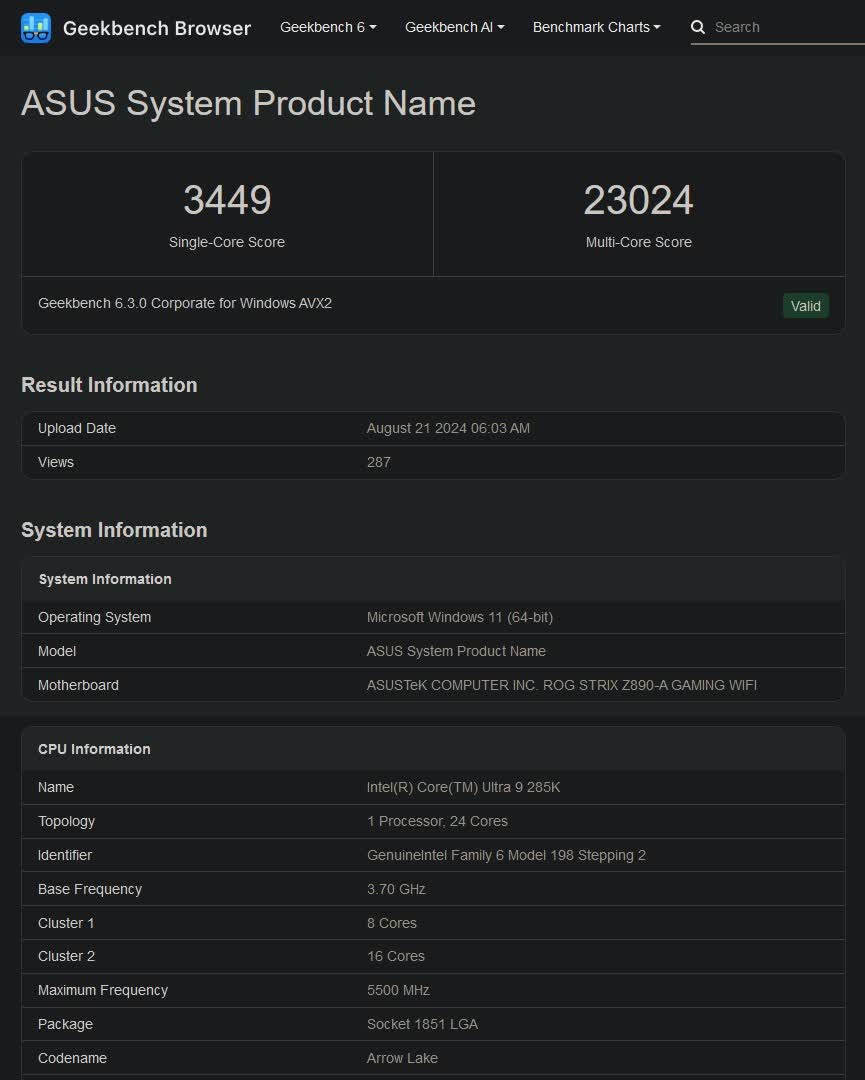
The Core Ultra 285K was tested on an Asus ROG STRIX Z890-A Gaming WIFI motherboard with 64 GB of DDR5-6400 memory. The listing also confirms earlier leaks that the new chip has 24 cores in total, including eight performance cores and 16 efficiency cores. The chip is also rumored to include 36 MB of L3 cache and feature a 125W PL1 TDP.

While Intel has yet to announce a definite launch date for the Arrow Lake lineup, a recent leak suggested it could arrive on October 10. Alongside the flagship Core Ultra 9 285K, Intel will likely also unveil the more mainstream Core Ultra 7 265K and Core Ultra 5 245K, all of which are expected to feature unlocked multipliers for overclocking. Intel's motherboard partners are also anticipated to announce their flagship LGA 1851 boards on the same day.

The new processors are rumored not only to offer significant performance gains over Raptor Lake but also to be more power efficient and stable than their predecessors. At a recent event in China, the company claimed that Arrow Lake will consume "at least" 100 watts less power than its current lineup. Intel is also hoping that the new lineup will avoid the stability issues that have affected many of its 13th- and 14th-gen Core CPUs.

Permalink to story:

 
I don't see how from 3,189/21,890 to 3,449/23,024 is considered "worthy upgrade" :(
that's not even 10%
A nearly 10% increase, while consuming "at least" 100w less power? That's a more significant upgrade than Zen 5 was over Zen 4. What was your opinion on Zen 5?
 
Zen 5 the same :( or worse because he can't run high RAM and you have to do battle with core parking
 
A nearly 10% increase, while consuming "at least" 100w less power? That's a more significant upgrade than Zen 5 was over Zen 4. What was your opinion on Zen 5?

With lower clock speeds! Zen5 at least kept clock speeds same, not lower.

Again, Zen5 is significant upgrade. If you don't think so, then use better software.
 
I think there’s alot of users who will wait for the benchmark comparison between the new X3D models and this cpu before deciding what to pick this year. I am a bit bummed that AMD don’t support faster memory with the 9xxx lineup
 
With lower clock speeds! Zen5 at least kept clock speeds same, not lower.
No one gives a rat's rump for "clock speeds" -- they'd buy a processor that ran at 60 hertz if it could outperform the current chips.

Again, Zen5 is significant upgrade. If you don't think so, then use better software.
The facts speak otherwise. The idea that you must defend the chip by telling the entire world to simply "write better software" for it makes that point for me even better than I.
 
No one gives a rat's rump for "clock speeds" -- they'd buy a processor that ran at 60 hertz if it could outperform the current chips.

Probably not because die size would be Huge.

The facts speak otherwise. The idea that you must defend the chip by telling the entire world to simply "write better software" for it makes that point for me even better than I.

What facts? Many CPUs have needed better software to perform well. Some argued those CPUs suck but same people would definitely NOT switch current software for old trash.

Intel: Pentium 4, sucked on x87 but had good SSE2. How about still using x87 instead SSEx? Sounds good?

AMD: Athlon64, 64 bits are useless, there is no 64-bit software around. It sucks. Let's just stick with 32 bits and 4 GB memory!

Both AMD and Intel have made CPUs that needed new software. Some like you argue always about everything. I don't think you disagree now that SSE2 or 64 bits are useful. So, you may argue NOW that Zen5 sucks etc but you'll see later that I was right. And then you have other thing to argue. That's how it always goes.
 
AMD: Athlon64, 64 bits are useless, there is no 64-bit software around. It sucks. Let's just stick with 32 bits and 4 GB memory!
Thanks for making my point for me. The entire reason AMD's X86-64 succeeded was because they didn't require "better software" to perform well -- they ran that old 32-bit software faster than the prior generation chips. That was in stark contrast to Itanium's IA-64 which -- like you say for Zen 5 -- required the world to "write better software" for it to function well.
 
Thanks for making my point for me. The entire reason AMD's X86-64 succeeded was because they didn't require "better software" to perform well -- they ran that old 32-bit software faster than the prior generation chips. That was in stark contrast to Itanium's IA-64 which -- like you say for Zen 5 -- required the world to "write better software" for it to function well.

And you say Zen5 is not running "previous gen software well?". It does. Main reason why Athlon64 was so fast was integrated memory controller, not that architecture were That much better.

Itanium was never meant to run x86 software well. Also Itanium required well written software because there was no good compiler for it. However with Zen5, all developer must do is to add compiler flag to generate AVX512 codepath. That takes literally Seconds!

All in all, your points are pretty much invalid.
 
And you say Zen5 is not running "previous gen software well?". It does
How quickly you forget your own posts. When we pointed out Zen 5 was only seeing a 2-5% uplift over Zen 4, you complained it was because every application in current existence was "crap software", "antiquated" and needed to be rewritten to take advantage of the instruction set tuning done for the chip.
 
How quickly you forget your own posts. When we pointed out Zen 5 was only seeing a 2-5% uplift over Zen 4, you complained it was because every application in current existence was "crap software", "antiquated" and needed to be rewritten to take advantage of the instruction set tuning done for the chip.
2-5% UPlift is pretty well, isn't it? And yes, you want more uplift, you COMPILE (not rewrite) software to support AVX512. Once again, it takes few seconds.

Why 2-5% UPlift is well? Here we have Pentium 4 1.6 GHz, look at FPU score:

VEPWJCU.gif


As you can see, Zen5 does well with antique software. Pentium 4 did not.
 
2-5% UPlift is pretty well, isn't it?
For a next-generation chip? No, it's abysmal. Next question?

...and yes, you want more uplift, you COMPILE (not rewrite) software to support AVX512.
Any current applications that can benefit from AVX512 have already been compiled to support it. Next question?

Why 2-5% UPlift is well? Here we have Pentium 4 1.6 GHz, look at FPU score:

As you can see, Zen5 does well with antique software. Pentium 4 did not.
Whoa, wait? You just benchmarked Zen 5 against a CPU released 24 years ago? You seriously cannot make this stuff up.
 
For a next-generation chip? No, it's abysmal. Next question?
Then Intel had only "abysmal" improvements after Sandy Bridge era.
Any current applications that can benefit from AVX512 have already been compiled to support it. Next question?
Trolling need some skill, that was about worst trolling attempt I have seen for long time.
Whoa, wait? You just benchmarked Zen 5 against a CPU released 24 years ago? You seriously cannot make this stuff up.
You have serious problems with understanding? Zen5 is few percent FASTER with antique code. Pentium 4 was 40% SLOWER with antique code. Yea, that's synthetic benchmark but still.
 
Lel what ? Pentium 4 in arrow lake discussion ?? lel :) how did you even faind this benchmark in the internet...
FPU score ? are you serius ? :) lel
 
Lel what ? Pentium 4 in arrow lake discussion ?? lel :) how did you even faind this benchmark in the internet...
FPU score ? are you serius ? :) lel
Some just don't understand.
Thanks for making my point for me. The entire reason AMD's X86-64 succeeded was because they didn't require "better software" to perform well -- they ran that old 32-bit software faster than the prior generation chips. That was in stark contrast to Itanium's IA-64 which -- like you say for Zen 5 -- required the world to "write better software" for it to function well.
Zen5 requires "better software" to function well and still it's FASTER than Zen4, even with "worse" software.

And then we have example of CPU that requires "better software" to perform well. However that is 40% slower if software is not good. Based on that, it would be "normal" for Zen5 to be 40% slower on "worse" software. Being few percent faster on "worse software" is indeed excellent.

You have absolutely no idea what you are talking about.
 
Zen5 requires "better software" to function well and still it's FASTER than Zen4, even with "worse" software.
Sure. If you define "worse software" as pretty much everything ever written, and you define "better" as 3 to 4 percent; the lowest generational increase in modern history.

And then we have example of CPU that requires "better software" to perform well. However that is 40% slower if software is not good.
Why do you continually spread disinformation? The P4 was not "40% slower" than P3 -- it was significantly faster. It had a much lower IPC, but at the time, "IPC" wasn't even a concept enthusiasts bandied about, because every new generation of chips saw major increases in clock rates. You only care about instructions per clock when you're short on clocks.

Furthermore and even ignoring all that, your argument is nothing more than "Zen 5 doesn't suck, because somewhere in the distant past, some other chip once sucked even worse."
 
Last edited:
Sure. If you define "worse software" as pretty much everything ever written, and you define "better" as 3 to 4 percent; the lowest generational increase in modern history.

Oh, now Only performance improvement on older software matter? How about power consumption, price, performance on modern software too? It's pretty much impossible to be great at ALL those, something needs to be sacrificed. And Zen5 chose performance on older software.

Why do you continually spread disinformation? The P4 was not "40% slower" than P3 -- it was significantly faster.

How about You stop trolling? You have absolutely no idea what you are talking about. Check P4 vs P3 on x87 heavy software and then say it's significantly faster. Everyone that have basic knowledge of Pentium 4 knows this very well.

It had a much lower IPC, but at the time, "IPC" wasn't even a concept enthusiasts bandied about, because every new generation of chips saw major increases in clock rates. You only care about instructions per clock when you're short on clocks.

I showed test where P4 has 60% clock speed advantage but still loses 40%. LOL.

Furthermore and even ignoring all that, your argument is nothing more than "Zen 5 doesn't suck, because somewhere in the distant past, some other chip once sucked even worse."

Where I said P4 sucked? Once again my point:

With Pentium 4 Intel decided to promote SSE2. Then they decided that having good x87 too performance is either expensive or it doesn't encourage developers to use SSE2. Or both. Then x87 performance was abysmal.

With Zen5 AMD decided to promote AVX512. Instead being 40% slowe on legacy software, AMD is bit faster.

Did you finally got it?
 
Oh, now Only performance improvement on older software matter? How about power consumption, price, performance on modern software too?
One last time. Software released in 2024 is modern software. And Zen 5 certainly doesn't win on price.

I showed test where P4 has 60% clock speed advantage but still loses 40%. LOL.
You showed no such thing. Learn to read a graph.
 
One last time. Software released in 2024 is modern software. And Zen 5 certainly doesn't win on price.
🤦‍♂️

Basically, you could take outdated engine from, say, 2006, use it to make game today. Now you say because it's released 2024 it IS modern. But technically it's still 2006 and that is pretty far from modern.
You showed no such thing. Learn to read a graph.
Perhaps it's YOU that should learn to read?

Pentium 4 1.6 GHz: 780 MFLOPS
Pentium 3 1 GHz: 1336 MFLOPS

Now do the math.
 
Back