
Intel vs. TSMC: Why economic factors, not tech, are at the heart of America's chip struggle

Jay Goldberg

Posts: 99   +2
Staff

Over the past few years, U.S. policymakers have developed a high degree of anxiety about America's need for onshore, leading-edge fab capabilities. The press has been filled with stories about all the ways the U.S. has fallen behind, how we can no longer produce chips at the leading edge. This anxiety is rooted both in geopolitical concerns around the rivalry with China and in worries that the U.S. has somehow lost the ability to produce chips, much like we seem to have lost the ability to manufacture many things.

We would argue that the problem is very much an economic one rather than a technological one.

Editor's Note:
Guest author Jonathan Goldberg is the founder of D2D Advisory, a multi-functional consulting firm. Jonathan has developed growth strategies and alliances for companies in the mobile, networking, gaming, and software industries.

Put simply, Intel can produce leading-edge semiconductors today; they just cannot do so economically. They have the know-how and the equipment. Their shortcomings are entirely based on the fact that they cannot yet make 18A, 3nm chips profitably.

Consider for a moment everyone's favorite fear-mongering scenario – what if the U.S. lost access to TSMC's Taiwan fabs? War, blockade, alien invasion – whatever the reason. And along with that, imagine the U.S. faced some military conflict, and the lack of leading-edge chips became an acute national security problem.

That would obviously cause immense disruption to the economy, but how long would it take for Intel to get its process working? It's reasonable to assume that the government could throw enough money at Intel to get its process up and running very quickly.

At first, Intel's yields would be terrible, and the government would effectively be covering those losses – paying fixed prices for wafers with only 5% or 10% good die. In semis, volume solves a lot of problems, and in a time of great need, they could afford all the bad wafers it would take to get enough learning under their belt to improve those yields.

The traditional narrative on TSMC's rise to success is that Intel missed the boat on mobile, TSMC became the foundry of choice for phones, and that drove their volumes.

Obviously, that is not a scenario anyone hopes for, but we mention it here because it speaks to an important but largely ignored reality today. The traditional narrative on TSMC's rise to success is that Intel missed the boat on mobile, TSMC became the foundry of choice for phones, and that drove their volumes.

With that volume, they were able to learn faster than others and, over time, win process leadership. All that is true, but it misses one critical factor. During that period, TSMC enjoyed massive subsidies. The best-known of those were direct subsidies from the Taiwan government, which allowed them to import wafer fabrication equipment in the early days. But a far bigger subsidy was indirect – the undervalued New Taiwan Dollar.
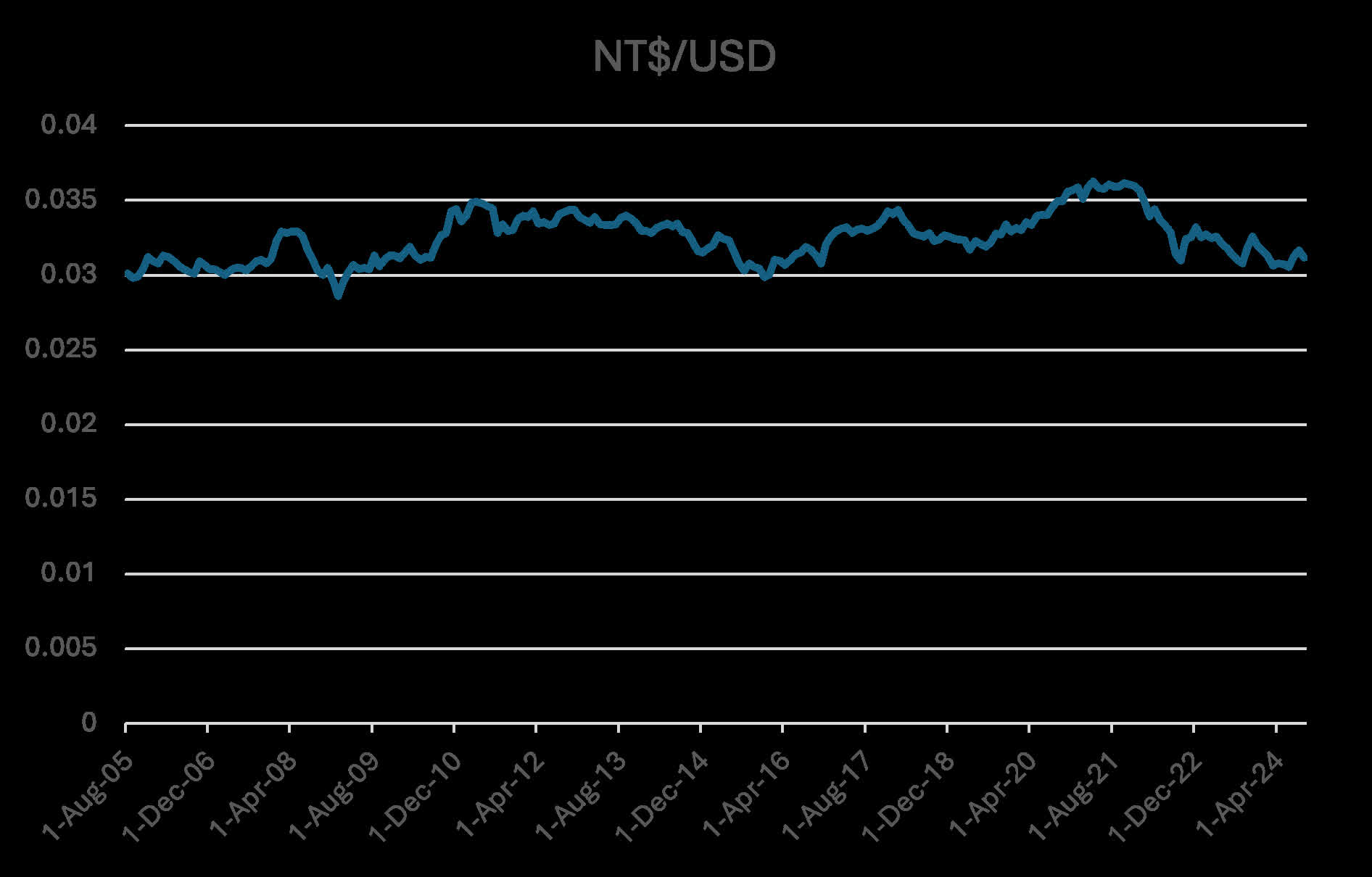
The NT$ is ostensibly a free-floating currency, but as the graph above shows, it appears to have been fixed to the U.S. dollar for over 20 years. Economist Brad Setser has written extensively about the mechanisms Taiwan uses to achieve this (TL;DR – commercial banks, then life insurance companies), essentially managing the currency to keep Taiwan competitive.

During this period, the U.S. dollar has inflated considerably, which effectively means the NT$ has fallen in value as well. The best way to demonstrate this is the Economist's Big Mac Index.
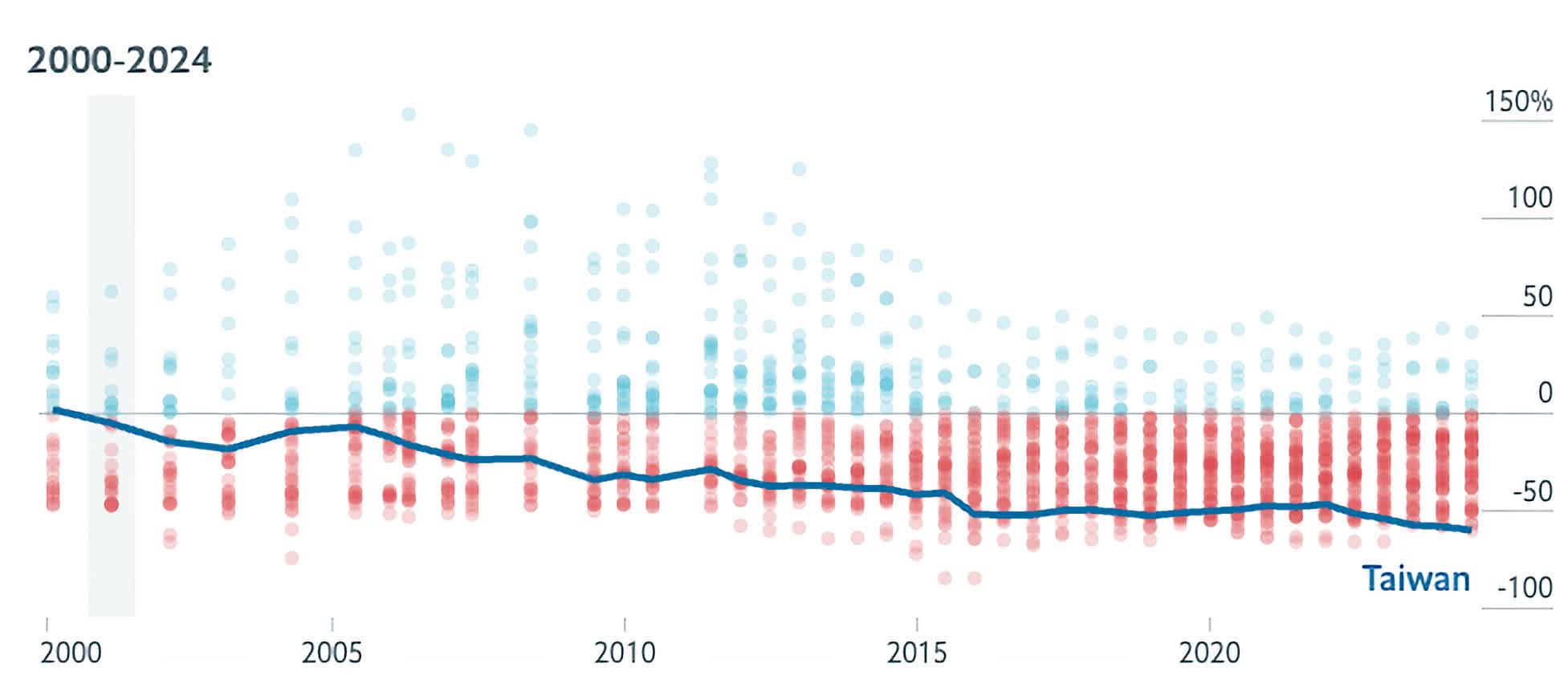
This is a handy way to show the degree to which a currency is under- or overvalued relative to the U.S. dollar. As this graph shows, the NT$ has steadily eroded in value against the U.S. dollar for the past twenty years, exactly the time when TSMC was rising. From what we understand, this decline really began with the Asian Financial Crisis in 1998 and has only grown over time.

This provides a massive, indirect subsidy to TSMC. They can pay their employees wages that are competitive in Taiwan but are effectively much less than what their competitors in the U.S. would have to pay.

TSMC's revenues are priced in U.S. dollars, but its workforce is paid in NT$, and they are the company's true asset. And this discount has been compounding for decades. We tend to think of devalued currencies as providing a way for exporters to undercut foreign competitors by offering lower prices. Instead, TSMC used the effects of that currency suppression to invest in its own talent pool.

We have read research that shows the NT$ is effectively underpriced by around 30% (using a more comprehensive method than the Big Mac Index, which shows a >50% level). So, we think it's no coincidence that TSMC has said its U.S. plant would be 20%-30% more expensive than its Taiwan fab's wafer costs.

To be clear, we are not diminishing TSMC's technical talent. They have immense capabilities and unrivaled human capital. But we think it's important to understand how they achieved those. TSMC management's true power move was investing their currency advantage into their own talent pool, rather than squandering it on far-flung acquisitions with tenuous ties to the core business.

This all raises the question of what anyone can do to compete with that.

The U.S. government is fully aware of the state of Taiwan's currency and has steadily declined to take any action against it. Competing in foundry requires outside funding pools. For Intel, that has led to further calls for direct government support.

We would obviously prefer a more commercial solution, in the form of investment from prospective customers, but there is a rising chorus begging encouraging the U.S. government to "save" Intel by subsidizing some group of equity holders.

The less obvious question is how Samsung can respond. The South Korean Won's status is actually not far off from the NT$, for similar reasons, but Samsung has chosen to spend that windfall elsewhere.

In the short run, Samsung Foundry will likely need support from the broader Samsung Chaebol. It's unclear to us to what degree the chaebol is interested in propping up Foundry. The memory business is important for the whole group. Does Foundry put that at risk? Does the cash burn from Foundry get so large that eventually the chaebol decides to fall back and focus on memory?

What is clear is that both Intel and Samsung will need considerable outside support to stay in the game.

Permalink to story:

 
Apple is the reason TSMC is where they are today. Without Apple money, they would not have had the funds to drive innovation and improve fabs.

Apple is also the reason TSMC built fabs in the US. They demanded it.

Apple also have priority on best nodes at TSMC. Others can use them, when Apple er done with them, or almost done with them.

Nvidia and AMD uses optimized 5nm right now.
Intel uses 3nm for Lunar and Arrow Lake.

You don't need the best node possible if architecture is good. AMD used 4nm aka optimized 5nm for Ryzen 9000 because it was around 50% cheaper.

Nvidia goes with 4nm again with 5000 series, because its cheaper and they don't need prime nodes to compete / beat AMD. They also have GDDR7 this time.

RTX 6000 series will be far more interresting. 3nm or better + improved GDDR7.
However Nvidia knew that AMD is not coming with anything good with Radeon 8000 series (AMD left high-end) so Nvidia did not need to spend on 3nm yet.
 
Last edited:
It certainly appears that EVERYONE wants the latest and greatest despite the fact that many uses simply don't need the fastest chip. Case in point, GM used the old Motorolla 8088 chip in it's cars up until 5 years ago and studies suggest they could still get by with this older chip. The cost of those 8088 chips was all of $5 ea. Makes you wonder how many other things on todays cars are unnecessarily expensive, driving the costs much higher than they need be.
 
The only thing is that you completely excuse Intel's blunders and stock price chasing, which was a HUGE contributor to this mess. When AMD shot themselves in the foot, the smartphone market was already increasing cores. Intel had the leadership in this, but when Opteron was defeated, and bulldozer was a total bust, Intel sat on the lead and started obscene product segmentation and pricing on server and HEDT chips. Add to that, the were late with 14nm, 10nm took forever, and Intel seems to never change course after they've started something that's not working. The only example of this is the decision to ditch 20A (whatever that really is after the marketing rename), which is a first and the only time I've seen them actually cut their losses instead of continuing to beat their heads against the wall

Add to that their pushing the power envelope to cover up their design deficiencies, their miserable GPU effort, their, what now is reported to be flawed software, AI effort, and you have a company that for the longest time had MORE than enough cash to throw at these issues, but thought they were bulletproof and wound up playing catch up. Possibly too late.

There is no other system that works better than capitalism, but it's Achilles's heal is when companies decided making money over the long term was passe, and there was such a thing as not making enough money. Who needs R&D and customer service?
 
TSMC reinvesting currency benefits into its talent rather than rapid, risky expansion speaks to a long-term vision that’s pretty unique in the tech sector. It suggests a deliberate strategy focused on creating a robust, highly skilled workforce as a sustainable advantage, which Intel and Samsung may find hard to match without similar, long-term economic structures supporting them.
 
It certainly appears that EVERYONE wants the latest and greatest despite the fact that many uses simply don't need the fastest chip. Case in point, GM used the old Motorolla 8088 chip in it's cars up until 5 years ago and studies suggest they could still get by with this older chip. The cost of those 8088 chips was all of $5 ea. Makes you wonder how many other things on todays cars are unnecessarily expensive, driving the costs much higher than they need be.

The problem is primarily supply; it's not like Intel is doing mass production of 8088's these days (though *many* companies were smart and signed lifetime supply agreements back in the 80s). But yes, for simple coprocessors things like the 386, 68000, and even the humble Z80 and 8088 are often sufficient.
 
The only thing is that you completely excuse Intel's blunders and stock price chasing, which was a HUGE contributor to this mess. When AMD shot themselves in the foot, the smartphone market was already increasing cores. Intel had the leadership in this, but when Opteron was defeated, and bulldozer was a total bust, Intel sat on the lead and started obscene product segmentation and pricing on server and HEDT chips. Add to that, the were late with 14nm, 10nm took forever, and Intel seems to never change course after they've started something that's not working. The only example of this is the decision to ditch 20A (whatever that really is after the marketing rename), which is a first and the only time I've seen them actually cut their losses instead of continuing to beat their heads against the wall

Add to that their pushing the power envelope to cover up their design deficiencies, their miserable GPU effort, their, what now is reported to be flawed software, AI effort, and you have a company that for the longest time had MORE than enough cash to throw at these issues, but thought they were bulletproof and wound up playing catch up. Possibly too late.

There is no other system that works better than capitalism, but it's Achilles's heal is when companies decided making money over the long term was passe, and there was such a thing as not making enough money. Who needs R&D and customer service?

The problem is that current laws outright *encourage* stock price chasing, especially when CEO pay is directly tied to stock gains. There's a reason why so many engineering firms are running into the same exact problems with long-term investments. One firm focuses on short term, and every other firm's investors get jealous of their stock, and demands that executives do the same. Which works, for a decade or two.

Hence why Capitalism in general is in such a sorry state, and who so many entrenched companies are being run into the ground before our very eyes.
 
TSMC employees work as machines for more than 12 hours a day, which partly explains the company's success in dominating the market while the competition fails and gets bogged down
 
"Put simply, Intel can produce leading-edge semiconductors today; they just cannot do so economically. They have the know-how and the equipment. Their shortcomings are entirely based on the fact that they cannot yet make 18A, 3nm chips profitably."
"It's reasonable to assume that the government could throw enough money at Intel to get its process up and running very quickly."

IOW, while TSMC was taking advantage of market conditions and improving their capabilities and competitiveness, Intel was sitting on their asses on fat stacks of cash. Now that they've wasted those fat stacks, they want the taxpayers to pay for their failures.
 
We live in a world where China controls 80+% of all CPU GRADE silicon production, not only as a purer source straight out of the ground, but also on a cost/tonne in refinement and production. If china embargos that refined silicon most all silicon based production on earth ends in 60 days. THERE IS NO OTHER MINE OR SOURCE OF CPU GRADE SILICON ON THE PLANET TO REPLACE CHINAS EXPORTS. EVERYTHING YOU OWN SHOULD HAVE A ''CHINA INSIDE'' STICKER...

Google > mining-and-refining-pure-silicon-and-the-incredible-effort-it-takes-to-get-there

Google > silicon production by country statista

Also Russia and the Ukrain produce most all of the Neon used in wafer processing .. if THEY stop exports again, we lose world wide production until someone else can produce the 80% of the world neon supply.. gee wonder why russia invaded the ukraine

Google > low-on-gas-ukraine-invasion-chokes-supply-of-neon-needed-for-chipmaking

If they team up. game over. No US based production of cpu/gpu will occur as domestic production is impossibly short on production and the current production in other countries cannot even supply JUST the US, let alone the entire market needs.
 
Apple is the reason TSMC is where they are today. Without Apple money, they would not have had the funds to drive innovation and improve fabs.

Your point about Apple driving TSMC’s growth and pushing them to expand into the U.S. is spot-on. Apple’s massive demand—and their commitment to leading-edge performance—gave TSMC a stable, long-term revenue source, which likely helped justify the costly investments in 3nm and other cutting-edge nodes. But beyond Apple’s funding, what’s interesting is how Apple’s approach has indirectly set an industry norm. By securing priority on the best nodes, Apple effectively ‘pays forward’ the R&D and infrastructure costs, which other companies like AMD and Nvidia then benefit from when they access those nodes later at a lower cost.
 
Your point about Apple driving TSMC’s growth and pushing them to expand into the U.S. is spot-on. Apple’s massive demand—and their commitment to leading-edge performance—gave TSMC a stable, long-term revenue source, which likely helped justify the costly investments in 3nm and other cutting-edge nodes. But beyond Apple’s funding, what’s interesting is how Apple’s approach has indirectly set an industry norm. By securing priority on the best nodes, Apple effectively ‘pays forward’ the R&D and infrastructure costs, which other companies like AMD and Nvidia then benefit from when they access those nodes later at a lower cost.
But there's a side effect: This pre-demand locks every other company out, preventing them from using cutting-edge nodes, giving the incumbents a rather significant market advantage (and I would argue, almost anti-competitively so).

Even for the previous node, if you are in chip design, 18-24 month lead time on parts is now the norm.
 
The other big argument is Intel paid ASML for development of leading edge EUV whilst everyone benefiting. Also using non industry standard software lead to barriers to getting new customers. Being last to get into contract foundry did not help. I can not explain if 10nm was an issue why not go for 12nm as a temp solution instead of going for 14+++nm. No riding of murphy and the ex Amd gpu guy earlier were big mistake, when a company has so much money the urge to diversify becomes to much.
 
Not having a plan B for every engineering challenge is an issue. Internal politics and woke over telent for engineers is a disaster waiting to happen. Sounds like a Boeing situation.
 
We live in a world where China controls 80+% of all CPU GRADE silicon production, not only as a purer source straight out of the ground, but also on a cost/tonne in refinement and production. If china embargos that refined silicon most all silicon based production on earth ends in 60 days. THERE IS NO OTHER MINE OR SOURCE OF CPU GRADE SILICON ON THE PLANET TO REPLACE CHINAS EXPORTS. EVERYTHING YOU OWN SHOULD HAVE A ''CHINA INSIDE'' STICKER...

Google > mining-and-refining-pure-silicon-and-the-incredible-effort-it-takes-to-get-there

Google > silicon production by country statista

Also Russia and the Ukrain produce most all of the Neon used in wafer processing .. if THEY stop exports again, we lose world wide production until someone else can produce the 80% of the world neon supply.. gee wonder why russia invaded the ukraine

Google > low-on-gas-ukraine-invasion-chokes-supply-of-neon-needed-for-chipmaking

If they team up. game over. No US based production of cpu/gpu will occur as domestic production is impossibly short on production and the current production in other countries cannot even supply JUST the US, let alone the entire market needs.

I may be mistaken, but I think this is actually the opposite of the current state of global production. Quartz from Spruce Pine, North Carolina is high quality and easily extracted, making it by far the majority source of semiconductor-grade. The wafer manufacturers themselves are concentrated in the US, Japan, Taiwan, and Europe.

I think the silicon you're looking at is important, but for other industrial uses like metallurgy, silicone products (and other chemicals), and simpler electronics (SMDs? PV? I'm not knowledgeable on the subject). Like steel (or, as the article notes, leading edge semiconductors), this silicon is probably a case where the US could, but doesn't, outcompete foreign powers due to economics.
 
Attributing TSMC' success to NTD exchange rate is nonsense.
First, buying USD to sustain NTD weak requiring central bank to printing money. This should cause domestic inflation, but do you see the Taiwan inflation rate outpaced other countries?
And if exchange rate is critical factor, other industries should take shares from US companies as they also share exchange rate benefit. But did u see how terrible is our own car brand, Luxgen,now?
As Taiwanese, I would said enterprise culture, Business strategy(aiming to fabless clients), labor cost and industry cluster are four keys. exchange rate might help, but definite not critical.
 
Back