IPv6 reaches majority use in 21 countries as Starlink and other providers modernize global connectivity

Skye Jacobs

Posts: 2,030   +59
Staff
What just happened? The number of countries where more than half of internet connections use the IPv6 protocol has surged from 13 to 21 over the past year. This rapid progress, tracked by measurements from organizations such as Akamai, APNIC, Facebook, and Google, highlights both evolution and the growing influence of new connectivity providers, most notably Starlink.
The most dramatic transformation has occurred in Tuvalu, a Pacific island nation with a population under 10,000. Until early 2025, Tuvalu had virtually no IPv6 presence. That changed almost overnight with the arrival of Starlink, SpaceX's satellite internet service.

Starlink's network is built on IPv6 by default, and its entry into Tuvalu's market – where it now commands an estimated 88 percent share – catapulted the country's IPv6 deployment from 0 to 59 percent in a matter of months. According to APNIC, Starlink is currently the only internet service provider in Tuvalu offering IPv6, making it the sole driver of this rapid adoption.
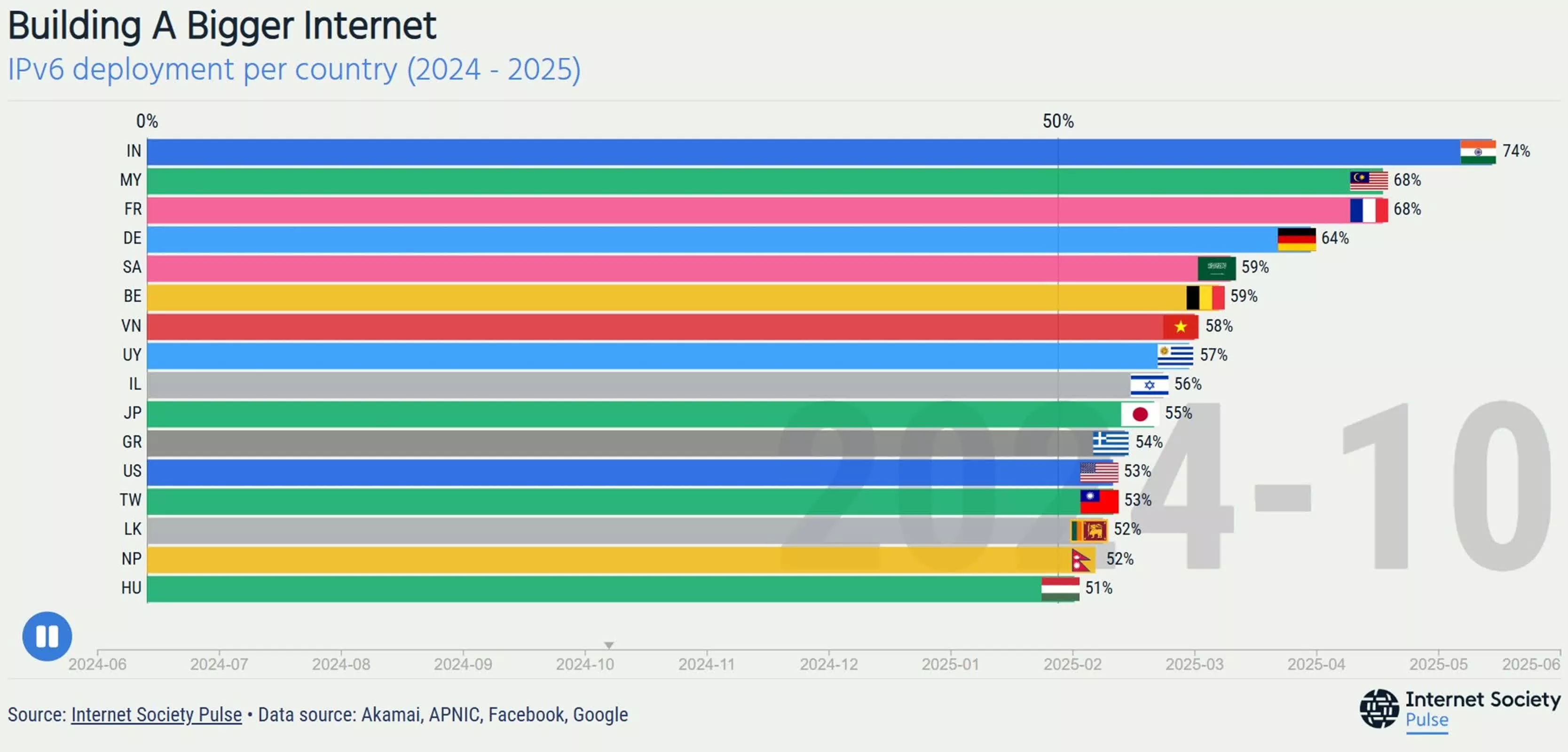
Tuvalu's experience is not isolated. Other countries, including Brazil, Guatemala, Hungary, Japan, Mexico, Puerto Rico, and Sri Lanka, have also crossed the 50 percent threshold for IPv6 deployment in the past year. In some cases, such as Japan and Puerto Rico, this represents a return to the majority club after brief declines, while for others like Brazil and Mexico, it marks a debut. France and India now lead the world in IPv6 adoption, with each country at 73 percent deployment.

IPv6, or Internet Protocol version 6, is the successor to the decades-old IPv4 system that underpins the internet. The main limitation of IPv4 is its 32-bit address space, which allows for approximately 4.3 billion unique addresses, a number that proved insufficient as the number of internet-connected devices worldwide exploded.

IPv6 solves this problem with 128-bit addresses, enabling approximately 340 undecillion (that's 340 trillion trillion trillion) unique identifiers. This vast address space ensures that every device, from smartphones to smart refrigerators, can have its unique address for decades to come.
Beyond its expanded capacity, IPv6 brings technical improvements. It simplifies packet headers for more efficient routing, supports automatic device configuration, and includes mandatory security features such as IPsec for encrypted and authenticated communication.

Unlike IPv4, which often requires workarounds such as Network Address Translation to share a single address among multiple devices, IPv6 enables direct, end-to-end connectivity.

Starlink's role in accelerating IPv6 adoption is particularly noteworthy. As a satellite-based provider, Starlink can deliver high-speed internet to remote or underserved regions where traditional infrastructure is lacking. By operating an IPv6-only network, Starlink not only brings connectivity but also helps leapfrog legacy technology, pushing entire countries toward modern standards in a single step. This effect has also been observed in other regions, including parts of Africa, where Starlink's presence is driving similar transitions.

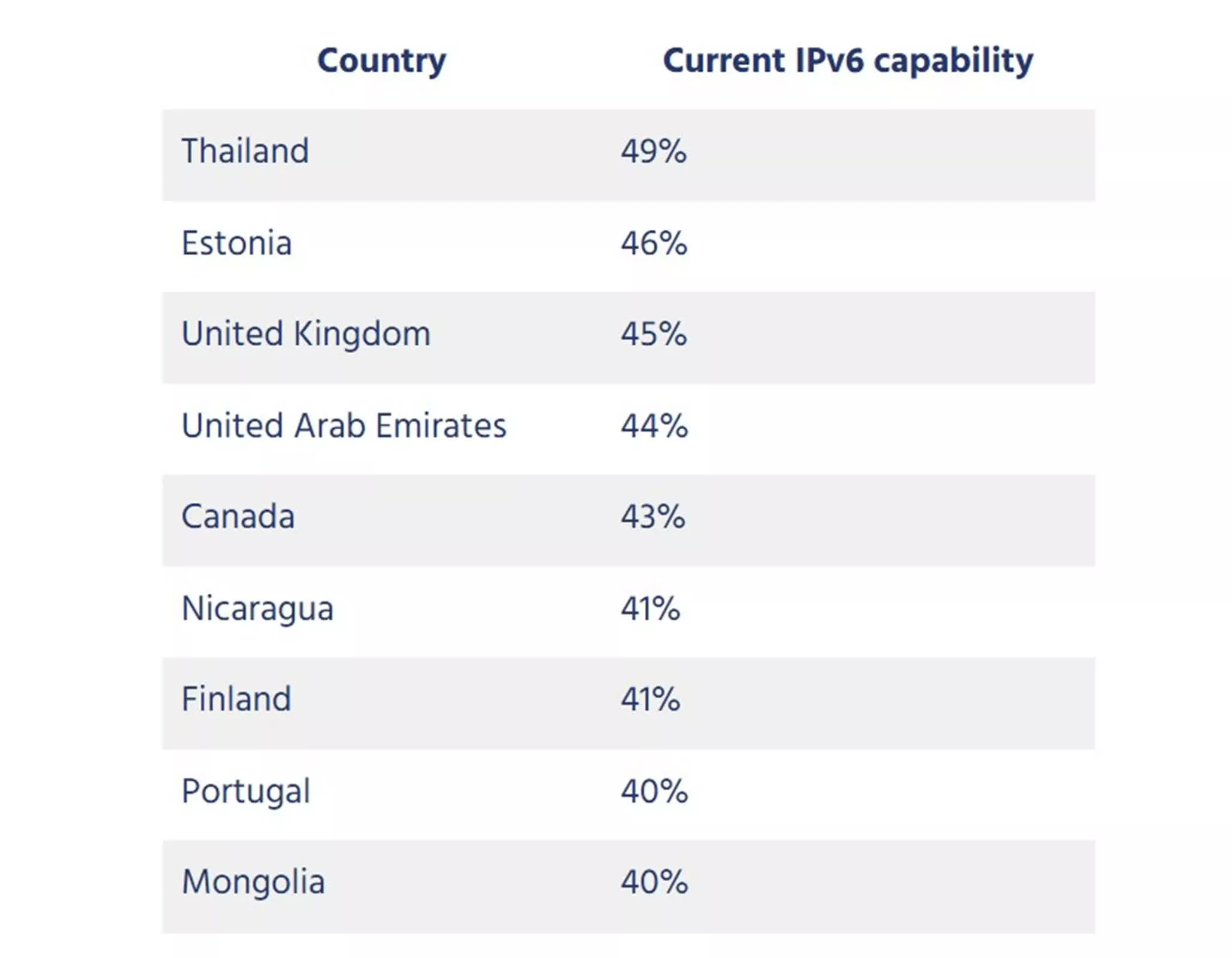
With countries such as Thailand, Estonia, and the United Kingdom now approaching the 50 percent mark, the list of majority-IPv6 nations is expected to keep growing, signaling a new era for the world's digital infrastructure.

Permalink to story:

 
I still want a static IPv4 address. IPv6 adoption has been slow but that's mostly because it's alot easier to remember 10.0.0.1 than it is to *insert random string of letters and numbers*

They could have made iPv6 easier to use by design, but I guess having more IP addresses than atoms in the universe is more important.
 
I guess one of these days I'm going to have to understand how IPv6 would apply on my LAN, but don't even understand how to give my machines their own static IPv6 and point them at my DNS, gateway, etc.

I have nothing against it but end up having to turn it off because if you want to give a windows machine a static v4 address, your choices are to manually configure ip v6 or disable it.
 
They could have made iPv6 easier to use by design, but I guess having more IP addresses than atoms in the universe is more important.

I suppose they could have used base64 encoding to shorten the length down, but then you have to deal with case sensitivity and "+/=" (or some others) as valid characters, which would probably cause a lot of trouble knowing how well standards get implemented in all the various places. On another note, there's about 10^80 atoms in the universe, about 10^41 more than IPv6 addresses.

I guess one of these days I'm going to have to understand how IPv6 would apply on my LAN, but don't even understand how to give my machines their own static IPv6 and point them at my DNS, gateway, etc.

I have nothing against it but end up having to turn it off because if you want to give a windows machine a static v4 address, your choices are to manually configure ip v6 or disable it.
Disabling it is actually smart to do if you don't need it. IPv6 is a whole different network stack, which means IPv4 based firewalls don't do anything to protect you from IPv6 attackers, for example. I suspect most home networks will continue to use IPv4, with perhaps only an IPv6 on the router to address to the internet, for some time. Though, as IPv6 becomes more common and legacy devices go away, IPv6 only home networks seems likely to be the most common by, my guess, at least the end of the century, possibly much sooner.
 
I suppose they could have used base64 encoding to shorten the length down, but then you have to deal with case sensitivity and "+/=" (or some others) as valid characters, which would probably cause a lot of trouble knowing how well standards get implemented in all the various places. On another note, there's about 10^80 atoms in the universe, about 10^41 more than IPv6 addresses.
Thanks for the correction, I don't know where I got that idea, but 10^41 is a lot less than 10^80th. Maybe it was more addresses than stars in the the universe or something.
 
Thanks for the correction, I don't know where I got that idea, but 10^41 is a lot less than 10^80th. Maybe it was more addresses than stars in the the universe or something.
Yes, there are "only" 10^22 to 10^24 stars in the universe, whereas 2^128 is 3*10^38. I heard it said somewhere that there are more stars than there are grains of sand on Earth, so we could assign every grain of sand its own IPv6 address and still have plenty left over for the rest of our devices.

Though, there are fewer than 2^128 IPv6 addresses due to reserved spaces and what not.
 
There are roughly ~4.3 x 10^9 IPv4 addresses and ~3.4 x 10^38 IPv6 addresses. For context, the 10 billion people are 10^10 and there are approximately ~10^58 atoms in the solar system, ~10^68 atoms in the Milky Way galaxy and about ~10^78 atoms in the universe. As we can see altering the exponent even slightly leads to a dramatic difference in scale – it truly adds a lot.
 
I guess one of these days I'm going to have to understand how IPv6 would apply on my LAN, but don't even understand how to give my machines their own static IPv6 and point them at my DNS, gateway, etc.

I have nothing against it but end up having to turn it off because if you want to give a windows machine a static v4 address, your choices are to manually configure ip v6 or disable it.
There's no reason to run it on an internal network. You only really need IPV6 for outward facing purposes, hence why its being used on ISP WANs.

Internal networks will never make the jump to IPv6, since unless you have billions of PCs on it there's no need for it.
 
My cable modem and router are long in the tooth at this point, but if they and Windows 11 are left at their defaults then my Windows devices will end up with IPv6 addresses. They work fine but are hard to parse.

Do modern consumer gateways automatically NAT local IPv4 traffic as IPv6 traffic on the ISP side? Or is that an ISP controlled setting?
 
I still want a static IPv4 address. IPv6 adoption has been slow but that's mostly because it's alot easier to remember 10.0.0.1 than it is to *insert random string of letters and numbers*

They could have made iPv6 easier to use by design, but I guess having more IP addresses than atoms in the universe is more important.
It’s true it uses base 16 (hexadecimal) characters to represent numbers, but IPv6 addresses are almost all truncated so it’s actually pretty short. For reference, an IPv4 address would be an 8 character long IPv6 address. It also leaves out leading zeroes, which cuts down on the length. This is one of the addresses for TechSpot: 2606:4700:10::ac43:1d23. If they represented it as IPv4 format (16 bit decimal groupings), it’d look like this instead: 38.6.71.0.0.32.0.0.0.0.0.0.172.67.29.35
 
There's no reason to run it on an internal network. You only really need IPV6 for outward facing purposes, hence why its being used on ISP WANs.

Internal networks will never make the jump to IPv6, since unless you have billions of PCs on it there's no need for it.

Well, you don't run IPv6 like you do a RFC1918 IPv4 network with NAT. There is no need for NAT. You just get a /whatever from your ISP and all your devices will use the assigned "public" IP subnet. Of course, you still have a firewall, etc.... on the "edge", but there is no need for NAT.

IPv6 makes things a lot easier (outside of remembering your IPs), but that's what DHCP with DNS updates is for. You just use the FQDN of the server. IPv6 to IPv4 gateways to reach IPv4 only services is also a PITA, but that's only a problem if you want or need it to be.
 
Last edited:
Sadly, it is not true that Starlink is IPv6-only. I am not sure how the author got to this conclusion. Looking at RIPE Atlas or other papers [1, 2], we see that Starlink offers IPv4 & IPv6. So, not really novel what Starlink does.


[1] "Measuring the Satellite Links of a LEO Network" by Pan et al. (2023)
[2] "LENS: A LEO Satellite Network Measurement Dataset" by Zhao et al. (2024)
 
Back