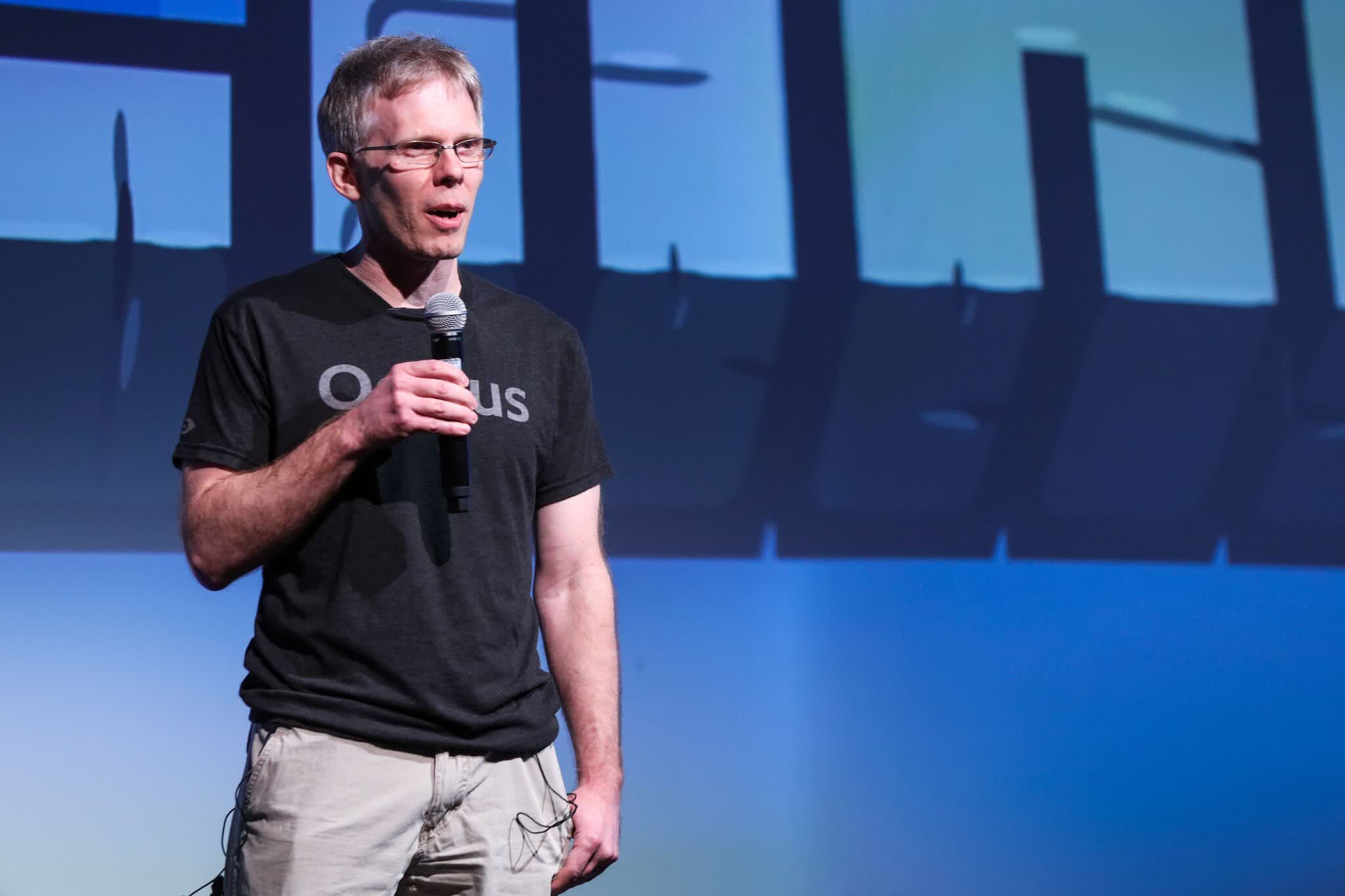
Big quote: Light, not silicon, could someday define how artificial intelligence stores and recalls its knowledge. That's the idea that recently surfaced when John Carmack – the engineer known for his work on Doom and Meta's virtual reality projects – proposed using fiber-optic loops as a form of high-speed data cache for AI models. His brief post on X turned into a dense technical conversation among researchers and technologists intrigued by the blend of classic computing theory and modern optical networking.
The thought experiment began with a number. Single-mode fiber optics can now transmit data at 256 terabits per second over 200 kilometers. Based on that capacity, Carmack estimated that about 32 gigabytes of information are stored in the cable at any given moment.
Instead of treating this as a mere data pipeline, Carmack suggested using the loop itself as storage. This "level-two" cache could hold model weights in continuous motion, circulating at light speed. The idea echoes how RAM buffers data between a drive and an active processor, but with nearly zero latency and vastly higher bandwidth.
The underlying physics of such an approach isn't new. Commenters quickly connected Carmack's speculation to delay-line memory, a mid-20th-century technique that stored information as pulses traveling through mercury tubes. Even Alan Turing once joked about experimenting with gin as a medium.
While those early systems were abandoned due to instability and practical limitations, fiber optics has rekindled the concept with modern precision. Compared with volatile DRAM, light offers predictability, low power draw, and enormous bandwidth potential.
256 Tb/s data rates over 200 km distance have been demonstrated on single mode fiber optic, which works out to 32 GB of data in flight, "stored" in the fiber, with 32 TB/s bandwidth. Neural network inference and training can have deterministic weight reference patterns, so it is...
– John Carmack (@ID_AA_Carmack) February 6, 2026
The potential efficiency benefits are part of what makes the proposal enticing. Dynamic RAM demands constant electrical refreshing to preserve bit states, consuming substantial energy in large-scale AI servers. Fiber, by contrast, requires minimal power to maintain optical signals.
As Carmack observed, fiber transmission may follow a more favorable growth curve than DRAM, particularly as component miniaturization slows. Yet he acknowledged a major barrier – 200 kilometers of high-grade fiber would be costly, and the amplifiers and digital signal processors needed to sustain transmission could offset any power savings.
The debate even veered toward the speculative. Elon Musk mused about vacuum-based optical data transfer – essentially laser memory in free space – though that idea remains more science fiction than an engineering plan.
Interesting idea. You could slow down light even more and increase data stored per km by using higher refractive index materials.
– Elon Musk (@elonmusk) February 7, 2026
Or just use vacuum, which costs nothing, over a longer distance ...
For Carmack, the practical next step seems more grounded: tightly coupling flash memory chips to AI accelerators through a direct interface, enabling model weights to move rapidly between computation units without relying on DRAM. Such integration would require cooperation between semiconductor manufacturers and accelerator designers, but no one considers it implausible given the flood of investment into AI infrastructure.
Research groups have already begun exploring similar architectures that use solid-state storage. Projects such as Behemoth and FlashNeuron, both from 2021, and FlashGNN have investigated using NAND flash as a near-memory cache for neural networks.
More recently, the Augmented Memory Grid initiative proposed an open-source framework to optimize key-value cache efficiency for large models. While these systems remain experimental, they show that the line between storage and memory is already blurring.
John Carmack proposes fiber-optic loops as high-speed AI cache


