Just 16% of Americans think AI will benefit society, despite chatbot use climbing to 49% of US adults

midian182

Posts: 11,722   +177
Staff member
The takeaway: Despite the apparent growth of an anti-generative AI movement, more Americans are using chatbots than ever before, according to a new survey. But somewhat paradoxically, just 16% of participants believe the technology will have a positive impact on society over the next 20 years, while 40% think the impact will be negative.
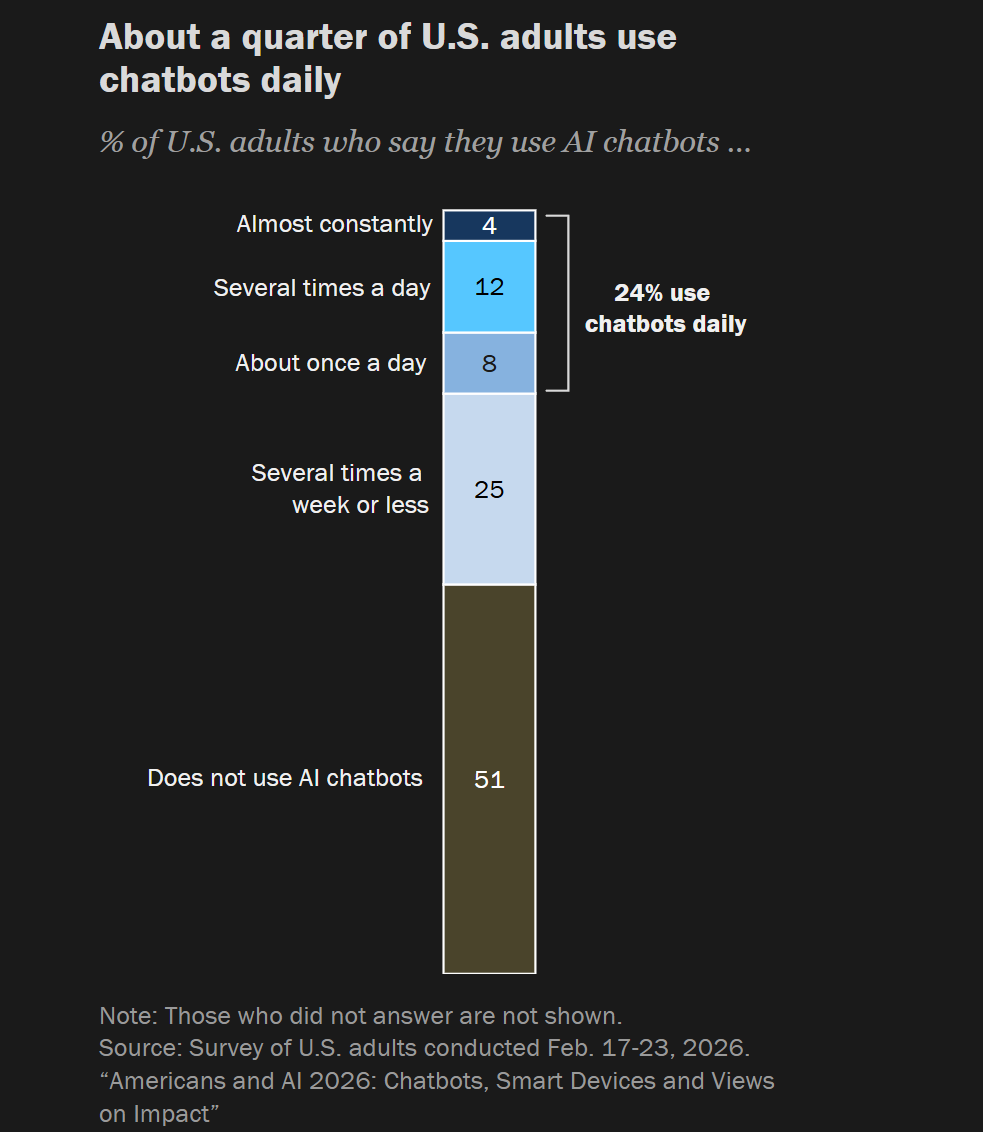
The Pew Research Center found that 49% of US adults now use chatbots, up from 33% two years ago. This includes roughly one in four who use these tools on daily basis. Fifty-one percent say they don't use chatbots at all, the majority of whom are 50 and older.
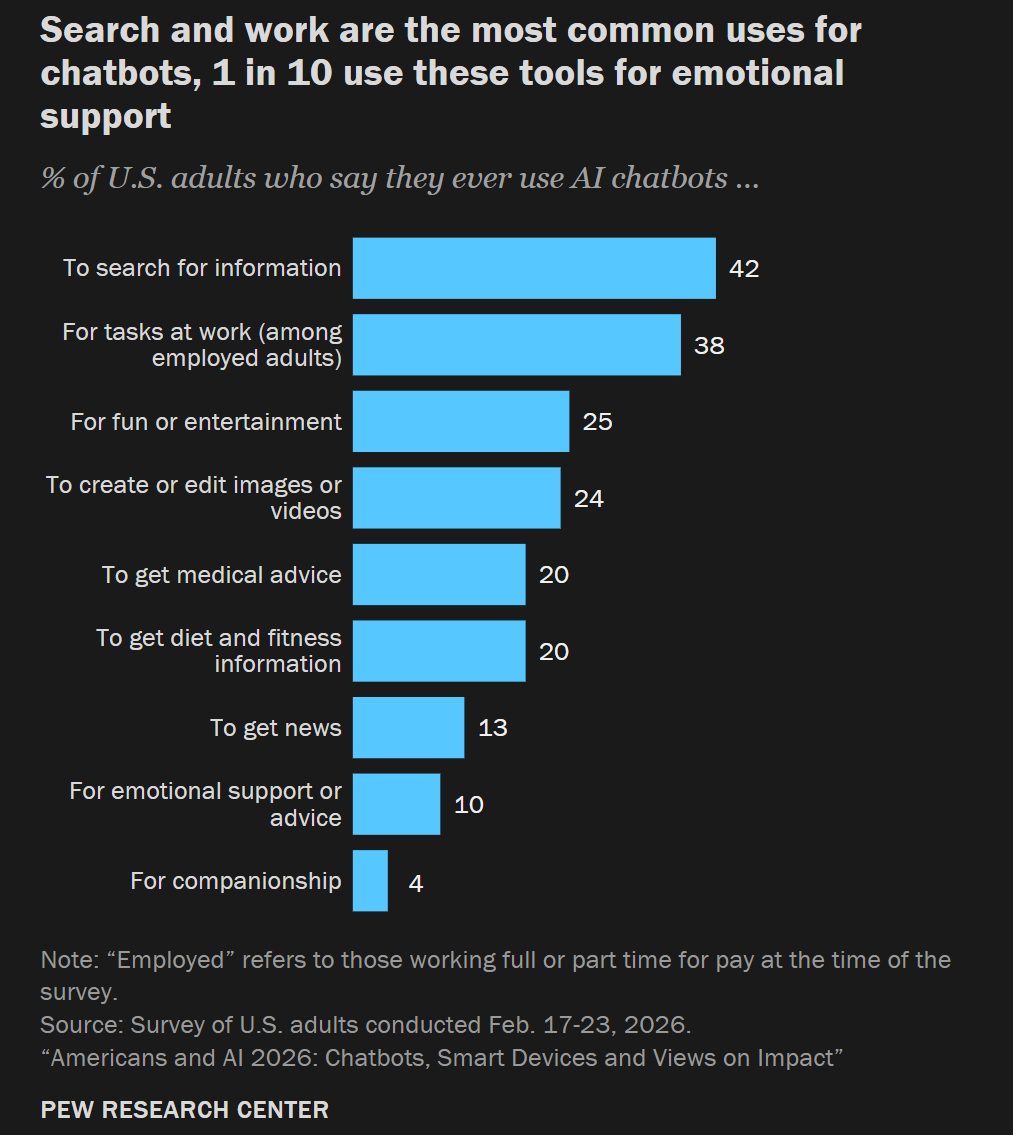
Most people use the bots to search for information, illustrating how many people are now using the likes of ChatGPT instead of visiting websites to find information, eroding the web's business model.

Work tasks, fun or entertainment, and creating or editing images are the other most popular use cases. Using them for medical and diet/fitness advice is also popular, though even the chatbots' makers advise users against relying on their tools for medical advice, diagnoses, or treatment recommendations.
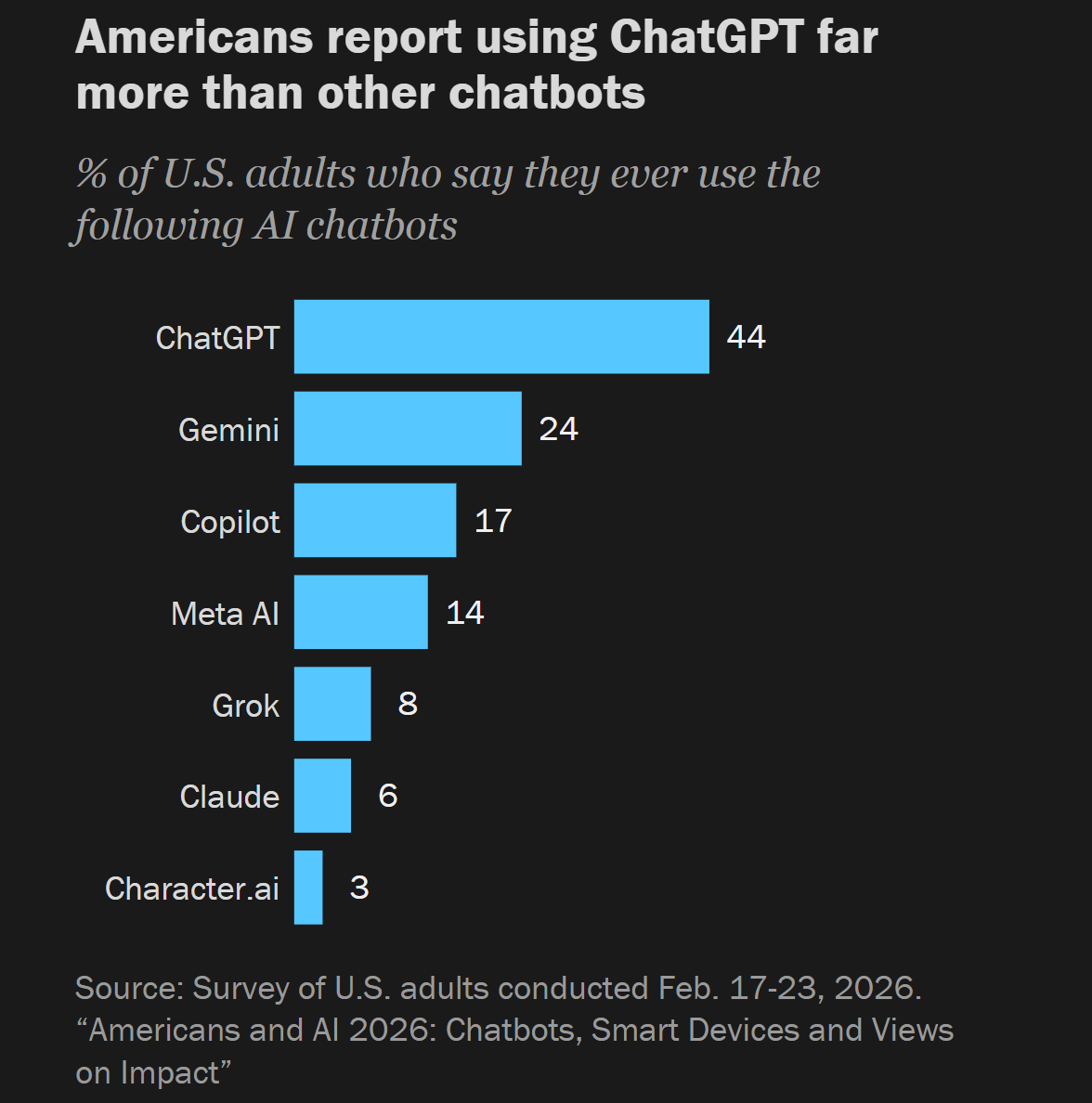
The survey also found that about a quarter of adults use the chatbots daily, while the other quarter use them several times a week or less. And while some of its rivals are catching up, ChatGPT remains the most popular chatbot (44%). It's followed by Gemini (24%), Copilot (17%), and Meta AI (14%).
Despite the increased usage, most Americans predict AI will be bad rather than good for society (40% vs. 16%), while one in three believes the effect will be equally positive and negative.

More people also expect it will have a negative rather than positive effect on their own lives (31% vs. 23%).

Unsurprisinglye group most concerned about AI's impact on society and their own lives is adults ages 18 to 29. The technology continues to drive mass job losses, though some execs now argue that it is creating just as many.
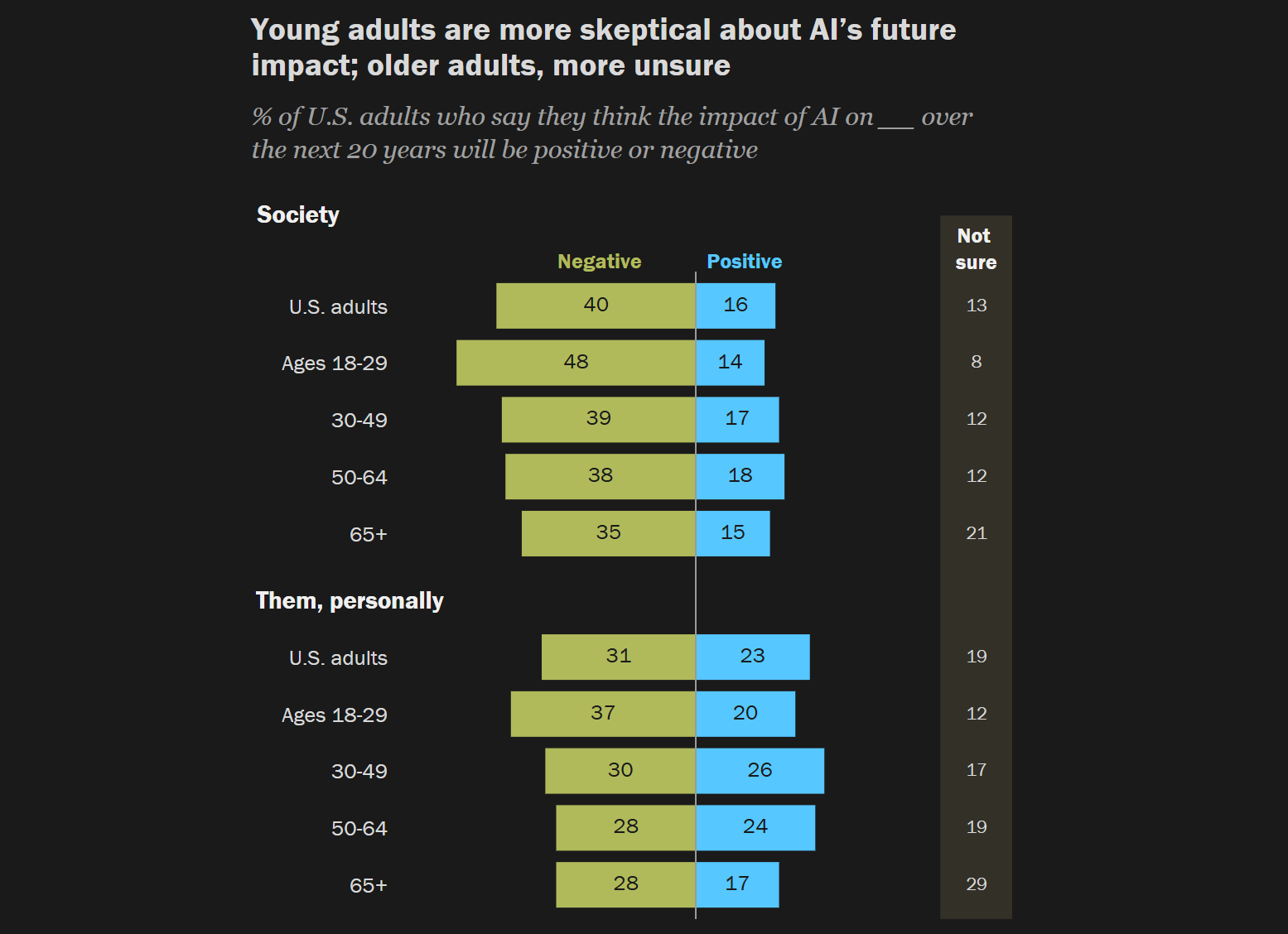
Another interesting finding is that around two-thirds of Americans think AI is advancing too quickly. This has been a concern since the generative AI revolution began, and has picked up steam since Anthropic called Mythos too dangerous to release.

Participants expressed other concerns: most think AI will make their personal information less secure, 67% have little to no confidence in the government to regulate AI effectively, and about six in ten adults are not confident in companies to develop and use these tools responsibly.

Another sign that generative AI use is growing in parallel with its dislike came from market intelligence firm Sensor Tower. It reported that ChatGPT has become the fastest app ever to reach one billion monthly app users (MAUs), beating the previous record holder, Google Maps.

Permalink to story:

 
In the late 19th Century, most of the world public hated and feared electricity: newspaper and magazine articles referred to it as a incredibly dangerous "unrestrained demon", and prominent individuals declared they'd never, ever allow it into their homes.


img1-The_Unrestrained_Demon_anti-electricity_cartoon_02.jpg
 
"Just 16% of Americans think methamphetamines will benefit society, despite meth use climbing to 49% of US adults"

Just because people are using it doesn't mean 1. they aren't abusing it; and 2. its actually good to use in a majority of use-cases. Methamphetamines refined and dosed as ADHD medication? Likely a net gain for society (a major gain for a minority population). Methamphetamines refined into recreational drugs, and sold straight, cut into other drugs, or cut with other drugs, all so the producers and dealers can make as much money as possible at the expense of their customer's health? Zero benefit for anyone who is actually trying to contribute to society.

Once again, its not the tool but how the tool is used. And the people building out this new tool don't have our best interests in mind, they just want to make as much money as possible - welfare of the rest of society be damned.
 
My woman is a Physics teacher.

She uses AI to automatically generate tests for her kids.

She uses AI to automatically generate lesson plans.

She uses AI to automatically grade work.

AI essentially cut her job workload - among 115 students - by more than 50%


I use AI more recreationally - along with the AI tech in my games: Rat Tracing, DLSS, noise cancelling, etc.
 
Sort of got ninja'd but I'll type it anyway because energy drink ha ha.
The people who run the AI companies are only in it for the money and they're ruthless psychopaths to boot.
Benefit society?
They'll bleed society dry if they can and don't care if they kill it in the process.
 
In the late 19th Century, most of the world public hated and feared electricity: newspaper and magazine articles referred to it as a incredibly dangerous "unrestrained demon", and prominent individuals declared they'd never, ever allow it into their homes.


img1-The_Unrestrained_Demon_anti-electricity_cartoon_02.jpg

Let's remember that when Edison finally started with practical uses, it was much like AI. No standards, lots of hype, elimination of jobs,etc. And much like AI there were competing standards that were out more for themselves more than practical application. Edison wanted DC generation and distribution, Tesla was committed to wireless power distribution, and finally Westinghouse won out with AC distribution. And it didn't happen overnight.

Contrast that to today, the company most out for themselves has created the standard (Nvidia), with everyone else getting scraps. The AI crowd is hyping overnight revolution, not "lets think about this" before committing budget breaking dollars to AI. Employers are shedding jobs in the name of AI, while returns don't match the activity. (Note: Most of these companies throwing employees overboard are probably more due to needing to free up cash to plow into AI, rather then AI replacing them in any effective way.

What concerns me it the lemming like way companies are following the hype. Not that it won't eventually get there.

The interstate system and air travel came well after the oil boom. It took a while before coming up with practical uses for oil after heat and light. It will help with some things, but what companies expect may take a while. Not to mention, half of the country seems to want to kill of said oil industry 100 and some odd years later.

Add to that, machine learning has been with us quite some time, and a LOT of this AI is just more advanced machine learning. In addition to ML being re-badged as AI, probably more than half of the "new" products out there.

As I've said before...I keep waiting for "New Tide laundry detergent! NOW with AI!"
 
Last edited:
The 20% using AI for medical advice is terrifying.

Although my medical doctor friends often lament Dr Google so maybe that’s not a new problem.
I think you've kind of missed out on how the medical research community is using it. They're not cranking out new drugs and rushing them into market. They're actually using AI in a very good way. Rather than use the internet to search out answeres from crackpots, they're programming medical biological, and chemistry datbases, which the AI (ML?) take that information and suggests compounds and medicine that MIGHT work. And the research scientists do the heavy lifting of evaluating them through the normal proceedures.

It already has some promising drugs being tested now.
 
I agree 100% with the comment about how surveys work.

This is reminiscent of when a major software company touted stats about the widespread adoption and acceptance of their new OS with zero mention of the rather significant point that they forcibly pushed it out as an update to millions of users with no opt-out option. They also excluded the number of users on both slow and metered connections who had to wait hours, days and/or weeks for the OS update to finish if it didn't fail due to timeout, insufficient system resources or insufficient internet connectivity.

Almost always, rush-to-market trends result in huge disruption and upheaval that get casually blown off and sometimes even besmirched as troglodyte end-user issues.

There is a reason why force-feeding is frowned upon. No one asked for it, no one needed it and inevitably, very few like it.

We used to joke about the fact that software companies, and specifically their developers, have a constant need to keep making changes to justify their job positions and to keep raking in the revenue and as such, will ruin perfectly functional, widely used apps just because they have to produce something new at the shareholder meeting. Newer is not always better.

Chasing trends is for fools and influencers who must always find (or fabricate) content to stay relevant.

 
"I say your civilization because as soon as we started thinking for you it really became our civilization which is of course what this is all about. Evolution, Morpheus, evolution, like the dinosaur."
 
Contrast that to today, the company most out for themselves has created the standard (Nvidia), with everyone else getting scraps.
You mean, like Edison first began with a total monopoly on power generation, before the "current wars" began? The true 'standards' in AI aren't NVidia's products, but the models themselves -- of which there are a bewildering and highly competitive variety.

Employers are shedding jobs in the name of AI...
Except this isn't happening, as reflected in the unemployment figures, which are basically flat over the last 18 months, and actually *better* than they were four years ago.

As I've said before...I keep waiting for "New Tide laundry detergent! NOW with AI!"
Chemical manufacturers -- including P&G who makes Tide -- have been using AI to design their products for over 15 years now. You've **already** long benefited from this, without knowing it.

"I say your civilization because as soon as we started thinking for you it really became our civilization which is of course what this is all about. Evolution, Morpheus, evolution, like the dinosaur."
You realize that "The Matrix" was a fictional work, right?
 
"will [eventually] benefit society" and "will have a net benefit on society [by which the respondent probably mostly means themselves and their circle] over the next 20 years" are two very different things IMO and make the answer a lot less surprising.

Lots and lots of kinks still to work out and the transition will have uneven effects. I'm worried about the first batch kids educated during a period when the easiest path forward to any assignment is typing it into GPT.
 
How many people who knew Oxy was bad VS how many people did it anyway cause it felt good.

Uh oh.
 
The industry keeps presenting adoption as proof of trust. In reality, people will use a convenient tool while distrusting the companies building it, the government regulating it, and the consequences of everyone else using it.
 
AI may be the first technology where half the population uses it, two-thirds think it is advancing too quickly, and every company interprets both numbers as permission to accelerate.

 
I use Alexa AI chat every single day since it's been activated in our house (a few months). It's FREE and it finally made the device useful more than than playing music and turning lights on an off. It's "dumb" AI, I cannot train it, it doesn't remember what we talked about after about 2-3 minutes of no interaction.

Honestly, it's one of the greatest inventions ever. I use it for information, data lookup (more for work), complex calculations and estimates. It's like having the Star Trek bridge computer at my disposal. After a few months I've trained myself how to use it most effectively and it's shockingly powerful when flexed to it's full potential. THAT SAID - It can be wrong on specific topics but, even more interesting, I can tell it to "look deeper and longer" and it will - sometimes correcting it's previous answer. I could write a full article about my experience with Amazon Alexa AI. It's that cool!

For our house, we'd be crippled without it. It's like having our own intelligent helper. We'd be back to fully using computers and cell phones to look up stuff. It's already saved us HOURS in manually searching and looking-up alone. It does all the hard work with a simple voice command.

Nobody else here is using it?
 
The 20% using AI for medical advice is terrifying.

Although my medical doctor friends often lament Dr Google so maybe that’s not a new problem.
My daughter just had an MRI last week. They had a cheaper option, as I recall for one third the price, to have an AI reading instead of the doctor. I told her HELL NO, pay the doctor, it was a potentially serious organ issue. Not something you want to put in the hands of AI, I don't care how good it's claimed to be. lol
 
My woman is a Physics teacher.

She uses AI to automatically generate tests for her kids.

She uses AI to automatically generate lesson plans.

She uses AI to automatically grade work.

AI essentially cut her job workload - among 115 students - by more than 50%


I use AI more recreationally - along with the AI tech in my games: Rat Tracing, DLSS, noise cancelling, etc.
Excellent utilization by your woman! It's a TOOL and she's taking advantage of it. The naysayers may cry but everything she does is reviewed and tweaked by her I'm sure.
 
My daughter just had an MRI last week. They had a cheaper option, as I recall for one third the price, to have an AI reading instead of the doctor. I told her HELL NO, pay the doctor, it was a potentially serious organ issue. Not something you want to put in the hands of AI, I don't care how good it's claimed to be. lol
Dunno what quack hospital gave you that option - AI works WITH doctors where I live… it often spots stuff a doctor never would - then a doctor checks and gives their synopsis.
 
Back