Micron's world-first PCIe Gen 6 SSD doubles data rates for AI data centers

Alfonso Maruccia

Posts: 2,508   +934
Staff
Highly anticipated: After over a year of teasing its latest storage technology, Micron is now almost ready to sell its storage breakthrough to enterprise and Big Tech customers. The world's first PCIe Gen6 SSD could become a key piece in the increasingly baffling puzzle of the AI industry.
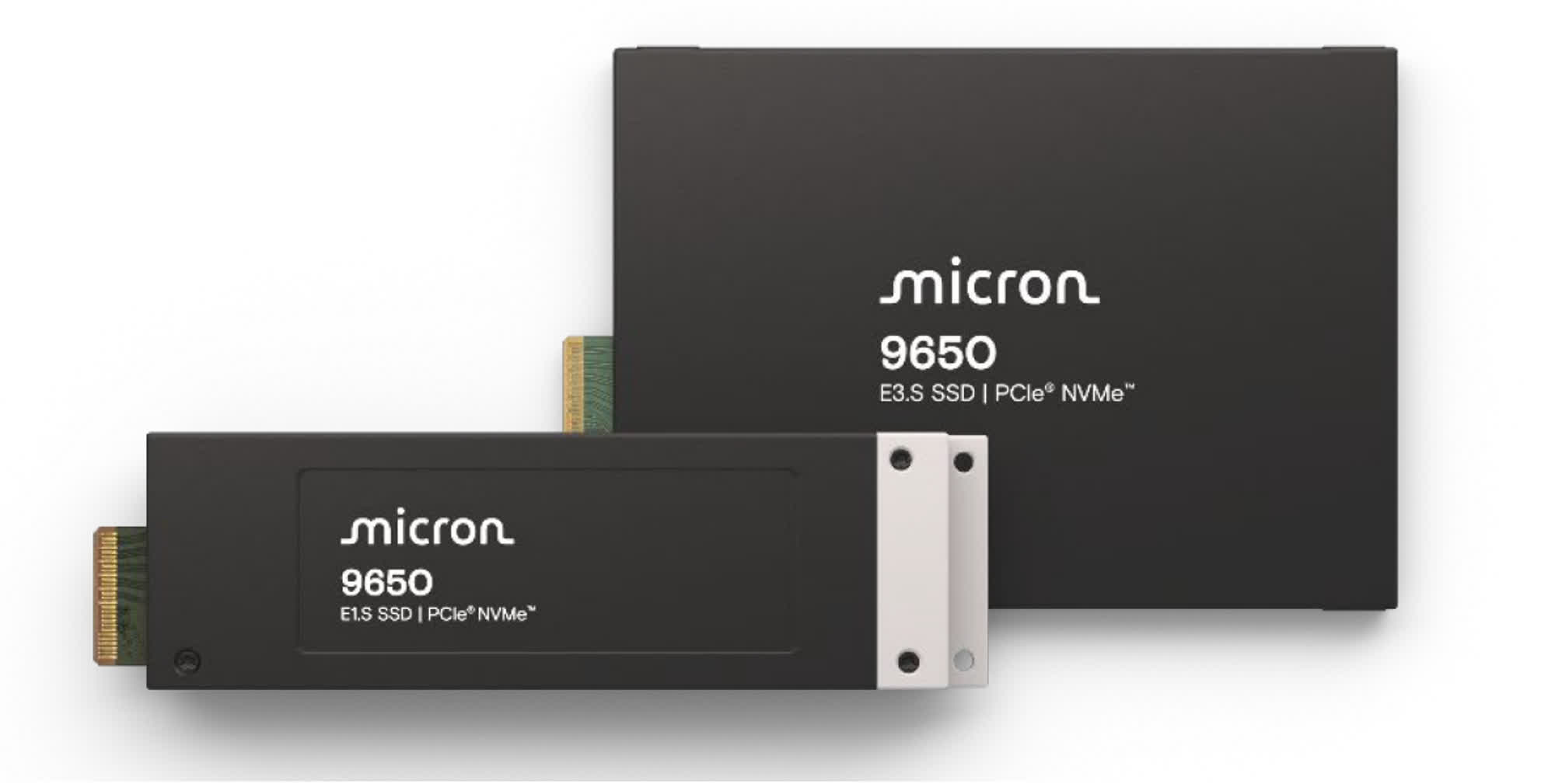
Micron has announced that the 9650 NVMe SSD has finally entered mass production, hailing the new drive as the first PCIe Gen6 storage product in the world. Like everything else these days, the high-end SSD is largely focused on accelerating AI workloads, and generating hefty returns thanks to Big Tech's voracious appetite for anything with a chip inside.

Micron began demonstrating its PCIe 6.0 technology a year ago, at a time when no compatible hardware peripherals were available. The company says PCIe Gen6 represents a big shift in storage performance, as bandwidth is "generally" doubled compared to PCIe Gen5 drives. That jump, Micron argues, makes the 9650 series particularly well suited for AI companies racing to scale their latest large language model deployments.

According to Micron's official spec sheet, the 9650 SSD can deliver sequential read speeds of up to 28,000 MBps – roughly double the 14,000 MBps ceiling of PCIe Gen5. Sequential write speeds climb to 14,000 MBps, a more modest 40 percent increase. Random performance also sees sizable gains, with read speeds reaching 5.5 MIOPS (+67 percent) and write speeds topping out at 900 KIOPS (+22 percent).
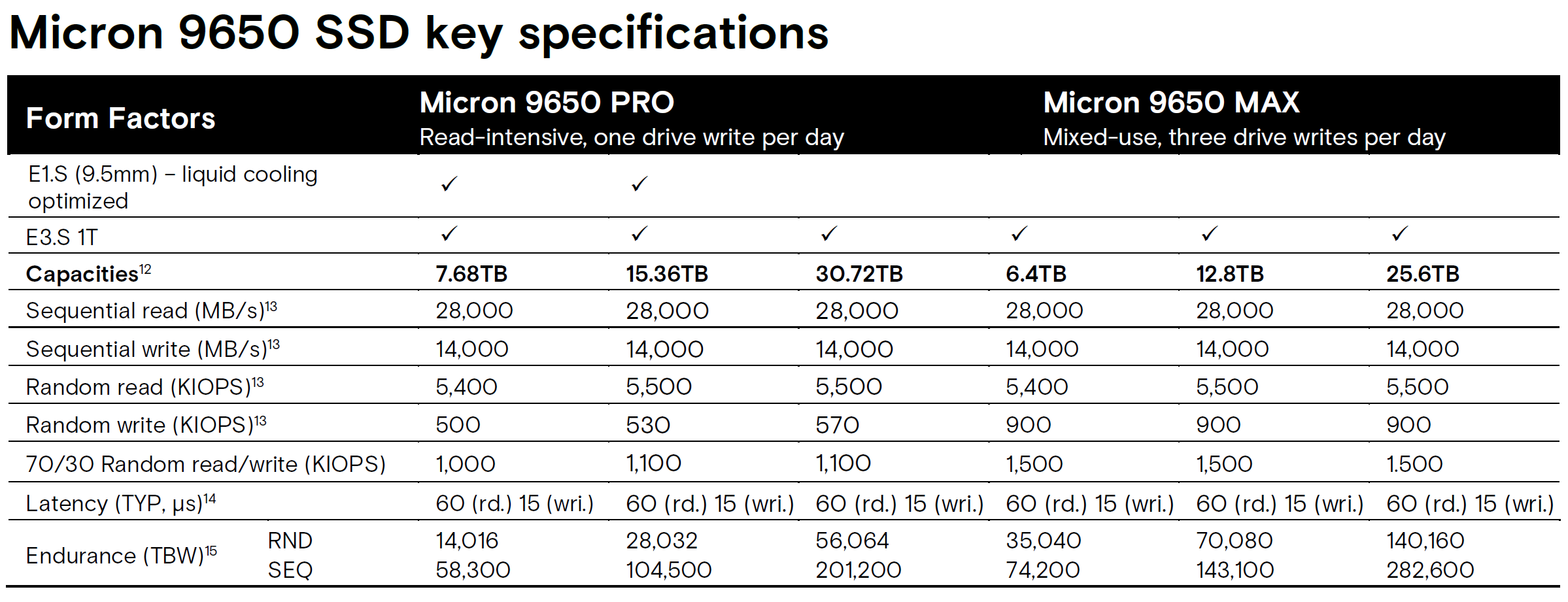
The Micron 9650 lineup spans capacities from 7.68 TB to 25.6 TB and is offered in both E1.S and E3.S 1T form factors. Smaller E1.S models, up to 15.36 TB, are optimized for liquid cooling as well. Micron has not shared pricing details, though the company's enterprise focus suggests these drives will not come cheap.

Micron is also reframing the role of storage in AI infrastructure. According to Vice President Alvaro Toledo, storage is no longer a secondary concern trailing behind compute. Instead, it has become a defining factor in overall system performance, influencing both throughput and efficiency across AI-driven data centers.

"In an AI driven world where data must move continuously, predictably, and at massive scale, storage performance has become a first order design constraint," Toledo said.

Efficiency, Micron claims, is another major advantage. Within the same 25-watt power envelope as PCIe Gen5 drives, the 9650 SSDs can deliver twice the sequential read efficiency. Moving more data without increasing power draw could help data centers inch closer to their often-cited sustainability targets, at least on paper.

The company says it has spent the past 18 months validating interoperability for the 9650 drives, laying the groundwork for broader adoption across the emerging PCIe Gen6 ecosystem. Still, with the memory market under strain, how quickly this next-generation storage finds its footing remains an open question.

Permalink to story:

 
I wonder what sort of temperatures they were seeing that made them go with a liquid cooling solution.
 
Micron? The people that dont value my money?! SKIP news.

Yea, I do wonder how hot they can get too. My Kingston gen 5 drive is insanely fast and very cool. As hot as 990 pro from samsung in fact. If they can keep that heat on gen 6, its all good. As long as it doesnt need a water cooling... or even air cooling. I dont mind a big block tho.
 
When money is no object, they can build anything they want to build.
Makes way more sense to go after the big money than the small money.
 
Micron? The people that dont value my money?! SKIP news.

Yea, I do wonder how hot they can get too. My Kingston gen 5 drive is insanely fast and very cool. As hot as 990 pro from samsung in fact. If they can keep that heat on gen 6, its all good. As long as it doesnt need a water cooling... or even air cooling. I dont mind a big block tho.
unfortunately, an increase in speed is linked to an increase in power consumption and therefore, heat. This didn't really start to be a noticeable problem until gen 4 can around and only big one until gen5. The fact that they are talking about liquid cooling isn't a good sign. We might see a return of a HDD sized m.2 drives with active cooling built in
 
unfortunately, an increase in speed is linked to an increase in power consumption and therefore, heat. This didn't really start to be a noticeable problem until gen 4 can around and only big one until gen5. The fact that they are talking about liquid cooling isn't a good sign. We might see a return of a HDD sized m.2 drives with active cooling built in
To be fair, a lot of the latest, highest end AI server racks are primarily water cooled, it might also be it's easier to impliment a water cooled SSD into those systems than an air cooled one, since these systems tend to be pretty slim with less fans in.
 
Since I can’t realistically max out my PCIe 4 drives, I don’t care that only enterprise is getting PCIe 6.

Servers are the only things running enough concurrent operations to hit those max transfer numbers. And my 4 drives run nice and cool.
 
To be fair, a lot of the latest, highest end AI server racks are primarily water cooled, it might also be it's easier to impliment a water cooled SSD into those systems than an air cooled one, since these systems tend to be pretty slim with less fans in.
im talking about for comsumers where it is easier to have a self contained unit than liquid cool everything. liquid cooling is also expensive and might not be appealing to everyone
 
im talking about for comsumers where it is easier to have a self contained unit than liquid cool everything. liquid cooling is also expensive and might not be appealing to everyone
Ah! I get ya now, I thought you were talking about the SSD's in this article, that are squarely marketed for AI datacenters and only fit into modern servers (E1.S & E3.S), which are also the only devices with Gen6 compatibility.
 
Ah! I get ya now, I thought you were talking about the SSD's in this article, that are squarely marketed for AI datacenters and only fit into modern servers (E1.S & E3.S), which are also the only devices with Gen6 compatibility.
But gen6 will eventually hit consumers and when it does, gen6 drives will need some sort of active cooling
 
But gen6 will eventually hit consumers and when it does, gen6 drives will need some sort of active cooling
Right, I agree also, they will eventually trickle down to the consumer market.

But you don't judge tech from F1 car engines that eventually trickle down to normal cars do you? It's similar here and it kinda happened with Gen5 SSD's also, it's not even been a year yet since Samsung released their first Gen5 SSD's on the consumer side.
 
Back