First look: Microsoft is taking a different approach in the race to build a practical quantum computer, betting on new materials and AI tools to solve longstanding technical challenges. This week, the company introduced Majorana 2, a next-generation quantum chip that features a redesigned materials stack and device architecture.
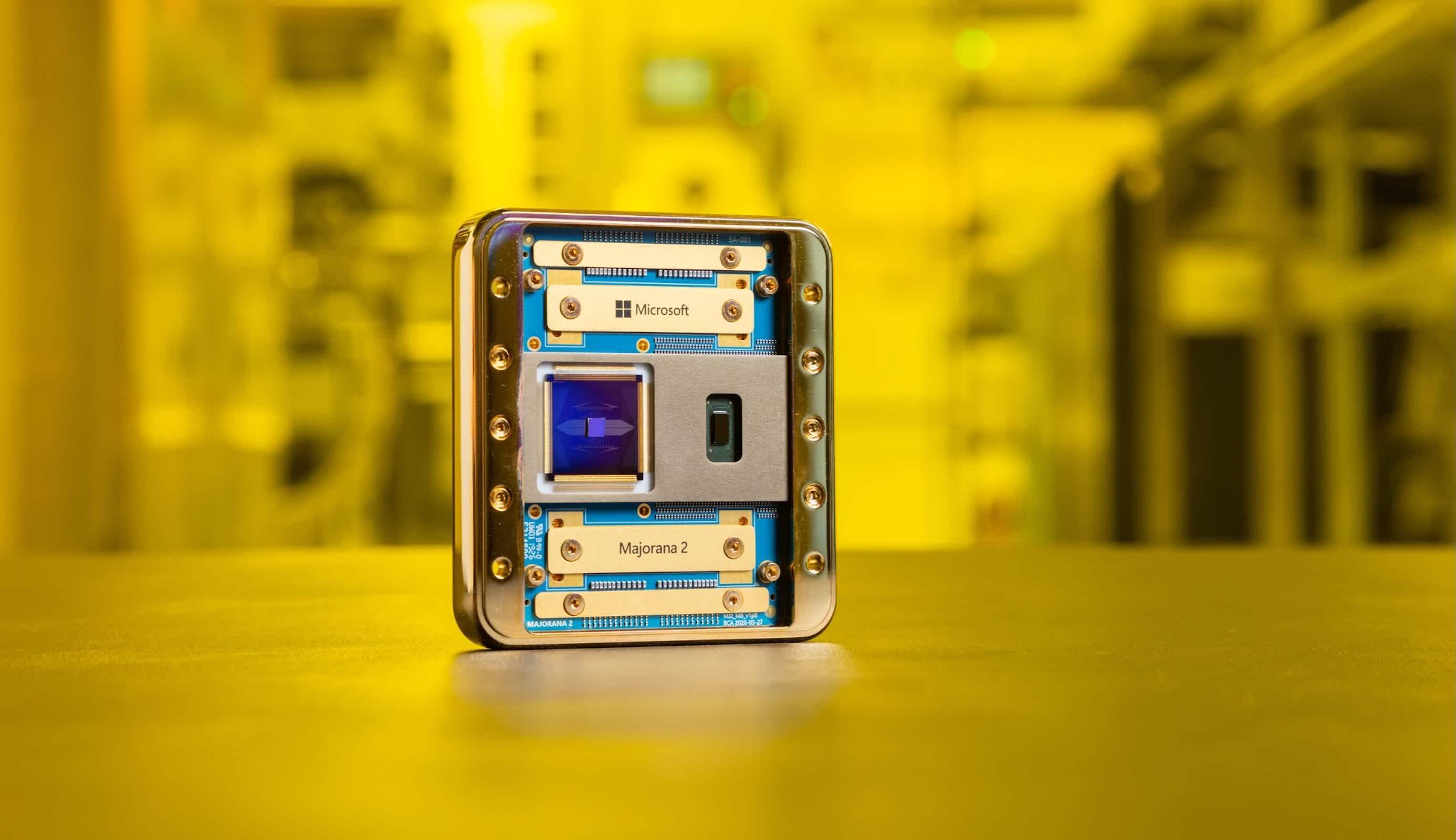
This week, the company introduced Majorana 2, a redesigned quantum chip that reflects a shift in both its engineering approach and underlying physics. Instead of the superconducting aluminum-based designs used by most rivals, Microsoft has built its latest system around lead. That choice forced the company to overcome manufacturing challenges that have long made lead difficult to use in chip fabrication.
That effort appears to be paying off, at least according to Microsoft's internal benchmarks. The company says the qubits in Majorana 2 can hold their quantum state about 1,000 times longer than those in its earlier design.
In practical terms, that moves qubit lifetimes from the microsecond range – common across much of the industry – to an average of roughly 20 seconds, with some lasting as long as a minute. The chip also operates at microsecond speeds and uses qubits that are about one-hundredth of a millimeter in size.
The materials shift did not come easily. Lead, which Microsoft uses in its topological qubits, presents a fundamental challenge: it dissolves in water, making it difficult to handle during fabrication.
"The reason why people don't use it to build chips is it requires an incredibly specialized process to be able to go figure that out. And we figured it out," Jason Zander, Microsoft's executive vice president overseeing quantum efforts, told Reuters.
A significant part of that process involved AI. Microsoft says it used internally developed agentic AI tools to speed up materials discovery and testing, helping researchers refine a new materials stack for more stable qubits. The same tools are now being positioned as part of a broader push to accelerate scientific research beyond quantum computing.
The improvements in qubit stability and size are central to Microsoft's updated timeline. The company now expects to reach a scalable, commercially useful quantum system by 2029, putting it on roughly the same schedule as competitors such as IBM. The broader field remains crowded, with Alphabet, Amazon, and several Chinese groups all working toward similar goals, each using different technical approaches.
Microsoft's path, however, continues to draw scrutiny. Its design relies on Majorana quasiparticles, an exotic state of matter that has been difficult to verify experimentally. While Microsoft maintains that it has observed these particles, some physicists remain unconvinced, citing a lack of publicly available data and unresolved questions from earlier research.
"Microsoft can use as much lead as they like - it is not going to shield them from the basic scientific principle that your results need to be reproducible," said Henry Legg, a lecturer in quantum physics at the University of St. Andrews.
The company has pushed back on those concerns, saying it has shared detailed findings with select government partners, including the US Defense Advanced Research Projects Agency, even if not all data can be released publicly. "We've done enough of the physics to really have great data," Zander said. "Believe me, I would not spend the money on the engineering if I felt like we were still off on the physics."
For Microsoft, the emphasis now is on steady gains rather than a single breakthrough moment. "We need to make improvements each year that will get us closer to delivering a computer that we believe will have massive commercial and societal value," said Chetan Nayak, a Microsoft technical fellow. "We've got to keep marching to that roadmap to accomplish that, but where are we relative to last year? We're 1,000 times better."
Whether those gains translate into a scalable system remains an open question. But with a different materials strategy and increased use of AI in its lab work, Microsoft is trying to stand out in a race that is still far from finished.
Microsoft unveils Majorana 2, a lead-based quantum chip designed with AI


