Microsoft will help your boss see how much you're using AI

midian182

Posts: 11,689   +177
Staff member
Why it matters: Microsoft wants companies to do more than just encourage AI use among their employees; it wants the tools to become mandatory. To help achieve this goal, Redmond has updated its Viva Insights monitoring tool with Copilot adoption benchmarks, allowing bosses and managers to see which teams are not going all-in on AI.

Viva Insights is a module in the Microsoft Viva suite – Microsoft's employee experience platform – designed to analyze metadata that can offer insights on how teams compare to each other, both inside and outside of an organization.

Microsoft has, of course, long pushed Copilot as an essential business tool for boosting productivity, though these claims are regularly disputed. In a move to encourage its use, Viva Insights now offers Copilot adoption benchmarks, allowing managers to track which teams are using the AI assistant and how much.

The update will allow organizations to compare Copilot usage internally across different company groups, as well as externally against similar companies, writes Microsoft.
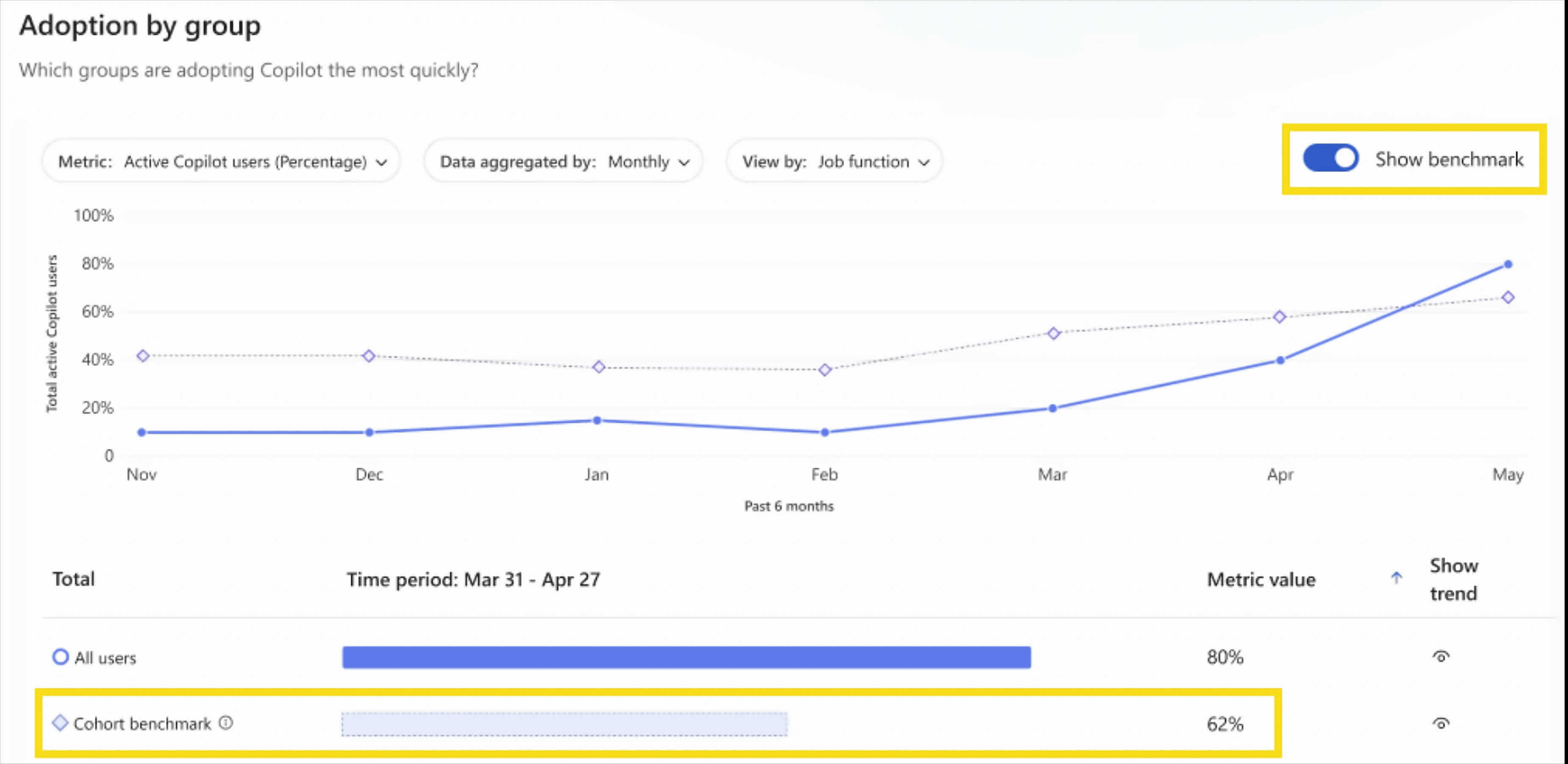
Cohorts within a company can be compared based on manager types, regions, and job functions, showing the percentage of Copilot users, adoption by app, and the returning user percentage.

Viva Insights also offers external benchmarks that will show how companies stack up against rivals when it comes to the number of active Copilot users.

Essentially gamifying the use of Copilot within an organization is unlikely to be welcomed by employees, even if it does analyze teams rather than individuals.

Makers of AI tools such a Copilot claim they boost workplace productivity, but this don't always prove accurate. In July, a study showed that AI coding assistants actually slowed down experienced developers, while another study from October 2024, showed they do not boost productivity or prevent burnout. There's also the impact on workers, some of whom say they now feel like an assembly line as AI increases output but diminishes creativity.

Some companies simply don't care about the productivity argument or the effect on workers and are mandating the use of AI. Coinbase's CEO said in August that he fired engineers who refused to use the technology. Microsoft mandates its use, obviously, as does Yahoo Japan, which aims to "double" productivity as a result.

Permalink to story:

 
Well gee thanks A-holes.

How about less gimmicks, way to go MS and giving people exactly what they don't want!

These companies are really pushing this AI crap into everything, must be hard to justify spending Billions $$$ while retrenching so many people? Then still have nothing worthwhile to show for it!
 
You can tell that MS has invested a fortune in to AI and is not seeing a return on investment. If the integration of AI was really that amazing and truly game changing, then people would be clamoring for it. Instead, MS is literally forcing it into products and now "tracking" its use and trying to convince companies it must have it.

What a weird world we live in now. Forcing people to use a tool that they don't find helpful or productive just because of hype. The enshitification just keeps on going.
 
AI currently has a documented 30–60% error rate, and in my experience, it’s often frustrating to work with—overly sensitive in its language filters (nanny-state vibes), sycophantic in tone (echo chamber), and underwhelming at anything beyond basic, surface-level tasks.

I’ve tried integrating it into workflows that require creative design and technical programming. So far, the result has been, at best, a productivity break-even. More often, it encourages a kind of problem-solving laziness—where if I had just worked through the issue myself, I would’ve done it faster and probably better. That’s a net loss.

Still, I can’t ignore it. Occasionally it solves problems better than I could or helps me operate in domains where I lack deep experience. So it does expand reach. And realistically, I assume the tech will improve. Without learning how to use it effectively, I risk falling behind someone who’s quicker on the draw. Professionally, that’s a frustrating and weird balancing act.

My deeper concern, though, is that we’re not actually becoming more capable—we’re just outsourcing capability to systems controlled by corporate power. It reminds me of cloud-dependent hardware: once the service sunsets, the product becomes a brick. Except now it’s humans being treated like bricked devices—obsolete, because we no longer have the skill, we just outsourced it.

Knowing when to adopt a tool—and just as importantly, when to reject it—feels like a skill I never wanted, but am now being forced to learn. It’s like a weird reverse education: training myself to learning when, why and how NOT to use a tool in order to improve my output while maintaining my own awareness and capabilities to this tech that has a side effect of vacuuming my skills out.

Interesting, I think I just described a kind of technological parasite. Creepy.
 
Last edited:
The biggest problem with this is it probably looks at Copilot tools and such. I used Bing quite regularly, not for AI, but because it was less filtered. Since the advent of AI, it's gibberish. All Bing AI dose is look and your search, and pull the most learned keyword and put out "this is what you want". I don't type in modifiers because I don't need them for the search.

How many of Copilots gimmicks and assistance for newbies will be counted as good for said newbies, and how many experienced users will get the boot because they can do it WITHOUT help?

How about improving your grammar when you typed what you wanted to to make a point, or it's just your writing style is different than Copilot?

This could wind up being a monumental crash and burn. Only problem is with this kind of money involved, no one will admit it until it's too late.
 
All this is going to do is get someone fired faster for being a good coder and not needing LLM's to pad their work. Will the stupid manager know and understand this, definitely no.
 
Just one more reason to hate Microsoft.

Not that adding one more reason really changes anything, it is like adding a tenth decimal to the value for Pi when gardening and arranging the lawn.

As a programmer and overall Microsoft user due to corporate playing it safe, my experience for years is one thing is a given, anything new from Microsoft is at best one step forwards and always two steps backwards. You may not see the two steps right away, but they are always there.
 
AI helps me with excel formulas from time to time but Microsoft collecting all my activities is too much. I'll use AI search in browser help but the MS local stuff and the hooks into MS's cloud is too annoying. It's like we are being watched every second. I use local account all day on my 3 pc's. But - can't use office without being logged on. I'm spooked. Might to disable it soon. MS Edge / Bing is the most intrusive / annoying of all
 
Last edited:
Well - Copilot licenses are quite expensive, if your company grants you one - it kinda makes sense to see if you're using it or not. I am using AI all the time in my work - It saves me tons of time. But you have to use it right - you have to set the correct parameters and provide sources. For instance during tenders, I provide the tender, our tech documents, price sheets and everything else I would need and specifically ask it to use only the provided documents as a source.
What you get out of it is an RFP response that is around 60% done, I still have go through it, edit parts and make sure the AI hasn't been hallucinating - but it can shave of days of work if used correctly with agents like "Researcher".
It won't be replacing me anytime soon - and it does help us majorly in tasks that are time sensitive
 
Well if you use it all the time to do your job your employer can just write a script to do your job.
 
No one is interested in a spying tool to see if the chef is using the oven/stove/grill, because the results speak for themselves.

The biggest use I'd see for this is the reverse case where for example if your contract with your client specified that no data would be passed to an external AI and/or all work would be original by the named human authors (and thus copyrightable, while AI output is not), you might want wants to verify that.
 
Well - Copilot licenses are quite expensive, if your company grants you one - it kinda makes sense to see if you're using it or not. I am using AI all the time in my work - It saves me tons of time. But you have to use it right - you have to set the correct parameters and provide sources. For instance during tenders, I provide the tender, our tech documents, price sheets and everything else I would need and specifically ask it to use only the provided documents as a source.
What you get out of it is an RFP response that is around 60% done, I still have go through it, edit parts and make sure the AI hasn't been hallucinating - but it can shave of days of work if used correctly with agents like "Researcher".
It won't be replacing me anytime soon - and it does help us majorly in tasks that are time sensitive
I gotta wonder where in the World you're working, because any type of employer surveillance is a no go in EU countries as well as most other European countries. So say an employer would like to know the a Copilot license is worth it, they'll ask their employees - that is provided the employees haven't already told.

Over here employees and employers is more like a partnership, instead of a boss <-> subordinate thing. Strong labor unions has pushed things to be like that, only even more so the fact that the results are just better. Ie. competitive productivity while working 20-25% less hours than in the US.
 
I wonder if Microsoft's massive investments in OpenAI are related to this senseless push to force Copilot on everyone―seeing as they need to produce something resembling "positive productivity growth", to justify all of that cash they incinerated on the LLM pyre―or maybe it's just a coincidence, that these two companies' products are so closely interwoven, that they might as well be a conglomerate at this point.

Oh well, who's to say?
 
Back