MSI Afterburner update to unlock additional voltage controls, but only on newer MSI RTX 5000 cards

Alfonso Maruccia

Posts: 2,581   +964
Staff
In a nutshell: The developer of MSI Afterburner is teasing some intriguing updates to the program. Fans of Nvidia's upcoming Blackwell GPUs may soon gain access to more advanced voltage controls, but there's a catch. To take advantage of these new capabilities, users will need an MSI-manufactured graphics card.
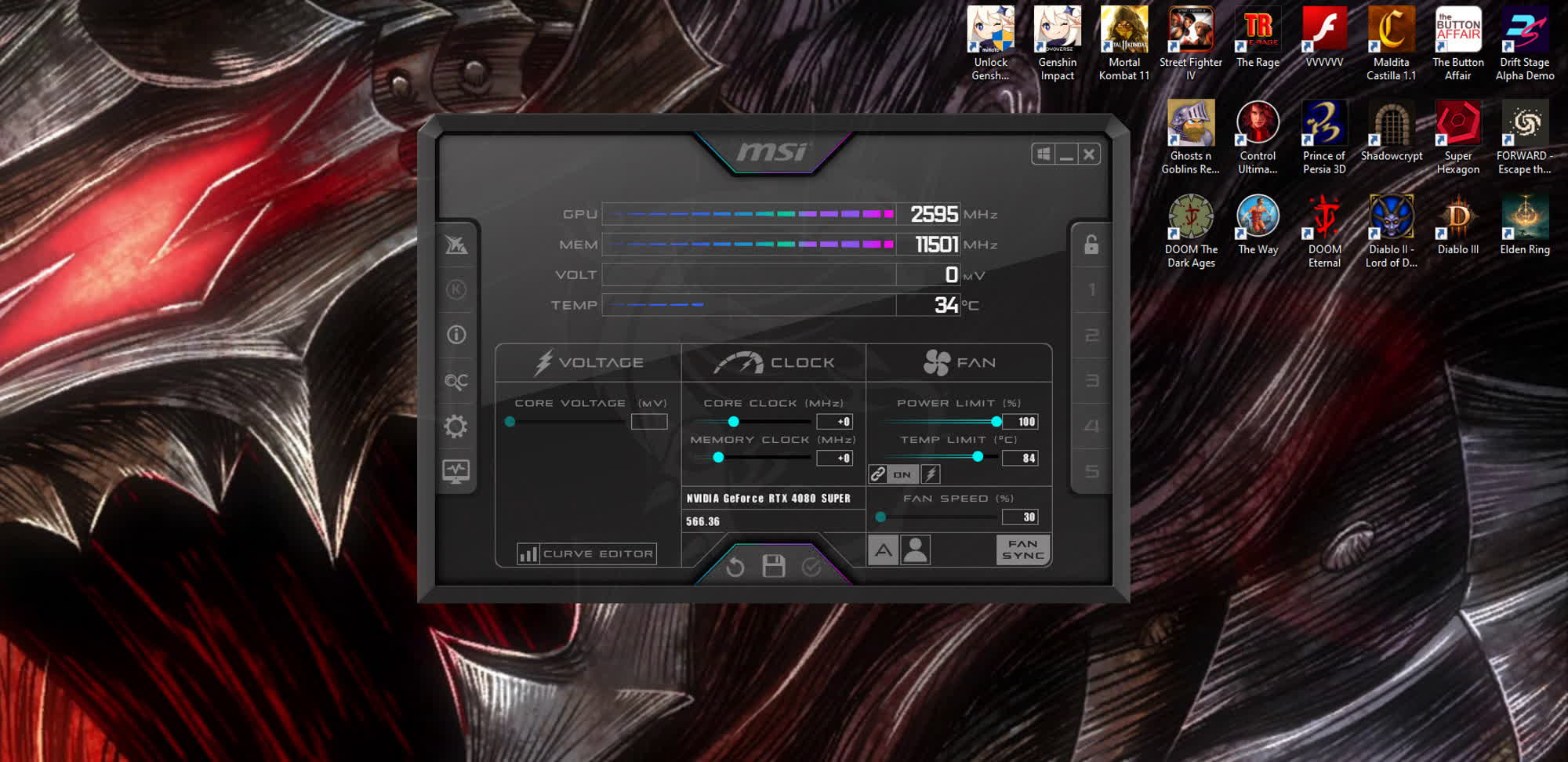
Alexey "Unwinder" Nicolaychuk, the sole developer of MSI Afterburner, is working on a new beta version of the program. The world's most popular GPU overclocking tool is set to deliver significantly improved voltage control on upcoming "MSI 50x0" GPUs, with the first working samples of the new cards already in the hands of the Russian coder.

Nicolaychuk first revealed the project in August. According to him, the new MSI GPUs will feature an expanded voltage-control module supporting the MP2988 and MP29816A pulse-width modulation ICs. These controllers already appear in "most" RTX 5080 and 5090 cards currently on the market but cannot yet be used to extend voltage control any further.

Nvidia is reportedly blacklisting these PWM ICs at the graphics driver level, rendering the controllers essentially "invisible" to software tools accessing the I2C bus via drivers. MSI's upcoming non-reference cards are expected to unlock the ICs, targeting customers interested in extreme overclocking experiments or high-end gaming builds.
The new MSI Afterburner beta, which supports the PWM controllers, is reportedly just around the corner. The update will introduce "extended triple channel" voltage control and monitoring for owners of the new MSI cards, offering three separate control options: core voltage, memory voltage, and auxiliary voltage.

Additionally, MSI Afterburner will allow overclocking enthusiasts to adjust core GPU voltage with a 100 mV offset, compared to Nvidia's default 20 mV control on reference cards. The new version will also include an option to "hide" support for a specific GPU, a feature that could be useful for users wishing to conceal their CPU's integrated GPU, according to Unwinder.

The Russian developer did not provide a specific release date for the update. Historically, MSI Afterburner has issued numerous beta versions, with occasional stable releases. From experience, most beta releases are sufficiently stable for reliably controlling GPU behavior and voltage.

MSI Afterburner is more than a tool for extreme overclockers. It offers a powerful framework for creating custom on-screen display layouts, and can also record gameplay or capture screenshots.

Permalink to story:

 
Outside of being a hobby and competing for benchmarks, I have never found over locking practically useful for anything in the real world. Some people say you can go up a teir in performance by over clocking, but the OC models cost as much as the base model of the next teir of cards/chips up.
 
Some people say you can go up a teir in performance by over clocking, but the OC models cost as much as the base model of the next teir of cards/chips up.

15+ years ago on mid and especially low-end models, that tier-up OC was possible. My R5 240 can be OC'd to get 50fps instead of 35 on the 2013 Tomb Raider (@720p low), which is a real useful OC.

But as everything auto-OCs nowadays (Nvidia's listed "boost" clock is still lower than what you usually see in-game), there are no tier-up OCs available which don't double your power use and require impractical LN cooling. Hey, that's fun for chasing OC records but useless for everyday gaming.
 
15+ years ago on mid and especially low-end models, that tier-up OC was possible. My R5 240 can be OC'd to get 50fps instead of 35 on the 2013 Tomb Raider (@720p low), which is a real useful OC.

But as everything auto-OCs nowadays (Nvidia's listed "boost" clock is still lower than what you usually see in-game), there are no tier-up OCs available which don't double your power use and require impractical LN cooling. Hey, that's fun for chasing OC records but useless for everyday gaming.
The old days were fun. I had two 550tis, both of which could clock up to 1100 mhz. That was a substantial gain, especially in games like borderlands or battlefield that took full advantage of SLI.

Nowadays, undervolting and lowering temps does way more to boost clocks. Manual OC doesnt really matter now. Look at Alder lake, the difference in performance from the variety of memory and fabric tweaks is insane.
 
Outside of being a hobby and competing for benchmarks, I have never found over locking practically useful for anything in the real world. Some people say you can go up a teir in performance by over clocking, but the OC models cost as much as the base model of the next teir of cards/chips up.
Hasn't been worth the effort for a long time now.

Back in the day you could squeeze 20-100% extra performance out of some CPUs and GPUs. Nowadays the binning process in the factory does a much better job so there isn't that much left on the table to begin with.
Add to that things running smart algorithms squeezing most of the easy gains out of it and there's little extra potential with. Imo not enough for end users to mess with unless you actually like doing it.

I liked the upside of manual overclocking (some CPUs got a few extra years of use out of it) but I don't miss the constant rebooting and stability testing just to try and figure out what works. I never had much luck with GPUs. (Other than unlocking hidden potential through BIOS flashing).

Nowadays, enable PBO, XMP and you got most of the performance already. Ryzen Master might get you a little bit extra. Trying to get more manually... Not worth the time, marginal gains at the cost of too much time

My best overclocking part was my Nokia N900s CPU. That thing went from base 400MHz to 800MHz without a hitch. With a slight overvolt it even did 1GHz!
 
Back