NASA puts Crew-13's launch-pad escape in the hands of the 11-times-recalled Cybertruck

midian182

Posts: 11,794   +179
Staff member
Facepalm: If you're an astronaut sitting in a rocket waiting to blast into space, you'd want the reassurance of knowing that a sturdy and reliable vehicle will carry you to safety should the launch encounter problems. This task is usually performed by a heavily armored military personnel carrier, but for the upcoming SpaceX Crew-13 mission, rescue duties will be carried out by the Cybertruck, a vehicle that has been subject to 11 NHTSA recall campaigns.
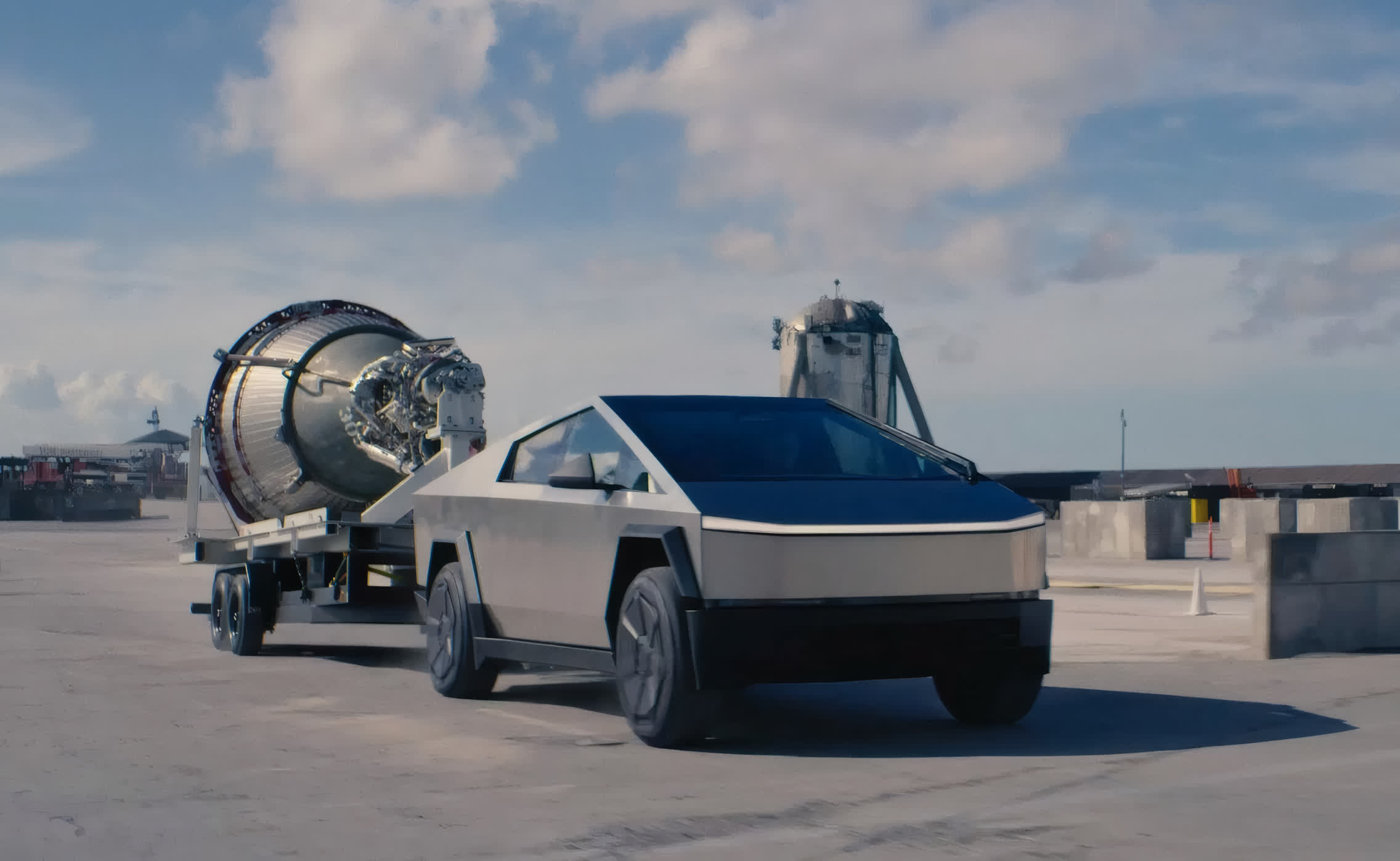
Making a hasty exit away from the launch pad should something go wrong is important, obviously, but given the potentially destructive power of a rocket, the vehicle coming to astronauts' aid also needs to be sturdy.

NASA uses Mine-Resistant Ambush Protected vehicles (MRAP) in this role. The agency previously said these vehicles' armor is so thick that each door weighs 600 pounds, giving them the sound and feel of a bank vault. This means that even if they aren't moving, they can still act as a bunker.

But for the four astronauts of SpaceX's Crew-13 mission, their safety will be put in the hands of a Cybertruck. NASA's Richard Jones said that using the EV means NASA doesn't have to organize an MRAP and its crew for the launch. He also noted that this avoids any conflict over resources – SpaceX had been preparing to launch Crew-12 at the same time NASA was preparing a launch attempt for Artemis II.

SpaceX does use Cybertrucks during its own launches. Jones admitted that the vehicles are much quicker than MRAPs for moving astronauts out of danger. They're also easier to drive while wearing gloves.

But Cybertrucks can't exactly compete with MRAPs when it comes to durability. Elon Musk once said that irs Armor Glass could survive baseball-sized hail, but the famous on-stage demo in which a metal ball shattered a window didn't inspire confidence – Musk later claimed hitting the car's body with a sledgehammer in earlier demo weakened the windows. Jones said no modifications had been made to the Cybertruck.

The Cybertruck has been subject to 11 separate US NHTSA safety-recall campaigns for reasons that include an accelerator pedal that could become trapped, wheels that could separate, and drive-inverter failure, none of which you would want to experience while trying to escape an exploding rocket.

The Crew-13's crew is made up of NASA's Jessica Watkins and Luke Delaney, plus the Canadian Space Agency's Joshua Kutryk and Roscosmos cosmonaut Sergey Teteryatnikov. The launch will take place no earlier than 12 September 2026.

The crew will join Expedition 75 aboard the ISS, where it will conduct scientific investigations and technology demonstrations intended to support future missions to the Moon and Mars. Expedition 75's research includes in-space manufacturing, AI- and augmented-reality-assisted health checks, and bioprinting human tissue.

Permalink to story:

 
If I were one of those astronauts, I'd refuse to get onto the pad. Let them explain why they are putting my alternate on the launch.
 
Better to be quick than dead as the old addage states. How many astronauts have been saved by an MRAP? That shining number... Zero. Anyone who has ever been in an MRAP or any other military vehicle knows two things... Heat kills and speed saves. If, by the off chance, an emergency happened, the armor on the MRAP will just be an amazing conductor of heat, like a cast iron skillet. An astronaut would bake inside. While they may survive the initial shock wave (that's a huge may), the fireball that's sure to follow would cook the occupants of the slow moving MRAP nice and toasty. So the thought here is speed. Get them out of ground zero asafp. The cyber truck accomplished that goal.

If you're talking about reliability and comparing the 11 recalls to any military vehicle I'll try to stop laughing long enough to type. Ask any military mechanic about the reliability of any government issued vehicle. You can be assured, 11 recalls would be about 100 times better than any military vehicle's track record. Those vehicles are kept in service by the amazing talents and adaptability of the military motor pool personnel literally jury riggiging them to stay operational.

This article should just be titled, we hate Elon and be done with it. But to try to make this an issue is a joke.
 
And how many of those 11 "recalls" were for software update? How about more context as to why you think that number is so significant now that production has matured quite a bit in 2026? Or is the author just going to insult our intelligence with such a disingenuous and weird article that conveniently leaves context out to get his biases across? Leave your clickbait title and spin on the editing room floor next time.

Otherwise, ignoring the article's unnecessary spin, it is an interesting situation. The vehicle is a lot more armoured than the average vehicle (albeit a bit ugly). Having an unmodified "tank" probably is a lot easier to take care of than a custom vehicle that doesn't get used often.
 
If I were one of those astronauts, I'd refuse to get onto the pad. Let them explain why they are putting my alternate on the launch.

- Undergraduate Degree (4 years)
- Graduate Degree (2 years)
- Professional Experience (2+ years)
- NASA Candidate Training (2 years)
- Odds of Selection: 1 in 15,000
- Odds of using escape vehicle: < 1%

I believe you :rolleyes:
 
If something happened where we needed to haul *** out of there, I'd rather be in something that does the quarter mile in 11 seconds than one that's probably somewhere in the 20's. I don't care how armored it is - I want distance away from what's happening.
 
I’m sure if a military vehicle had to be scrutinized by the same standards as consumer vehicles there would be more than 11 recalls lol. I’d rather have a vehicle get me as far away from an explosion waiting to happen then a slow stroll in the park.

For science Elon should have the two race.
 
If something happened where we needed to haul *** out of there, I'd rather be in something that does the quarter mile in 11 seconds than one that's probably somewhere in the 20's. I don't care how armored it is - I want distance away from what's happening.
The shockwave from the explosion would still out-run you. You aren't outrunning any blast; just outrunning whatever 'timer' the blast is on. It cheaper for NASA to borrow an MRAP from time-to-time than it is to maintain a bunker for each pad. And MRAP can drive through the debris field on its own.
- Undergraduate Degree (4 years)
- Graduate Degree (2 years)
- Professional Experience (2+ years)
- NASA Candidate Training (2 years)
- Odds of Selection: 1 in 15,000
- Odds of using escape vehicle: < 1%

I believe you :rolleyes:
I got 3/6. So now its just down to the 'lottery' and work of steps 4 & 5. Plus the step you left out: getting selected for a mission and the mission actually flying. More than an astronaut candidate or two never fly (e.g. Johnny Kim was one of the most qualified on paper astronauts in recent history, and he made it through final candidate training and selection in 2017 but didn't fly until 2025; the moon missions he was being trained for got cancelled)
 
I foolishly thought that was what the capsule launch escape system on the Dragon capsule was for, get the astronauts away from the rocket and pad ASAP! As fast as rocket anomalies happen on test firing, pad exercises...etc. the crew could not even get unstrapped fast enough. The shuttle astronauts would have been exceedingly lucky to get away from the pad in time.

NASA this is NOT the shuttle, get your head out of your....!!!
 
Last edited:
Elon Musk once said that irs Armor Glass could survive baseball-sized hail, but the famous on-stage demo in which a metal ball shattered a window didn't inspire confidence
Embarrassing typo reveals biased article writer's emotional hatred of Tesla. It's also a flat out lie. The window stayed intact after absorbing the impact of the thrown metal ball, although it did get cracked/smashed (it's impossible to tell which without looking at the glass from a different angle). It simply did not shatter. There are plenty of cases that show the durability of the windows. Thieves are unable to get into the Cybertruck with specialized glass smashing tools which can't even puncture through it. Here's a comprehensive test that show it took 3/4 hits from the same 3 inch steel ball bearing ball along with countless other impacts:

Furthermore, while the Cybertruck may have issues with durability with many of its parts under unusual conditions, its body and glass are not included in that. The cabin would be protected against explosions as shown by WhistlinDiesel (1 lbs of C4 applied directly to the body, again glass stayed intact):
 
Last edited:
Whoa... It's so dazzling that a decade ago anyone that would need protection from a blast would choose an armored vehicle that the USA army would use to protect it's own crew... Now looking at people defending the decision to use a civilian eletric pickup... EVEN if they choose the most durable civilian semi truck, I would choose the military grade armored vehicle any day... "But the velocity, the easy to drive..." ... Man, if you are zeroed at the launch pad and have time to get off the rocket or still haven't entered it... Or even 100mt away... Which vehicle you think will give you more chances to survive? ...

It's incredible to see how badly the reality distortion field from the tech bros cooked so many brains to the point they think an EV civilian vehicle would survive a blast and stay in better shape then an armored vehicle...

642511120_17939481591151108_5282574165054345071_n.jpg


From:

The Caiman is a mine-resistant ambush-protected vehicle with a V-hull design based on the Family of Medium Tactical Vehicles (FMTV) and Low Signature Armored Cab (LSAC), initially developed by Stewart & Stevenson and now produced by BAE Systems Platforms & Services.

The Caiman is based on the chassis and automotives of the Medium Tactical Vehicle variant of the FMTV and features:

10-man crew capacity
Tensylon composite armor[1]
Armor enhancement capable
Accepts all types of manned and remote weapons stations
85 percent parts commonality with standard FMTV models (40,000 of which are already fielded)
Electronic Central Tire Inflation System (CTIS)

... Cybertruck: Barely can stand 2 baseball and a sledgehammer...

How much it costed NASA to get 4 MRAP Caiman vehicles from the USA Army? Zero, it was gave to NASA by the USA Army.

How much did the Cybertrick costed? Well, sure Elon owns SpaceX, but I would not be surprised if Tesla sold it to NASA becase well.... it's Elon Musk.

Reasons to choose an USA ARMY MRAP: .... plenty above... perhaps that WHY NASA officials choose it?
Reasons to choose a Cybertrick: make it look cool on TV so sales can go up a notch...

... Good luck surviving a blast in a Cybertruck.

PS.: For anyone saying "oh you won't survive a blast from a rocket anyway...", Yeah, you are right, but what if you got enough cleareance from the pad before the rocket exploded... how far you need to be to survive on a Cybertruck that itself is a potential harm and can carry only 4 normal sized humans when compared to a Caiman MRAP that can carry 10 armored personnel?... Jesus... It's a totally non brainer...

 
Last edited:
The shockwave from the explosion would still out-run you. You aren't outrunning any blast; just outrunning whatever 'timer' the blast is on. It cheaper for NASA to borrow an MRAP from time-to-time than it is to maintain a bunker for each pad. And MRAP can drive through the debris field on its own.

I got 3/6. So now its just down to the 'lottery' and work of steps 4 & 5. Plus the step you left out: getting selected for a mission and the mission actually flying. More than an astronaut candidate or two never fly (e.g. Johnny Kim was one of the most qualified on paper astronauts in recent history, and he made it through final candidate training and selection in 2017 but didn't fly until 2025; the moon missions he was being trained for got cancelled)
If you think an MRAP can withstand the blast from a rocket explosion you failed basic physics. An MRAP is designed to withstand the blast of an IED. A few milliseconds of shockwave at an extremely lower decibel than the shockwave and temp of a fully fueled rocket explosion. Your only hope in that situation is speed (truly there is no hope whatsoever but at least it'll look faster). An MRAP would be melted beyond recognition and all inside would be liquefied and burned to ashes. Absolutely zero astronauts have ever been able to escape a rocketpad explosion. If there was a fault that was detected prior to boarding, speeding off on a fast moving vehicle would be your only hope.

As far as reliability goes, even if 11 recalls were for mechanical issues, an MRAP maintenance, recall and part schedule is at least 100 times that. Anyone who has been in the military and involved in any military vehicle will attest to the fact, if it ain't broke, it ain't government issue. LAVs in the USMC are out of service far, far more often than they are in service.
 
I foolishly thought that was what the capsule launch escape system on the Dragon capsule was for, get the astronauts away from the rocket and pad ASAP! As fast as rocket anomalies happen on test firing, pad exercises...etc. the crew could not even get unstrapped fast enough. The shuttle astronauts would have been exceedingly lucky to get away from the pad in time.

NASA this is NOT the shuttle, get your head out of your....!!!
The capsule launch escape system is for after the launch, not before. Or at least after the crew gantry has been retracted. It also does not help you at all if you haven't boarded the capsule yet, when the rocket is still getting fueled or is already fueled.

In the interim, you likely want a zipline to an MRAP in the event there is something like pressure in the fuel tanks or fuel system continuously increasing, or fuel begins leaking.
Furthermore, while the Cybertruck may have issues with durability with many of its parts under unusual conditions, its body and glass are not included in that. The cabin would be protected against explosions as shown by WhistlinDiesel (1 lbs of C4 applied directly to the body, again glass stayed intact):
I am not going to watch any youtuber do anything, but did they at least try to measure the peak pressure inside of the cabin during the explosion? And did they measure it well? Because the wind shield being intact means nothing if the pressure from the detonation liquifies your brain and/or organs. The wind shield being intact kind of suggests that there is poor sealing between the inside and outside of the truck, so there would be less of a pressure differential between the inside and outside of the cabin.

Also, I suspect a rocket exploding has a little more energy than 1lb of C4 on the car directly, even at the distances the rocket would be at relative to the wind shield.
 
People, people!! Please understand a fact:

ANY negative talk about Musk's products will cause a ferocious fury among some people here. Essentially, it's like you are attacking their manhood (or even womanhood, who knows)!

Back on subject: That's why the US Army also should replace all their tanks or armored personnel carriers with Cybertrucks. Because, as one really smart person put it: "Those are needed to haul *** out of there".
Those stupidest things on wheels could have really helped to....... haul *** out of Vietnam, Afghanistan, Iraq, and possibly more conflicts....instead of the usual stupid armored stuff!!

Extreme smartness is spreading across the land....
 
Back