Bottom line: Steam's flood of new releases in 2025 underscores an ongoing tension in PC gaming: a thriving ecosystem that also risks overwhelming its own creators. Data aggregated by SteamDB shows that Valve's digital storefront saw 19,112 games launch over the year. Nearly half of them – 9,327 titles – received fewer than 10 user reviews, suggesting they never reached a meaningful audience. For 2,229 games, the review count never rose above zero.

Those numbers point to a widening gap between output and engagement on the world's largest PC game marketplace. Steam's open publishing model has dramatically lowered the barrier to release, but visibility has become a scarce resource. For small studios and independent developers without marketing budgets, standing out on Steam can be as difficult as making the game itself.
The pattern is not new. In the previous year, nearly 19,000 titles launched on Steam, yet only a little more than one in five attracted enough players for Valve to enable community features like trading cards, badges, and emoticons.
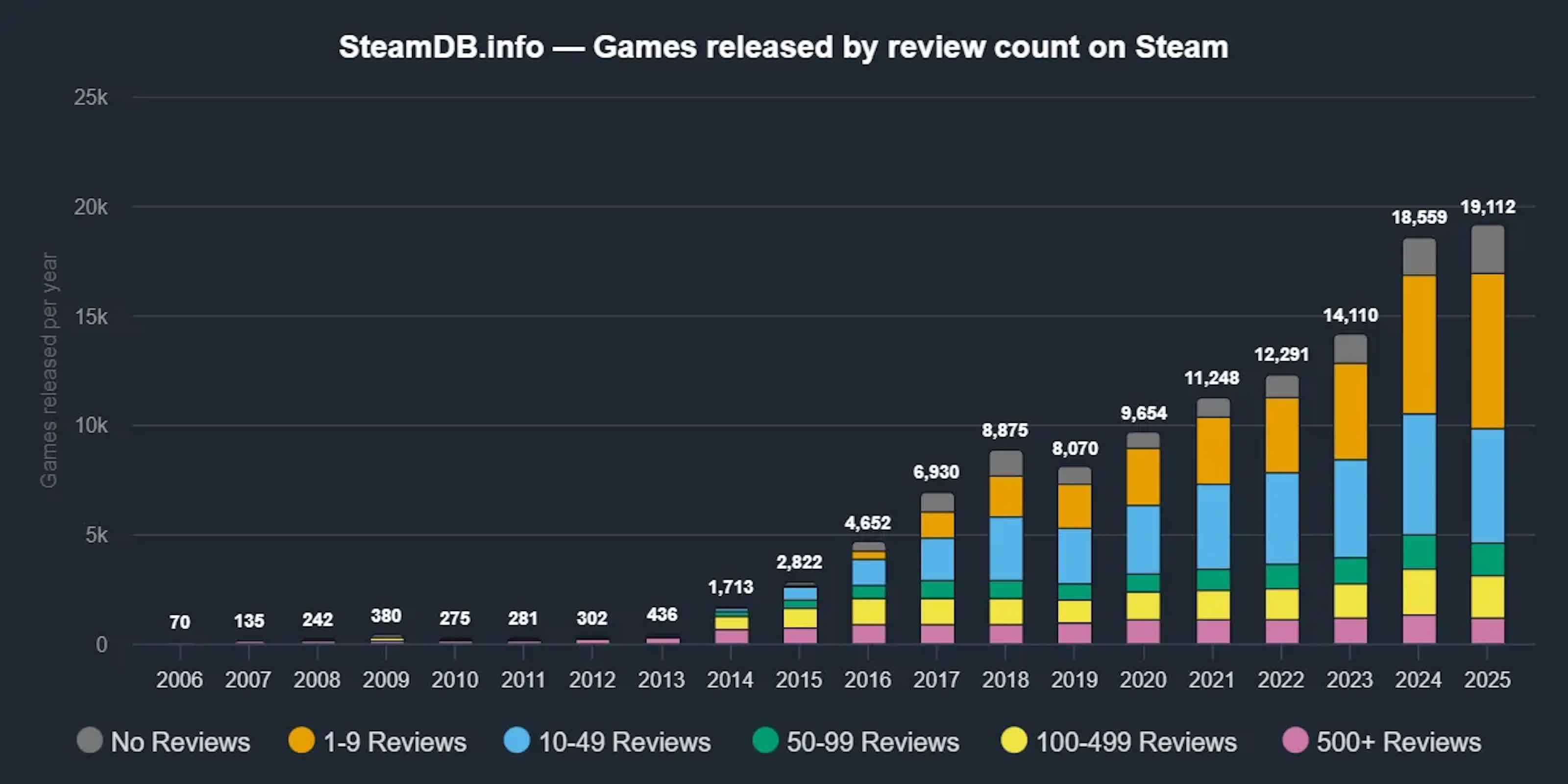
SteamDB's metrics also suggests the issue isn't simply one of quality. Among the hundreds of small releases that failed to attract attention are inventive and technically ambitious projects, from a high-speed parkour title featuring an armless priest maneuvering through an underworld setting, to a physics-based skateboarding game that replaces boards with fish.
Valve has introduced numerous systems intended to help: wishlists, algorithmic discovery queues, curator networks, and user tagging. These features, along with personalized recommendations, were designed to guide players toward relevant titles and support organic discovery. Yet the algorithms that determine store visibility remain opaque to developers and players.
That lack of transparency has led many developers to look beyond Steam itself for visibility. Some coordinate with third-party sales or community-organized genre tag campaigns that attempt to give underrepresented categories – such as "survivors-like" or "bullet heaven" – a more recognizable identity within Steam's structure. Despite these efforts, discoverability remains one of the most persistent barriers in PC game publishing.
For many developers, Steam has democratized distribution on an unprecedented scale. At the same time, that success has produced a level of noise that few new releases can rise above. As launch counts climb to record highs, the number of games that are actually played – or even noticed – tells a far quieter story.
Nearly half of the 19,000 games released on Steam this year went almost unnoticed


