Something to look forward to: A new tool could dramatically accelerate how scientists design and test batteries. Researchers at the University of Michigan have developed a machine-learning system that can predict a battery's lifetime after only a fraction of the usual testing, potentially cutting months or even years from the prototyping process.
Unlike traditional testing, which requires hundreds or thousands of charge – discharge cycles, the model can estimate a new battery's useful life after just 50 cycles. The team says the approach reduces the time and energy required for testing by up to 95 percent, allowing engineers to evaluate performance with unprecedented speed and efficiency.
The system, described in Nature, was developed by a team led by assistant professor Ziyou Song and doctoral candidate Jiawei Zhang in the University of Michigan's department of electrical and computer engineering. They built what they describe as a team of "agentic" AI tools, each with a specialized role. Together, these components collaborate much like researchers in a lab – sharing data, testing hypotheses, and refining results.
The work was funded by Farasis Energy USA, a California-based battery developer that also supplied real-world data and pouch cells to evaluate the model's predictions.
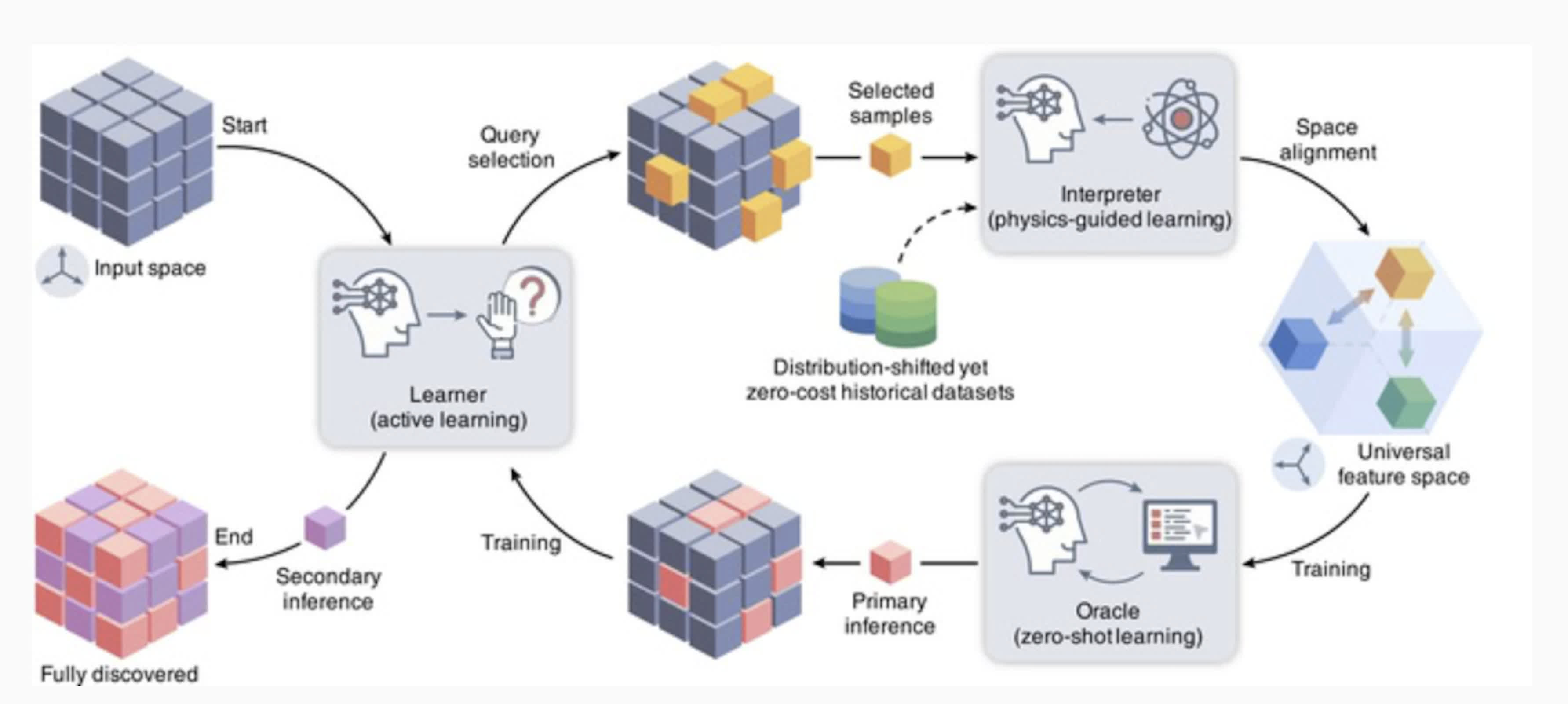
A diagram of how the discovery learning system developed at U-M works.
The AI framework draws inspiration from discovery learning, a pedagogical principle that emphasizes problem-solving through exploration and experience. In this case, the AI "student" learns from past experiments much like a human researcher. It reviews historical data from previous battery designs, conducts small-scale experiments, and applies physical models to link early performance characteristics with eventual cycle life.
The process is divided into three distinct roles: a learner, an interpreter, and an oracle. The learner begins by selecting promising battery candidates to test under specific temperature and current conditions. These initial trials span roughly 50 cycles, generating data that the interpreter analyzes using a physics-informed simulator. Finally, the oracle combines those results with existing knowledge to predict the full operational lifetime of each design.
The learner then incorporates this output into its growing dataset, improving accuracy over time. Once trained on enough examples, the system can begin forecasting battery lifetimes without repeating the full experimental loop – achieving what the researchers describe as a form of autonomous scientific reasoning.
What sets the Michigan approach apart from standard statistical models is the depth of its understanding. Rather than focusing solely on surface-level electrical signals such as voltage curves or charge rates, the system interprets underlying physical and chemical parameters, including how electrode materials behave under heat, stress, and repeated cycling.
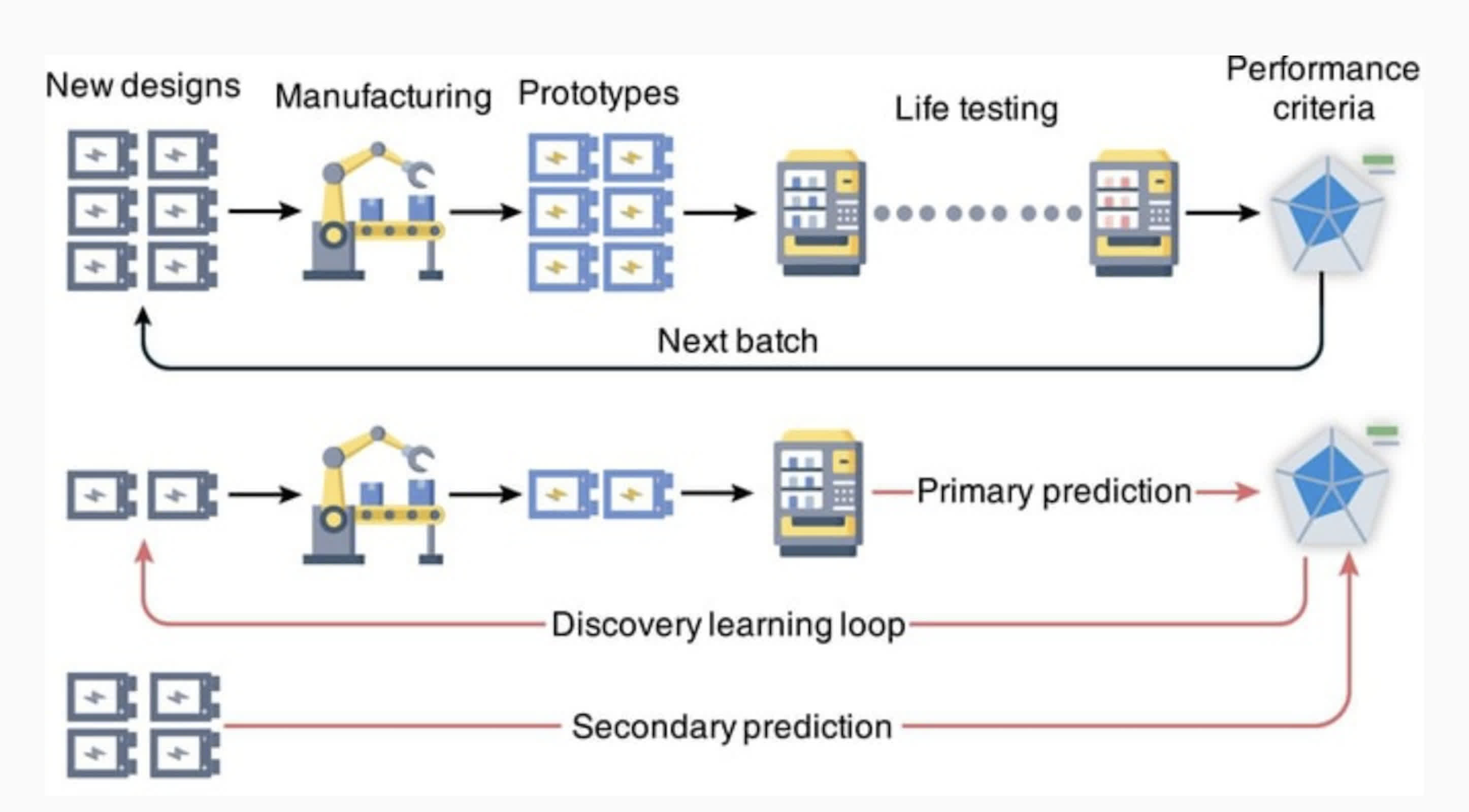
A diagram comparing traditional battery testing – where lifetime validation takes months or years – with the discovery learning approach, which lets designers refine new prototypes after only days or weeks of testing.
These insights allow the model to generalize across battery formats, from small cylindrical cells used in consumer electronics to the flexible pouch cells found in electric vehicles.
When trained exclusively on data from cylindrical cells, the AI was still able to accurately forecast performance for the much larger pouch cells supplied by Farasis. This result suggests that its physics-based framework captures universal patterns of battery degradation. In practical terms, that translates to reliable lifetime predictions after just a few days of testing, rather than the months or years required for conventional endurance trials, which often extend to 1,000 cycles or more.
The energy implications are equally striking. According to the research team's analysis, predicting cycle life with this AI system consumes only about five percent of the power typically required for large-scale laboratory testing.
While the current work focuses on predicting cycle life, the researchers are already looking ahead to expanded capabilities, including anticipating safety limits, optimizing charge rates, and identifying materials best suited for next-generation lithium-ion batteries.
Their broader vision extends well beyond energy storage. Because discovery learning functions as a generalizable scientific approach, the team believes similar frameworks could accelerate research across chemistry, materials science, and other disciplines constrained by long, expensive experimental feedback loops.
New AI model can predict battery lifespan after only 50 cycles


