Forward-looking: A European research team involving scientists from DESY and Hamburg University of Technology have unveiled a newly demonstrated triboelectric nanogenerator that produces electricity by pushing water in and out of nanoporous silicon. Their work marks a significant step toward battery-free power for sensors and other low-power devices.
The researchers set out to explore whether simple ingredients – silicon and water – could be arranged so that mechanical pressure and fluid motion could serve as a reliable electrical source rather than wasted energy. Their answer is a triboelectric generator built around nanostructured silicon that uses water flow through pores measured in nanometers to produce charge.
At the core of the device is a silicon structure engineered to be three things at once: electrically conductive, filled with nanoscale pores, and hydrophobic. Making silicon conductive is routine in microelectronics, but combining that property with a controlled nanoporous architecture and water-repelling surfaces in the same piece of material is a key advance.
This combination lets the team shape how water enters, moves through, and exits the pore network, which in turn stabilizes the triboelectric effect and makes it scalable rather than a fragile lab curiosity.
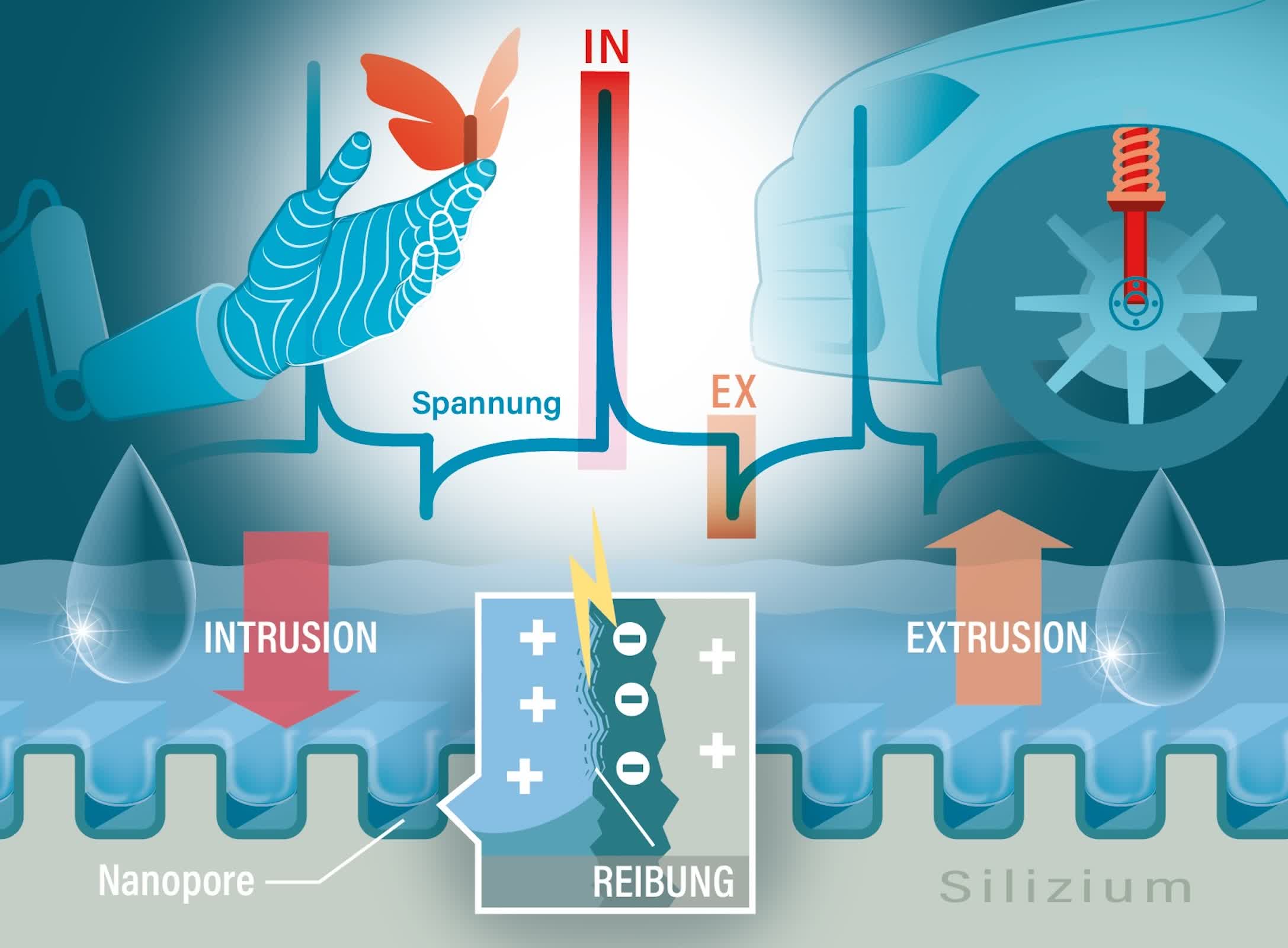
The energy conversion mechanism is triboelectrification – the same family of effects that causes a person to pick up a charge by walking across a carpet and then discharge it with a small spark on contact with another object.
Here, however, the moving phase is a liquid rather than a solid shoe sole. As water is forced into and out of the tiny pores under pressure, it rubs against the solid silicon surfaces, transferring charge at the liquid – solid interface. The device architecture is designed to capture this interfacial charge and convert it into usable electrical output rather than letting it dissipate.
One of the striking claims from the research team is a conversion efficiency of about 9% for this class of triboelectric generators – the highest reported so far for similar systems. In practical terms, that means a relatively large fraction of the mechanical energy used to drive water in and out of the pores appears as electrical energy at the device terminals.
For triboelectric systems, which often struggle with low or inconsistent efficiency, clearing that benchmark is significant because it moves the concept closer to real-world power budgets for sensors and low-power electronics.
The researchers position the technology as a route to autonomous, maintenance-free sensor systems that draw power directly from their environment. They point to applications such as water detection, sports and health monitoring in smart textiles, and haptic robotics, where touch or motion generates the electrical signal needed for sensing.
In these scenarios, the generator can be integrated into surfaces or structures already subject to movement or pressure, potentially removing the need for batteries or wired power and reducing maintenance overhead.
The team pointed to vehicle suspension systems as an example. Inside a wheel well, shocks and vibrations already generate mechanical motion and pressure changes. Embedding a silicon-water triboelectric module in that environment would allow cyclic compression and relaxation to push water through the nanoporous network, turning otherwise wasted mechanical noise into power for local sensors that monitor performance, wear, or safety conditions.
A notable aspect of the work is its reliance on abundant, well-understood materials rather than exotic compounds. The device uses silicon, the most widely used semiconductor in the electronics industry, and water, the most common liquid on Earth. These choices were not just philosophical, they matter for manufacturing and cost.
The Hamburg-led project sits within a broader wave of research into harvesting small amounts of energy from routine motion and environmental flows. In France, for example, students have built metro turnstiles that generate enough power from passenger traffic to run station display screens.
In another effort, an international team has demonstrated methods to tap the energy produced when slow wind passes over water droplets, turning subtle fluid dynamics into a power source. These parallel developments point in a common direction: treating everyday mechanical and fluid motion as an energy resource rather than background noise.
New nanotech generator could replace batteries in tiny devices


