Scientists made espresso with sound instead of heat, and most drinkers couldn't tell the difference

Skye Jacobs

Posts: 2,013   +59
Staff
The takeaway: New research is challenging a basic assumption about espresso: that it has to be made with hot water. Instead of relying on near-boiling water, researchers have shown that high-frequency sound waves can produce an espresso-style shot with similar strength and taste – no heat required.
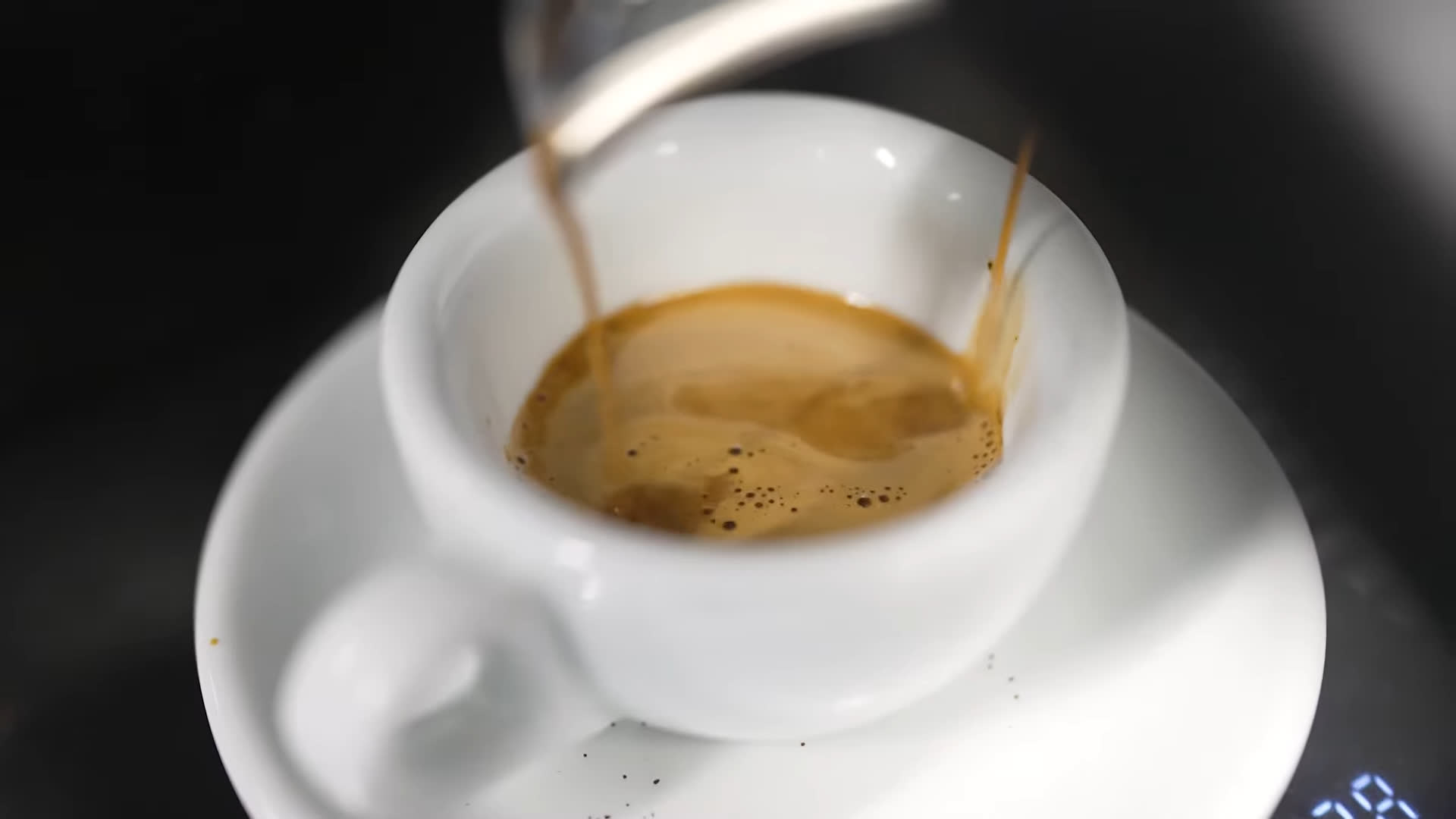
Developed by engineers and food scientists at UNSW Sydney, this new method is called "ultrasonic espresso" and replaces heat with mechanical energy. It runs at room temperature, using sound waves to pull flavor from finely ground coffee, and reaches espresso-level intensity in under three minutes despite the cold-water start.

The setup still begins with a standard espresso basket. A small metal transducer is mounted against its wall, and once activated, it emits ultrasound – sound waves above the range of human hearing – that travel through the water and coffee bed.

What happens next is the key step.
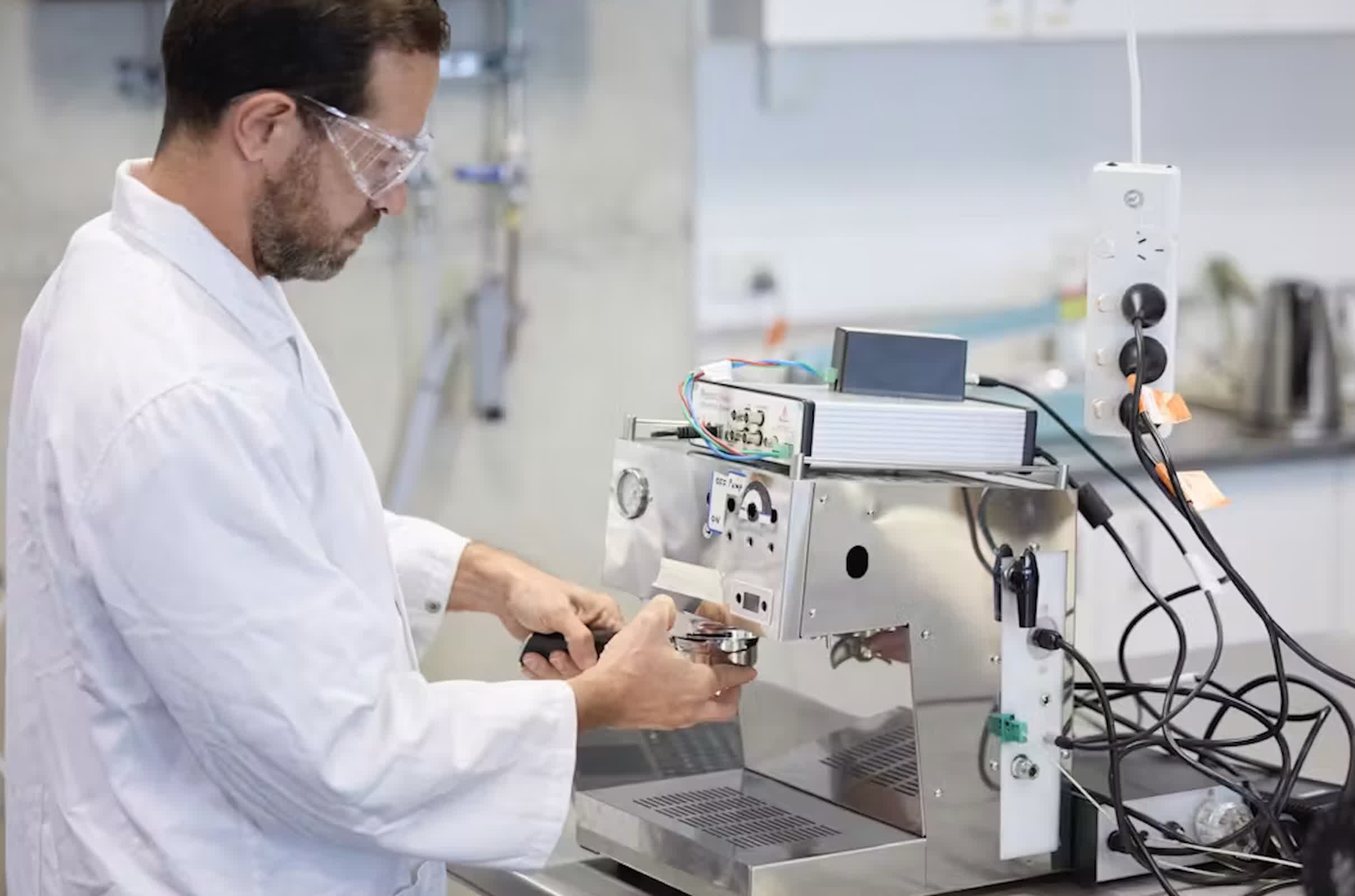
The sound waves trigger acoustic cavitation, a process where tiny bubbles form in the liquid and collapse in rapid succession. When those bubbles implode near coffee particles, they generate microscopic bursts of force that chip away at the grounds, speeding up the release of oils, flavor compounds, and caffeine into the water.

In effect, the system swaps heat for controlled agitation at a microscopic level, using pressure changes and localized mechanical action instead of temperature to drive extraction.

That distinction matters more at scale than it does on a kitchen counter. For a home user, skipping the heating step might not move the needle much. But in industrial settings – particularly ready-to-drink coffee production – energy consumption becomes a central concern, and the researchers estimate that eliminating the need to heat water could cut energy use by up to 75%.

The process also introduces some logistical flexibility. Because the coffee is produced at room temperature, it can go straight into bottled drinks or milk-based products, or be shipped as a concentrated liquid and diluted later, potentially simplifying production and distribution.

Ultrasound is not entirely new to coffee science. Earlier work from the same UNSW team explored its ability to speed up cold brewing, compressing what is typically a 12 to 24-hour process into a matter of minutes. But espresso presents a different challenge: it is not just about extracting caffeine or basic flavor, but about achieving a specific balance of bitterness, aroma, and body typically associated with high heat and pressure.

To hit that target, the researchers, led by Dr. Francisco Trujillo, fine-tuned several variables. Grind size played a clear role, with finer particles allowing faster extraction. The water-to-coffee ratio had to be carefully controlled to avoid under-extraction or dilution, and timing proved equally important, with the optimal window landing between two-and-a-half and three minutes of ultrasonic exposure.

Matching the chemistry of espresso is only part of the equation, though. The more practical question is whether people can actually taste the difference.
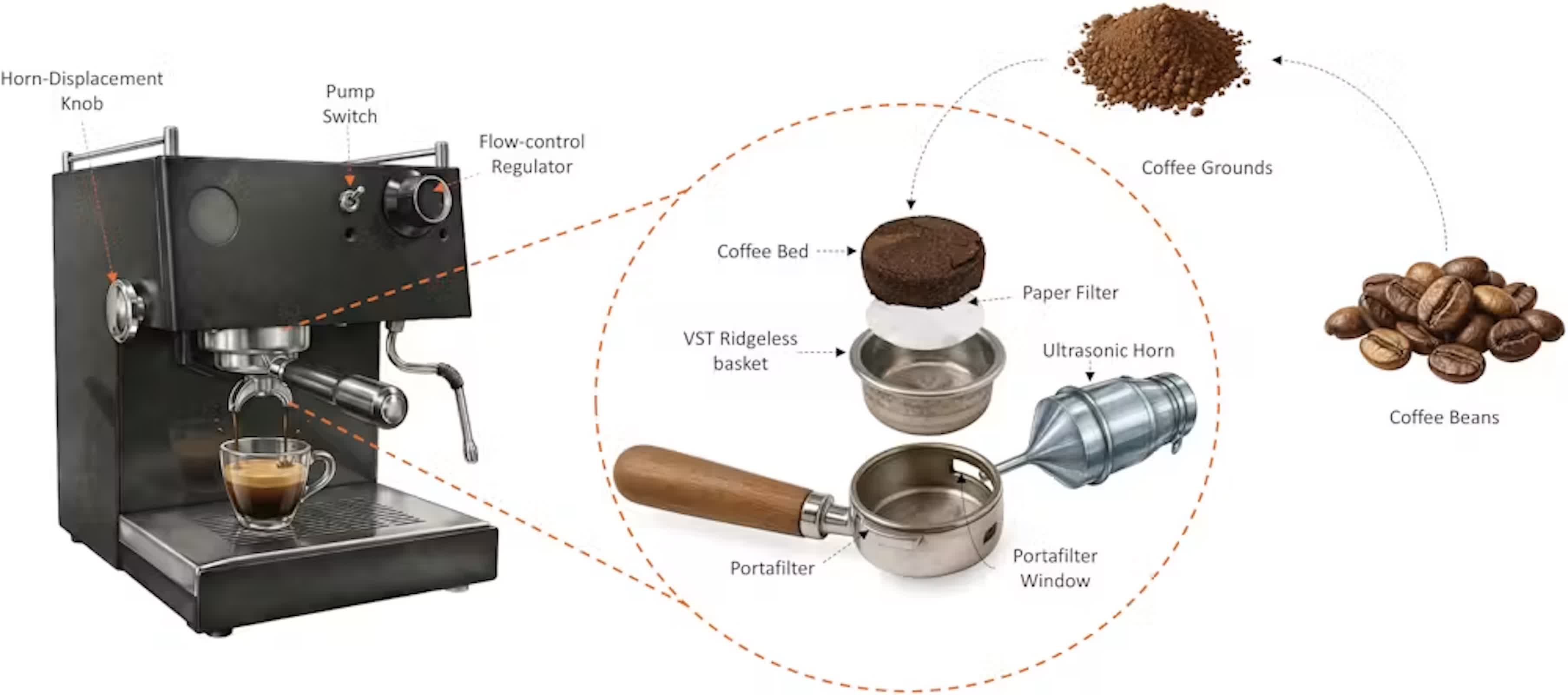
To test that, the team ran a blind evaluation with about 100 regular coffee drinkers, those findings are published in the Journal of Food Engineering. Participants sampled four coffees: traditional espresso, ultrasonic espresso, and both traditional and ultrasonic filter coffee, served at the same temperature and in random order.

The results were strikingly close. Participants couldn't reliably distinguish between the traditional espresso and the ultrasonic version, with the two performing nearly identically across aroma, flavor, bitterness, and overall preference. In the filter category, the ultrasonic version was actually favored, with tasters describing its bitterness as more balanced.

The findings suggest that heat may not be as essential to espresso as long assumed. By using ultrasound to accelerate extraction, the process reproduces the defining characteristics of espresso while significantly reducing energy input. For an industry built around heat-driven methods, this opens up a different way of thinking about how coffee can be made.

Image credit: The Conversation

Permalink to story:

 
Clever stuff. Lets hope this finds it's way into cheaper, quality, reliable, consumer coffee machines. I can't function without at least 3 cups of proper coffee before midday.
 
Wonder if the shelf life is affected negatively if this is mostly for industrial pre-made stuff.
100°c water will kill any bacteria so if you're using sound instead you're effectively no longer sterilizing the product.
 
Wonder if the shelf life is affected negatively if this is mostly for industrial pre-made stuff.
100°c water will kill any bacteria so if you're using sound instead you're effectively no longer sterilizing the product.


Sound waves can kill bacteria. It can literally shake their membranes apart.

 
From an enterprise standpoint 75% power efficiency or reduction is very important but for home use your power bill wouldn't see a significant difference compared to current latte machines for a 1 to 5 user capacity. This is pretty cool though. I have the Phillips latte go 4400 we bought a few years back the machine paid for itself within few months of use compared to buying Starbucks multi times per week for my wife and I.

cheers!
FYI best time to buy one is black Friday and Prime day. Eg. Phillip latte go 3300 close to $500 now.
1000017488.jpg
 
Last edited:
I wonder what it would be like to add heat and ultrasound extraction in one?

Caffeine and screens, dependencies for the current age!
 
Wonder if the shelf life is affected negatively if this is mostly for industrial pre-made stuff.
100°c water will kill any bacteria so if you're using sound instead you're effectively no longer sterilizing the product.
If you're making coffee at 100°c, you're destroying the flavor. And coffee is generally made with (presumed sterile) tap water in any case.
 
100°c water will kill any bacteria so if you're using sound instead you're effectively no longer sterilizing the product.

Nobody brews coffee at 100c. That would ruin it! Sterilization happens at roast and preservation relies on blocking oxygen rather than killing bacteria.

The National Coffee Association defines The golden standard for coffee brewing at 195f to 205f (90.5c to 96.1c). I myself brew fresh grind with a French press for 3-4 minutes with 200f filtered tap water.

coffee is generally made with (presumed sterile) tap water

Tap water is not remotely close to sterile. It still contains plenty of microbes that are relatively harmless to the human digestive system.

However, depending on source, tap water can actually be highly dangerous if internalized outside the digestive system—which is a remarkable biological process, fully capable of handling all kinds of otherwise nasty bugs.

For example, never use raw tap water for nasal rinses or neti pots because it may contain amoebas that can breach the blood/brain barrier. Should also be avoided for cleaning contact lenses to prevent the possibility of severe eye infections. And avoided in CPAP machines or humidifiers because they aerosolize any contained bacteria straight into the air/lungs. For these uses, always buy distilled water or high-boil your tap water for at least one full minute first!
 
Sterile water is usually sold exclusively at the pharmacy or medical use. Distilled water while not sterile is sold readily retail as a commodity. Current trends are for tabletop filters that filter even to go so far as removing forever chemicals as some claim like Aqutrue. While some latte machines come with their own proprietary filters you can easily have a under counter filtration system especially in 2026 or newer tabletop desktop filtered water to use to make your coffee. When purchasing coffee made by vendor you can only hope they use some level of pured water overlooked by all the other gmo, preserved, processed, artificially flavored and plastic lining additive that are piled up.
 
Last edited:
Tap water is not remotely close to sterile ... never use raw tap water for nasal rinses or neti pots because it may contain amoebas
Do you regularly use coffee for nasal rinses? In the context of the post, tap water is safely sterile. No water is ever perfectly sterile, though deionized, triple-distilled water comes close.

raw tap water ... should also be avoided in CPAP machines or humidifiers because they aerosolize any contained bacteria straight into the air/lungs.
Your other points are sound, but this one is rather ridiculous. The air in an average home already contains several kilograms -- not grams, but kilograms -- of water, all of it aerosolized from outside your home, an environment far less sterile than tapwater.
 
If you're making coffee at 100°c, you're destroying the flavor. And coffee is generally made with (presumed sterile) tap water in any case.
I just went with the 'boiling' in the article, I don't drink coffee myself (or anything that isn't water really).
I assume if it's detrimental to the flavor they use lower temperatures in industrial coffee making but as long as it's 75°c+ it's still hot enough to sterilize.
Tap water isn't sterile but the bigger difference I imagine would be from the ground coffee having bacteria that don't come into contact with the hot water.

Sterilizing with sound is possible but since the goal is extracting flavor I've no idea if sterilizing is happening as a side effect or if a little more effort is required.
 
Nobody should ever waste money on coffee. I use instant Nescafe Ice Brew crystals with cold water. It's delicious and doesn't use any electricity, and also gives me a good buzz from the caffeine. If anyone wants to try it, they are on sale right now for $1 less than normal price. There are also a lot of other brands, but I tried one other one and this one is the best cause it's a fine powder vs larger chunks and it mixes super well compared to the other one.
 
Nobody should ever waste money on coffee. I use instant Nescafe Ice Brew crystals with cold water. It's delicious and doesn't use any electricity, and also gives me a good buzz from the caffeine. If anyone wants to try it, they are on sale right now for $1 less than normal price. There are also a lot of other brands, but I tried one other one and this one is the best cause it's a fine powder vs larger chunks and it mixes super well compared to the other one.
The best quality instant coffee that I've tasted and was our goto brand for years was the made in Germany Mount Hagen organically modified instant coffee ( USDA certified one).
Coffee business is a $350 billion dollar revenue of annual world expenditure. It's easy to say no one should spend money on coffee. They make individual packets too. lol.1000066843.jpg
 
In the context of the post, tap water is safely sterile.
Or you could use appropriately defined words. Tap water is, by definition, not sterile.

Your other points are sound, but this one is rather ridiculous.
It is well known that tap water can carry harmful microorganisms like Legionella, Pseudomonas, and nontuberculous mycobacteria (NTM). Inhaling these can cause severe respiratory infections, pneumonia-like illness, and dangerous sinus conditions. Not everybody’s potable water is as clean as you seem to think.
 
Last edited:
Or you could use appropriately defined words. Tap water is, by definition, not sterile.
No water is perfectly sterile; the term has relative meaning only; not absolute.

It is well known that tap water can carry harmful microorganisms like Legionella, Pseudomonas, and nontuberculous mycobacteria (NTM). Inhaling these can cause severe respiratory infections, pneumonia-like illness, and dangerous sinus conditions...
Yes, but you've forgotten that tap water is significantly more sterile than groundwater entering the air through evapotranspiration. Evaporating tap water in your home is replacing that water with a cleaner source.
 
Sounds like it's going to be more 'particularly ready-to-drink coffee production'.
Reading the source paper they stated 'A total of 100 untrained coffee consumers participated in the study (consuming coffee at least once per week)' Once a week?! Amateurs! :D
Interesting though
 
The best quality instant coffee that I've tasted and was our goto brand for years was the made in Germany Mount Hagen organically modified instant coffee ( USDA certified one).
Coffee business is a $350 billion dollar revenue of annual world expenditure. It's easy to say no one should spend money on coffee. They make individual packets too. lol.View attachment 90883
Thanks for the recommendation. I'll try it.
 
Back