New self-healing material can repair itself over 1,000 times, extend the lifespan of cars and aircraft

DragonSlayer101

Posts: 989   +14
Staff
The takeaway: Engineers from North Carolina State University and the University of Houston have developed a fiber reinforced composite material that can reportedly self-repair more than 1,000 times. It is also said to be significantly stronger than the composites currently used to manufacture aircraft wings, turbine blades, and similar hardware. Researchers believe it could significantly extend the lifespan of automobiles, aircraft, spacecraft, wind turbines, and other critical machines.

The breakthrough addresses a critical structural failure known as delamination, where layers in fiber reinforced polymer (FRP) materials begin to separate over time. The new composite looks similar to traditional FRPs but is designed to be tougher, making it less prone to cracking or breaking.

It achieves this by using a 3D printed thermoplastic healing agent to form a patterned interlayer between the composite's laminates. Made from poly(ethylene-co-methacrylic acid) (EMAA), the interlayer makes the material two to four times more resistant to delamination than conventional FRPs, reducing cracking and structural damage.

Another key innovation is the addition of carbon-based embedded heater layers. When an electric current is applied, these layers warm and melt the EMAA interlayer, allowing the material to flow into microscopic cracks and re bond the damaged interface. The process, which relies on polymer chain re entanglement, is referred to as "thermal remending."
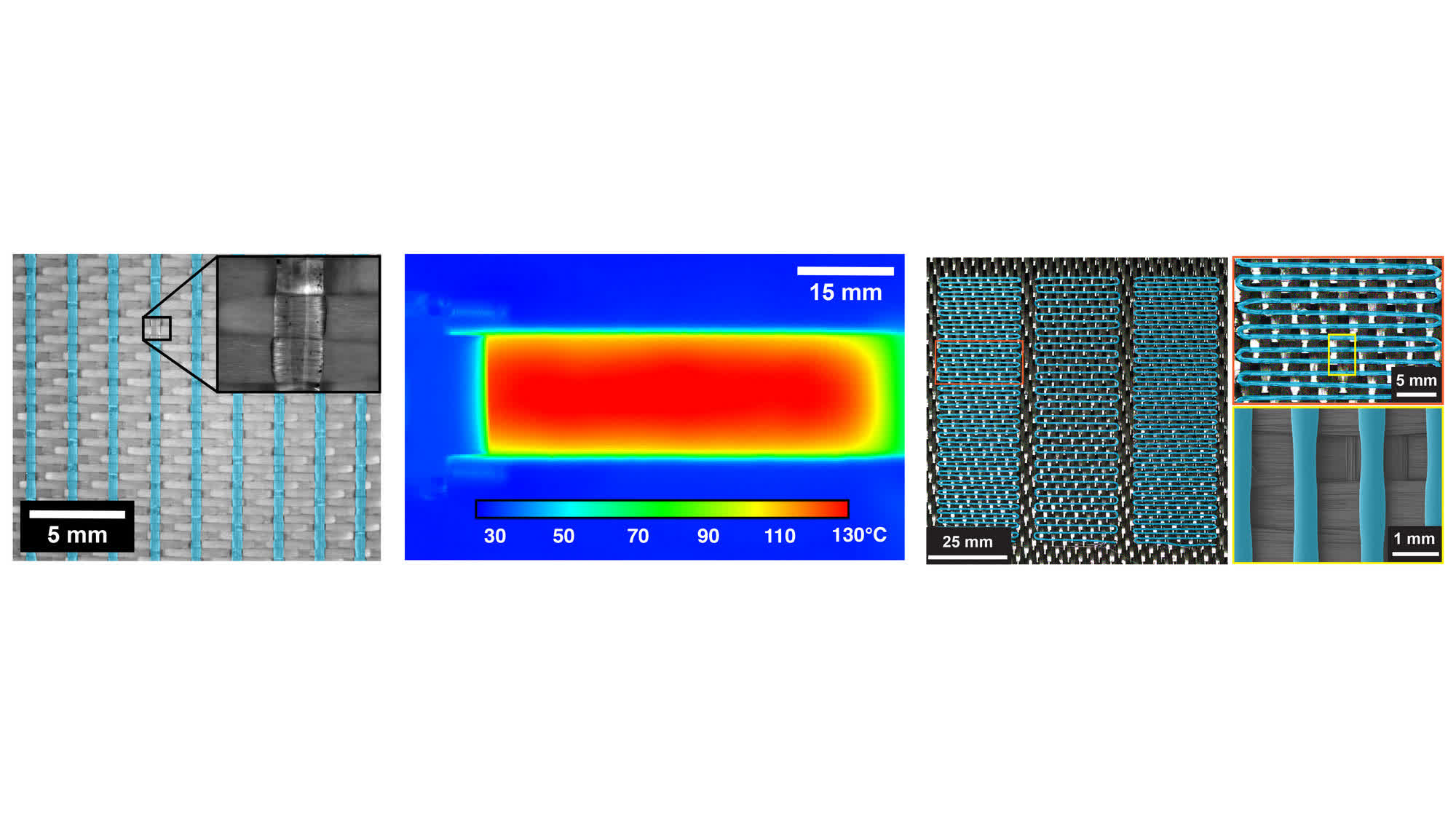
To test the material's self healing capabilities, the team applied tensile force to simulate real world use. After creating a 2 inch delamination, they activated the healing process and repeated the cycle 1,000 times over 40 days to measure how many cycles the material could endure without losing structural integrity.

They observed that the material was able to self-heal damages and retained its toughness during the tests, suggesting that its large-scale adoption in the aerospace, renewable energy, automotive, and other industries could potentially extend the service life of key components in cars, airplanes, windmills, and spacecraft from a few decades to several centuries.

According to lead author Jack Turicek, the material is stronger than conventional composites from the outset and can better withstand damage for at least 500 cycles.

While toughness does decline with repeated healing, it does so very slowly, potentially allowing components to remain functional for up to 500 years. By comparison, conventional FRP composites have a typical lifespan of about 15 to 40 years.

Researchers say the material could help reduce costs by increasing the lifespan of critical components and lowering energy use, as well as improve industrial waste management by reducing the need for frequent replacements. However, they caution that the material still needs to be tested in real world conditions before it can be hailed as the real deal.

Permalink to story:

 
Well, it won't see use in consumer vehicles most likely. Car dealers & autobody shops THRIVE on autobody repair/replacement. 🤣
Oh FFS, auto bodies don’t delaminate on their own, and I doubt this stuff will repair itself after a car accident. It’s not gonna be kept off market by evil corporate types
 
Last edited:
With the current rate of progress, I don't think we need anything to last more than a decade or two, simply because it will be technologically obsolete.

Anyway, there are thousands of promising lab experiments that shatter into pieces after colliding with real life.
 
With the current rate of progress, I don't think we need anything to last more than a decade or two, simply because it will be technologically obsolete.
I mean, that's just not true, I'd argue in certain markets, they're going backwards, cars from the likes of BMW for example, I'd argue they made better cars 10-20 years ago compared to brand new BMW today.

I'm not talking about engine vs electric power either, I'm talking about the actual experience, iDrive has become a mess, physical buttons have become rare, it bings and bongs at absolutely everything as you drive down the road, over-the-air updates, subscription models for basic features already installed on the car, this list goes on.

I'm just using BMW as an example, but plenty of other car manufacturers have gotten worse, and I'm just using the car industry as an example, there's plenty of other industries that are, for the lack of a better word "enshitifying" themselves.

The problem with your train-of-thought, if we accept everything is end-of-life and obsolete after 10-20 years, how do you show these companies that you aren't impressed with their new products? You're forced to upgrade anyway, so why do they care if they produce a good product or not?
 
Well, it won't see use in consumer vehicles most likely. Car dealers & autobody shops THRIVE on autobody repair/replacement. 🤣
They thrive on people who should not be allowed to drive. I had my car damaged at least 5 times in parking lots. I have developed a hatred for this kind. Like, how hard is it to pull out slowly, or move back a bit to park without touching another car? I am not even angry for them running away without fixing what they broke as much as being so pathetic at such a simple task.
 
I mean, that's just not true, I'd argue in certain markets, they're going backwards, cars from the likes of BMW for example, I'd argue they made better cars 10-20 years ago compared to brand new BMW today.

I'm not talking about engine vs electric power either, I'm talking about the actual experience, iDrive has become a mess, physical buttons have become rare, it bings and bongs at absolutely everything as you drive down the road, over-the-air updates, subscription models for basic features already installed on the car, this list goes on.

I'm just using BMW as an example, but plenty of other car manufacturers have gotten worse, and I'm just using the car industry as an example, there's plenty of other industries that are, for the lack of a better word "enshitifying" themselves.

The problem with your train-of-thought, if we accept everything is end-of-life and obsolete after 10-20 years, how do you show these companies that you aren't impressed with their new products? You're forced to upgrade anyway, so why do they care if they produce a good product or not?
Well, I beg to differ. Fully agree about physical controls in cars, using sliders on a screen is not only annoying, it could be dangerous ... but besides that, what's worse in contemporary cars? That's not the point, actually - better or worse, cars have a lifespan. A car is rarely used for more than 20 years, so it simply makes no sense to make certain parts of it super-durable. Most consumer products have even shorter lifespans, and even big and very expensive stuff like airplanes are retired after no more than 40-50 years. If extra durability comes at no extra cost, fine. But if not, what's the point?
 
...better or worse, cars have a lifespan. A car is rarely used for more than 20 years, so it simply makes no sense to make certain parts of it super-durable.
I hear you, but the entire reason cars have a lifespan is due to those parts wearing out. If we increase the average lifetime of those parts, the car's lifespan naturally increases also. Already, cars today last significantly longer without overhaul than those built 40+ years ago.

...very expensive stuff like airplanes are retired after no more than 40-50 years.
Well, we have some 737-200s still flying 55 years later, and I believe the US military has a couple Stratotankers approaching age 70. And my point is even more relevant to aircraft: the diligence with which their engines and electronics are maintained, they only need to be removed from service when the airframe itself wears out. A century from now, most planes might indeed be flying for 75+ years.
 
With the current rate of progress, I don't think we need anything to last more than a decade or two, simply because it will be technologically obsolete.

Anyway, there are thousands of promising lab experiments that shatter into pieces after colliding with real life.
Indoctrination just works.

In reality we need long lasting materials and designs, standardized parts and open source hardware as well as software. If it isn't obvious to you, you need a common sense lesson.
 
Indoctrination just works.

In reality we need long lasting materials and designs, standardized parts and open source hardware as well as software. If it isn't obvious to you, you need a common sense lesson.
Indoctrination works? I was of the impression it mostly doesn't ..
Who indoctrinated you? I should congratulate them for proving me wrong.
 
I hear you, but the entire reason cars have a lifespan is due to those parts wearing out
How many of the wearing out parts are made of composites?
I think cars have a lifespan mostly because newer models are more efficient, more safe, easier to maintain, with a lot better infotainment and generally speaking with a lot better everything.
If we increase the average lifetime of those parts, the car's lifespan naturally increases also.
Only if we do that for (almost) all the parts. If the number of failing parts is above a certain threshold, it doesn't really matter how durable the rest are.
Already, cars today last significantly longer without overhaul than those built 40+ years ago.
What I'm trying to say is that lasting longer is not all that important for products that improve fast. Using something for a long time in many cases means you're not using the best and safest product. There are even 70+ years old cars still moving in Cuba :), even really ancient stuff may be kept functioning, but the Cubans lucky to have escaped prefer new cars.

Very durable materials are fine for infrastructure bulilding, construction etc. if they are cheaper/better than the already available durable materials. But after all, what we have so far is just a promising lab experiment.
 
I think cars have a lifespan mostly because newer models are more efficient, more safe, easier to maintain, with a lot better infotainment...
In 50+ years, I've never met someone who traded in their vehicle because the newer model was safer or more efficient. It's either cosmetic reasons (new and shiny trumps old and muddy) or because they're concerned about breakdowns and reliability.

The 'infotainment' is a relatively new phenomenon and pretty much all new cars have it now. Throw that, airbags, and a couple other features into the pot, and cars really haven't changed much in 60 years.

Only if we do that for (almost) all the parts. If the number of failing parts is above a certain threshold, it doesn't really matter how durable the rest are.
True, and we've been improving the reliability of metal parts for a full century. The average vehicle warranty in the '70s was 12 months/12K miles. Now its 5 times that; several manufacturers offer 10 year/100K warranties.

Now, let's throw EVs into the scenario. This more than anything else will I think make car maintenance evolve like automobiles. If you regularly replace the battery pack and motors, there's really no reason to not use the frame for 40+ years.
 
Back