No more x86S: Intel halts push for streamlined x86 architecture

Alfonso Maruccia

Posts: 2,561   +951
Staff
Editor's take: Intel is navigating a pivotal moment in its decades-long history. The company that invented the CPU is currently without a CEO, laying off thousands of workers, and losing ground to AMD in both sales and technological performance. At the very least, Chipzilla appears willing to reverse some controversial decisions made in recent years, such as its unilateral attempt to simplify the x86 processor with the new x86S standard.

A year after unveiling its initiative to introduce a fundamental technology shift to the x86 ecosystem, Intel has confirmed that the x86S ISA is officially being discontinued. While the company is now focusing on other priorities, it remains "deeply" committed to the x86 architecture, as demonstrated by its willingness to collaborate with historical competitors like AMD.

Intel announced the change in a statement shared with Tom's Hardware. By pivoting away from the x86S initiative, the company ensures that future PC CPUs will maintain full (theoretical) compatibility with 16-bit and 32-bit applications from the DOS and Windows 9x eras. Additionally, Intel plans to work with partners in the newly established x86 Ecosystem Advisory Group to solidify x86 technology as a universal CPU architecture.

Initially introduced in 2023, x86S ISA was proposed as an exclusively 64-bit architecture. The initiative aimed to eliminate native support for 16-bit and 32-bit x86 code and operating systems, while still allowing 32-bit (Win32) applications to run on modern 64-bit operating systems. The x86S ISA also sought to remove legacy features like 16-bit real mode, VT-x unrestricted mode, segmentation gates, and other outdated components.
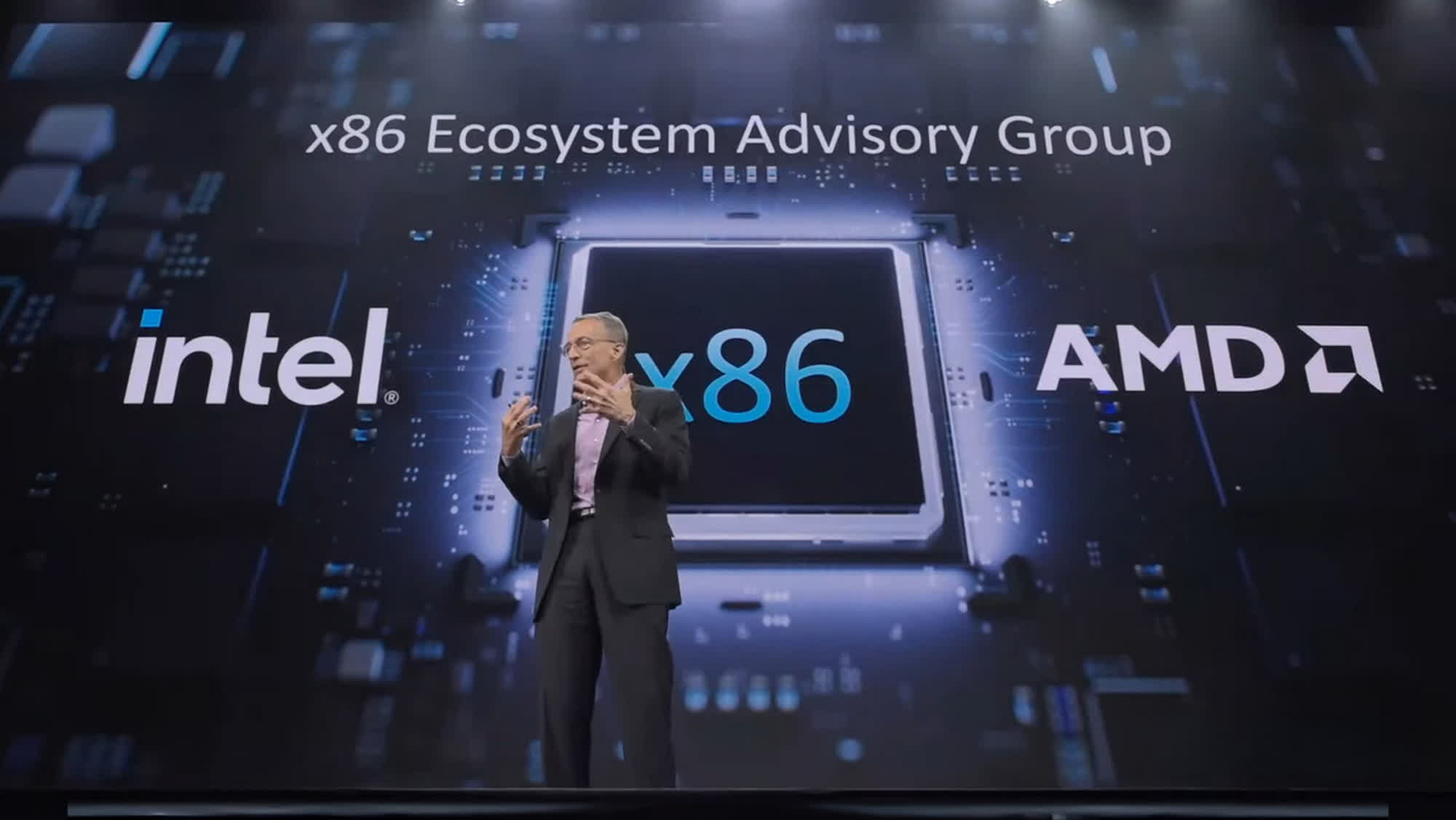
Intel released the latest x86S specifications (version 1.2) in September, followed by the formation of the x86 Ecosystem Advisory Group in October. While the 64-bit-only x86S ISA was an Intel-driven initiative, AMD and other industry partners in the advisory group likely had strong opinions about the proposal for a "simplified" CISC instruction set architecture based on the de facto standard for PC computing since the 1970s.

At 46 years old, x86 technology remains a cornerstone of the computing world, but it faces mounting competition from newer architectures. Arm-based processors like Qualcomm's Snapdragon X Elite are pushing boundaries in the traditional PC market, presenting a real challenge to the dominance of x86.

By collaborating with AMD, Microsoft, Google, HPE, and other key players in the x86 ecosystem, Intel is positioning itself to avoid repeating past missteps – such as the infamously criticized Itanium architecture.

Permalink to story:

 
From a technical point of view, this is a sad moment, as the benefits could have made the "standard" (non-ARM) processors of the future better. Better power efficiency, more space on the die for modern features, perhaps cheaper chips (fewer vestiges of the past need to be included), etc.

From a practical point of view, the politics and transition would have been complex, many 32 bit applications (older games) would suffer performance penalties (emulation or virtualization overhead), and it's not clear how well it would compete with ARM.

I'm not opposed to a 64-bit only ISA, but I would want it to be something jointly developed by Intel and AMD, with demonstrable benefits and few (if any) downsides, as well as a commitment to traditional x86-64 architecture for several years until the kinks are worked out. But, as it stands, looks like this will be years away. Unless ARM or RISC-V kill x86 (and potential replacements), a new ISA will eventually be introduced. The question is when, what form, and how much of a PITA the transition would be.
 
From a technical point of view, this is a sad moment, as the benefits could have made the "standard" (non-ARM) processors of the future better. Better power efficiency, more space on the die for modern features, perhaps cheaper chips (fewer vestiges of the past need to be included), etc.

From a practical point of view, the politics and transition would have been complex, many 32 bit applications (older games) would suffer performance penalties (emulation or virtualization overhead), and it's not clear how well it would compete with ARM.

I'm not opposed to a 64-bit only ISA, but I would want it to be something jointly developed by Intel and AMD, with demonstrable benefits and few (if any) downsides, as well as a commitment to traditional x86-64 architecture for several years until the kinks are worked out. But, as it stands, looks like this will be years away. Unless ARM or RISC-V kill x86 (and potential replacements), a new ISA will eventually be introduced. The question is when, what form, and how much of a PITA the transition would be.
The space savings would be minuscule, look at ANY modern X86 core breakdown. The x86 portion is tiny, maybe you could fit another byte of cache there.

As for power consumption, please explain lunar lake pushing ARM level battery life. Almost like core design is far more important then ISA for power use....
 
From a technical point of view, this is a sad moment, as the benefits could have made the "standard" (non-ARM) processors of the future better. Better power efficiency, more space on the die for modern features, perhaps cheaper chips (fewer vestiges of the past need to be included), etc.

From a practical point of view, the politics and transition would have been complex, many 32 bit applications (older games) would suffer performance penalties (emulation or virtualization overhead), and it's not clear how well it would compete with ARM.

I'm not opposed to a 64-bit only ISA, but I would want it to be something jointly developed by Intel and AMD, with demonstrable benefits and few (if any) downsides, as well as a commitment to traditional x86-64 architecture for several years until the kinks are worked out. But, as it stands, looks like this will be years away. Unless ARM or RISC-V kill x86 (and potential replacements), a new ISA will eventually be introduced. The question is when, what form, and how much of a PITA the transition would be.
I interpret the decision as Intel realising that going alone with X86S makes no sense now that they have the x86 Ecosystem Advisory Group. I'm sure a modernised X86 standard is on the groups agenda, with X86S likely being a starting point for that discussion, but Intel needed to formally kill X86S first to open space for that to occur.
 
The space savings would be minuscule, look at ANY modern X86 core breakdown. The x86 portion is tiny, maybe you could fit another byte of cache there.

As for power consumption, please explain lunar lake pushing ARM level battery life. Almost like core design is far more important then ISA for power use....
Yeah. This power consumption issue is common misunderstanding. Because first ARM CPUs were low power and most still are, people think ARM is low power by ISA which it's not.

As for dropping x86s, Intel probably thought that customers will want hardware compatibility to remain. As customers probably do not want to rely on software emulation/virtual machines on critical designs.
 
The space savings would be minuscule, look at ANY modern X86 core breakdown. The x86 portion is tiny, maybe you could fit another byte of cache there.

As for power consumption, please explain lunar lake pushing ARM level battery life. Almost like core design is far more important then ISA for power use....
Yeah. This power consumption issue is common misunderstanding. Because first ARM CPUs were low power and most still are, people think ARM is low power by ISA which it's not.

As for dropping x86s, Intel probably thought that customers will want hardware compatibility to remain. As customers probably do not want to rely on software emulation/virtual machines on critical designs.
It's definitely true that manufacturing process and core design are huge factors in power efficiency. But, I can't help but wonder, if both AMD and Intel struggled for so long to put chips out that could have great power efficiency vs ARM, there haven't been many if any devices rivaling the battery life of their ARM counterparts until recently (of course, a device is about way more than just the cores), I can't help but wonder if the ISA is playing a part. May not be the x86 portion per se, but something about the ISA. I won't go so far as to claim it is CISC vs RISC (I won't claim anything for that matter, I'm not knowledgeable enough on it to make a claim), but it feels like ISA is contributory here. Maybe not, but then why the years long struggle to get close, let alone compete, with ARM and ARM powered devices?
 
It's definitely true that manufacturing process and core design are huge factors in power efficiency. But, I can't help but wonder, if both AMD and Intel struggled for so long to put chips out that could have great power efficiency vs ARM, there haven't been many if any devices rivaling the battery life of their ARM counterparts until recently (of course, a device is about way more than just the cores), I can't help but wonder if the ISA is playing a part. May not be the x86 portion per se, but something about the ISA. I won't go so far as to claim it is CISC vs RISC (I won't claim anything for that matter, I'm not knowledgeable enough on it to make a claim), but it feels like ISA is contributory here. Maybe not, but then why the years long struggle to get close, let alone compete, with ARM and ARM powered devices?
Well, there are several reasons for this and none of them have something to do with ISA.

1. Integrated RAM. Gives more speed but makes expanding memory basically impossible. AMD/Intel were very hesitant to go this route before.

2. Manufacturing tech. Intel messed up with 10nm tech and it still haunts them today. Also Apple always uses latest and most expensive tech from TSMC.

3. Single core for all purposes. Intel has majority of laptop market and their CPUs are good enough. No reason to make different core for laptops only. And since Intel has most of laptops no matter AMD does, AMD also has no real reasons to design "laptop only" core.

Perhaps 3 is most important reason. We have seen that just making core that is good for 3.7 GHz and not 5.7 GHz (Zen4 vs Zen4c) makes huge difference in die size (even ignoring smaller L3 cache). x86 core designed from ground up for "only" 3.x GHz would be much more efficient than x86 core designed for 5.x GHz.

Then we have one thing that has Something to do with ISA, backwards compatibility. x86 have all kinds of legacy stuff that Intel and AMD would like to get rid of, that is what x86s is all about. But, maintaining backwards compatibility is main reason why x86 has been around for decades and customers would not be happy if that changes.

Jim Keller is one of few CPU designers that have designed x86 and ARM core for same company at same time. He did it for AMD around 2013-2015. He says there is no major difference in efficiency between x86 and ARM.
 
Intel hasn't given up on a simplified ISA, it's simply pursuing it though the x86 Ecosystem Advisory Group instead of the go-it-alone approach with x86S.
 
Back