What just happened? Normal Computing, a young company founded by alumni of Google Brain, Google X, and Palantir, has introduced what it calls a new era in computing. The startup announced the successful tape-out of CN101, the first thermodynamic computing chip, positioning itself at the forefront of efforts to make computing significantly more efficient by leveraging the fundamental physics of silicon.
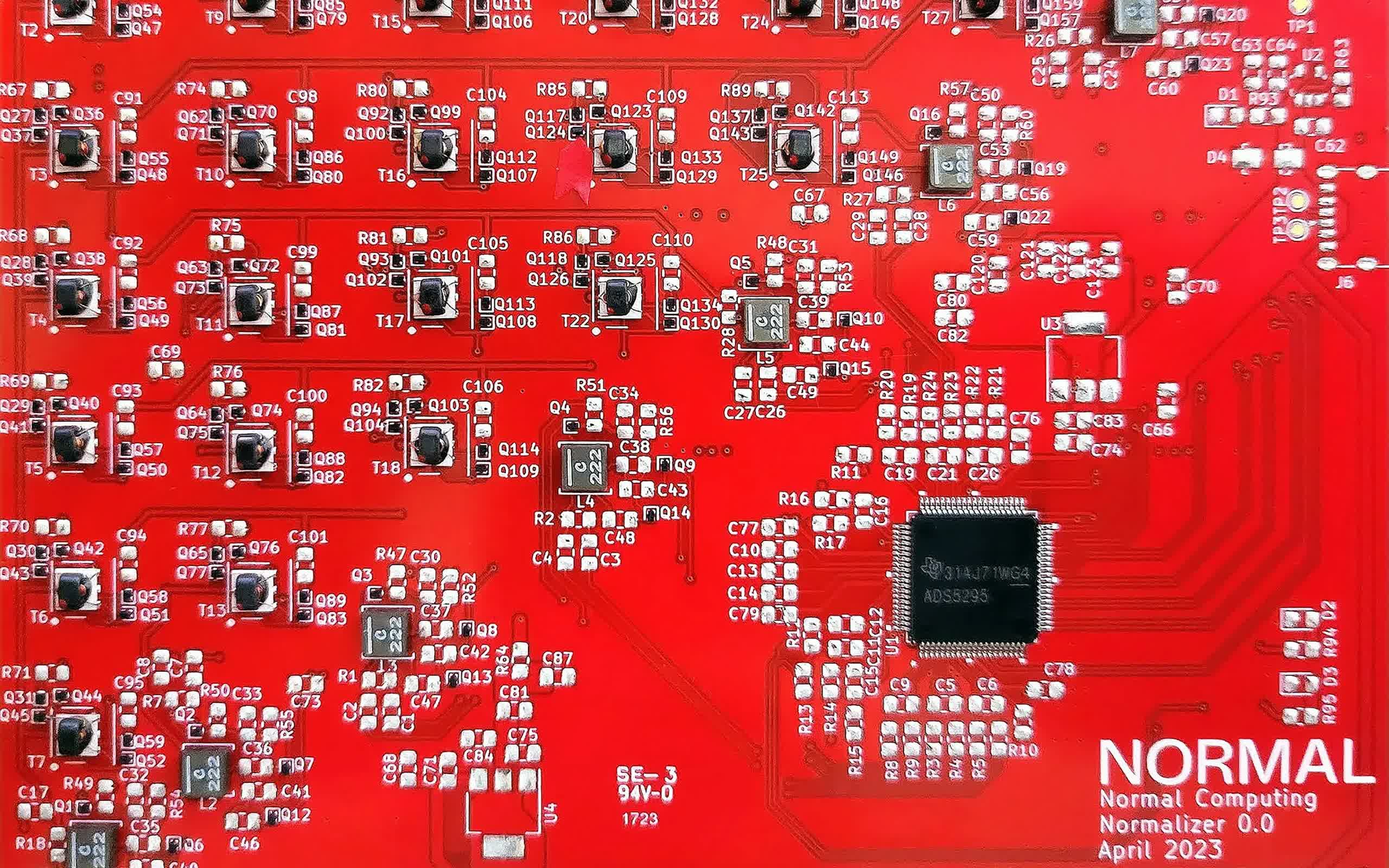
Thermodynamic computing is similar to probabilistic computing, where randomness and noise aren't obstacles to overcome but valuable tools for solving complex problems. Traditional computer chips consume significant energy ensuring every calculation produces the exact same result every time.
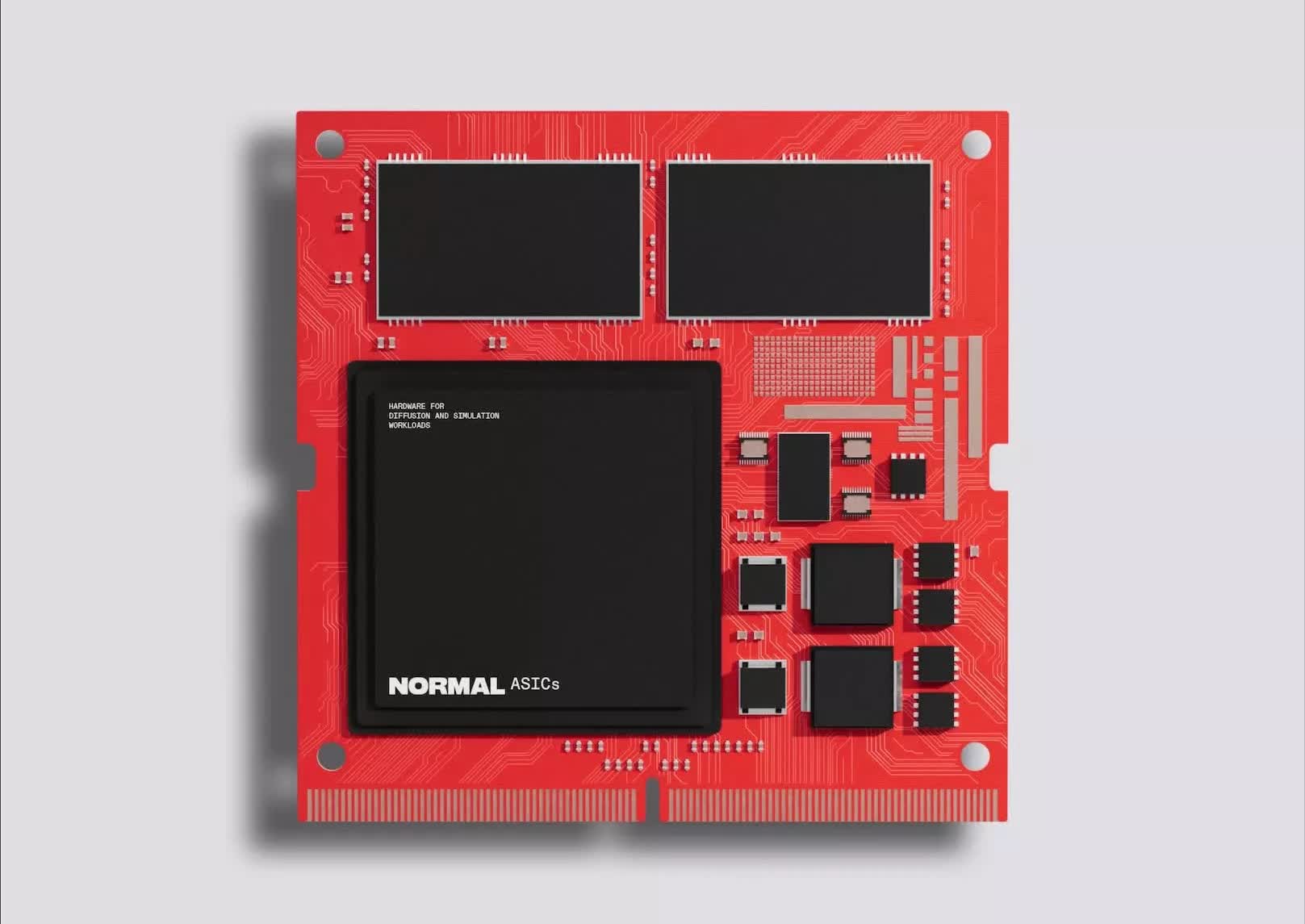
Normal's chips, called Physics-Based ASICs, take a different approach. They harness natural fluctuations, energy dissipation, and inherent randomness within the chip to perform computations, particularly for artificial intelligence and scientific workloads. According to the company, this method can make certain computations up to 1,000 times more efficient.
The CN101 chip is built on what Normal calls the Carnot architecture, a design that accelerates complex tasks by allowing the chip's physical state changes to contribute to finding solutions. Unlike conventional chips that strive to eliminate or control noise, CN101 embraces it.
In this system, components start in a semi-random configuration. The problem is encoded by adjusting the interactions among these components. As the system gradually settles into equilibrium, its final state represents the solution.
Normal Computing's first prototype demonstrated that useful computational work can be achieved using noise, such as matrix inversion and Gaussian sampling – both important for many AI tasks.
The chip is built from interconnected physical resonators. At the beginning of each calculation, these resonators start with semi-random values. The problem is encoded in the way the resonators are linked together. Over time, their interactions naturally converge to an equilibrium state, which is then read as the solution.
"In a conventional chip, everything is very highly controlled," said Gavin Crooks, Normal Computing staff research scientist, to IEEE Spectrum. "Take your foot off the control little bit, and the thing will naturally start behaving more stochastically."
The first version of the chip relied on capacitor-inductor resonators, but this design was difficult to scale to larger chips. To address this, Normal removed the components that made scaling hard – such as inductors – and moved toward a fully silicon-based design.
The CN101 chip is optimized for the types of tasks common in large-scale AI and scientific computing, including linear algebra, matrix operations, and a custom lattice random walk algorithm for probabilistic calculations. These operations are foundational for engineering simulations and machine learning workloads.
Normal's goal is to maximize computational work per watt, per rack in a data center, and per dollar spent – a critical priority as energy constraints tighten. By embracing noise and randomness, CN101 aims to deliver faster response times and higher throughput, particularly for AI inference, potentially transforming how large-scale computing tasks are executed.
And this is only the beginning. The company has ambitious plans for future chips:
- CN201 (expected in 2026) will target high-resolution diffusion models and a broader set of AI challenges.
- CN301 (planned for late 2027 or early 2028) will handle large-scale video diffusion models and push the limits of generative AI efficiency.
With CN101 now taped out, Normal Computing has begun testing and benchmarking the chip. These results will guide the design of the next generation. Although significant challenges remain, such as ensuring reliable performance at commercial scale, creating a working thermodynamic computing chip in silicon could mark a turning point for the industry.
If successful, Normal's chips could complement CPUs, GPUs, quantum processors, and other emerging technologies, helping meet the ever-growing compute demands of AI and large data centers.
Image credit: IEEE Spectrum
Normal Computing tapes out the world's first thermodynamic chip for AI and scientific computing


