Researchers built a switch 1,000 times faster than today's AI chips, and it barely generates any heat

DragonSlayer101

Posts: 984   +14
Staff
The big picture: Researchers at the University of Tokyo have developed a magnetic switching device that can operate at speeds up to 1,000 times faster than the fastest AI accelerators on the market today, but uses only a fraction of the energy and generating minimal heat. The new invention could potentially solve the problem of overheating and battery drain in electronics, paving the way for super-efficient computers and smartphones.
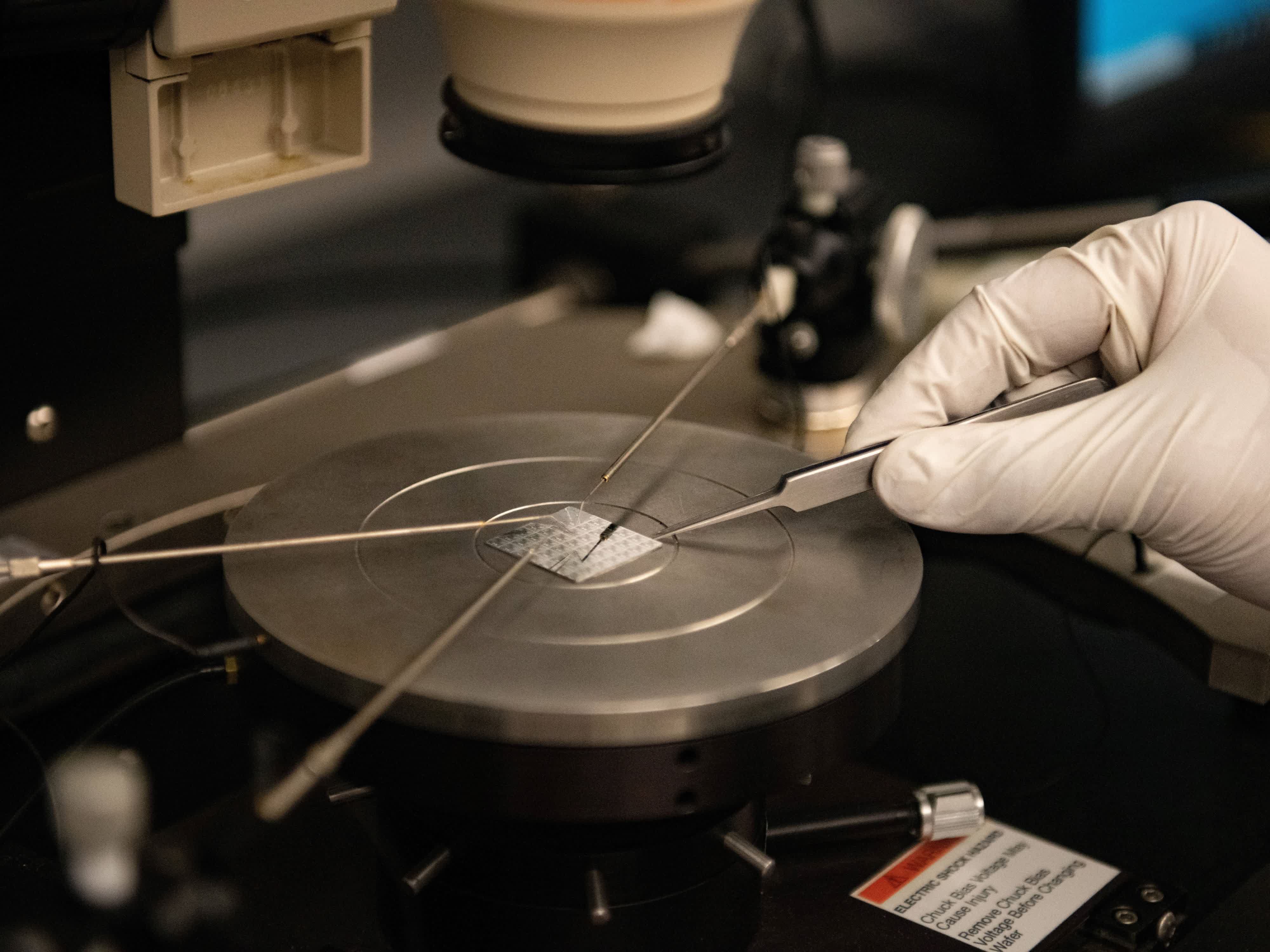
The research, which was published in Science earlier this week, builds on another study published in Nature in January 2025. It demonstrates a new way to flip a binary magnetic state at picosecond speeds - a massive improvement over the nanosecond-scale switching considered standard for modern silicon-based processors.

The research could lead to a new technology capable of handling the fundamental problem with conventional processors: heat. The speed of a processor is directly proportional to the amount of heat it generates, meaning the faster they run, the more heat they generate. This leads to excessive power consumption, which puts a massive strain on the infrastructure around data centers.

The study's authors believe they have finally solved this problem by building a new spintronic device using a manganese and tin compound (Mn3Sn) known as an antiferromagnet. Spintronic devices utilize both the charge and the spin of electrons in specialized materials to process, store, and transmit data, rather than relying solely on charge, as in traditional semiconductors.

As a proof of concept, the researchers demonstrated that sending a 40-picosecond electrical pulse through the antiferromagnet to flip its magnetic state from one binary position to another generates minimal resistive heat compared to traditional computing switches. It also uses a fraction of the energy used by modern AI accelerators, raising hopes for faster and more efficient AI hardware in the future.

In case you're wondering, one picosecond is an incredibly brief unit of time equal to one trillionth of a second. It is 1,000 times shorter than a nanosecond and is primarily used by physicists to measure the lifetimes of subatomic particles and the time it takes to break certain chemical bonds.

If the technology can reliably and economically transition from research labs to commercial factories, it could find applications in cloud-based quantum services, making optical quantum computing accessible to general users. According to Professor Tomo Nakatsuji of the University of Tokyo, "there is (also) a possibility that data that takes an hour to download can be processed in one second."

However, it is worth noting that although the switching of the binary state is the fundamental operation of computing, increasing its speed by 1,000x won't raise the total computing speed one thousand times. This is because a computer is not just a switch. It relies on myriad hardware and software components working in unison to read, process, and transmit data, so a faster switch can only do so much.

Permalink to story:

 
This is the kind of breakthrough that truly sparks the imagination. We’re reaching a point where the traditional evolution of computing is starting to collide with physical limits — heat, energy consumption, transistor density, and material constraints. Every piece of hardware generates heat, whether it’s idle or operating under heavy load, and that has become one of the biggest barriers to future performance scaling.
What makes this new -switch technology so fascinating is the possibility of breaking away from those limits entirely. Instead of relying purely on electrical transistors, researchers are exploring systems that use light itself for computation and switching, potentially achieving speeds up to 1,000 times faster than today’s silicon-based technology.

If breakthroughs like this continue over the next century or two, humanity could eventually reach a level of computing power that feels genuinely science-fiction compared to today. A modern computer already dwarfs the capabilities of machines from just a decade ago, yet both still operate within the same fundamental technological framework. The real revolution will happen when computation escapes the limitations that define current hardware.
That kind of leap could transform everything: artificial intelligence, medicine, simulations, robotics, space exploration, and even the way humans interact with reality itself. Looking 200 years ahead, it’s possible civilization could evolve into something almost unrecognizable by modern standards — not through fantasy, but through exponential advances in computation and energy efficiency driven by technologies like this.
 
The heat problem in computing is so fundamentally underappreciated by people outside the industry. We're not slowing down chip development because engineers ran out of ideas — we're slowing down because we literally cannot remove heat fast enough from increasingly dense silicon.

Every data center built in the last five years is essentially an elaborate refrigerator that happens to run software. A switching technology that decouples speed from heat generation would be a bigger deal than any single chip architecture improvement in decades.
 
There is also the not insignificant problem of making 20 billion of these small enough to be useful, not to mention to be able to mass produce these switches at a reasonable cost.
 
This is the kind of breakthrough that truly sparks the imagination. We’re reaching a point where the traditional evolution of computing is starting to collide with physical limits — heat, energy consumption, transistor density, and material constraints. Every piece of hardware generates heat, whether it’s idle or operating under heavy load, and that has become one of the biggest barriers to future performance scaling.
What makes this new -switch technology so fascinating is the possibility of breaking away from those limits entirely. Instead of relying purely on electrical transistors, researchers are exploring systems that use light itself for computation and switching, potentially achieving speeds up to 1,000 times faster than today’s silicon-based technology.

If breakthroughs like this continue over the next century or two, humanity could eventually reach a level of computing power that feels genuinely science-fiction compared to today. A modern computer already dwarfs the capabilities of machines from just a decade ago, yet both still operate within the same fundamental technological framework. The real revolution will happen when computation escapes the limitations that define current hardware.
That kind of leap could transform everything: artificial intelligence, medicine, simulations, robotics, space exploration, and even the way humans interact with reality itself. Looking 200 years ahead, it’s possible civilization could evolve into something almost unrecognizable by modern standards — not through fantasy, but through exponential advances in computation and energy efficiency driven by technologies like this.
It's a pity you didn't remove the evidence that this is clearly an AI-generated post. Maybe Techspot needs a "report for AI slop" button.
 
Probably 50 years from now. This is just fantasy hardware until somebody can do more than just "switching fast" with it.
Oops! If you can build a switch, you can build logic gates, and if you can build logic gates, you can build a CPU ... which ultimately is nothing more than a collection of high-speed switches.

And in fact, companies today are already bringing spintronic based devices like this to market.

 
Oops! If you can build a switch, you can build logic gates, and if you can build logic gates, you can build a CPU ... which ultimately is nothing more than a collection of high-speed switches.

And in fact, companies today are already bringing spintronic based devices like this to market.

Sure dude, and we can also add wings to pings and expected them to become birds.

Do you have any idea just how long it takes these fantasy like technologies to get into production? We've been dreaming of Silicon Photonics to hit mainstream for over two decades. We've had demos of chips using it for over a decade.

The same with solid state battery tech. We've had in lab demos of batteries for almost two decades. Every year we keep hearing about how it's "production ready" (including the Donut Labs announcement this year), but nobody actually makes them.

As for the link you gave, what they have is extremely limited and only talk about future products. The existing products that they make are MRAM based with a bit of FPGA added on top for very limited logic, tech which has been available since the 80s. We had ST-MRAM working as cache for SSDs for over a decade.
 
Do you have any idea just how long it takes these fantasy like technologies to get into production?
Yes -- it's already done. Magnetic-switched spintronics devices are already in production. Today.

This isn't an entirely new technology: it's simply performing the switching via anti-ferromagnets, rather than the ferromagnetic switching already in production.

We've been dreaming of Silicon Photonics to hit mainstream for over two decades.
Yes, and photonics based switches form the backbone of the 5G network today. At least in the US ... backwards areas of Eastern Europe may be using older technology.

The same with solid state battery tech. We've had in lab demos of batteries for almost two decades.
You're lumping together all innovations based on what you read in brief pop-sci articles?

The existing products that they make is MRAM based with a bit of FPGA added on top for very limited logic, which has been available since the 80s.
The acronyms have confused you. Spintronic based STT-MRAM -- first commercialized a decade ago -- is entirely different from the "MRAM" you read of in the 1980s.
 
Last edited:
Why don’t we just go back to larger nodes with further optimizations and refinement? It’s easier to make more advanced gates at a larger scale and the additional density would make it easier to cool. What am I missing here other than dies just being larger?
 
Why don’t we just go back to larger nodes with further optimizations and refinement? It’s easier to make more advanced gates at a larger scale and the additional density would make it easier to cool. What am I missing here other than dies just being larger?
The "dies just being larger" is a pretty big "just". Larger dies means worse yields, and that means limitations on what you could build. The rtx 4060 has 7 billion more transistors then the 1080ti. Would you be ok with rtx 4060 performance for $3000? Because that is what you get with older transistors that are larger.

Not to mention far worse power consumption. Technology progresses, no amount of refinement is going to make a 14nm node perform like a 3nm node.
 
Last edited:
Why the need to compare it to a label like "AI chips" as if "AI chips" works in an entirely different wafer and manufacturing technology than "non AI chips". Techspot is trying too hard to make AI ubiquituous.
 
Yes -- it's already done. Magnetic-switched spintronics devices are already in production. Today.

This isn't an entirely new technology: it's simply performing the switching via anti-ferromagnets, rather than the ferromagnetic switching already in production.


Yes, and photonics based switches form the backbone of the 5G network today. At least in the US ... backwards areas of Eastern Europe may be using older technology.


You're lumping together all innovations based on what you read in brief pop-sci articles?


The acronyms have confused you. Spintronic based STT-MRAM -- first commercialized a decade ago -- is entirely different from the "MRAM" you read of in the 1980s.
No they aren't, not the ones proposed in this article, I already explained what is in production, but you can't seem to be capable of reading, as per usual.

You love to take things out of context or simply lie about them. You always do this.
 
No they aren't, not the ones proposed in this article, I already explained what is in production, but you can't seem to be capable of reading, as per usual.

You love to take things out of context or simply lie about them. You always do this.
Why not just admit you were wrong and move on? First you failed to realize that binary switches *are* a computer, then you represented this as entirely new tech, rather than a refinement of existing spintronic devices, then conflated it with 40-year old MJT-based RAM, and then finally, to top it all, claimed photonics switches -- widely used today -- are "fantasy tech".

Mass production feasibility remains to be seen, but barring that, these devices can easily be commercialized in ten years or less. This isn't Star Trek antigravity.
 
Last edited:
You love to take things out of context or simply lie about them. You always do this.

It's his favourite pastime (and he has A LOT of time on his hands) - a servile rehashing of the Mango Messiah's demented shtick. Sort of guy that thinks Hitler was "left wing" LMAO
 
It's his favourite pastime (and he has A LOT of time on his hands) - a servile rehashing of the Mango Messiah's demented shtick. Sort of guy that thinks Hitler was "left wing" LMAO
So why don’t you attempt to DISPROVE what he said instead of just slandering him… I’m guessing cause you hate that he’s right? Not about Hitler though…
 
So why don’t you attempt to DISPROVE what he said instead of just slandering him… I’m guessing cause you hate that he’s right? Not about Hitler though…
I already did, multiple times. I completely destroyed him and he keeps copy-pasting the same things to others again and again that I've completely disproven with known facts.

BTW, on the nazi topic, I was literally forced to copy-paste the same answers he game before because he was trying to BS somebody else and then said the same things a third time to me. Maybe he thinks I have short memory or that historic facts are beneath his great mind?

You want me to feel sorry for somebody who clearly has an agenda here on this forum?

Imagine agreeing with somebody who thinks that the Nazis were "pro worker unions" after literally killing, looting and destroying all independent worker unions on May 2nd 1933 with a great plan they implemented and executed nation wide, a known historic fact. And his answers? Saying that the Nazis ran on "pro unions" in their campaign before they got into power... Like what?

Imagine pushing the blame on Obama and democrats for the 2008 epstein deal, which was negotiated and signed before he became president by GOP party members... and the guy who got epstein the deal later joined trump in his first term.

Imagine agreeing with somebody who thinks that the Nazis "abolished unearned income" because they ran on a fake 25 points campaign which they never implemented (none besides the anti-jew points) and even killed all the left-wing members who were not happy that they didn't do it.

It's lies like this that I will not tolerate. I will call anybody out who actively thinks that everybody here is too stupid to properly fact check him.
 
Last edited:
Back