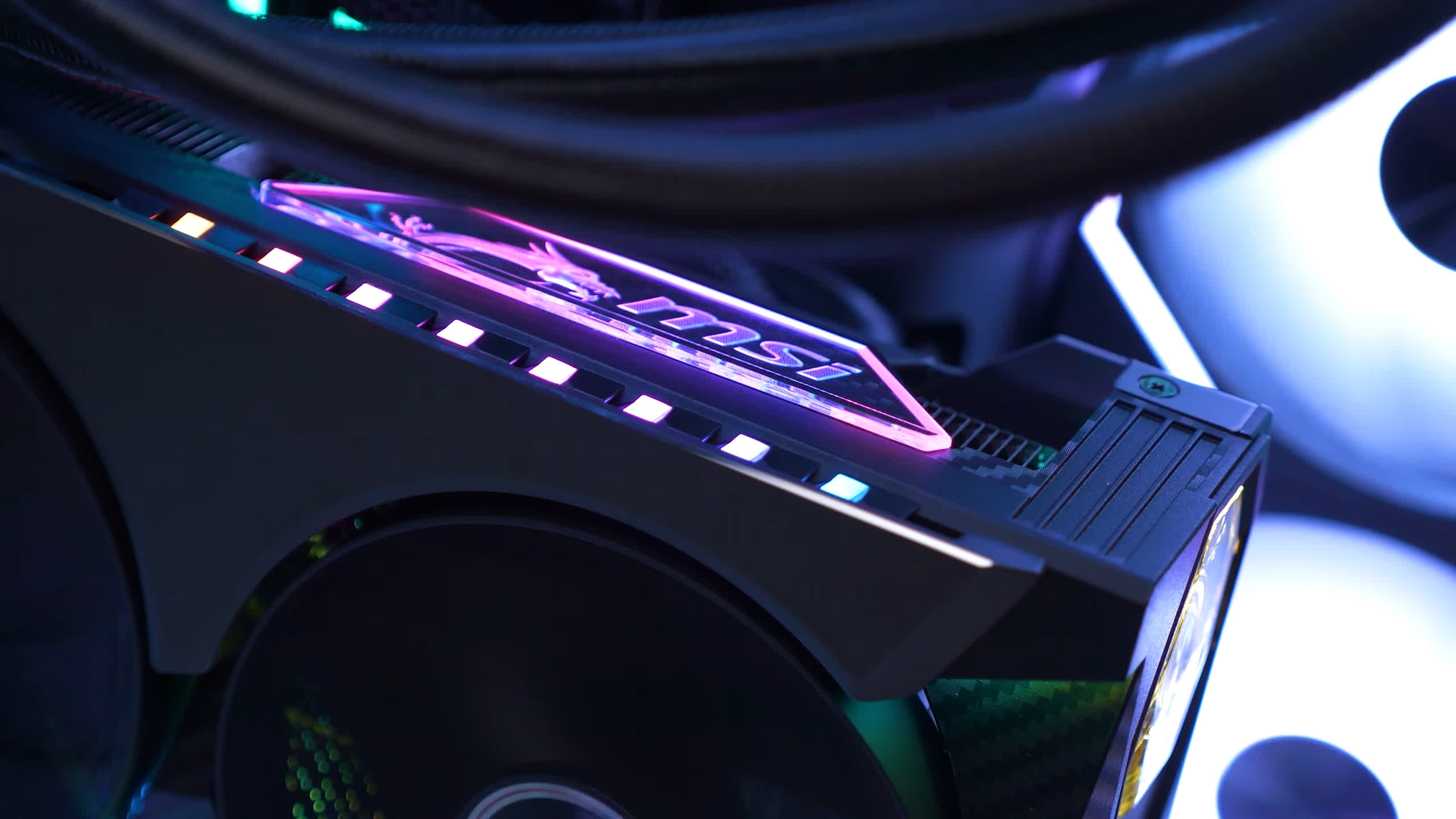
Nvidia GeForce RTX 5070 Ti vs AMD Radeon 9070 XT with DLSS and FSR Enabled

I'd really appreciate you folks doing some VR benchmarking as well, e.g. F1 2025, MSFS 2024, coz I wanna play VR games and am torn between precisely these two cards.
 
RTX all day.
You get what you pay for.

"Ray tracing performance
RTX 5070 Ti: Has a clear advantage, particularly in workloads that are heavily ray-traced. Nvidia's ecosystem, including its ray tracing capabilities, is considered a step ahead.
RX 9070 XT: Shows significant improvement in ray tracing compared to previous AMD cards, but it still trails the 5070 Ti in most ray tracing scenarios.
Upscaling and image quality
RTX 5070 Ti: Nvidia's DLSS 4 with Multi-Frame Generation (MFG) often delivers superior image quality and higher frame rates in games that support it.
RX 9070 XT: AMD's FSR 4 is a good technology, but it generally does not match the image quality and performance uplift of DLSS, especially in visually demanding games. "
 
RTX all day.
You get what you pay for.

"Ray tracing performance
RTX 5070 Ti: Has a clear advantage, particularly in workloads that are heavily ray-traced. Nvidia's ecosystem, including its ray tracing capabilities, is considered a step ahead.
RX 9070 XT: Shows significant improvement in ray tracing compared to previous AMD cards, but it still trails the 5070 Ti in most ray tracing scenarios.
Upscaling and image quality
RTX 5070 Ti: Nvidia's DLSS 4 with Multi-Frame Generation (MFG) often delivers superior image quality and higher frame rates in games that support it.
RX 9070 XT: AMD's FSR 4 is a good technology, but it generally does not match the image quality and performance uplift of DLSS, especially in visually demanding games. "
You can just add a 2x multiplier to FRAPS and get the same effect as MFG.
 
In the market for a new card, but with the rumored "Super" variants coming in Q1 or Q2 next year, I can definitely wait. At the very least we should see some price changes with the new SKU's across most of the current lineup.
 
At 600 USD, the RX 9070 XT doesn't have competition. As for upscaling support, all the new games come with FSR4 and for older games if you need upscaling (which you don't ) you have optiscaler. As for frame gen, I'm sorry, but I won't spend 600 USD or more to fake frames.
 
At 600 USD, the RX 9070 XT doesn't have competition. As for upscaling support, all the new games come with FSR4 and for older games if you need upscaling (which you don't ) you have optiscaler. As for frame gen, I'm sorry, but I won't spend 600 USD or more to fake frames.

Mhm, sure. OptiScaler readme, installation section, fist sentence:

Warning: Do not use this mod with online games. It may trigger anti-cheat software and cause bans!

Off to a great start indeed.

Sorry, but some random 3rd party hack that may or may not work, and may or may not get you banned is not the way I make purchase decisions in the $500+ range.

D2R only supports the native resolution, and on my 2160p monitor even 60 FPS is a struggle (and it doesn't support FSR at all). So yes, I do need these features, despite you already deciding for me that I don't need them.
 
Im sure every GPU comparison I read on Techspot leaves me more confused on which GPU to buy. They seem to show competing products as roughly the same. But are they really the same? My experience with GeForce cards over the years is a lot better than on Radeon cards but it's been a hot minute since I purchased an AMD card (the last one being the 7970ghz edition).

Although im not sure why im bothering to read this particular article. I know im going to buy a 5090 because I dont really care how much it costs and I want something that can drive my new OLED 4K 120hz 65inch TV and none of these parts are up to it.
 
Too little too late AMD. I was desperately trying to buy a 9070xt at launch just to have my $750 purchase through Newegg get refunded due to "lack of availability" just to see the exact same model reposted at $900. Once the 9070xts and 5070tis started approaching a thousand dollars I just said screw it and bought the 5080 I wanted to begin with because those prices were coming *down* as the mid range was going up.

Now that you're cutting support for RDNA1 and 2 it quickly gave me flashbacks of getting screwed on a Vega based APU I bought that you kept selling in laptops a full year *AFTER* you dropped all Vega support. Not "maintenance mode," fullblown End Of Life. I finally gave AMD another chance after getting burned repeatedly on FX just to get burned again.

Takes me back to berating my brother for buying a 4080 over an XTX. He said "You only regret paying too much for Nvidia for a couple weeks. You regret buying AMD for the entire life of the product."
 
Im sure every GPU comparison I read on Techspot leaves me more confused on which GPU to buy.

The problem I have with Techspot reviews is they lean heavily into Sony titles that heavily favor AMD, as well as competitive shooters that also heavily favor AMD. Hardly ideal.

For raw speed at low rez AMD has always been strong. Once you start cranking up the resolution and turning on all the bells and whistles like raytracing that's when Nvidia starts to shine.

If all you want to play is Fortnite or CoD at low settings AMD is the clear option. If you really want to pound that GPU with eye candy Nvidia becomes the clear leader.
 
DLSS 4 with a 5000 series Nvidia GPU is a game changer. If your gaming preference are single player RPGs and is supported by DLSS 4, your $400.00 GPU can provide incredible performance.

It's like this: regarding Discrete GPU Market Share (Steam Hardware Survey, August 2025) For installed base among PC gamers:
Nvidia: 74.88%
AMD: 17.32%

AMD holds only 8% of GPU market share. Are all these people uninformed, *****ic, blind fanboys? Nope. I've owned AMD GPUs. Their driver update cadence for new game releases pales in comparison to Nvidia. While DLSS adoption is equally greater from developers.

AMD simply doesn't have the GPU market share to lead with innovations. They have (and had) to play follow the leader and with Nvidia constantly improving DLSS they are a tough act to follow.

With DLSS 4 supported games a single player game like Hogwart's Legacy, Diablo 4, Indiana Jones, Cyberpunk, and much more you can get was used to be 4090 level performance from a 5600ti today.
I don't "hate" Nvidia, and hold a magnifying glass to my monitor and then be a cheer leader for a GPU manufacturer that holds 8% market share trying to find imperfections.

5000 series GPUs are wise investments and gamers agree, as the numbers speak for themself.

Next up on the Nvidia innovation front: "Neural Texture Compression (NTC) an AI-powered technique compresses textures using neural networks, achieving up to 96% VRAM savings in demos without noticeable quality loss. It's integrated with DirectX Raytracing (DXR) 1.2 and targets gaming and rendering applications, potentially extending the viability of budget GPUs like the RTX 5060." Bam!
 
Last edited:
DLSS 4 with a 5000 series Nvidia GPU is a game changer...

I tend to agree, but I think you're being harsh on AMD.

FSR4 is very good (slightly below DLSS4) and will surely be available in all future games.

AMD Driver management and Adrenalin have been excellent for several years now (just hope they continue to support RDNA 1/2).

NTC has been talked about for years, but I haven't seen any concrete use for it, even though some games really need it...

With a price difference of 15% or more, the 9070xt is a very good choice.
 
AMD and Nvidia dropped the ball this generation.

They both equally BAD!

@ Techspot do a review about 4070 TI Super & 5070TI, and maybe include the 4080 Super & 5080. Let's see if there is much of a difference now.
 
Great comparison What stood out to me is how close these two GPUs actually are once DLSS and FSR are enabled. At native, the RTX 5070 Ti has a small lead (~5%), but with upscaling it basically turns into a tie.

It also seems pretty game-dependent—Nvidia still wins more in ray tracing titles, while AMD can pull ahead in some raster-heavy games. The interesting part is how FSR 4 sometimes scales better than DLSS 4 in certain cases, which wasn’t really expected.

Overall, it feels like the decision comes down more to features and price rather than raw performance, since the real-world difference is pretty small.
 
Back