Nvidia research promises 2x to 3x faster path tracing with better visuals

Daniel Sims

Posts: 2,418   +73
Staff
Why it matters: Path tracing has dramatically enhanced the presentation of light, shadow, and reflections in titles such as Cyberpunk 2077, Alan Wake 2, Resident Evil Requiem, and Pragmata. However, its extreme computational cost limits the feature to the latest high-end Nvidia graphics cards. But new research from the company outlines how the performance impact of path tracing might be reduced by at least half while improving image quality.
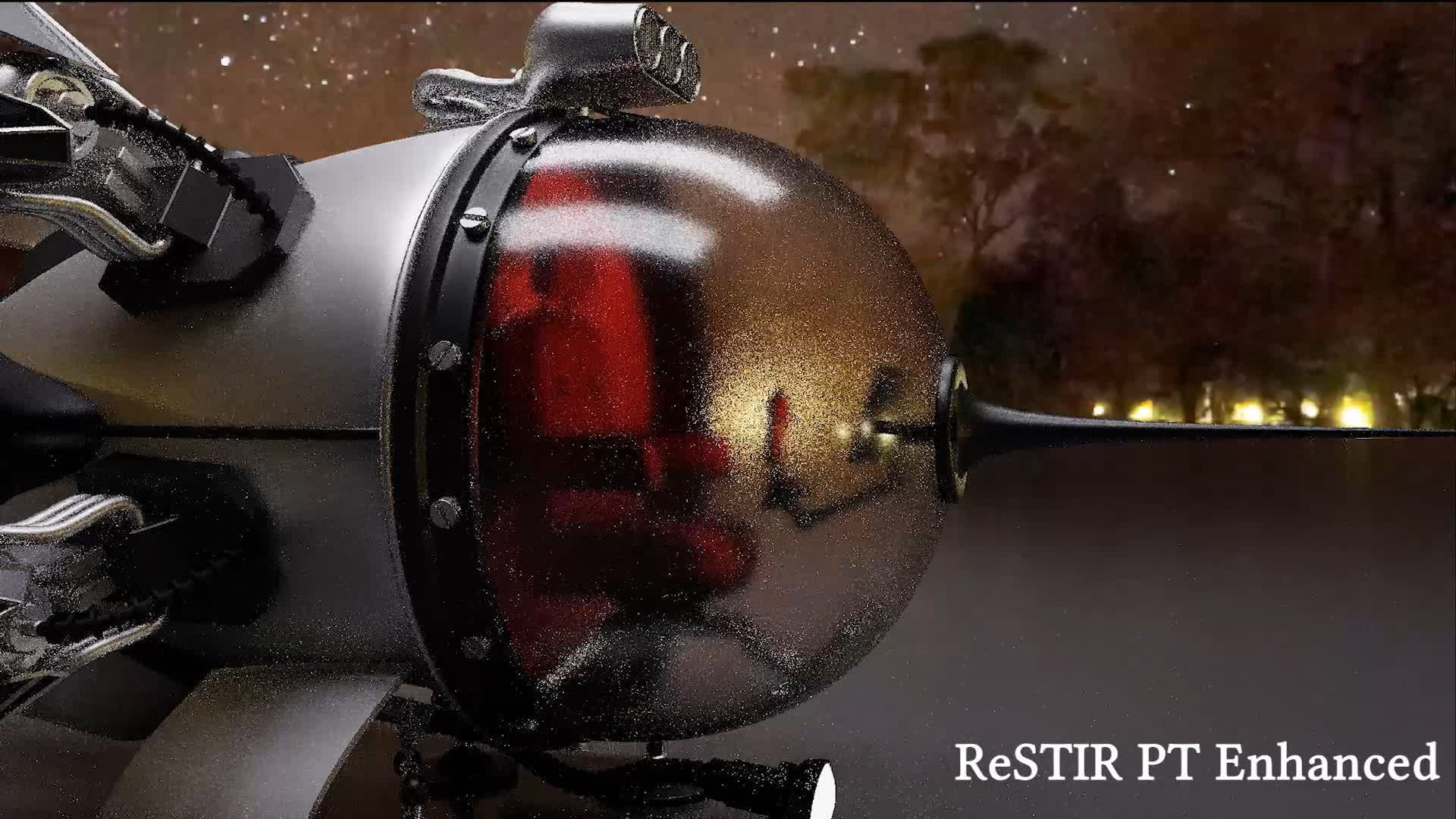
A new research paper from Nvidia describes how an in-development update to ReSTIR (Reservoir Spatiotemporal Importance Resampling) path tracing addresses several of its flaws. While the technology is not quite ready for implementation in commercial games, it could enhance path tracing performance by 100% to 200%.

Nvidia introduced ReSTIR in 2020 to make the then-nascent path tracing more efficient. To calculate lighting for each pixel, the technology saves time by reusing information from neighboring pixels and prior frames. Games such as Black Myth: Wukong and Nvidia's Portal RTX project used ReSTIR for global illumination and shadows.
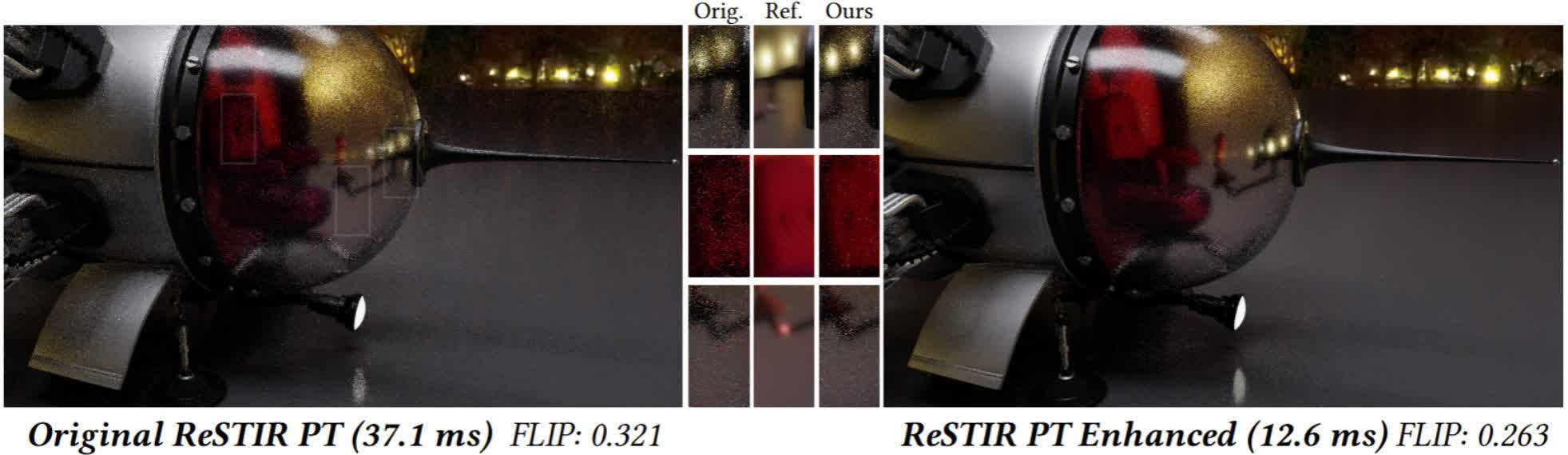
The updated version uses several optimizations to enhance accuracy while completing calculations in a fraction of the time. These include unifying calculations for direct and indirect illumination, reducing divergence when neighboring light paths contact different material types, reducing noise, and much more.

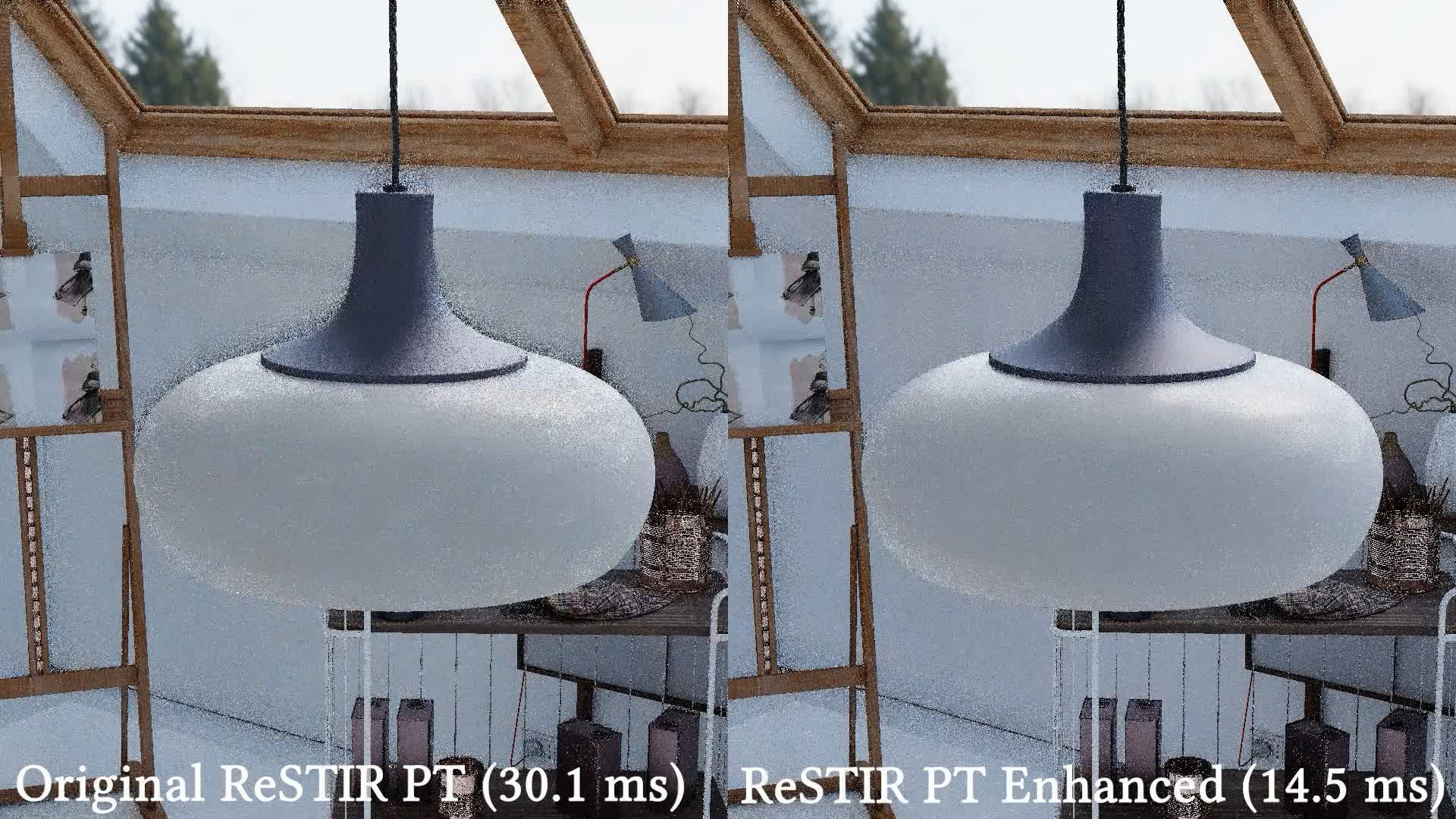
Multiple comparison shots in the attached video show that the update resolves some visual flaws while rendering the scene in half the time or sometimes just over a third. At 1080p, on a system using an RTX 5880 Ada Lovelace workstation GPU and an AMD Ryzen Threadripper Pro 3975WX CPU, average frame times fell from around 35 to 15 milliseconds. The best result cut the render time from 50 to just over 16.1ms, creating a more accurate path-traced image three times as quickly.
ReSTIR improvements are among several changes that Nvidia and Microsoft are introducing to make path tracing less demanding. For example, the latest versions of DirectX and Shader Model standardize Shader Execution Reordering to further reduce divergence. SER has already improved performance by approximately 24% in Indiana Jones and the Great Circle and an incredible 370% in Wukong, and its inclusion in DirectX will help bring the feature to more games and non-Nvidia GPUs.

Meanwhile, Opacity Micromaps enhances performance when shading vegetation and other transparent objects, while improvements to RTX Mega Geometry enable path tracing to interact with large-scale micropolygon scenes. Remedy Entertainment and CD Projekt Red aim to use the enhancements in Control Resonant and The Witcher 4, respectively.

Permalink to story:

 
So it isn’t out yet but it’s already in games. That’s not confusing at all.
I find it infinitely frustrating that they keep making new tech that just eats up compute. It feels like gaming peaked in 2018/19. At first it was Ray tracing, now it's path tracing. Can anyone actually tell the difference between the 2? And if they could, would it be worth paying for? I don't want to pay $2000 every couple years just to play video games.
 
I find it infinitely frustrating that they keep making new tech that just eats up compute. It feels like gaming peaked in 2018/19. At first it was Ray tracing, now it's path tracing. Can anyone actually tell the difference between the 2? And if they could, would it be worth paying for? I don't want to pay $2000 every couple years just to play video games.
In theory, ray tracing is more realistic. In practice, one has to look closely to see the difference that took up disproportionate compute. A more "bang for the watt" approach is called for. Nor do I think rasterised lighting has been exhausted: over twenty years ago, we had Doom 3's real-time per-pixel lighting which, despite the ugly square faces, stands respectably next to the lighting of today, with allowances. How did Carmack achieve that with GeForce FX and R300 hardware?
 
So it isn’t out yet but it’s already in games. That’s not confusing at all.
It's not confusing. It's in tech demos made internallly by nvidia, and occasionally, in experimental builds on a few major games, made in collaboration between the game studios and nvidia. That's how it works.
 
I don't want to pay $2000 every couple years just to play video games.

Most of the gains of moving up to high/ultra/max detail settings are imperceptible unless you're standing still or counting pixels. $300-500 on a GPU upgrade every 4-6 years will satisfy 90% of the minority of the userbase that isn't already mostly playing Steam top 100 games (optimized for 60+FPS on an x60 in the majority of worst cases) in the first place. The only gamers who upgrade their x90 every 2 years have more money than brains.

Now, if the argument is that x60/70 class GPUs will suddenly jump to $2000, then...
 
I find it infinitely frustrating that they keep making new tech that just eats up compute. It feels like gaming peaked in 2018/19. At first it was Ray tracing, now it's path tracing. Can anyone actually tell the difference between the 2? And if they could, would it be worth paying for? I don't want to pay $2000 every couple years just to play video games.
I can tell the difference.

Path tracing is true ray tracing. "Ray tracing" as used in gaming industry is limited and partial ray tracing.

None of this is new tech. It's just tech that was WAY beyond what consumer GPUs could do when Nvidia decided to launch it to one up AMD. So they called it ray tracing while actually only doing partial tracing of some of the rays.

This story is about how they are using less compute to do a better job so everyone should like that. We're not going to see 2-3X RT/Path performance from silicon any time soon. This is the optimization people are always screaming about.

And you can always turn it off if you don't want it.
 
I find it infinitely frustrating that they keep making new tech that just eats up compute. It feels like gaming peaked in 2018/19. At first it was Ray tracing, now it's path tracing. Can anyone actually tell the difference between the 2? And if they could, would it be worth paying for? I don't want to pay $2000 every couple years just to play video games.
There are tens of thousands of sprite-based 2D games you haven't yet played. No law requires you to play the very latest games, at the highest quality settings and/or resolutions.

I hate to stereotype a class of people as large as avid videogamers, but the class as a whole does seem to be far more whiny and entitled than is either normal or justified. NVidia and the rest of the hardware industry doesn't force studios to make more compute-intensive games; they merely make those tools available. And trust me -- each and every software developer does the absolute utmost to pitch its products at the very peak of the customer-interest curve. Sexy graphics sell: that's a sad fact of life ... but it's still a fact.
 
I can tell the difference.

Path tracing is true ray tracing. "Ray tracing" as used in gaming industry is limited and partial ray tracing.

None of this is new tech. It's just tech that was WAY beyond what consumer GPUs could do when Nvidia decided to launch it to one up AMD. So they called it ray tracing while actually only doing partial tracing of some of the rays.

This story is about how they are using less compute to do a better job so everyone should like that. We're not going to see 2-3X RT/Path performance from silicon any time soon. This is the optimization people are always screaming about.

And you can always turn it off if you don't want it.

- The path tracing in real-time software isn't "true" raytracing either. It's just a layer cake of marketing BS.

Remember when "RTX" first debuted it had to sell itself as "real" ray-tracing vs Raster lighting also and now that AMD is roughly equivalent RT performance there we need a new "real" ray-tracing.

And on and on and on.

This article literally goes into some of (but not all) the shortcuts and tricks Nvidia/AMD etc are implementing to give us an image that is nearly indistinguishable from a fully ray traced image without actually having to do the brute forced work.

Its just a different kind of hacked together lighting model that produces results closer to what we'd expect from photorealistic lighting.
 
Please don't give them any ideas.......
I mean, I literally sold my 3070 for 1600 euro. And now I got a 5080 with that pandemic free money lol. 2000 ain't too far off if some big disster happen haha. Heck, 5080 is already going close to 2000 bucks without any huge world issues/shortages. Its not a huge leap to say RTX 5070 can go up to 2K bukz. We are not that far off.
 
- The path tracing in real-time software isn't "true" raytracing either. It's just a layer cake of marketing BS.

Remember when "RTX" first debuted it had to sell itself as "real" ray-tracing vs Raster lighting also and now that AMD is roughly equivalent RT performance there we need a new "real" ray-tracing.

And on and on and on.

This article literally goes into some of (but not all) the shortcuts and tricks Nvidia/AMD etc are implementing to give us an image that is nearly indistinguishable from a fully ray traced image without actually having to do the brute forced work.

Its just a different kind of hacked together lighting model that produces results closer to what we'd expect from photorealistic lighting.

It’s far less hacked together than rasterization. It’s called progress.
 
It’s far less hacked together than rasterization. It’s called progress.
Well, for instance, in cyberpunk, only raster has dynamic shadows for palms and trees.. while PT looks so drastically different it makes OG raytracing indistinguishable from raster. That both make first RT implementation “hacked”
 
It’s far less hacked together than rasterization. It’s called progress.

- Just pointing out that it is not "real" ray-tracing and still employs a huge number of shortcuts to be viable in real-time, if for no other reason than to prevent people from being confused when NV announces rAI-Tracing or whatever the next "real" RT tech is with the 6xxx series.

Eventually we'll just work our way back to Raster. It looks 99.9% like Ray tracing but with 1000% more performance! :joy:
 
Back