Nvidia shows neural compression can cut VRAM usage from 6.5GB to 970MB

Skye Jacobs

Posts: 2,010   +58
Staff
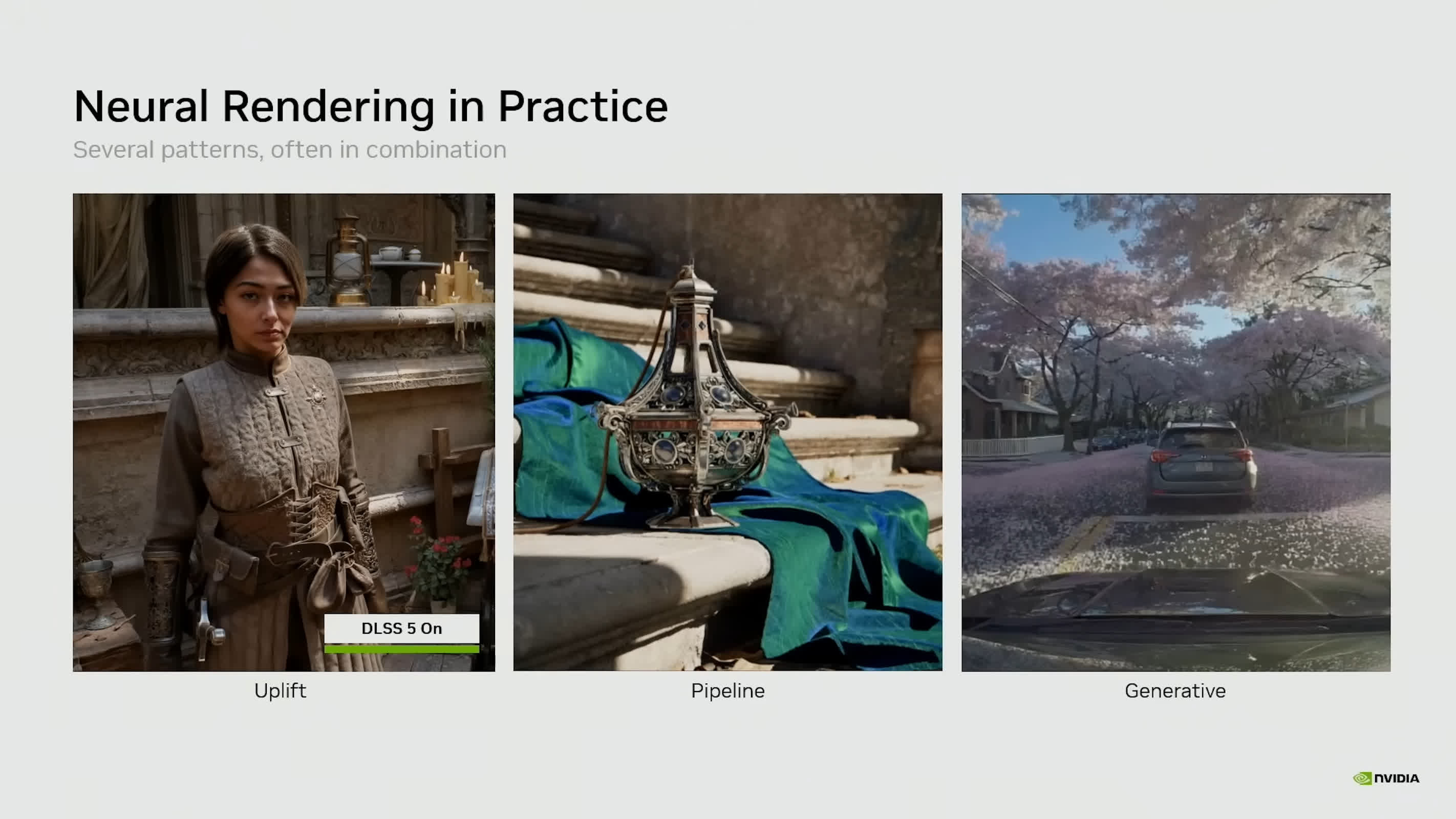
Forward-looking: Nvidia's latest push into neural rendering is not just unfolding on keynote stages, but also in follow-up technical briefings. A recent video released days after the DLSS 5 presentation takes a closer look at how these systems are intended to work inside real engines. The breakdown points to a quieter but potentially more consequential shift for developers: moving texture and material data into compact neural representations to reduce memory use and improve performance, rather than relying primarily on an end-of-pipeline upscaler.
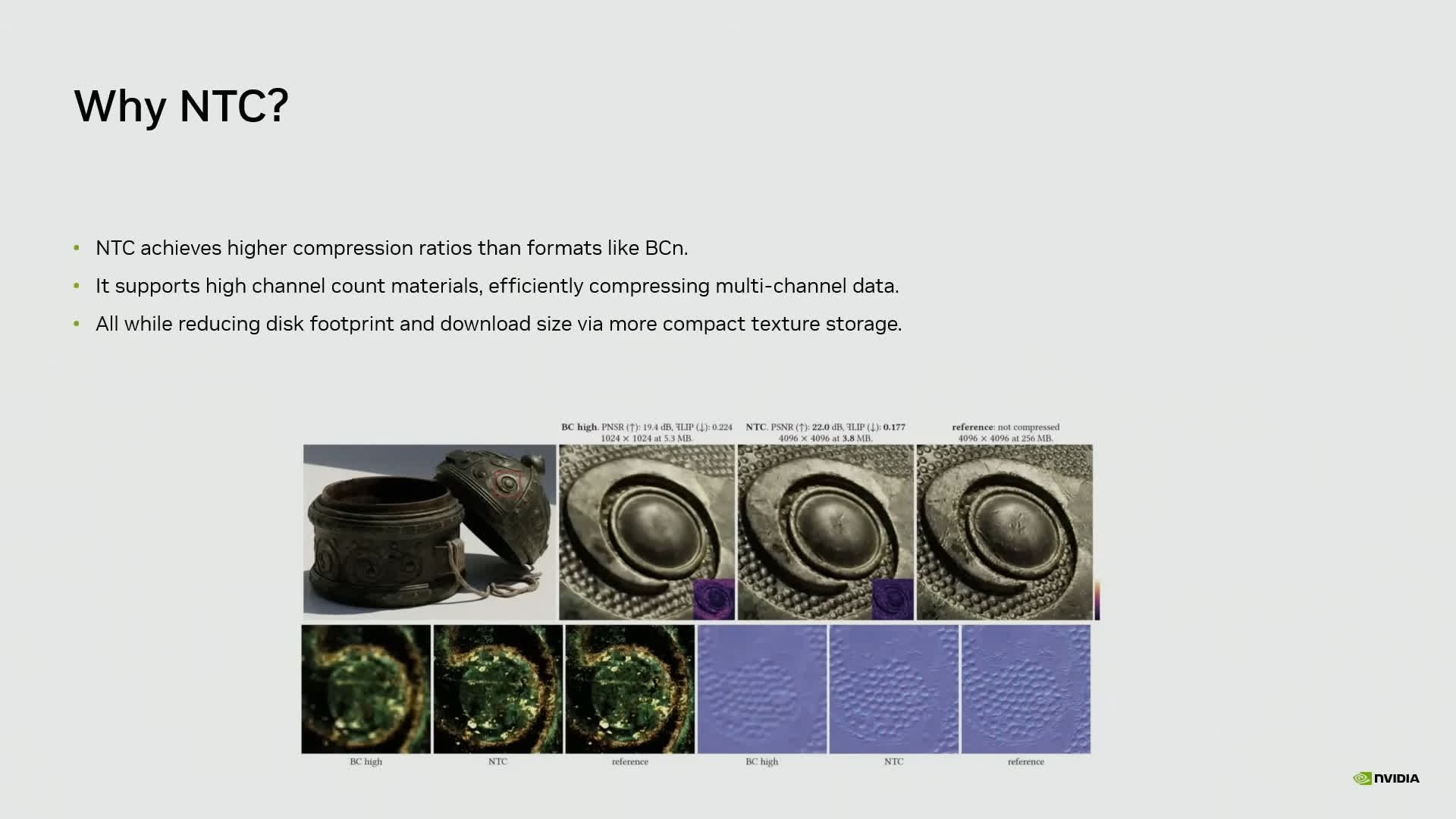
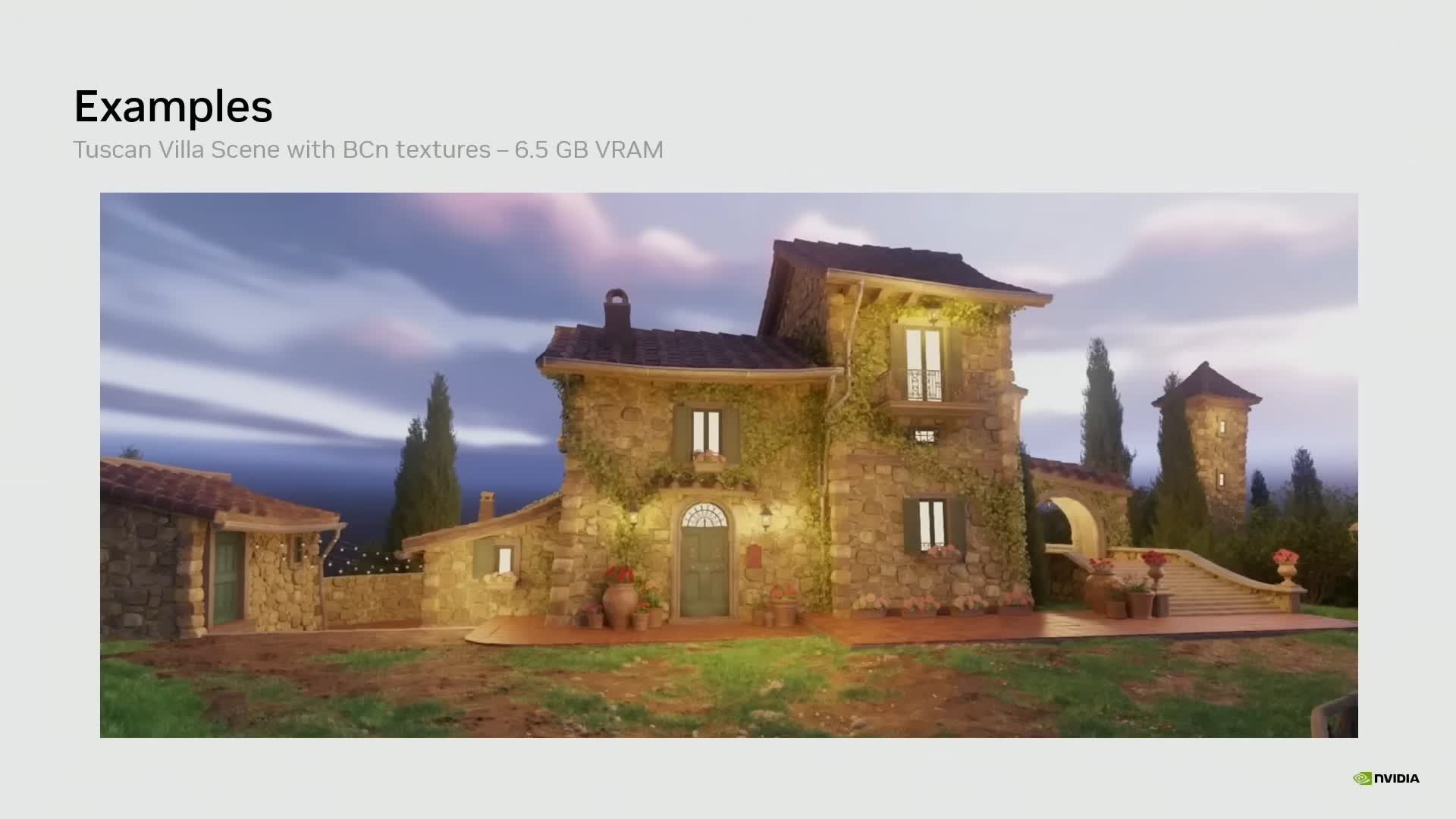
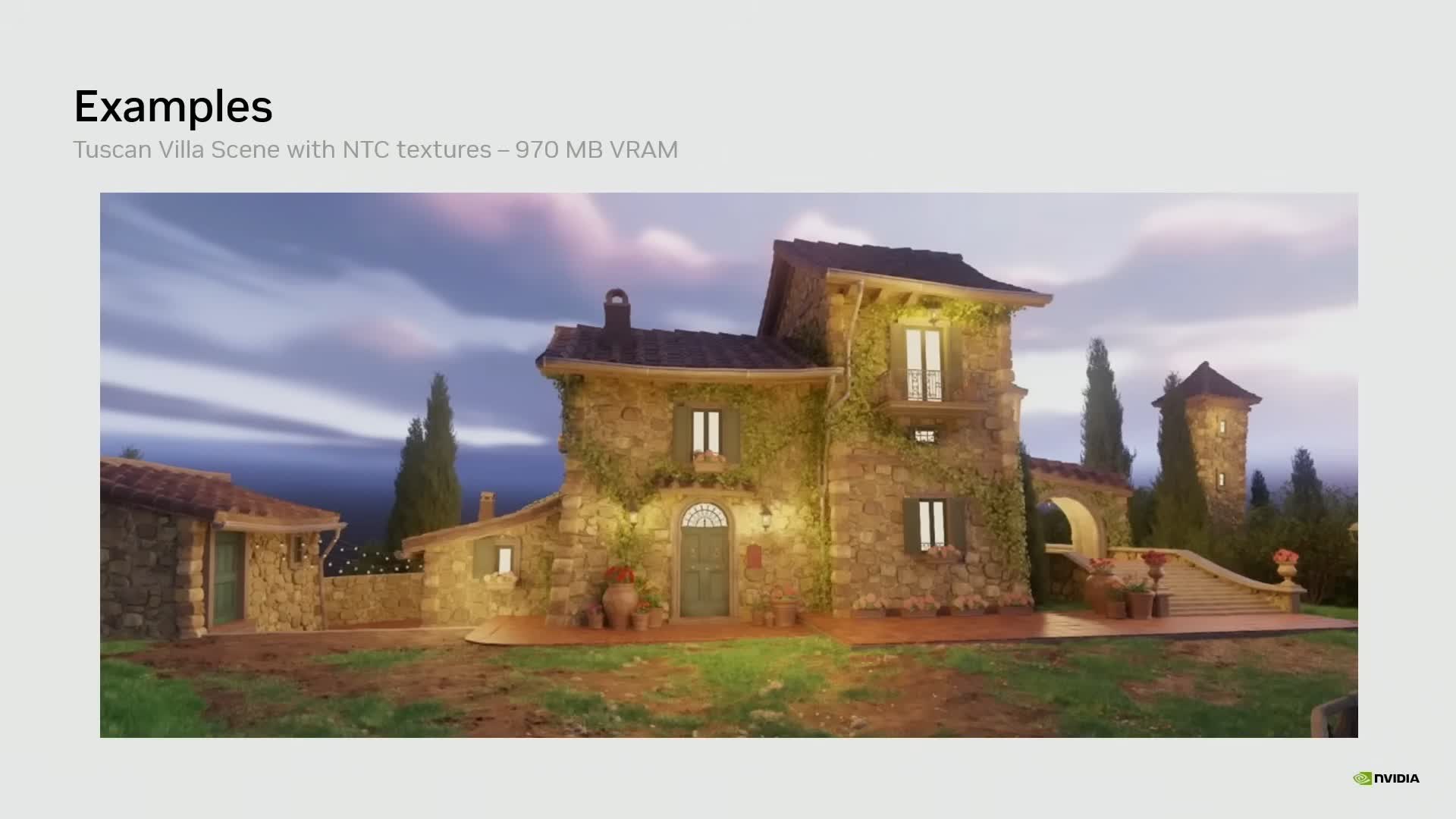
Consider Nvidia's work on Neural Texture Compression (NTC). In its "Tuscan Wheels" demo, the company showed VRAM usage dropping from roughly 6.5GB with traditional BCN-compressed textures to 970MB using NTC, while keeping image quality close to the original.
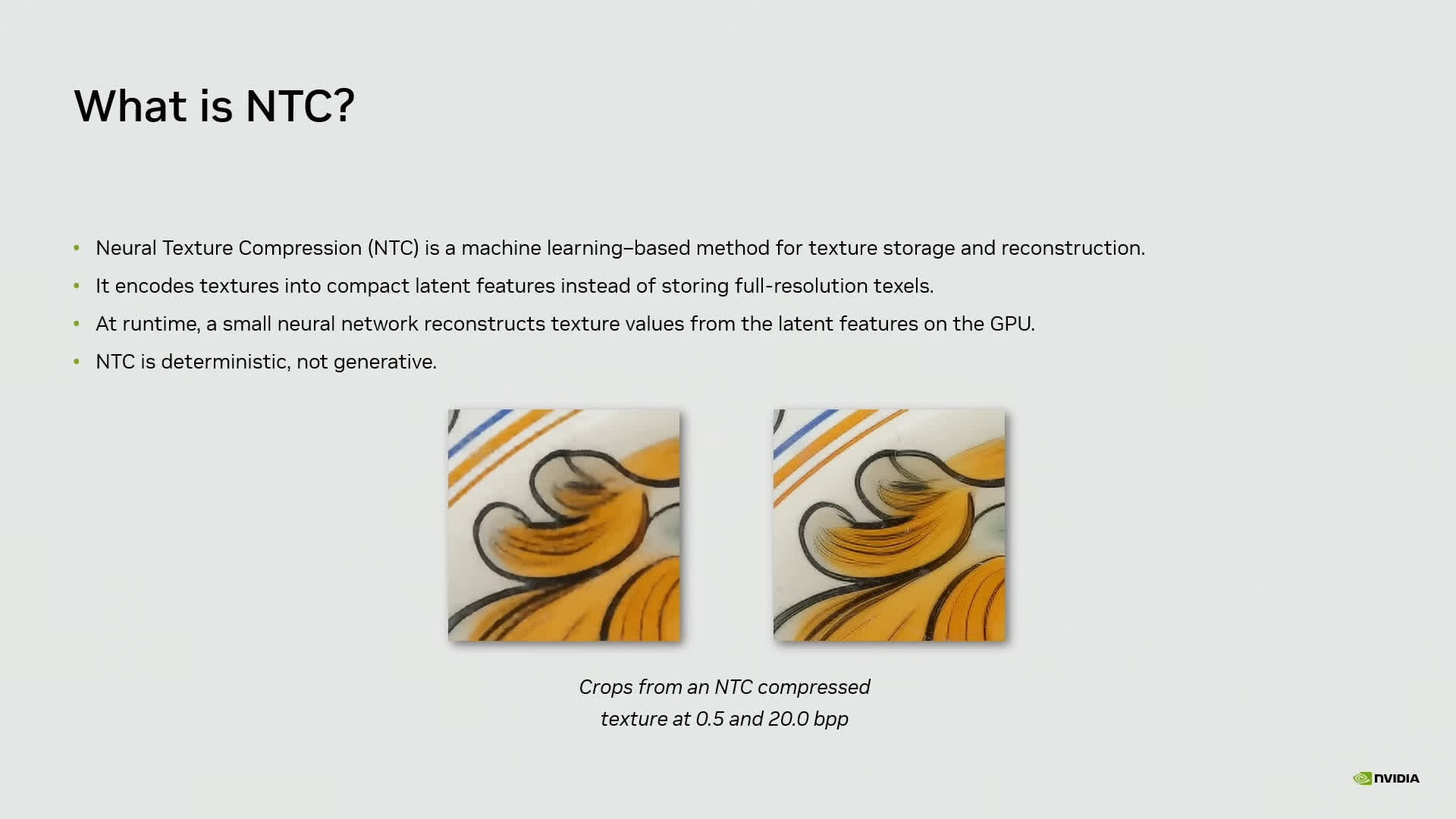
At that same 970MB memory budget, NTC preserved more detail than standard block compression. The result is smaller game installs, lighter patches, reduced download bandwidth, and more headroom for higher-quality assets on a given GPU.

For studios dealing with texture bloat, that kind of reduction offers a practical advantage in a way that another layer of image reconstruction does not.

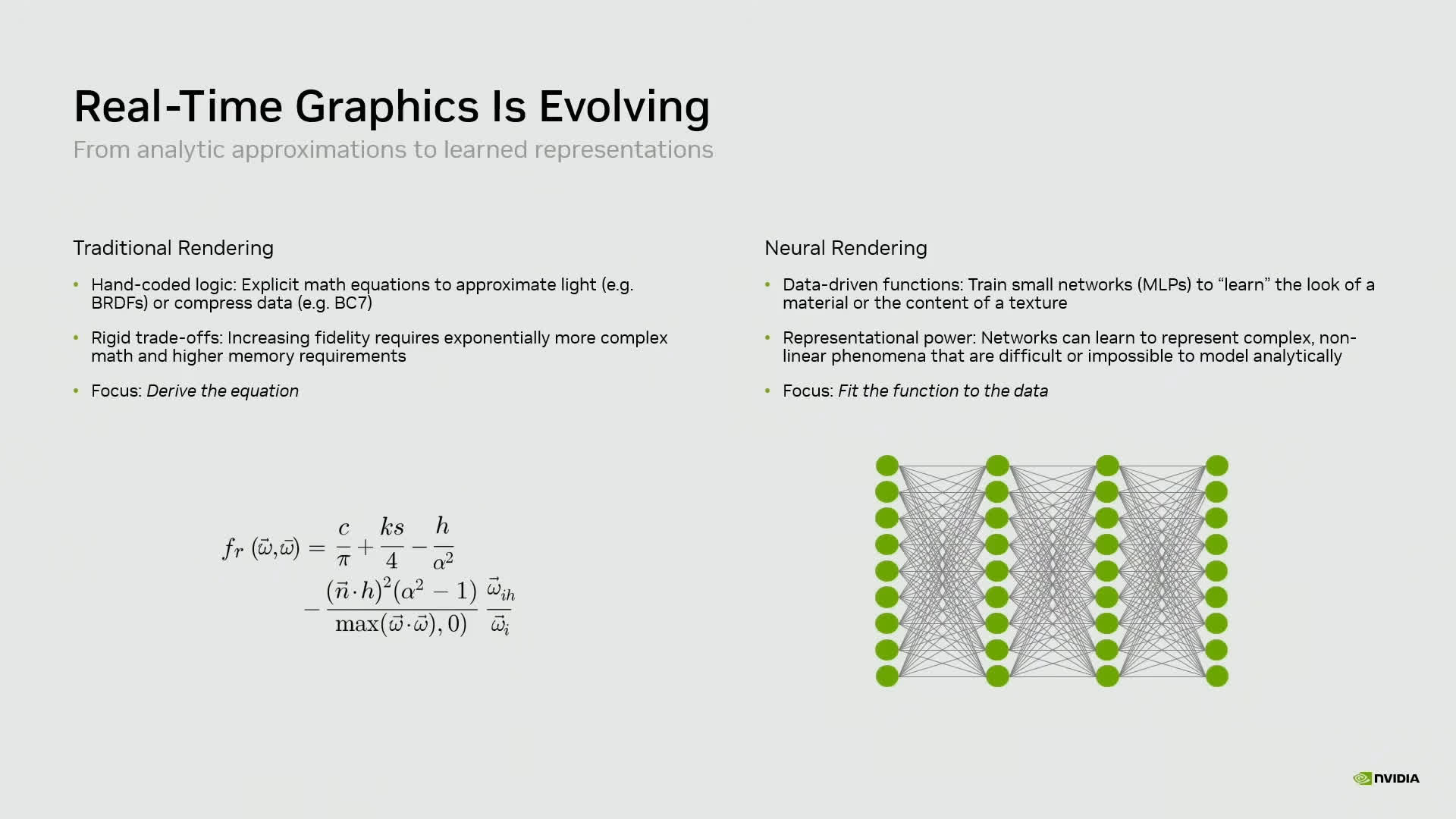
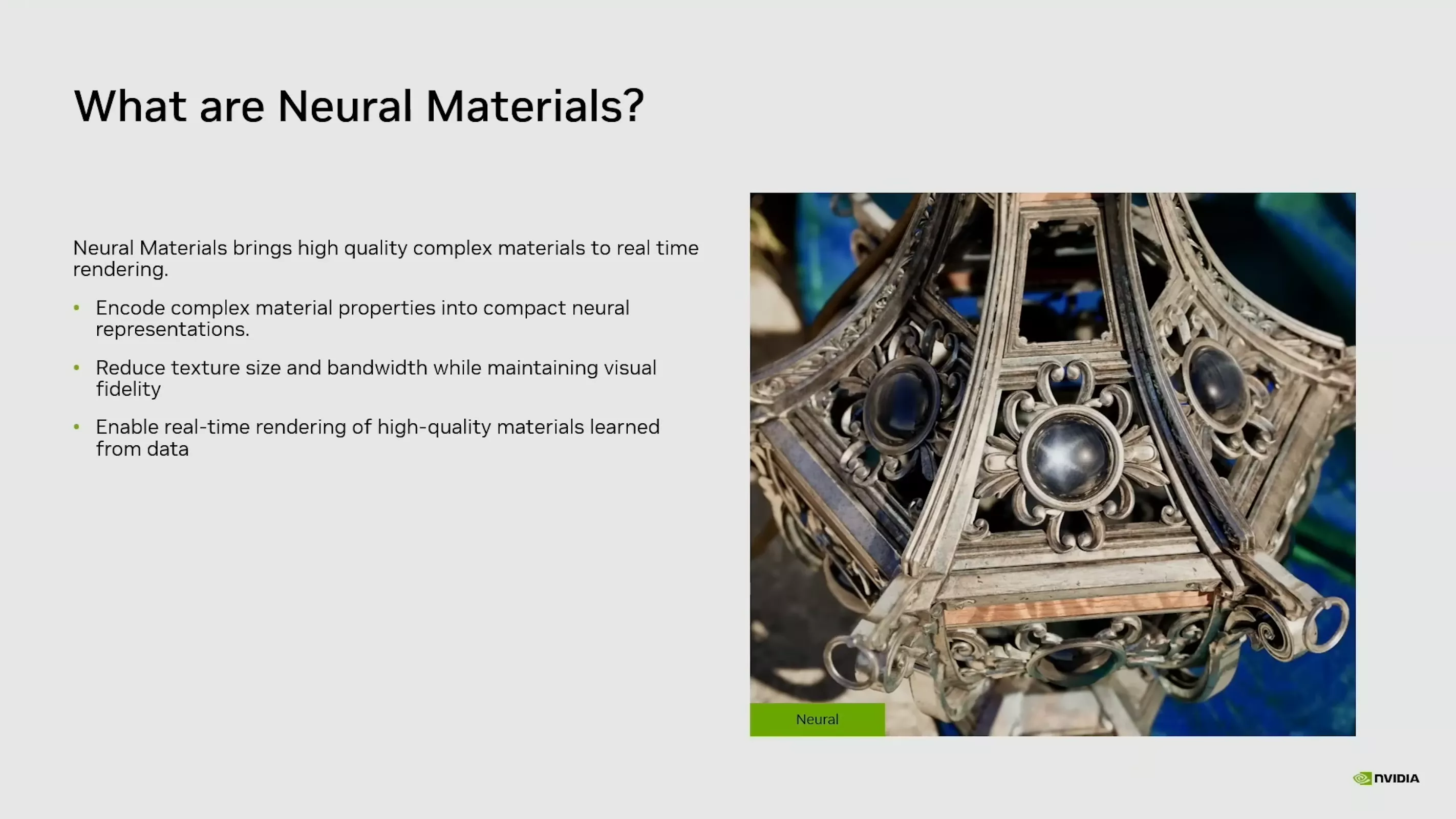
Neural Materials (NM) applies a similar idea within the shading pipeline. Instead of storing a large set of texture channels and running heavier BRDF (Bidirectional Reflectance Distribution Function) math, Nvidia encodes material behavior into a compact latent representation that a small neural network decodes at render time.

In one example, a material setup with 19 channels was reduced to eight, with Nvidia reporting 1.4x to 7.7x faster 1080p render times in that scene. The company frames this work less as a way to invent new visuals and more as a method for storing and evaluating existing material data more efficiently, allowing for greater scene complexity within the same hardware budget.

These techniques are part of a broader "neural rendering" roadmap that extends beyond DLSS 5. While DLSS 5 operates at the end of the pipeline, applying machine learning to the final image, Nvidia's more recent technical discussion focuses on embedding smaller neural networks deeper inside the engine.

The goal is to assign compact models to specific tasks such as decoding textures, evaluating materials, and reducing memory traffic, rather than relying on a single, monolithic filter at the end of the frame.
This approach also reflects a growing divide since DLSS 5 was introduced. Some developers and players remain wary of AI-driven reconstruction potentially overriding artistic intent, and would prefer AI to be used for optimization, image quality, and performance without reshaping a game's visual identity.

With its emphasis on NTC and NM, Nvidia is making the case that AI could also provide meaningful advances for games from invisible parts of the pipeline: systems that shrink assets, accelerate shading, and free up resources, while leaving the look of a game in the hands of its creators.

Permalink to story:

 
So, now Nvidia will be able to sell midrange gaming cards with 2GB vram (4GB on the xx60Ti) without lowering the prices, great for them!

Even in these cherry-picked and very grainy screenshots, there are some noticeable downgrades in the Tuscan Villa when you look up close. Especially the ground. The NTC version makes the ground look like it's using 2x or 4x AF instead of 8x or 16x AF.
 
And I am guessing the processing of the new technology would lower the FPS of the card.
I would be willing to trade off to increase my minimum fps. Its really bad in some games looking at you The Last of Us.

I have no problem lowering some settings to keep a minimum 60/fps. But when its due to vram, there is sometimes nothing you can do.
 
Pretty sure I made a statement quite some time ago that Nvidia will be selling tiny vram cards again. Saw this coming from miles away, its the perfect way to segment the market.
Instead of giving more vram on consumer cards making them more useful for other uses they use some latest tech Nvidia exclusive nonsense that's yet another visual downgrade.
They lower their costs, segment the market and the fanboys will gobble it up.

Let us have some fake vram (yay compression quality loss) on top of a fake resolution and fake frames and then in a few years we can wonder why old games looked so crisp compared to the layers of fakery. All whilst paying $1000 for a $200 product.
 
Last edited:
Yep, Nvidia is preparing the consumers and gamers for their brand-new 1 GB VRAM GPUs, starting at the amazing low price of $450!! (Just lower your monitor's res to 180x180 and you're golden!!)
And one further advantage: The don't go up in flames (crossing fingers)!!

No pre-ordering yet?? Maybe next week.
 
And just like on TPU everyone is busy cryposting about nvidia selling them 1GB GPUs again instead of discussing the new tech. Y'all need to go touch grass.
Would be pretty sweet for my good ol 8gb 3060ti that seems to have enough horsepower for what I need but sees Vram bottlenecks.

But the new techs are never given to their older products.
DLSS 4.5 works on RTX 2000 series cards.

Did you confuse AMD and nVidia here? If the workload works on older tensor cores there's no indication it will be limited to blackwell.
 
And just like on TPU everyone is busy cryposting about nvidia selling them 1GB GPUs again instead of discussing the new tech. Y'all need to go touch grass.
Ah yes, the same site where the owner decided it was a great idea to use AMD as the butt of an April fools "joke" with no hint it was really a joke. Totally not biased there. At least the "AMD buys Intel" headline here was clearly fake and a bit amusing given how impossible it would be given Intel is taking govt funding.
Nvidia probably won't sell 1gb gpus again, but they won't be giving you any more vram.
Nvidia loves to create problems and then wants to sell you again on the solution, case in point, ray tracing, which years later is only feasible on the highest end cards, so they want to sell you on proprietary upscaling methods. And now since vram is too expensive due to Nvidia also being the main factor behind the AI bubble, the next thing is vram compression.
8gb will probably still be the mainstream while the jacket man can charge double for the 12gb xx70 tier with enough gaslighting to convince loyal consumers it'll get a bajillion fps with upscaling and fake frames.
DLSS 4.5 works on RTX 2000 series cards.

Did you confuse AMD and nVidia here? If the workload works on older tensor cores there's no indication it will be limited to blackwell.
DLSS 4.5 includes MFG 6X and dynamic multi frame gen, which doesn't work on anything but the latest cards, but as always double standards are allowed for Nvidia. If this feature only works on the 50 series, the influencers and team green apologists will defend it because the jacket man said it can't work on older cards.
 
Last edited:
In time, when they feed into these neural pipelines the geometry and the textures for the faces, walls etc etc they wish to render I expect it will be a really valid system and produce some amazing results. But for now when it looks at essentially 2D images and just AI smears them it's meaningless pap.
 
DLSS 4.5 works on RTX 2000 series cards. Did you confuse AMD and nVidia here?
Oh, you mean AMD, the company that made it so my RTX 3060 had access to FSR frame generation, while Nvidia themselves artificially limit it to the 4000/5000 series cards?

It speaks volumes that you're here touting DLSS 4.5 as a positive (when it's functionally useless on older cards due to the performance cost, which makes it not worth using over native/DLAA with older presets), and yet conveniently ignoring the very intentional choice Nvidia made to withhold frame generation from older cards.
 
Doesn't AMD have its own neural compression tech?

Anyway, the villa screenshots look terrible, its like something made with unreal 1. 970mb wasted.
A better example is needed.


Why so many web sites publish this already year old article of nVidia PR?

Where is that one nVidia tech demo (what its name?) game?
What generation of cards will it need to do all the woodoo?
Will it be released before next gen of cards?

Any other game using NTC?
 
Excerpt from nVidia HQ
- Memory prices are going up! Customers have to pay more!
- Not our problem
- Sir, it's starting to affect sales
- Bring forth the neural compression.
 
Back