AMD CPUs hit another Steam survey record as Intel gap shrinks to all-time low

midian182

Posts: 11,745   +178
Staff member
The takeaway: Valve has just released the results of the Steam survey, two days later than usual. The biggest takeaway from May's findings is that AMD CPUs have once again reached an all-time high user share as Intel's falls, making the gap between the two platforms smaller than ever.
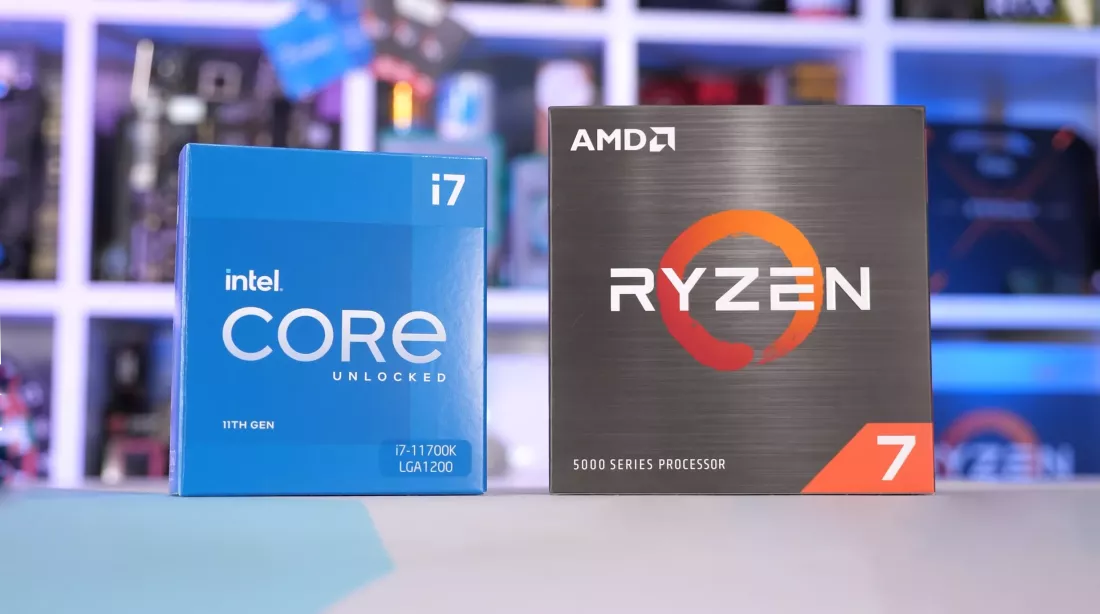
Thanks to a 0.79% increase last month, almost 45% of Steam survey participants now use AMD processors. With Intel's share falling by the same amount, the gap between to the two rivals is just under 10%.

Barring a few anomalous months, including one in February, Team Red has been consistently gaining CPU users for well over a year now. AMD's X3D CPUs have long been driving the company's sales among gamers thanks to their excellent gaming performance, and while March's Core Ultra 200 Plus chips have been some of Intel's best-received in years, they haven't slowed the company's decline in the survey.

AMD could further improve its fortunes in the chart following the announcement at Computex that it is bringing back the Ryzen 7 5800X3D for AM4 users and launching a cheaper Ryzen 7 7700X3D for AM5 on July 16. The company also said it was extending AM5 support through to 2029.

Moving on to the GPU chart, the six-year-old RTX 3060 remains at the top despite a slight fall in user share. It could cement its position at number one following news that the Ampere-era card has been re-released in China and, as rumors suggest, will soon arrive in other markets.
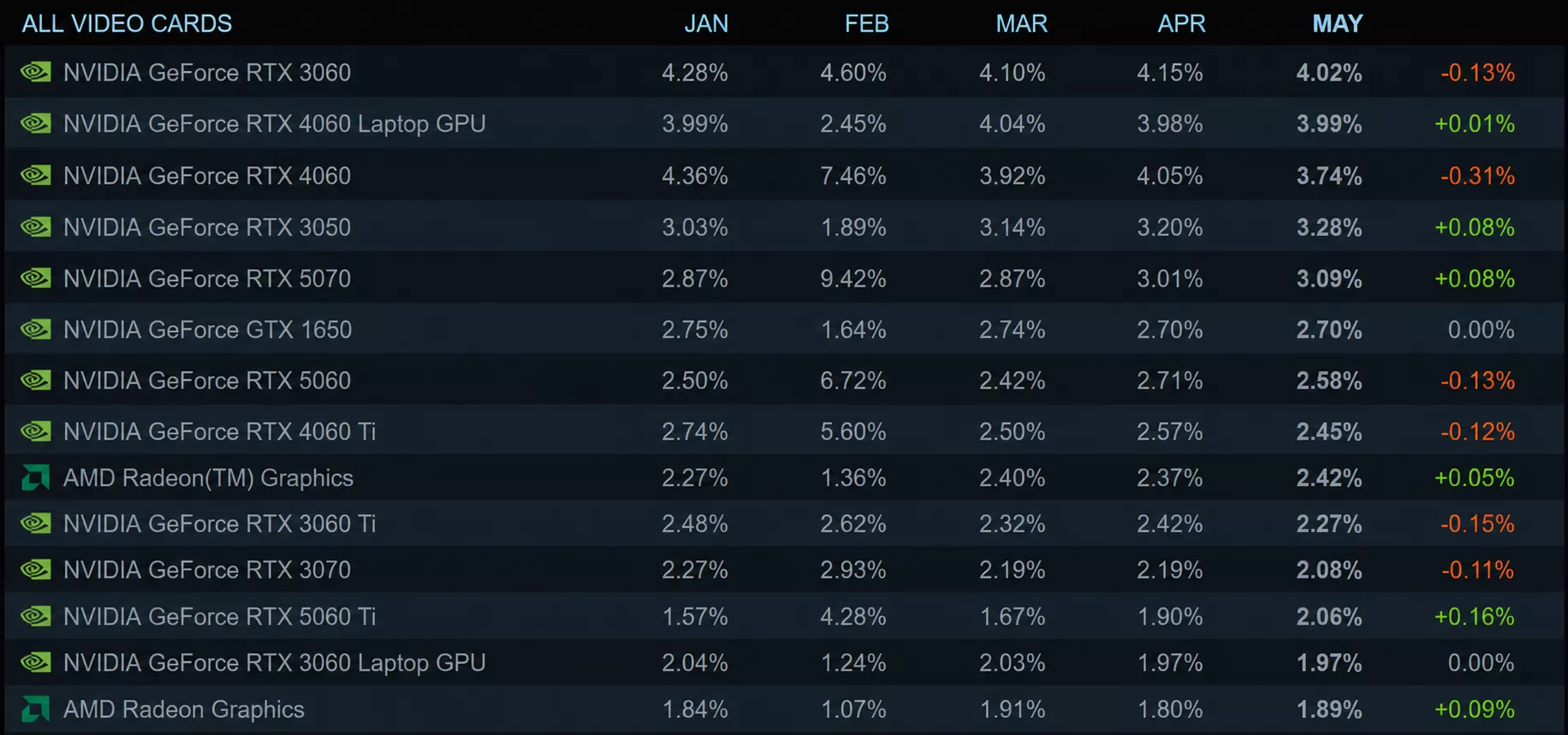
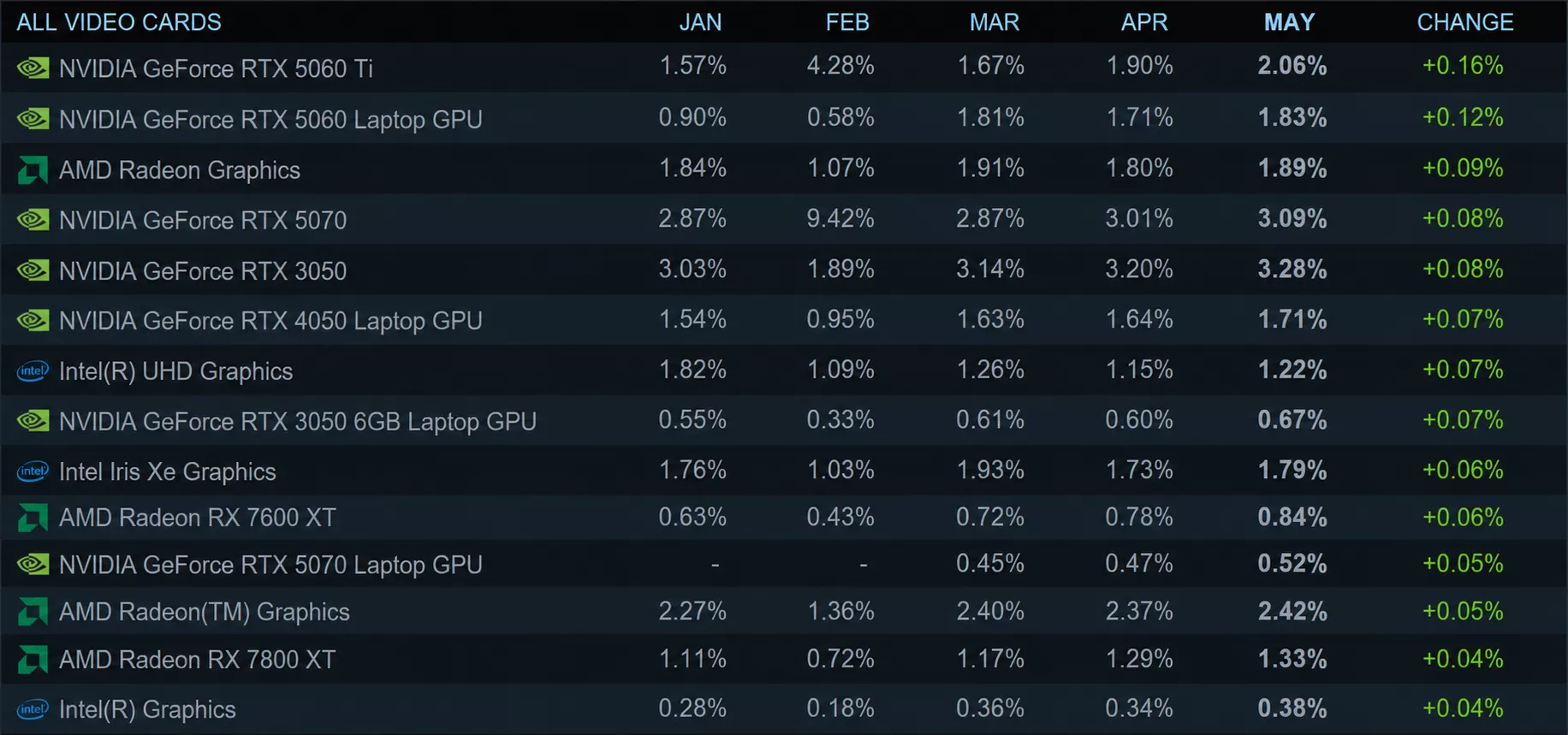
Looking at the month's best performers, the RTX 5060 Ti saw the largest gains (0.16%), followed by the RTX 5060 laptop. The RTX 3050 and its 6GB laptop variant were also in the top ten, which could be a sign of consumers turning to older, second-hand cards as new models become increasingly expensive.
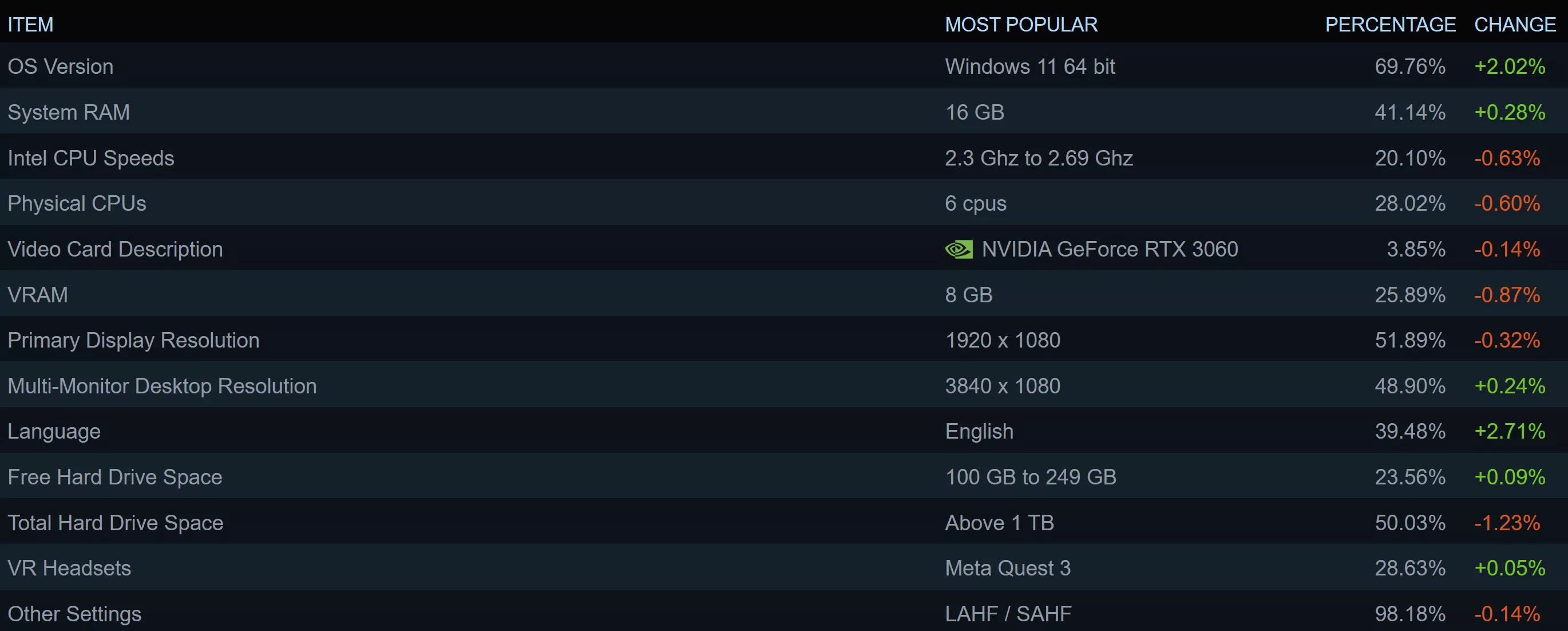
Speaking of RAMageddon, the number of participants with 16GB of system memory (the most popular amount) increased in May as those with 32GB fell. Elsewhere, 8GB is still the most common amount of VRAM, though it did fall slightly as 16GB increased.
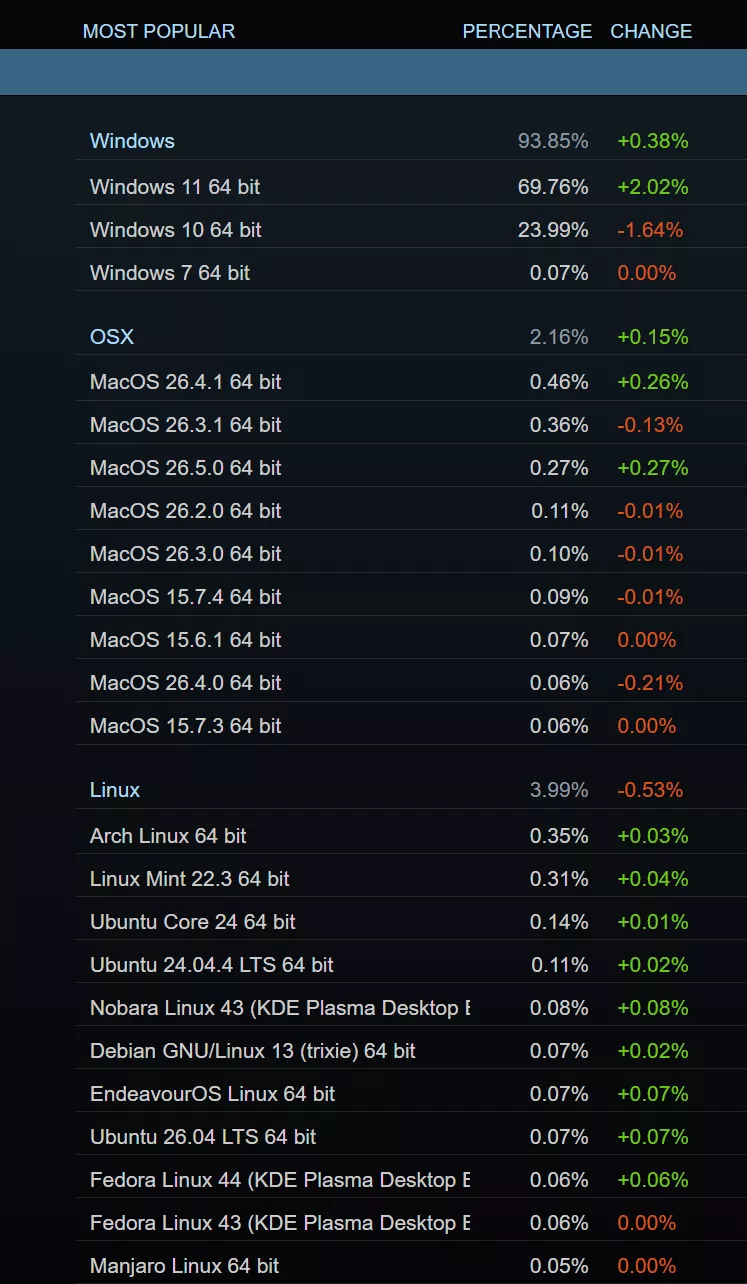
Finally, there's the OS section. Windows 11's share keeps increasing, with 7 out of 10 participants now using Microsoft's latest operating system. Windows 10 is declining, but it still holds close to a quarter of the total share. Linux, meanwhile, was down slightly to just under 4%, even though almost all the distros saw their individual shares increase last month. This is the second month in a row that Linux's user share has declined, but that could have been influenced by the now-addressed Steam Deck shortages.
Permalink to story:

 
The 5800X3d is a wonderful product, I'm glad they're making more of them because they became quite expensive for awhile. I'm curious why adding cache makes them better at gaming, but it's nice that it is as simple as just adding cache. While Intel is better at most productivity applications, that's hardly why people get excited about hardware.

With ramagedon currently going on, re-releasing the 5800x3d could boost sales and keep gaming going. I've heard people calling AM4 a dead platform because you can't upgrade, but I also see lots of people talking about how the x3d has enough performance that they aren't in a rush to upgrade.
 
With ramagedon currently going on, ...
Where I live, ramageddon has definitely hit local AMD sales far worse than Intel. Intel parts are suddenly filing 5 of the top 10 sales slots. The diehard Intel fans are still buying it seems. Probably non-gaming purchases but it'll still be interesting to see if there is an impact on Steam survey over the next few years.
 
Intel's problem, as that happens with a LOT of companies once they get on top, is they STOP innovating!
They release something new, which is similar to last year's thing, but not really anything innovative.
That and stockholder/CEO's don't want to spend the money. Why bother? We're already on top.
The American auto industry is a good example. They were the kings from after WW2 until the "energy crisis". The Japanese came in and took over with their inexpensive higher MPG vehicles. The American auto industry was building land yachts at the time. By the time they caught up in the 80's, Japan had already taken a HUGE chunk out of the American auto industry and still do. Heck, drive around today and you will see mostly Toyota, Honda along with Hyundai and others. Plus, the failure rate on American vehicles is pretty high.
Intel has to spend the money on research to get back in the ballgame or they will go the way of The American auto industry, Sears, Xerox, Motorola, and many others who were top in their markets.
 
The 5800X3d is a wonderful product, I'm glad they're making more of them because they became quite expensive for awhile. I'm curious why adding cache makes them better at gaming, but it's nice that it is as simple as just adding cache. While Intel is better at most productivity applications, that's hardly why people get excited about hardware.

With ramagedon currently going on, re-releasing the 5800x3d could boost sales and keep gaming going. I've heard people calling AM4 a dead platform because you can't upgrade, but I also see lots of people talking about how the x3d has enough performance that they aren't in a rush to upgrade.
Productivity is usually about raw power so the many smaller cores Intel has can help there and also why the 16 core AMD CPUs also do well. And most tasks don't need to access the RAM frequently.

Gaming is about delivering frames faster by the GPU so the CPU must give the relevant data as fast as it can as to not keep the GPU waiting and more cores don't generally help that much (generally hitting a limit set by the game engine and graphics API used).

The extra cache reduces the the time it takes the CPU to send and receive information from system memory (from RAM and sometimes directly from VRAM) which is a huge bottleneck. Instead of waiting for 5 packets of info, each with its delay overhead, the CPU can receive 1 single much larger packet and do tasks in bulk without having to wait as long.

You do see the extra cache also help in some productivity applications like Photoshop where the app is more complex and needs to access the RAM often.

TL;DR the extra cache helps the CPU keep being fed with data without having to wait as much and this helps latency sensitive applications like games.
 
Productivity is usually about raw power so the many smaller cores Intel has can help there and also why the 16 core AMD CPUs also do well. And most tasks don't need to access the RAM frequently.

Gaming is about delivering frames faster by the GPU so the CPU must give the relevant data as fast as it can as to not keep the GPU waiting and more cores don't generally help that much (generally hitting a limit set by the game engine and graphics API used).

The extra cache reduces the the time it takes the CPU to send and receive information from system memory (from RAM and sometimes directly from VRAM) which is a huge bottleneck. Instead of waiting for 5 packets of info, each with its delay overhead, the CPU can receive 1 single much larger packet and do tasks in bulk without having to wait as long.

You do see the extra cache also help in some productivity applications like Photoshop where the app is more complex and needs to access the RAM often.

TL;DR the extra cache helps the CPU keep being fed with data without having to wait as much and this helps latency sensitive applications like games.
Thanks for the info
 
Linux down 0.53% yet people said gamers are fleeing to Linux haha.
Windows with a massive 94% marketshare.

Linux and MacOS is niche for gaming and I don't see this change anytime soon.

People with new(er) hardware, wanting to play the full PC gaming catalog, new games especially, is not running Linux.

I run Linux as 2nd boot option and have a Steam Deck too. Contributed to Linux marketshare as I sent my specs from all devices (2 times on primary PC, Windows + Linux). Meanwhile 99% of my gaming happens on tweaked and debloated Windows 11. Runs great and delivers top notch performance.

Windows gives me far better overall performance and less issues, 9800X3D/4090.
Vastly higher minimum 1% low and avg. fps on Windows. All games work flawless. Multiplayer included.

Running Linux only, on a beefy new PC made for gaming, then you might as well shoot yourself in the foot too. No-one does that in reality.

Game devs and (gaming/consumer) hardware manufacturers have one focus: Windows - If a game works on Linux, great but not guarranteed and in most cases, you won't see better performance either.

Proton comp. layer often eats 5-25% perf on its own. There is exceptions and there is also a few cases where Linux performs better than Windows in very specific cases (hardware and game combination) but overall, Windows is still the far superior platform for gaming with actual support from devs and Microsoft has no reason to be scared, if they fulfill their K2 plan/promise.

Xbox devices in the future is going to be Windows devices. HW Outsourced. Hence why Microsoft bought up many major game devs in the last 5 years.
 
Last edited:
Intel's problem, as that happens with a LOT of companies once they get on top, is they STOP innovating!
They release something new, which is similar to last year's thing, but not really anything innovative.
That and stockholder/CEO's don't want to spend the money. Why bother? We're already on top.
The American auto industry is a good example. They were the kings from after WW2 until the "energy crisis". The Japanese came in and took over with their inexpensive higher MPG vehicles. The American auto industry was building land yachts at the time. By the time they caught up in the 80's, Japan had already taken a HUGE chunk out of the American auto industry and still do. Heck, drive around today and you will see mostly Toyota, Honda along with Hyundai and others. Plus, the failure rate on American vehicles is pretty high.
Intel has to spend the money on research to get back in the ballgame or they will go the way of The American auto industry, Sears, Xerox, Motorola, and many others who were top in their markets.

The real issue with intel was they fabricated their own CPUs and that seems to be more difficult than designing them. They had innovative CPU designs, but their fab couldn't keep up with their designs. However, a lot of people seem to have forgotten about Intel's extreme processors that were innovative, unfortunately they were expensive and out of reach for most buyers. The intel i7-6950X was an innovative product: quad channel memory, 10 core, 20 threads, 4.0ghz in 2016. But at around $1700 at launch, they were out of reach for most DIY PC builders, which is why they didn't get as much attention as their mainstream products.
 
Back