Nvidia's blockbuster quarter eases AI spending fears as data center revenue explodes

midian182

Posts: 11,718   +177
Staff member
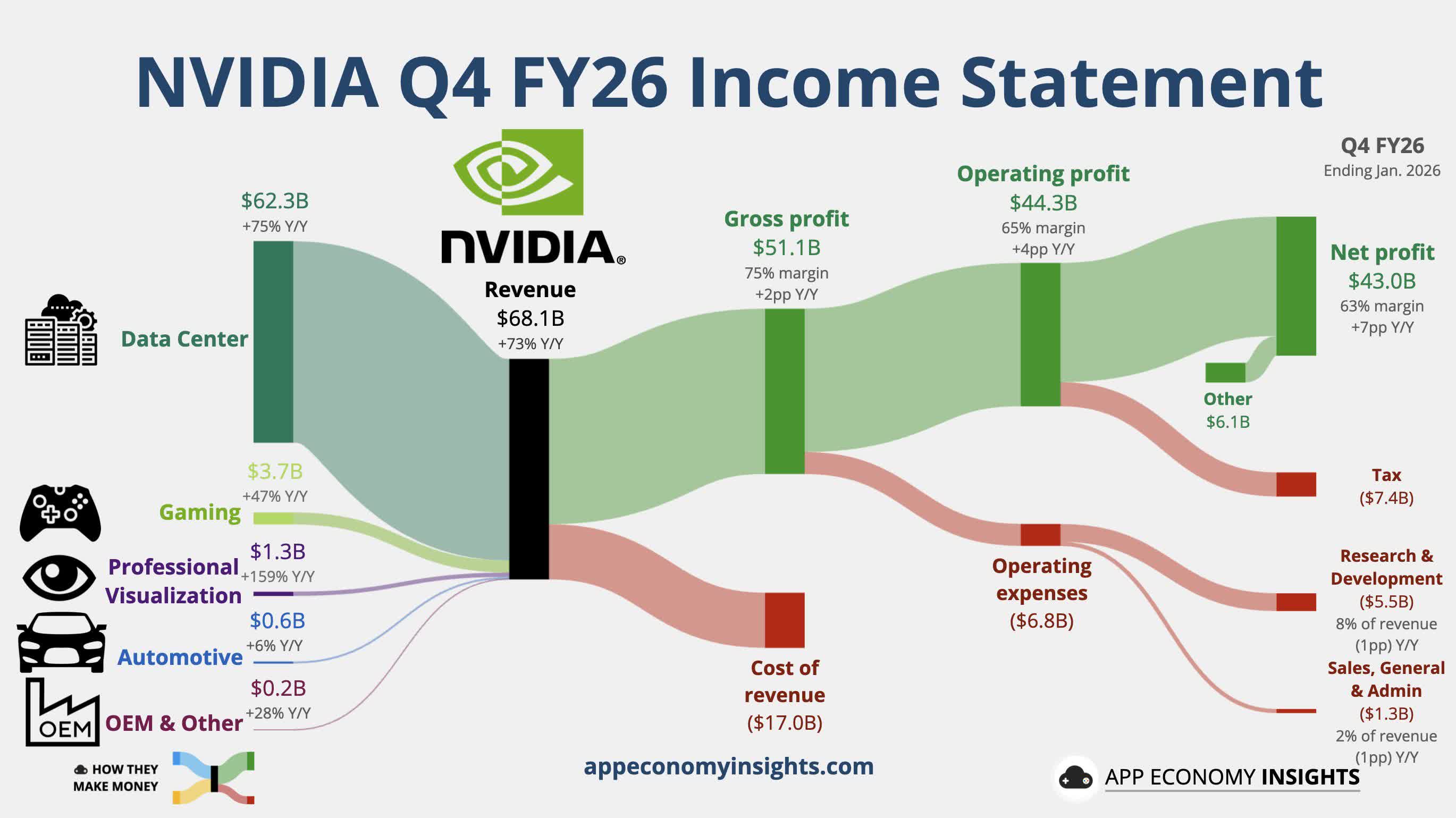
What just happened? Nvidia has alleviated investor concerns over the amount of money companies are spending on AI products. Team Green has reported better-than-expected fiscal fourth-quarter results, with 75% of growth coming from its data center business. Elsewhere, gaming revenue was up 47% to $3.7 billion, though Nvidia admitted it expects supply constraints to continue.
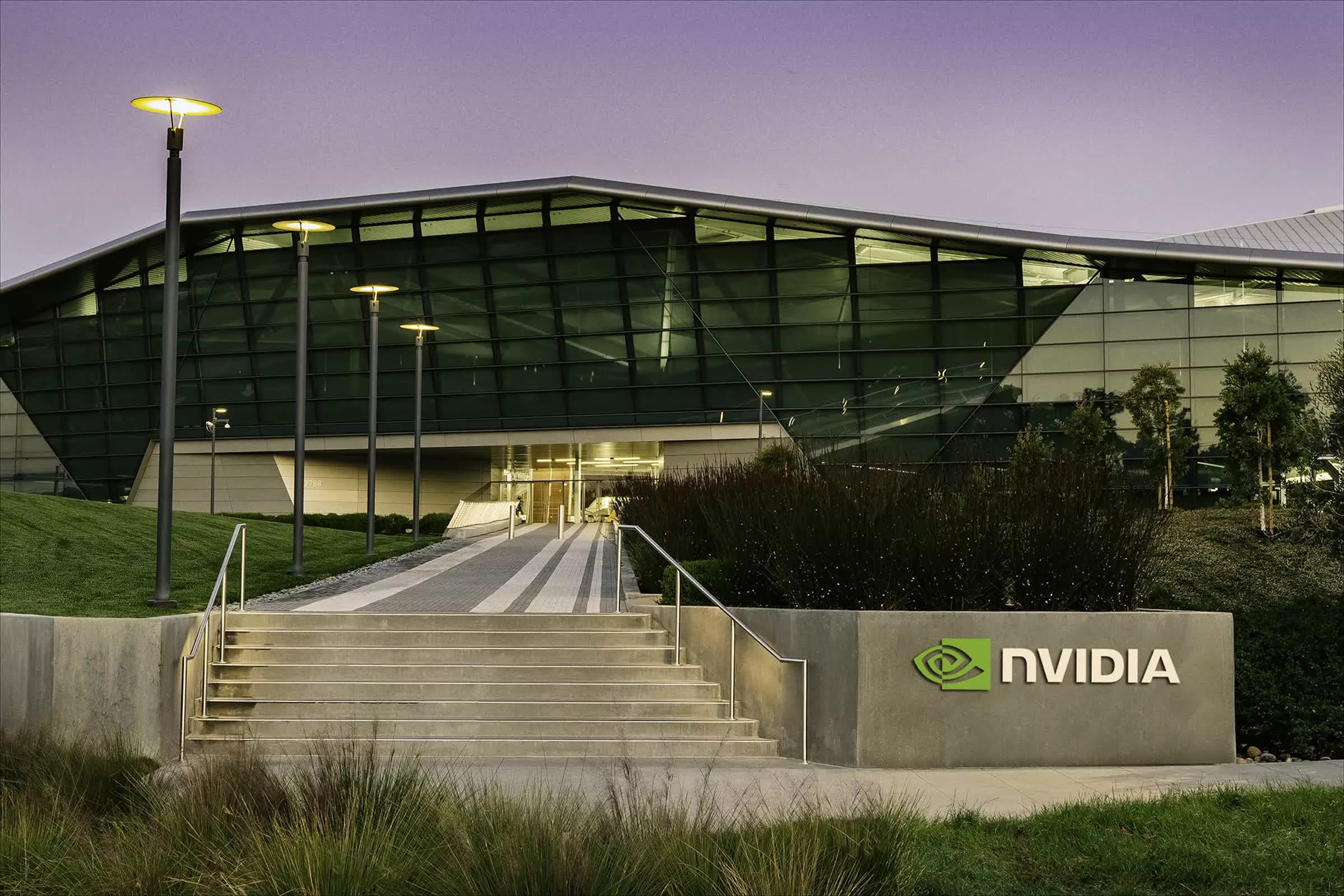
Nvidia reported $68.1 billion in revenue for the fourth quarter and $1.62 earnings per share, beating analyst estimates of $66.1 billion and $1.54, respectively.
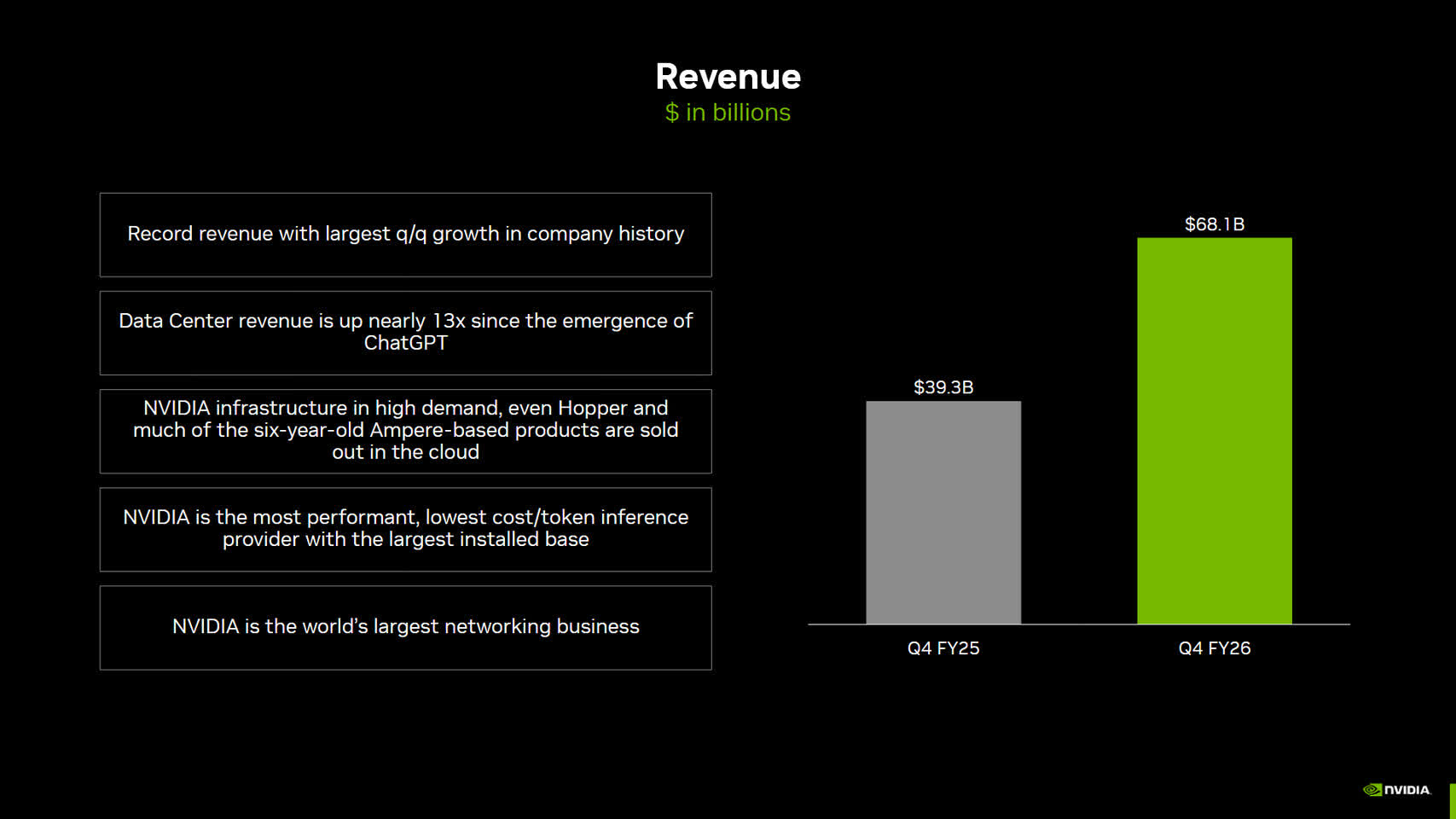
There have been plenty of concerns over the huge amount of money being spent within the AI industry recently, but Nvidia's total revenue for the year hit a record $215.9 billion. Net income, meanwhile, almost doubled to $43 billion for the quarter – up 73% from $39.3 billion a year earlier – and data center revenue reached $62.3 billion.

"Our customers are racing to invest in AI compute – the factories powering the AI industrial revolution and their future growth," said CEO Jensen Huang.

In the gaming and AI PC segment, fourth-quarter revenue was up 47% YoY to $3.7 billion, driven by strong Blackwell demand, while full year revenue rose 41% to a record $16.0 billion.
Credit: App Economy Insights

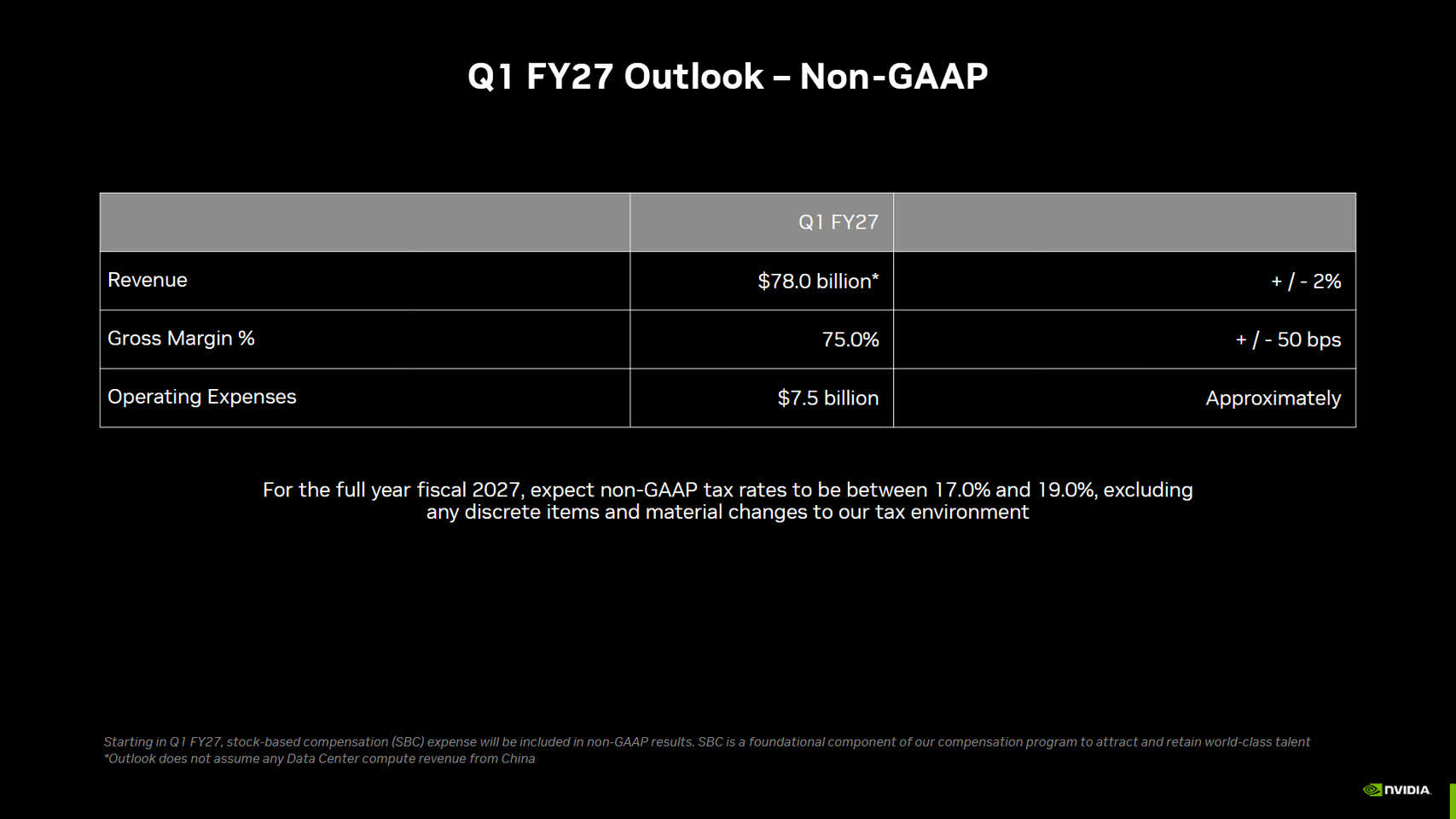
Nvidia CFO Colette Kress did warn, however, that the company expects supply constraints to be a headwind to the gaming arm in the first quarter of fiscal 2027 and beyond, essentially confirming we're not going to see an RTX 5000 Super series anytime soon (or likely ever). The memory crisis that is ravaging the industry with shortages and high prices is showing no signs of abating.

In a later earnings call, an investor asked if Nvidia's gaming business can "still grow year-over-year," despite the memory shortage. "As much as we would love to have [...] more supply, we do believe for a couple quarters, it is going to be very tight," Kress said. "If things improve by the end of the year, there is an opportunity to think about what this is from a year-over-year growth, but it's still too early for us to know at this time."

Tesla, Microsoft, Alphabet, Meta, Apple, and Amazon – which, alongside Nvidia, are known collectively as the magnificent seven – have yet to see their stocks make gains this year. Nvida is the group's only exception. Its shares were up 3% in after-hours trading following the earnings report, although its gains fell to less than 1% as the day went on.

Amazon, Alphabet, Meta, and Microsoft are forecast to spend close to $700 billion on AI infrastructure this year. Nvidia said hyperscalers remained its largest customer category at slightly over 50% of data center revenue.
As budgets tilt toward infrastructure and automation, plenty of companies are trimming headcount – often explicitly tying reductions to AI-driven efficiency or restructuring. We've heard plenty of warnings about what's to come, including an apocalypse for white-collar positions. Huang disagrees, of course.

For Nvidia, though, the message to investors is simple: whether this cycle ends as a gold rush or a bubble that will burst like no other in history, the company selling the pickaxes is still printing money.

Permalink to story:

 
The bubble will only last so long as the banks only have so much money to lend out in the form of collateralized loans. The fact that all circula investing using collateralized loans has become the norm is the first sign of trouble because the banks stopped giving these companies regular access to capital.

There currently isn't any clear path to profitability, just all the "build it and we will figure it out later" mindsets. And so much of companies sticking AI ik everything to see what works has become more of an annoyance than a benefit.

So much of the AI boom is making products that noone wants with money that doesn't exist. Further, AI is making everything more expensive, not cheaper. Utilities,.computers, housing. They're using AI algorithms to track us to create individual pricing on products in the freaking grocery store.

And it isn't just the AI market that's going to crash, this will have ripple effects across the economy for years. I've seen 3 major crashes in my life and they can all be summed up as "propping up the economy with money that doesn't exist".

 
It is extraordinary that, despite countless reports showing little to no benefits from AI adoption in the vast majority of business cases, they just plough on. The investment is so over-the-top now it has a blinkered-don't-look-over-the-precipice feel to it. Keep spending a fortune even though we are getting no returns. NVidia, AMD, TSMC, Micron and everybody else involved in the production of the hardware can't believe their luck.
In the long term though, businesses will have to pay for the massive energy costs required to run these models and you can bet that once the companies are onboarded and the workforce let go the subscription fees to keep these LLMs churning out slop (or whatever your business requires of them) will go up and up.
 
It is extraordinary that, despite countless reports showing little to no benefits from AI adoption in the vast majority of business cases, they just plough on.
Probably because those reports exist only in the minds of AI-naysayers. Whether you're referring to healthcare, logistics, defense, materials science, or any other industry, AI is transforming it.

You're likely referring to the MIT study referenced in the link below. However, the doomsayer headlines left out several facts. The study was limited to GenAI, not the larger and much more mature field of predictive AI. It also narrowly defined "success" as having a measurable effect on ROI within 6 months of the initial pilot program -- akin to claiming the entire world lighting industry is a bust, because Edison took more than 6 months to develop his first light bulb. Thirdly, the study relied on an opt-in self-reporting poll in which industry CEOs have a strong incentive to underreport results. If AI is giving you a competitive advantage, the last thing you wish to do is inform your competitors of it.

 
We can't help ourselves.

MV5BMmE1OGY5OTAtZTQ0YS00YWQxLWE3NDMtMTAwNTI5MGMxMzZiXkEyXkFqcGdeQXVyODg0OTM4NTc_._V1_FMjpg_UX960_.jpg

url
 
Probably because those reports exist only in the minds of AI-naysayers. Whether you're referring to healthcare, logistics, defense, materials science, or any other industry, AI is transforming it.

.....and NOT for the better. Dearie me. Another A.I "disciple", who thinks it's the best thing to happen since the invention of sliced bread.

SO naive. Wait until your job's deemed irrelevant, and you're tossed on the scrapheap. Then see how upbeat you still are about the whole deal...

(shrug...)


Miq.
 
Probably because those reports exist only in the minds of AI-naysayers.
So you color anyone who disagrees with you as a naysayer and throw out the study showing that AI hardly makes any of the claimed impact. Gee I wonder if you have a vested interest in AI succeeding that might be tinting your vision a bit?
 
Probably because those reports exist only in the minds of AI-naysayers. Whether you're referring to healthcare, logistics, defense, materials science, or any other industry, AI is transforming it.

You're likely referring to the MIT study referenced in the link below. However, the doomsayer headlines left out several facts. The study was limited to GenAI, not the larger and much more mature field of predictive AI. It also narrowly defined "success" as having a measurable effect on ROI within 6 months of the initial pilot program -- akin to claiming the entire world lighting industry is a bust, because Edison took more than 6 months to develop his first light bulb. Thirdly, the study relied on an opt-in self-reporting poll in which industry CEOs have a strong incentive to underreport results. If AI is giving you a competitive advantage, the last thing you wish to do is inform your competitors of it.

AI is helping people who shouldn't even be working in a field to me mildly productive with basic tasks. I also have noticed a trend where the most "pro-AI" people out there are also individuals that noone really wants to talk to, so maybe AI is filling that loneliness niche
 
So you color anyone who disagrees with you as a naysayer and throw out the study showing that AI hardly makes any of the claimed impact.
We've gone from "countless studies" down to just one study, so that's progress. But you missed the explanation of why that study was so limited in scope and applicability. Most industries amortize major investments over a period of ten, twenty, sometimes 30+ years. Claiming a project is a "failure" if it didn't pay for itself AND improve the bottom line within its first six months is a rather asinine goalpost, wouldn't you agree?

Gee I wonder if you have a vested interest in AI succeeding that might be tinting your vision a bit?
Not any longer. I was involved in my particular field with machine learning and predictive AI since the 1980s, but those days are long behind me.

I also have noticed a trend where the most "pro-AI" people out there are also individuals that noone really wants to talk to, so maybe AI is filling that loneliness niche
Interesting. I've noticed a trend that those most critical of AI are those whose jobs are most threatened by it; those who lack the expertise and confidence to succeed in the new AI-driven world.
 
Last edited:
Interesting. I've noticed a trend that those most critical of AI are those whose jobs are most threatened by it; those who lack the skills, expertise, and confidence to succeed in the new AI-driven world.
AI literally cannot do my job. Maybe the AI robots could, theoretically, do it, but you need multiple of them and I don't think they can fix things when they go wrong. I don't get paid just to do Masonry, I get paid to solve problems. McDonalds and TacoBell failed spectacularly trying to replace the jobs of normal employees. If it can't replace fast food employees, it's not going to be out in the field solving problems. Also, many of our contracts state explicitly that we cannot share schematics with AI due to security concerns. The irony is most of the projects I was on last year on were AI data centers that didn't allow us to use AI
 
AI literally cannot do my job.
Which likely explains why you're at least moderately acceptive to it, rather than being one of the "AI IS THE DEBIL!" posters here. AI will amplify your capabilities, not obviate them.

many of our contracts state explicitly that we cannot share schematics with AI due to security concerns. The irony is most of the projects I was on last year on were AI data centers that didn't allow us to use AI
It's not "AI" they're concerned about, but rather feeding proprietary data into a public system where it might potentially be exposed to competitors. Disclosure concerns like this predate AI by centuries. I remember in the early 90s being barred from placing corporate data on web servers and, a decade before that, similar bans on use of email.
 
Last edited:
Which likely explains why you're at least moderately acceptive to it, rather than being one of the "AI IS THE DEBIL!" posters here. AI will amplify your capabilities, not obviate them.


It's not "AI" they're concerned about, but rather feeding proprietary data into a public system where it might potentially be exposed to competitors. Disclosure concerns like this predate AI by centuries. I remember in the early 90s being barred from placing corporate data on web servers and, a decade before that, similar bans on use of email.
Well I just know that this going to create an economic crash for the third time in my life and I'm more worried about that. Am I concerned that AI is going to take my job? No, I'm concerned that circular investing and the debt based economy is going to destroy jobs. Not AI, but the corporations taking loans, reducing liquidity in the market. So since most of the projects are financed with debt, their won't be a bank to finance the project.

AI isn't going to take very many jobs at all, what it will do is crash the economy altogether when the companies can no longer service the trillions in debt they accumulated. The cracks in the system are already starting to show and the US won't be able to print there way out of this one. If they do the dollar will be worthless. It took about 5 years to recover from the 2008 crash, it could be argued that the economy still hasn't recovered from COVID and what we are seeing with the AI crash is the end of the dollar and the American empire.

That's what I'm worried about. It won't matter if I have a job if the country I live in doesn't exist anymore and the currency I'm paid in is worthless. We have seen this happen multiple times before, it will happen again and the only difference is how bad it will be. We're already seeing banks getting nervous, were seeing countries stop holding the dollar as the world reserve currency and even head funds/private equity are looking to offshore assets because they're getting nervous. The central banks are the only ones really pushing back again this kind of behavior because that means giving up control of the money supply.
 
Obviate - it's a big word to throw in there. Makes no sense in that context but it makes it sounds like you know what you are talking about at least.
You've sunk to this level now?

Ob-vi-ate: (n) remove (a need or difficulty), e.g. "The Venetian blinds obviated the need for curtains", or "the AI model obviated the need for human skills or capabilities"
 
Back